Global reports and market data
Documents
The Casual (but Regal) Swipe: Creating Game Mechanics in Reigns
The design philosophy behind Reigns centers on the concept of efficient laziness, utilizing a minimalist swipe-based interface to bridge the gap between casual player input and the profound, often fatal consequences of ruling a kingdom.
- Reigns utilizes a minimalist, swipe-based interface to translate simple casual input into high-stakes narrative consequences, prioritizing player-driven storytelling over complex numerical optimization.
- The game employs a probabilistic-driven narrative engine that dynamically selects cards based on the kingdom's current state, ensuring a fluid and infinite gameplay loop.
- Development relies on a flexible, spreadsheet-based architecture that balances linear narrative elements with randomized outcomes to allow for emergent mechanics and unique death conditions.

Practical Procedural Generation for Everyone
Procedural content generation serves as a foundational pillar for modern game development, offering a scalable approach to world-building that balances technical efficiency with creative flexibility.
- Effective procedural generation relies on modular, iterative techniques like tile-based assembly, recursive grammars, and hierarchical distribution rather than complex artificial intelligence.
- To prevent content from feeling repetitive, developers must prioritize perceptual differentiation and intentional design over raw mathematical uniqueness.
- Techniques such as fractal distribution, intersection blending, and textural detailing are essential for creating naturalistic environments that remain computationally manageable.
Forging Honor: Providing a Coherent Vision for a New IP
Establishing a coherent vision for a new intellectual property requires shifting the focus of leadership from a singular, initial sales presentation to a continuous, iterative process of communication.
- Pitching is not a request for funding, but a method to signal core values and earn the confidence of collaborators regarding the project's success and meaningfulness.
- To maintain a coherent vision for a new IP, teams should prioritize rapid iteration by building hundreds of prototypes early in development, as seen in the 18-month prototyping phase for For Honor.
- Teams should validate progress through regular, high-stakes internal tournaments every three months using stable builds, which forces developers to prove the game's viability and stability consistently.

Modular, Reusable Social Behavior In Video Game AI
This analysis examines a procedural artificial intelligence framework designed to create modular, reusable, and symmetric social behaviors for non-player characters (NPCs) in real-time, first-person interactive environments.
- The architecture decouples social interactions from specific characters and environments by using modular 'social games' that represent domains like authority or alliance, moving away from rigid, scenario-specific scripting.
- By integrating symbolic reasoning with utility-based 'soft' rules, the system achieves complex, reactive social dynamics while avoiding the brittleness typically associated with traditional symbolic AI.
- The framework ensures symmetry by processing player input—captured via whole-body sensors—through the same social state expectations as NPCs, allowing players to participate in the same social affordances as the AI.

Believable Humans (In Video Game Animation)
The pursuit of believable digital humans in video games has shifted from a focus on raw technical fidelity to the cultivation of emotional resonance and character empathy.
- The industry is shifting from raw technical fidelity to emotional resonance, using high-quality performance capture to bridge the gap between interactive gaming and cinematic storytelling as seen in titles like The Last of Us and Uncharted.
- Modern facial animation rigs now utilize over 1,000 blend shapes to achieve photorealistic micro-expressions and visual realism.
- A critical industry bottleneck has emerged due to a scarcity of specialized experts capable of managing complex, high-fidelity animation systems.

Owlboy: The Motivational Power of Inspiration
The nine-year development cycle of the indie title Owlboy serves as a case study for the critical role of sustained creative inspiration in long-term game production.
- Maintaining long-term motivation over a 9-year development cycle requires a team-wide commitment to a core vision, even when faced with significant financial hurdles and the need for secondary employment.
- Design inspiration can be sourced by internalizing experiences from other media, such as architectural elements observed during travel, and by allowing the mind to wander during periods of boredom.
- Iterative design is more effective when moving from small, rough sketches to pixel art sprites, which helps developers focus on essential shapes and silhouettes rather than getting stuck on minute details.
The Salt and Sanctuary Postmortem
Salt and Sanctuary, developed by the two-person team at Ska Studios, represents a 2D action RPG heavily inspired by the Dark Souls series.
- Prioritize building robust, custom development tools early in the production cycle, as the quality of these tools directly dictates the quality and efficiency of the content creation process.
- Implement a 'task-switching' workflow where developers focus on a single discipline—such as music, coding, or animation—for at least 2–3 days at a time to minimize the mental overhead of context switching.
- Avoid launching with incomplete localization; the developers found that players notice and react negatively to 'faked' or missing language support, whereas professional localization significantly boosts engagement and sales.
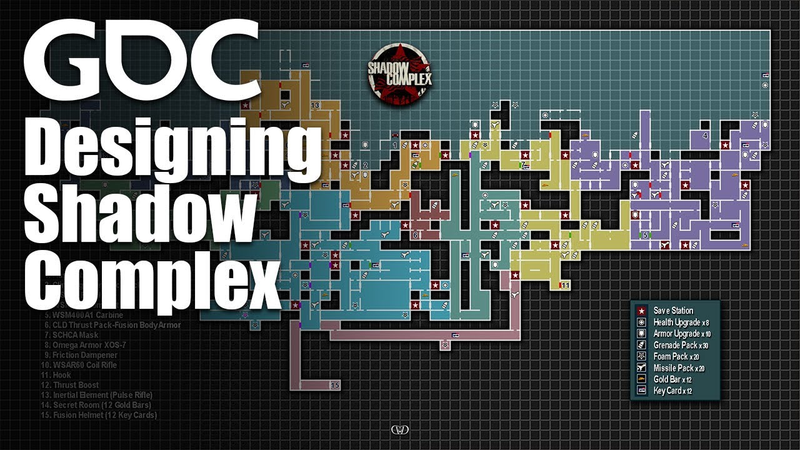
Designing Shadow Complex
Small-scale game development thrives when teams embrace inherent constraints by prioritizing high-quality, focused gameplay over the expansive, resource-heavy scope of traditional retail titles.
- Prioritize unique gameplay experiences over technical development by leveraging existing engines like Unreal, allowing small teams to focus resources on original design rather than building foundational technology.
- Maintain a lean development process by using short, concise design documents—such as the five-page document used for Shadow Complex—to facilitate rapid team alignment and iteration.
- Define a clear core gameplay loop early in development, such as the exploration-combat balance in Shadow Complex, and ensure every feature and asset directly supports that loop to avoid unnecessary bloat.

ARK: Survival Evolved: Lessons from the Trenches of Early Access
The development of ARK: Survival Evolved demonstrates the efficacy of an emergent development strategy, which prioritizes iterative growth and high-level guiding principles over rigid, pre-defined design documentation.
- Success in Early Access relies on an emergent development strategy that prioritizes iterative growth and high-level guiding principles over rigid, pre-defined design documentation.
- The development team utilizes a structured feature scorecard system to objectively evaluate updates based on development feasibility, team passion, and long-term meta-game health.
- Concurrent user counts serve as the primary metric for project success, functioning as a more reliable indicator of engagement than Steam reviews.
The Importance of Everything: Analytics of Map Design
Analytics serves as a vital methodology for iterative game design, functioning not as a definitive formula for success but as a tool to test hypotheses and refine player experiences.
- Analytics should be used as a tool for testing design hypotheses and refining player experiences rather than as a definitive formula for game success.
- Designers must distinguish between raw metrics, which merely record past events, and true analytics, which function as a social science to inform future decision-making.
- Effective map design requires moving beyond the 'where' of player behavior to uncover the 'why' behind specific actions.
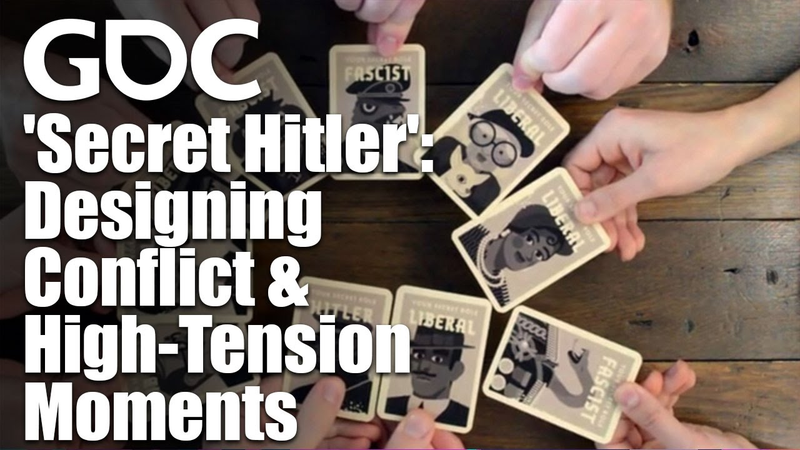
Secret Hitler: Designing Conflict & High-Tension Moments
Secret Hitler functions as a masterclass in social deduction design, prioritizing high-tension interpersonal drama and narrative-driven gameplay over rigid mechanical balance.
- The core design philosophy of Secret Hitler focused on maintaining high-tension, personal conflict and a sense of a 'knife's edge' throughout the entire session, rather than prioritizing perfect game balance or deterministic outcomes.
- The game utilizes a 'rising action' structure where fascist policy enactment increases the intensity of suspicion and social interaction, ensuring the game remains engaging until the final moments.
- To prevent the 'snowball effect' where one team dominates, the developers implemented mechanics like term limits and presidential succession to force players to interact with new, potentially untrusted partners rather than relying on a fixed group of allies.

Why Do We Ship Buggy Games? - A Look Behind the Scenes - Extra Credits
The release of buggy AAA games is rarely the result of developer laziness or malice, but rather the consequence of complex, early-stage production decisions and rigid scheduling constraints.
- Shipping buggy games is primarily a calculated financial decision where the cost of fixing deep-seated technical issues outweighs the projected returns of further development.
- Fundamental bugs often originate from core engine architecture or third-party middleware, creating dependencies on external partners that are difficult to rectify late in the production cycle.
- Rigid marketing campaigns and high-cost advertising placements are locked in months ahead of time, making it logistically and financially difficult to delay a release.