Global
Documents

The Xsolla Report: State of Play Q2 2025
Mobile gaming has become the dominant engine of the global video‑game market, now accounting for more than half of total industry revenue and projected to exceed $126 billion in 2025, with an overall forecast of $150 billion for the segment. The surge is driven by unprecedented user engagement—4.2 trillion hours of app usage in 2024—and a rapid shift toward direct‑to‑consumer (D2C) commerce following the April 2025 court order in Epic Games v. Apple, which obliges iOS platforms to permit external web‑shops and allows developers to retain up to 95 % of transaction value. Early adopters report revenue recoveries measured in millions and a 60 % increase in user engagement for high‑volume titles.
Regulatory reforms across the EU, United States, Japan, South Korea and China are dismantling traditional app‑store monopolies, mandating alternative storefronts, transparent odds disclosure and the elimination of hidden fees. Despite tighter oversight, the mobile ecosystem remains robust, with the United States generating roughly $52 billion in in‑app‑purchase sales, while emerging markets in Latin America, Southeast Asia and Saudi Arabia expand the geographic footprint. Hybrid monetisation—combining in‑app purchases, advertising and subscriptions—is employed by 72 % of developers and now represents about three‑quarters of mobile revenue; live‑ops‑driven hybrid‑casual titles are delivering a 30 % year‑over
- Mobile gaming is the industry's primary revenue driver, projected to reach $126 billion in 2025 with a total segment forecast of $150 billion.
- Following the April 2025 Epic Games v. Apple court order, developers can now utilize direct-to-consumer web-shops to retain up to 95% of transaction value, with early adopters seeing millions in revenue recovery.
- Hybrid monetization models—combining in-app purchases, advertising, and subscriptions—are used by 72% of developers and account for approximately 75% of total mobile revenue.
- Global mobile user engagement reached 4.2 trillion hours in 2024, while the United States market alone generated $52 billion in in-app purchase sales.
- Regulatory reforms in major markets including the EU, US, Japan, South Korea, and China are mandating alternative storefronts and increased transparency to dismantle traditional app-store monopolies.
The State of Video Gaming in 2026
The global video game industry is currently navigating a period of significant contraction and structural realignment following a decade of rapid expansion between 2011 and 2021. Real-term spending on game content has declined by approximately 12% since 2021, as the market shifts from a growth-oriented environment to a capital-constrained, zero-sum landscape. This downturn is marked by record-high layoffs, widespread studio closures, and a sharp reduction in venture capital funding. The industry is increasingly dominated by a small cohort of entrenched live-service titles that act as "black holes," consuming the vast majority of player time and financial resources, which makes the launch of new, independent titles increasingly difficult.
Market dynamics are further complicated by extreme resource inflation, with AAA production budgets frequently ballooning to between $200 million and $500 million. While mobile gaming remains the primary driver of global revenue, it faces its own challenges, including declining download volumes and rising user acquisition costs. Meanwhile, the console sector shows signs of stagnation, with current-generation hardware trailing its predecessors in total unit sales. As traditional growth models stall, the industry is pivoting toward new strategies, including the integration of programmatic advertising, the adoption of generative AI to improve production efficiency, and a push toward cross-platform accessibility to maximize player retention.
Geographically, the center of gravity is shifting toward Asian markets, where local developers are increasingly challenging Western incumbents with high-performing, globally resonant titles. Concurrently, the rise of user-generated content platforms like Roblox and the maturation of PC-based modding ecosystems are redefining how players engage with digital worlds. Looking forward, the industry is pinning its recovery on technological advancements in cloud computing and AI-driven development, alongside regulatory shifts that may allow developers to capture a larger share of revenue through alternative distribution channels. Success in this new era requires moving beyond traditional gameplay loops toward interconnected, persistent ecosystems that prioritize social infrastructure and long-term engagement.
- The video game industry is in a period of contraction, with real-term spending on content declining by approximately 12% since 2021.
- AAA production budgets have ballooned to between $200 million and $500 million, contributing to a capital-constrained environment marked by record-high layoffs and studio closures.
- A small cohort of entrenched live-service titles now dominates the market, acting as 'black holes' that consume the majority of player time and spending, making new independent launches increasingly difficult.
- The industry is pivoting toward generative AI to combat production cost inflation and integrating programmatic advertising to offset stalling growth in traditional console and mobile sectors.
- The global center of gravity is shifting toward Asian markets, where local developers are increasingly challenging Western incumbents with high-performing, globally resonant titles.

2025 GDC Trends Report: Connecting the World Through Games
The global game industry in 2025 is defined by a strategic pivot toward practical generative AI implementation and sustainable monetization models in response to market saturation and rising development costs. Approximately one-third of developers now utilize AI tools to streamline prototyping and NPC creation, focusing on "human-in-the-loop" workflows to enhance personalization. However, this technological shift is met with significant friction regarding ethical sourcing, copyright concerns, and the potential displacement of narrative designers. To combat AAA stagnation, studios are increasingly adopting "niche" live service models and "hybrid-casual" mobile strategies, leveraging telemetry for personalized monetization and prioritizing player re-acquisition over expensive new user acquisition.
Financial sustainability has become a primary concern, with 56% of studios now relying on personal funding as the publishing landscape becomes more selective. This has led to a surge in self-publishing and the adoption of HTML5 and WebGPU technologies for more efficient cross-platform distribution. The mobile sector reflects this shift, with narrative-driven advertising propelling the in-game ad market to $100 billion in 2024, officially surpassing in-app purchase revenue. Simultaneously, the industry is embracing social responsibility through the Accessible Games Initiative, which introduces standardized storefront tags to assist the 16% of the global population living with disabilities.
The labor market is undergoing a historic transformation, marked by a 17% layoff rate that has catalyzed the formation of the United Videogame Workers union. Despite these workforce challenges, technical innovation continues across hardware and software, evidenced by the rise of affordable mixed-reality devices and the debut of high-performance handheld platforms like the Snapdragon G3 Gen 3. Creative excellence remains a central pillar of the industry, as demonstrated by the indie title Balatro winning Game of the Year at the 2025 Game Developers Choice Awards, signaling that innovative, community-focused projects can still achieve massive success in a highly competitive global market.
- The mobile in-game advertising market reached $100 billion in 2024, officially surpassing revenue generated from in-app purchases.
- Financial instability has forced 56% of studios to rely on personal funding as the publishing landscape becomes increasingly selective.
- The industry is experiencing a 17% layoff rate, which has served as a primary catalyst for the formation of the United Videogame Workers union.
- Approximately one-third of developers are now integrating generative AI into workflows for prototyping and NPC creation, despite ongoing ethical and copyright concerns.
- Studios are shifting focus from expensive new user acquisition to player re-acquisition, utilizing telemetry to drive personalized monetization in niche live service and hybrid-casual models.
Global Gaming Report: Q1 2025
The global gaming industry experienced a significant resurgence in financial activity during the first quarter of 2025, marked by a substantial rebound in mergers, acquisitions, and private placements. Total deal value for the quarter reached $4.4 billion across 48 announced transactions, representing the highest quarterly valuation in nearly two years. This momentum was primarily driven by large-scale strategic consolidations, such as the $3.5 billion acquisition of Niantic’s games division by Scopely and AppLovin’s $900 million studio spin-off. Simultaneously, private investment surged to $3.5 billion across 149 deals, anchored by a landmark $3 billion investment into Infinite Reality at a $12.25 billion valuation.
Investment trends during this period shifted toward AI-driven entertainment and mobile user acquisition technologies. Strategic players like Savvy Games Group and Tencent maintained leadership roles in capital deployment, while venture capital firms such as BITKRAFT and Andreessen Horowitz remained the most prolific investors by volume. Geographically, the Asian developer market demonstrated steady stability with a median revenue growth of 9%, while the hardware and tools sector outperformed broader segments with a 20% average revenue increase. This growth was heavily influenced by the dominance of NVIDIA, which saw a 114% year-over-year revenue surge, positioning it as a cornerstone of the industry’s infrastructure with a $2.6 trillion market capitalization.
Despite the overall recovery reflected in the 16.37% return of the Drake Star Gaming Index, the market exhibited extreme volatility among individual public companies. While Sea Limited experienced a dramatic 223% increase, established entities like Unity and Ubisoft faced significant downturns, with valuations falling by over 50%. This divergence highlights a period of intense transition where hardware providers and AI-integrated platforms are capturing the majority of market gains, while traditional software developers and engine providers navigate a more challenging and fragmented economic landscape.
- The gaming industry saw a major financial rebound in Q1 2025, with $4.4 billion in M&A deal value across 48 transactions and $3.5 billion in private investment.
- NVIDIA has become a critical industry infrastructure pillar, achieving a 114% year-over-year revenue surge and a $2.6 trillion market capitalization.
- Private investment was anchored by a $3 billion funding round for Infinite Reality, which reached a $12.25 billion valuation.
- Market performance is highly polarized: while the Drake Star Gaming Index rose 16.37%, companies like Sea Limited grew 223% while Unity and Ubisoft saw valuations drop by over 50%.
- Strategic consolidation was led by major deals including Scopely’s $3.5 billion acquisition of Niantic’s games division and AppLovin’s $900 million studio spin-off.
Live Streaming Trend Report: Q2 2025
Live‑streaming activity in the second quarter of 2025 expanded by five percent year‑over‑year, pushing total consumption past the nine‑billion‑hour mark for the first time since late 2021. The surge was led by YouTube Gaming, which recorded a historic 2.2 billion hours watched, while Kick’s creator‑incentive scheme lifted its viewership share by 5.5 percent. In contrast, Twitch’s share slipped 4.6 percent, dropping below five billion hours for the first time in nearly five years. These dynamics illustrate a reshaping of platform dominance, with emerging services gaining traction at the expense of long‑standing incumbents.
Esports consumption followed a parallel upward trajectory, rising six percent to a record 729 million hours despite a 37 percent contraction in the number of tournaments held. The sector’s growth was driven by a pivot toward mobile titles, co‑streaming formats, and creator‑led events, exemplified by the Rainbow Six Siege Invitational 2025. This shift underscores a broader trend in which audience engagement is increasingly tied to personalities and flexible production models rather than traditional tournament structures.
Content analysis highlights the ascendancy of hybrid formats that blend gaming with established intellectual properties, such as “Den Ring Nightreign” and “Survival Games with Dune.” VTuber Usada Pekora emerged as the most‑subscribed creator, confirming the expanding influence of virtual personalities. Collectively, cross‑genre collaborations, VTuber‑centric audiences, and creator‑driven esports are identified as the primary engines propelling live‑streaming growth throughout 2025, signaling a continued evolution toward integrated, personality‑focused entertainment across the global market.
- Live-streaming consumption reached over nine billion hours in Q2 2025, a five percent year-over-year increase driven by YouTube Gaming's record 2.2 billion hours watched.
- Twitch’s market share declined by 4.6 percent, causing its quarterly viewership to drop below five billion hours for the first time in nearly five years.
- Kick grew its viewership share by 5.5 percent during Q2 2025, bolstered by the platform's active creator-incentive programs.
- Esports viewership rose six percent to a record 729 million hours, even as the total number of tournaments contracted by 37 percent.
- Audience engagement in esports is shifting away from traditional tournament structures toward mobile titles, co-streaming, and creator-led event formats.
State of Mobile Gaming 2025
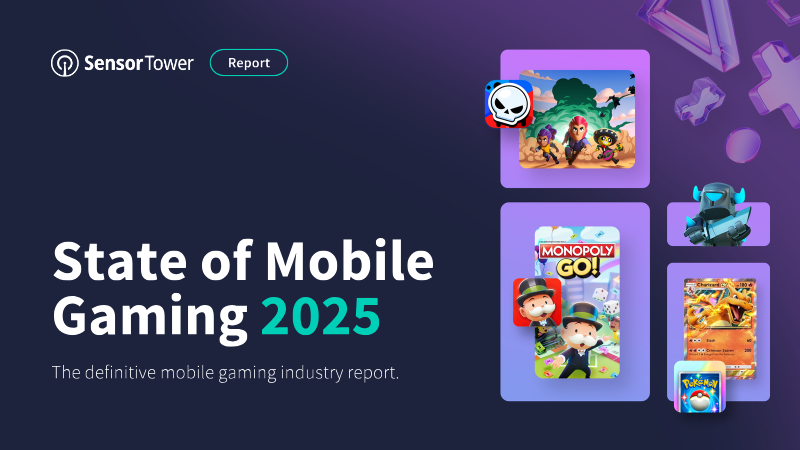
The global mobile gaming market entered a period of mature recovery in 2024, characterized by a strategic pivot toward live services and high-value player retention. While total downloads declined by 6.6%, global in-app purchase revenue grew by 4% to reach $82 billion. This growth was primarily driven by North America and the Middle East, offsetting spending declines in Asia. The industry has transitioned into a "live operations" era, where 84% of all revenue is generated by games utilizing continuous updates and seasonal events. This shift is further evidenced by a 50% decrease in new game releases since 2020, as publishers prioritize high-quality core titles over volume.
Genre performance highlights a market dominated by Strategy and RPG titles, which collectively generated over $34 billion in 2024. Action games emerged as the fastest-growing category with a 46% revenue increase, fueled by breakout hits like Last War: Survival. Despite the dominance of established franchises, a record 11 games surpassed $1 billion in annual consumer spend, including MONOPOLY GO!, which secured the top global position. The market is also seeing a demographic shift, particularly in the United States, where the 18-24 age group now represents 18% of the player base, up from 13% in 2022.
Marketing strategies have evolved to combat rising user acquisition costs, with a significant move toward high-intent creative content and short-form video platforms. TikTok experienced a 67% year-over-year growth in social ad share, while mid-core developers nearly doubled their impression share on social networks. To maintain profitability, publishers are increasingly leveraging external web stores, celebrity partnerships, and localized cultural influencers, such as virtual YouTubers in the Japanese market. These trends underscore a broader industry movement toward sophisticated monetization models and IP-driven growth in an increasingly concentrated competitive landscape.
- Global mobile gaming revenue grew 4% to $82 billion in 2024 despite a 6.6% decline in total downloads, signaling a shift toward high-value player retention.
- The industry has entered a 'live operations' era, with 84% of total revenue now generated by games utilizing continuous updates and seasonal events.
- Publishers have reduced new game releases by 50% since 2020, focusing resources on high-quality core titles rather than volume.
- Strategy and RPG titles remain the market leaders with over $34 billion in combined revenue, while Action games emerged as the fastest-growing category with a 46% revenue increase.
- A record 11 games surpassed $1 billion in annual consumer spend in 2024, with MONOPOLY GO! securing the top global position.

Games Investment Review: Q1 2025 Executive Summary Report
The Q1 2025 Games Investment Review provides a comprehensive analysis of global financial activity within the video game industry, covering investments, mergers and acquisitions (M&A), and initial public offerings (IPOs). The report identifies a significant recovery in market activity, noting that the combined value of investments and M&As reached $7.8 billion across 245 transactions. This represents the largest quarterly total since late 2023 and the second consecutive quarter of growth, signaling a stabilizing investment landscape.
Key findings highlight a massive surge in investment value, which rose 370% quarter-over-quarter to $4.4 billion. This growth was primarily driven by a $3.0 billion mid-to-late-stage investment in Infinite Reality. While M&A volume hit a two-year high with 55 transactions, the total reported value fell to $3.3 billion, largely because 80% of these deals did not disclose financial terms. The exit market showed strength through Asmodee’s $2.2 billion IPO and several billion-dollar acquisitions, such as Miniclip’s purchase of Easybrain. Additionally, new fund announcements reached a three-year peak of $21.8 billion, with 65% of that capital concentrated in five major funds.
The scope of the research encompasses diverse industry segments, including Console/PC, Mobile, Tech/Other, eSports, and Web3/Blockchain. Geographically, activity was led by Asia and Europe, while North America contributed high transaction volume with lower disclosed values. Methodology relies on a proprietary database tracking officially closed deals rather than mere announcements, ensuring data reflects actual capital deployed. The analysis emphasizes that artificial intelligence and blockchain remain primary areas of investor enthusiasm, with AI-related game investments totaling $3.1 billion during the quarter.
- Global gaming investment and M&A activity reached $7.8 billion across 245 transactions in Q1 2025, marking the highest quarterly total since late 2023.
- Investment value surged 370% quarter-over-quarter to $4.4 billion, largely driven by a single $3.0 billion mid-to-late-stage investment in Infinite Reality.
- New fund announcements hit a three-year peak of $21.8 billion, with 65% of that capital concentrated within just five major funds.
- Artificial intelligence remains a primary investment driver, accounting for $3.1 billion in game-related funding during the quarter.
- M&A volume reached a two-year high of 55 transactions, though total disclosed value was limited to $3.3 billion because 80% of deals did not report financial terms.

Mobile App Trends: 2025 Edition
The mobile app economy is entering a significant scaling phase, with global consumer spending projected to reach $626 billion by 2030. This growth is underpinned by a 2024 surge in app installs and a notable rise in App Tracking Transparency opt-in rates to 35%, suggesting that privacy-centric measurement is successfully rebuilding user trust. As the industry moves into 2025, the integration of artificial intelligence and machine learning has transitioned from a conceptual trend to an operational necessity, particularly for predictive analytics and campaign optimization across diverse platforms like Connected TV and in-app advertising.
Mobile commerce currently serves as the primary driver of the digital landscape, accounting for 73% of global e-commerce sales with anticipated 2025 revenues of $2.5 trillion. While e-commerce app installs grew by 17% in 2024, the sector must navigate rising acquisition costs, which have reached an average of $3.44 per install. This financial pressure is particularly acute in emerging markets such as MENA and LATAM, where reliance on paid media is increasing. Simultaneously, the mobile gaming sector remains the most popular category, expected to reach $126.1 billion in 2025. Although gaming faces retention challenges in North America and Europe, strategy games have seen an 83% growth in installs, and global session lengths have extended to over 30 minutes.
The financial services vertical is also experiencing a period of robust expansion, especially within the APAC and LATAM regions. Global session lengths for finance apps have risen to 6.66 minutes, while average revenue per monthly active user has climbed significantly to $4.10. Across all sectors, the 2025 outlook emphasizes a shift toward omnichannel strategies and a rebound in mobile-first holiday shopping. Success in this evolving market requires developers to balance aggressive growth in high-potential regions with sophisticated, privacy-compliant data strategies to maintain long-term user engagement.
- Global mobile consumer spending is projected to reach $626 billion by 2030, supported by a 2024 surge in app installs and a 35% App Tracking Transparency opt-in rate.
- Mobile commerce accounts for 73% of global e-commerce sales, with 2025 revenues expected to hit $2.5 trillion despite rising acquisition costs averaging $3.44 per install.
- The mobile gaming sector is projected to reach $126.1 billion in 2025, with strategy games experiencing an 83% growth in installs and global session lengths exceeding 30 minutes.
- Financial services apps are seeing robust expansion in APAC and LATAM, with average revenue per monthly active user reaching $4.10 and session lengths increasing to 6.66 minutes.
- Artificial intelligence and machine learning have become operational necessities for predictive analytics and campaign optimization across Connected TV and in-app advertising.
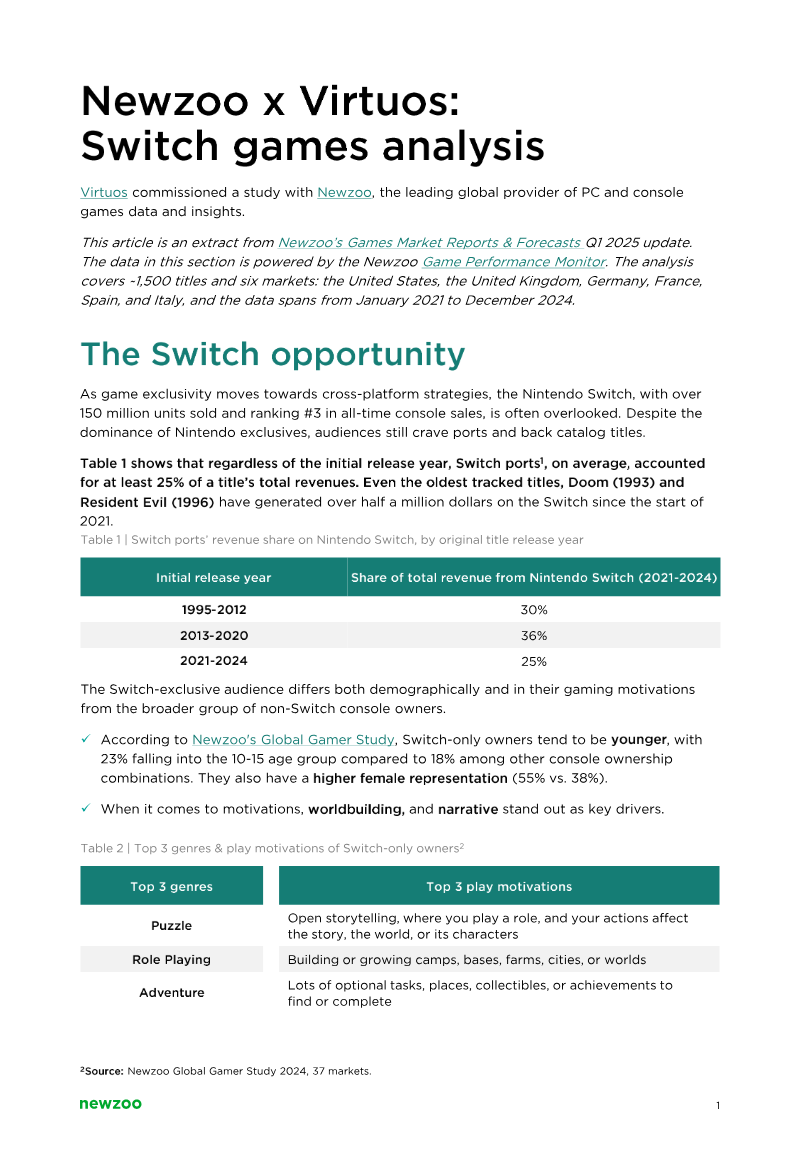
Newzoo’s Games Market Reports & Forecasts Q1 2025 Update
This analysis examines the Nintendo Switch market landscape from January 2021 to December 2024, focusing on the performance of third-party ports across the United States, United Kingdom, Germany, France, Spain, and Italy. Utilizing data from approximately 1,500 titles, the study highlights that while Nintendo-published exclusives dominate the platform, third-party ports represent a significant and growing revenue stream. By 2024, ports accounted for over a third of the console's revenue, a trend accelerating as the industry anticipates the transition to the next generation of hardware.
The findings reveal a distinct demographic and motivational profile for Switch-only owners. This audience is younger than the broader console market—with 23% aged 10-15—and features a higher concentration of female players at 55%. Their primary gaming motivations include immersive storytelling, world-building, and completionism. Consequently, genres such as Role-Playing, Simulation, and Platformers consistently outperform others. Role-Playing titles are particularly successful, with over one-third of ported RPGs generating more than $1 million in revenue.
The data distinguishes between simultaneous and staggered releases, noting that staggered ports often achieve higher average revenue per title due to major hits like Hogwarts Legacy, while simultaneous releases capture a higher percentage of total cross-platform revenue share. Fighting games also emerge as high performers when tied to strong intellectual properties. Ultimately, the analysis concludes that while the Switch offers substantial long-tail revenue opportunities, success depends on navigating technical hardware limitations and aligning game design with the specific preferences of the handheld audience.
- Third-party ports have grown to account for over one-third of total Nintendo Switch revenue as of 2024.
- The Switch audience is distinct from the broader console market, with 23% of users aged 10–15 and 55% identifying as female.
- Role-Playing, Simulation, and Platformer genres consistently outperform others, with over one-third of ported RPGs generating more than $1 million in revenue.
- Staggered releases often achieve higher average revenue per title, exemplified by high-performing ports like Hogwarts Legacy, while simultaneous releases capture a larger share of total cross-platform revenue.
- Fighting games demonstrate strong commercial performance on the platform when paired with established intellectual properties.
Live Streaming Trend Report: Q1 2025
I’m ready to synthesize the full report, but I only have the beginning of the first section. Could you please provide the remaining section summaries so I can create a complete, cohesive summary?
- Live streaming viewership increased by 8.9% year-over-year in Q1 2025, primarily driven by competitor platforms, as Twitch's viewership decreased by 6.9% from Q1 2024.
- Non-gaming content is the most popular streaming category, growing 25.6% year-over-year, with Kick, Chzzk, and SOOP Korea showing roughly 94% year-over-year increases in non-gaming content.
- Twitch remains the largest platform with 59% of the market share, while Kick experienced strong growth with a 112% year-over-year increase in hours watched, securing an 8.6% share of total viewership.
- YouTube Gaming's market share grew in Q2 2024 following Twitch's shutdown in South Korea, with new Korean platforms like SOOP (AfreecaTV's new platform) and Chzzk seeing streamers prosper after departing Twitch.
- Counter-Strike boasted the highest growth in Q1 2025, increasing its viewership by 55%, driven by high-profile esports events, while League of Legends, despite remaining #1, saw a 3% quarterly viewership decline.

Mobile Games Industry Trends Survey: Winter 2024/25
The mobile games industry entered a period of significant recalibration during the winter of 2024/25, characterized by a transition from rapid expansion to a focus on long-term sustainability. While the market is returning to growth, it is currently defined by a "reality check" phase where 56.7% of professionals identify widespread layoffs as the year’s most impactful trend. High user acquisition costs and evolving privacy regulations have created a consolidated landscape favoring established organizations, as evidenced by the fact that nearly 39% of companies have operated for over a decade while the presence of new startups has notably diminished.
Strategic priorities have shifted toward maintaining existing portfolios through live operations and hybrid-casual models rather than launching new intellectual property. Over 40% of organizations released no new titles in the past year, choosing instead to prioritize top-line revenue and retention as their primary performance indicators. In-app purchases and video advertisements remain the foundational business models, though rising acquisition costs are cited by 64.2% of respondents as the greatest threat to continued profitability. Despite these headwinds, the industry maintains a cautiously optimistic outlook for 2025, with 44.1% of professionals expressing confidence in the coming year.
Growth opportunities are increasingly sought in emerging markets, particularly the MENA region, and through strategic networking at global industry summits. Professional events remain vital for the ecosystem, with nearly 90% of participants attending for networking and over 31% seeking investment or publishing partnerships. As the industry moves forward, the reliance on proven development tools like Unity and a data-driven approach to player retention will be essential for navigating a market that increasingly rewards operational efficiency and established brand presence over speculative new ventures.
- Rising user acquisition costs are the primary threat to profitability, cited by 64.2% of industry professionals as the greatest challenge to the sector.
- The industry is in a period of consolidation, with 56.7% of professionals identifying widespread layoffs as the most impactful trend of the 2024/25 period.
- Strategic focus has shifted away from new IP, as evidenced by over 40% of organizations releasing zero new titles in the past year to prioritize existing live operations.
- The market landscape is increasingly dominated by established players, with nearly 39% of companies operating for over a decade while startup formation has notably declined.
- Despite current headwinds, 44.1% of industry professionals maintain a cautiously optimistic outlook for growth in 2025.

The Game Development Renaissance
The global game development industry is undergoing a fundamental transition toward a more sustainable and efficient operational model, moving away from volatile hiring cycles in favor of long-term stability. With the market projected to reach $190 billion by 2025, industry leaders express significant optimism, as 77% of developers anticipate continued growth and a marked reduction in workforce instability. This evolution is characterized by a strategic shift toward leaner production cycles where studios prioritize creative intellectual property over the maintenance of internal technical infrastructure.
Central to this transformation is the widespread adoption of externalized technology and third-party backend services. While only 6% of developers intend to rely on internal builds in 2025, nearly half plan to integrate specialized third-party tools to manage complex requirements such as cross-platform synchronization and unified player inventories. By outsourcing non-core technical burdens, studios can accelerate time-to-market and mitigate the financial risks associated with building bespoke systems. This shift enables a deeper focus on LiveOps and "forever game" models, which are increasingly viewed as the primary drivers of player lifetime value and long-term revenue.
Furthermore, the industry is diversifying its financial and distributional strategies to bypass traditional gatekeepers. Developers are increasingly leveraging alternative funding sources, such as crowdfunding, and utilizing direct-to-consumer webshops to avoid high app store fees. As studios embrace sophisticated metagames and personalized engagement strategies, the integration of cross-platform capabilities and web-based distribution is becoming a strategic necessity. This new paradigm emphasizes technical agility and creative innovation, positioning the industry for a period of disciplined, technology-driven expansion.
- The global game development market is projected to reach $190 billion by 2025, with 77% of developers anticipating continued industry growth and reduced workforce instability.
- Studios are shifting toward leaner production models by outsourcing non-core technical infrastructure, with only 6% of developers planning to rely on internal builds by 2025.
- Nearly 50% of developers plan to integrate specialized third-party tools to manage complex requirements like cross-platform synchronization and unified player inventories.
- The industry is prioritizing 'forever game' models and LiveOps as the primary drivers for increasing player lifetime value and long-term revenue.
- Developers are increasingly bypassing traditional gatekeepers by utilizing alternative funding sources like crowdfunding and direct-to-consumer webshops to avoid high app store fees.