Global
Documents
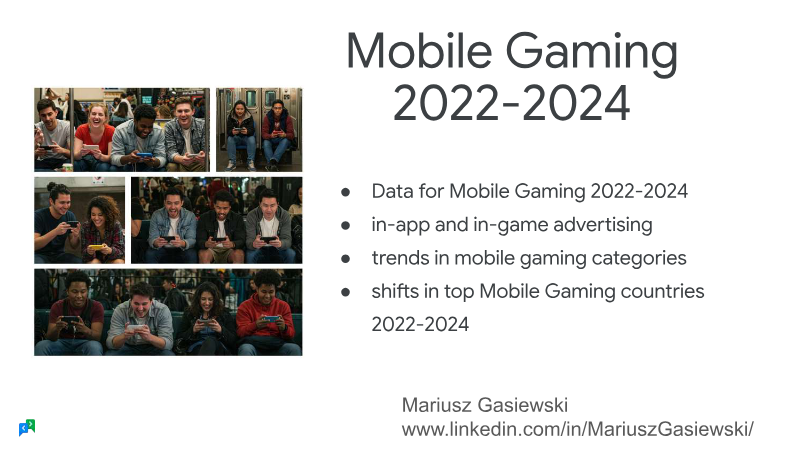
Mobile Gaming 2022-2024
The analysis tracks mobile‑gaming dynamics from 2022 through 2024, arguing that the sector’s financial expansion now exceeds its ability to attract new users. Revenue on Google Play rose roughly 10 % year‑on‑year in 2023‑24 while download volumes stagnated or slipped slightly, and iOS revenue grew about 12 % against an 8 % rise in downloads. Despite this divergence, the concentration of earnings among the top ten publishers has held steady, indicating that market power remains entrenched even as overall spend accelerates.
Consumer‑device preferences reveal a near‑universal reliance on smartphones, with 97 % of Brazilian gamers using mobile phones in 2024 and personal PCs ranking as the only other significant platform; console usage is negligible. Across the United States and Brazil, the primary incentives for trying a new title are free‑to‑play pricing, recognizable brands or characters, and easy access through subscription services. Gender nuances appear modest: men place greater value on non‑pay‑to‑win structures and strong single‑player experiences, whereas women are drawn to customizable avatars and peer recommendations.
Behavioral data show a pronounced tendency toward deep engagement with a single game. Approximately half of respondents in Brazil, Germany, Japan and the United States report completing one title before moving to the next, suggesting that the market favors sustained, title‑centric play rather than rapid turnover. The findings collectively underscore a maturing mobile‑gaming ecosystem where revenue growth is driven by monetisation depth and brand loyalty rather than sheer user acquisition.
- Mobile gaming revenue growth is decoupling from user acquisition, with Google Play revenue rising 10% and iOS revenue growing 12% in 2023–2024 despite stagnant or slowing download volumes.
- Market power remains highly concentrated, as the top ten publishers continue to capture the vast majority of earnings despite the overall acceleration in consumer spending.
- The mobile ecosystem is shifting toward a maturity model where revenue increases are driven by monetization depth and brand loyalty rather than the expansion of the total user base.
- Approximately 50% of gamers in major markets like the U.S., Germany, Japan, and Brazil prefer deep, sustained engagement with a single title rather than rapid game turnover.
- Consumer acquisition is primarily driven by free-to-play pricing, recognizable IP, and accessibility through subscription services.

Rewarded Returns
Rewarded Returns explores the evolution of reward-based user acquisition (UA) from its origins as a controversial incentivized traffic tactic to a sophisticated, data-driven pillar of modern mobile game marketing. The primary thesis is that technological advancements and deeper reward structures have effectively addressed legacy concerns regarding fraud and user quality, positioning rewarded UA as a high-performance alternative to traditional channels in an increasingly challenging privacy-centric landscape.
The findings are based on a late 2024 survey of 502 mobile game developers in the United States and United Kingdom, primarily representing mid-sized companies with 50 to 100 employees. While 64% of respondents characterize the current UA environment as challenging due to privacy rules and high costs, 77% have already integrated reward-based campaigns into their strategies. Among these adopters, 82% report that rewarded campaigns outperform traditional UA, and 95% believe these strategies provide a distinct competitive advantage. Furthermore, 79% of developers observe stronger long-term retention from rewarded users compared to non-rewarded sources.
The study identifies a significant shift in perception, noting that fraud concerns for rewarded UA (47%) are now nearly identical to those for traditional channels (46%). Despite these lingering concerns, 59% of current users plan to expand their rewarded UA budgets in 2025. Among non-adopters, 62% express concern about falling behind competitors, and 43% intend to adopt the strategy in the coming year.
Looking ahead, the scope of the industry is expected to expand, with 90% of experienced developers predicting that reward-based mechanisms will move beyond mobile and web into console gaming. The conclusion emphasizes that as the industry moves toward 2025, real-world rewards—particularly cash and gift cards—are becoming a fundamental discovery and engagement mechanism rather than a mere experimental tactic.
- 82% of developers using reward-based user acquisition report that these campaigns outperform traditional channels, with 79% noting stronger long-term retention from rewarded users.
- 77% of mid-sized mobile game developers in the US and UK have integrated reward-based campaigns into their strategies, with 59% planning to increase these budgets in 2025.
- Fraud concerns for rewarded user acquisition have stabilized, with 47% of developers citing risks compared to 46% for traditional UA channels.
- 95% of developers currently using rewarded strategies believe they provide a distinct competitive advantage in an environment where 64% find standard UA increasingly challenging due to privacy rules and costs.
- 43% of developers not currently using rewarded UA intend to adopt the strategy in 2025, driven by a 62% concern among non-adopters about falling behind competitors.
State of Mobile 2025
The global mobile economy reached a significant milestone in 2024, with consumer spend hitting $150 billion. This growth was primarily propelled by a 25% surge in non-gaming app revenue, particularly within the entertainment, productivity, and generative AI sectors. While total app downloads declined for the fourth consecutive year, indicating a maturing market, user engagement reached a record 4.2 trillion hours. The rise of generative AI served as a primary catalyst for this engagement, with AI chatbot downloads increasing by 635 million and the subgenre generating nearly $1.3 billion in revenue.
The mobile gaming sector demonstrated a robust recovery in 2024, reaching $80.9 billion in internal purchase revenue. Although total game downloads fell by 6%, the market shifted toward high-quality, core genres. Strategy and RPG titles dominated monetization, while the "hybrid-casual" model—combining simple mechanics with midcore progression—emerged as a vital growth driver. Established franchises continue to exert dominance, with titles older than two years accounting for over 80% of revenue. Notably, the industry saw a record eleven games surpass $1 billion in annual revenue, signaling a concentration of wealth among top-tier performers.
Beyond gaming, the landscape was defined by the continued dominance of social media, which accounted for 2.4 trillion hours of global usage. TikTok became the first non-game app to reach $15 billion in lifetime spend, reflecting a broader trend of social platforms diversifying revenue through in-app purchases and subscriptions. In the retail sector, Chinese e-tailers like Temu and SHEIN expanded their global footprint, while the finance sector saw a resurgence driven by cryptocurrency and digital wallets. Despite signs of "digital fatigue" in traditional streaming, the mobile ecosystem remains resilient, characterized by strategic shifts toward ad-supported tiers, meaningful AI integration, and incentivized health and fitness platforms.
- The global mobile economy reached $150 billion in consumer spend in 2024, driven by a 25% surge in non-gaming revenue despite a four-year decline in total app downloads.
- Mobile gaming revenue recovered to $80.9 billion, with 80% of earnings generated by titles older than two years and a record eleven games surpassing $1 billion in annual revenue.
- Generative AI became a primary engagement catalyst, with chatbot downloads increasing by 635 million and generating nearly $1.3 billion in revenue.
- Total mobile user engagement hit a record 4.2 trillion hours, with social media platforms accounting for 2.4 trillion of those hours.
- The 'hybrid-casual' gaming model has emerged as a critical growth driver, while strategy and RPG titles continue to dominate monetization.
Gaming CEO Survey: 2024 in Review
Industry leadership maintains a cautiously optimistic outlook for 2025, with 98% of executives expecting consumer spending to either increase or remain stable. Growth expectations are strongest in the mobile sector, where 41% of leaders anticipate expansion in in-app purchases and 31% expect growth in advertising revenue. While the PC segment remains relatively healthy with a 33% growth projection, the console market appears more stagnant, as 70% of respondents forecast stable performance and only 15% predict growth. This outlook is tempered by concerns regarding content saturation and a challenging user acquisition environment, which are cited as the primary hurdles facing the industry.
Operational strategies for the coming year signal a shift toward expansion and increased investment. A majority of companies plan to initiate more game development projects in 2025 compared to the previous year, supported by higher or stable budgets and increased marketing spend. Talent acquisition remains a priority, particularly in game development and engineering roles. Furthermore, the mergers and acquisitions landscape is expected to intensify, with 71% of executives anticipating more opportunities in 2025 and none predicting a decrease in activity.
Artificial intelligence has reached a significant level of penetration within the sector, with 84% of companies reporting either limited implementation or advanced integration across multiple functions. Executives identify art, game design, and engineering as the areas where AI will provide the most significant value. These findings, compiled by a leading global investment bank specializing in gaming, reflect a sector transitioning from a period of consolidation toward a renewed focus on production, technological integration, and strategic deal-making.
- Industry leadership is optimistic for 2025, with 98% of executives expecting consumer spending to increase or remain stable.
- AI adoption is widespread, with 84% of companies already implementing the technology across functions like art, game design, and engineering.
- The M&A landscape is expected to intensify, as 71% of executives anticipate more deal-making opportunities in 2025 compared to the previous year.
- Mobile gaming is the primary growth driver, with 41% of leaders expecting increased in-app purchases and 31% projecting growth in advertising revenue.
- The console market is largely stagnant, with 70% of respondents forecasting stable performance and only 15% predicting growth.

Global LiveOps Trends 2025
The global mobile gaming landscape in 2025 is characterized by a notable deceleration in overall market growth, with revenue increases stalling at 0.7% and download growth slowing to 4.1%. In response to this stagnation, developers are intensifying LiveOps strategies to sustain engagement and monetization. The average number of monthly events per game has risen to 89, shifting away from traditional holiday-centric scheduling toward persistent, competitive mechanics such as Win Streaks, Leaderboards, and various collection-based systems. This strategic pivot reflects a broader industry effort to maximize the lifetime value of existing player bases, particularly within the Midcore and Hybridcasual segments.
Genre performance is undergoing a significant realignment, as Puzzle and Strategy titles experience growth while RPG and Shooter categories face substantial declines. Midcore titles remain the primary drivers of revenue, relying on cooperative events and targeted monetization of high-spending players to maintain stability. Simultaneously, the Hybridcasual sector has emerged as a high-growth area, recording a 75% year-over-year revenue increase despite stagnant download figures. This success is largely attributed to the integration of Casual-style mechanics, such as Digging and Expedition events, which effectively boost session length and ad-based monetization.
The industry is currently defined by a move toward greater mechanical complexity and event density. By adopting diverse features like Stamp-based systems and Core Duplicates, developers are successfully diversifying their monetization strategies across different player archetypes. While Midcore games continue to prioritize whale-focused cooperative events, Hybridcasual titles are increasingly leveraging competitive, short-term engagement loops to drive performance. Ultimately, the 2025 market environment demonstrates that sustained success is no longer dependent on rapid user acquisition, but rather on the sophisticated, data-driven application of LiveOps to deepen engagement within established gaming ecosystems.
- The global mobile gaming market has stagnated, with revenue growth slowing to 0.7% and download growth to 4.1%, forcing a shift toward maximizing the lifetime value of existing players.
- Hybridcasual games have emerged as a high-growth sector, recording a 75% year-over-year revenue increase despite flat download numbers.
- LiveOps strategy has shifted toward high-frequency engagement, with the average number of monthly events per game rising to 89.
- Developers are moving away from holiday-centric calendars in favor of persistent, competitive mechanics like Win Streaks, Leaderboards, and collection-based systems.
- Genre performance is realigning, with Puzzle and Strategy titles showing growth while RPG and Shooter categories face substantial declines.

Vorhaus Digital Strategy Study: All Findings
The 2025 digital landscape is defined by a fundamental transition in entertainment consumption, as smartphones and connected TVs have officially supplanted traditional television as the primary mediums for American audiences. This shift is accompanied by a broader decline in legacy pay TV services, with nearly a quarter of consumers signaling an intent to cancel subscriptions within the next year. While the streaming market remains highly competitive, with the average consumer maintaining 3.5 paid subscriptions, cost-sensitivity has emerged as the primary driver for churn. Simultaneously, digital engagement is deepening across gaming and social platforms, with 80% of the population now participating in gaming activities, reflecting a 4% increase since 2024.
Gaming has evolved into a central pillar of digital life, characterized by rising in-game spending and a growing preference for mobile platforms across all age groups, including those over 55. Discovery mechanisms are also shifting, as traditional advertising loses efficacy in favor of video-based gameplay content, which has become a critical influence for younger demographics. While interest in emerging technologies like the Metaverse, virtual reality, and augmented reality remains concentrated among the 18–34 cohort, adoption is tempered by broader consumer apprehension regarding data privacy and security. Furthermore, while the creator economy is expanding in terms of participation, monetization remains a significant hurdle, with many creators facing declining average earnings despite the rise of user-generated content platforms.
The demographic profile of this digital ecosystem is largely composed of educated, established homeowners, though self-identification varies sharply by age. Younger users increasingly embrace niche digital identities, whereas older cohorts lean toward mainstream engagement. Looking ahead, the integration of virtual goods and blockchain-based tracking presents a potential avenue for increased revenue, as a significant portion of gamers express a willingness to spend more if ownership and transferability of digital assets are secured. Despite this, cryptocurrency adoption remains limited, suggesting that while consumers are increasingly comfortable with digital transactions, they remain cautious regarding speculative financial technologies.
- Gaming participation has reached 80% of the U.S. population, marking a 4% increase since 2024 and establishing gaming as a primary pillar of digital engagement.
- Traditional pay TV is in decline, with nearly 25% of consumers planning to cancel their subscriptions within the next year as smartphones and connected TVs become the dominant media platforms.
- Cost-sensitivity is the primary driver of churn in the streaming market, where the average consumer currently maintains 3.5 paid subscriptions.
- Mobile gaming is the preferred platform across all age groups, including users over 55, while video-based gameplay content has replaced traditional advertising as the most effective discovery mechanism for younger demographics.
- While interest in the Metaverse, VR, and AR is concentrated in the 18–34 age demographic, widespread adoption is currently hindered by consumer concerns regarding data privacy and security.
PC & Console Year in Review: 2025
The 2025 PC and Console Year in Review provides a comprehensive analysis of the global gaming landscape, focusing on market performance, consumer behavior, and development trends. The primary thesis highlights that while pre-launch marketing and wishlist campaigns remain foundational for success, post-release player reception and the integration of social, co-op elements are the primary drivers of long-term revenue and sustainability. The analysis covers the period from January 1, 2025, through late 2025, utilizing proprietary data estimates to track sales, player engagement, and platform distribution across global markets.
Key findings indicate that the premium game market remains dominant, accounting for 78% of Steam’s $16.8 billion revenue. Indie developers continue to capture significant market share, contributing over 25% of Steam’s total revenue, with "Triple-I" titles demonstrating exceptional return on investment. Geographically, China has solidified its position as a critical market, serving as the top region for Steam and a major driver for both Western and Eastern-developed titles. Furthermore, the data reveals a shift in marketing efficacy; while wishlist counts are rising, conversion rates are declining, forcing studios to experiment with in-game incentives and community-driven engagement strategies.
Genre trends show that action, adventure, and RPG titles continue to lead in player interest, though "cute" and atmospheric games experienced significant year-over-year growth in revenue. Co-op mechanics have emerged as a vital pillar for commercial success, with 11 of the top 20 highest-grossing titles featuring cooperative elements. From a technical perspective, Unreal Engine maintains its status as the market leader for AA and AAA development, while many studios continue to leverage proprietary engines for large-scale projects. The report concludes that while pre-launch hype is a useful tool for visibility, the post-release sales trajectory is ultimately dictated by player sentiment and the ability of a title to foster sustained social interaction.
- Premium games dominate the market, accounting for 78% of Steam’s $16.8 billion total revenue in 2025.
- Cooperative gameplay is a primary driver of commercial success, with 11 of the top 20 highest-grossing titles featuring co-op mechanics.
- Indie developers contribute over 25% of Steam’s total revenue, with 'Triple-I' titles delivering exceptional return on investment.
- China has become the top global region for Steam, serving as a critical market for both Western and Eastern-developed titles.
- Marketing efficacy is shifting as wishlist counts rise while conversion rates decline, necessitating a move toward in-game incentives and community-driven engagement.

Maximize Your ROAS: Cutting-Edge Attribution Strategies in Mobile Gaming
Mobile gaming marketers currently face a critical measurement crisis driven by tightening privacy regulations, increased media fragmentation, and the inherent inaccuracies of traditional Last-Touch Attribution. These factors have rendered legacy models insufficient for capturing the true impact of marketing spend, as they frequently over-index on bottom-of-funnel touchpoints while ignoring the incremental value generated by upper-funnel awareness campaigns. To maintain competitive advantage and optimize Return on Ad Spend, the industry is transitioning toward sophisticated Marketing Mix Modeling, which leverages aggregated, privacy-compliant data to provide a more comprehensive view of channel performance.
The most effective strategy for modern publishers involves a dual-measurement framework that integrates tactical, real-time insights from Last-Touch Attribution with the strategic, long-term perspective offered by Marketing Mix Modeling. This hybrid approach is particularly vital for organizations managing substantial monthly budgets across diverse media channels, provided they possess at least one year of historical data to ensure model accuracy. By identifying the true incrementality of various platforms, developers can move beyond attribution blind spots and allocate resources with greater precision.
This analytical shift is essential for navigating the complexities of the global mobile gaming landscape. Platforms such as Kochava’s Always-On Incremental Measurement, often utilized in tandem with partners like TikTok for Business, represent the current standard for advertisers seeking to reconcile privacy-first data requirements with the need for actionable growth insights. Adopting these advanced modeling techniques allows publishers to move past fragmented measurement silos, ensuring that marketing investments are directed toward the channels that provide the most significant, measurable impact on long-term user acquisition and revenue growth.
- Mobile gaming marketers must transition from legacy Last-Touch Attribution to Marketing Mix Modeling (MMM) to overcome privacy regulations and media fragmentation that render bottom-of-funnel-focused models inaccurate.
- A dual-measurement framework combining real-time Last-Touch Attribution with long-term Marketing Mix Modeling is the most effective strategy for optimizing Return on Ad Spend.
- Marketing Mix Modeling requires a minimum of one year of historical data to ensure the accuracy necessary for identifying true channel incrementality.
- The hybrid measurement approach is specifically recommended for organizations managing substantial monthly budgets across diverse media channels.
- Platforms such as Kochava’s Always-On Incremental Measurement, used alongside partners like TikTok for Business, are currently the industry standard for reconciling privacy-compliant data with actionable growth insights.

Video Gaming Report 2025: How Platforms Are Colliding and Why This Will Spark the Next Era of Growth
The global video game industry is currently emerging from a three-year period of stagnation, transitioning toward a future defined by platform convergence and hardware-agnostic ecosystems. The traditional era of console-centric competition is being replaced by a multiplatform landscape where success is increasingly dictated by community engagement, user-generated content, and discoverability. This structural shift is underpinned by the integration of generative AI, the expansion of cloud gaming, and the diversification of distribution channels, which collectively aim to move the industry beyond the limitations of legacy hardware.
Cloud gaming is projected to reach $18.3 billion in revenue by 2030, serving as a primary catalyst for this growth. However, this transition introduces significant challenges, most notably the risk of market saturation caused by an influx of low-quality, AI-generated content. To maintain profitability and relevance, developers are pivoting toward direct-to-consumer monetization strategies, including tiered pricing models, windowing, and the integration of in-game advertising. These tactics are designed to capture value from a increasingly price-conscious global player base while navigating a shifting regulatory environment.
The dominance of incumbent app stores is simultaneously being challenged by the rise of developer-owned webstores and alternative distribution platforms. While these new channels offer the potential for improved margins and deeper player relationships, their long-term viability depends on the industry’s ability to address consumer concerns regarding security and platform convenience. Ultimately, the next era of growth will be defined by the ability of stakeholders to balance technological innovation with the necessity of fostering sustainable creator economies, ensuring that discoverability remains the central pillar of the modern gaming experience.
- Cloud gaming is projected to reach $18.3 billion in revenue by 2030, acting as a primary driver for industry growth as the market moves toward hardware-agnostic ecosystems.
- The industry is shifting from console-centric competition to a multiplatform model where success depends on user-generated content, community engagement, and discoverability.
- Developers are adopting direct-to-consumer monetization strategies—including tiered pricing, windowing, and in-game advertising—to address a price-conscious global player base.
- The rise of developer-owned webstores and alternative distribution platforms is challenging the dominance of incumbent app stores to improve margins and deepen player relationships.
- Market saturation caused by an influx of low-quality, AI-generated content poses a significant risk to profitability and requires a focus on sustainable creator economies.

Gaming's Cheating Crisis: The Impact on Players and Profit
The gaming industry is currently facing a widespread crisis regarding online cheating, which significantly undermines player retention, community trust, and developer revenue. This analysis, based on a survey of 2,013 gamers across the United Kingdom and the United States, reveals that cheating is no longer a fringe issue but a pervasive challenge affecting the majority of the gaming population. The findings underscore a critical need for industry-wide accountability measures to restore fair play and protect the financial health of game studios.
Data indicates that 80% of gamers have encountered cheating in online environments, with over half experiencing it at least monthly. This prevalence has direct consequences for business performance: 42% of players have considered quitting games entirely due to the presence of cheaters, and 55% have either reduced or ceased in-game spending. The impact is particularly acute among high-value players who spend between $11 and $50 monthly, a segment that represents the revenue backbone for many developers.
Despite these challenges, the gaming community remains highly receptive to robust solutions. A significant 83% of respondents expressed a greater likelihood to play games marketed as cheat-free, and 73% are willing to undergo identity verification to ensure a fair environment. Furthermore, there is strong support for systemic accountability, with 79% of gamers advocating for penalties that apply across multiple titles to prevent ban evasion.
The research concludes that while traditional anti-cheat measures are necessary, they are insufficient without mechanisms that enforce persistent, cross-game consequences. By adopting identity-based verification and unified accountability systems, developers have a clear opportunity to mitigate the negative financial impacts of cheating, improve player retention, and foster more sustainable, trustworthy gaming communities.
- Cheating is a pervasive issue, with 80% of gamers encountering it and over 50% experiencing it at least monthly.
- The presence of cheaters directly impacts revenue, as 55% of players have reduced or stopped in-game spending, particularly among high-value spenders.
- Cheating is a significant churn driver, with 42% of players reporting they have considered quitting games entirely due to unfair play.
- There is strong consumer demand for stricter security, with 83% of players more likely to play games marketed as cheat-free and 73% willing to undergo identity verification.
- 79% of gamers support systemic, cross-title penalties to prevent ban evasion and ensure persistent accountability.

2025 GDC Trends Report
The global video game industry is undergoing a strategic pivot toward operational sustainability and niche market penetration as of 2025. Developers are increasingly moving away from high-risk, large-scale AAA live service projects in favor of smaller, cost-effective titles that prioritize player retention over aggressive acquisition. This shift is mirrored in the mobile sector, where hybrid-casual models and data-driven advertising are gaining prominence, alongside a notable resurgence in HTML5 gaming as a platform for broader accessibility.
Technological integration remains a primary driver of industry evolution, particularly regarding generative AI and extended reality. While AI tools are being rapidly adopted to accelerate prototyping and enhance non-player character complexity, their implementation is tempered by significant concerns surrounding copyright, ethics, and long-term job security. Simultaneously, the VR, AR, and MR sectors are transitioning toward mass-market accessibility, with a focus on affordable hardware and the development of immersive multiplayer experiences. These trends are underscored by the success of titles like Balatro, which exemplify the growing market appetite for innovative, independent-minded gameplay.
The industry is also experiencing a fundamental change in its social and structural foundations. The formalization of labor organization, exemplified by the debut of the United Videogame Workers, reflects a growing commitment to addressing developer burnout and workplace equity. Furthermore, the industry is standardizing accessibility through initiatives like the ESA’s Accessible Games program, recognizing that inclusive design is essential for long-term growth. As funding becomes more selective, developers are increasingly relying on robust community building as a primary mechanism to secure investment and ensure the viability of their projects in a competitive global landscape.
- Developers are shifting away from high-risk AAA live service projects to prioritize smaller, cost-effective titles that focus on long-term player retention.
- Generative AI is being widely adopted to accelerate prototyping and increase NPC complexity, though its use remains constrained by ongoing ethical, copyright, and job security concerns.
- The mobile gaming sector is pivoting toward hybrid-casual models and data-driven advertising, while HTML5 gaming is seeing a resurgence as a tool for broader accessibility.
- The VR, AR, and MR sectors are moving toward mass-market adoption by prioritizing affordable hardware and immersive multiplayer experiences.
- Labor organization is becoming formalized, with groups like the United Videogame Workers emerging to address industry-wide issues of developer burnout and workplace equity.

Global Gaming M&A and Growth Financing Advisory: Q1 2025
The global gaming industry experienced a notable resurgence in early 2025, characterized by a rebound in merger and acquisition activity and sustained interest in private financing. During the first quarter, 48 announced acquisitions reached a total value of $4.4 billion, anchored by the significant $3.5 billion acquisition of Niantic’s games division by Scopely. Simultaneously, the private placement market remained active, recording 149 deals worth $3.5 billion. These investments were primarily concentrated in mobile-focused developers and companies integrating artificial intelligence into their entertainment platforms, with major strategic entities like Savvy Games Group and Tencent continuing to drive market momentum.
Despite this activity, the financial landscape remains bifurcated. While the broader sector shows signs of recovery, with the Drake Star Gaming Index posting a 16.37% gain, performance remains highly volatile across the top 35 public gaming companies. Valuation disparities are particularly pronounced; industry leaders such as NVIDIA and AppLovin command premium revenue multiples, while many other firms face a more challenging environment. Furthermore, while early-stage funding remains accessible, later-stage financing continues to present significant hurdles for companies seeking capital.
Looking forward, the industry is positioned for a gradual increase in consolidation as public markets stabilize. Strategic focus is shifting toward the integration of AI and advanced technological platforms, which are expected to serve as primary catalysts for future growth. As market conditions improve, the sector is likely to see a renewed pipeline of initial public offerings, signaling a transition toward a more mature and diversified investment climate for global gaming stakeholders.
- Q1 2025 saw 48 M&A deals totaling $4.4 billion, headlined by Scopely’s $3.5 billion acquisition of Niantic’s games division.
- The private placement market recorded 149 deals worth $3.5 billion, with capital primarily flowing into mobile developers and AI-integrated entertainment platforms.
- The Drake Star Gaming Index rose 16.37% in Q1 2025, though performance remains volatile across the top 35 public gaming companies.
- Valuation gaps are widening, with industry leaders like NVIDIA and AppLovin commanding premium revenue multiples while other firms face significant capital constraints.
- While early-stage funding remains accessible, companies seeking later-stage financing continue to face substantial hurdles.