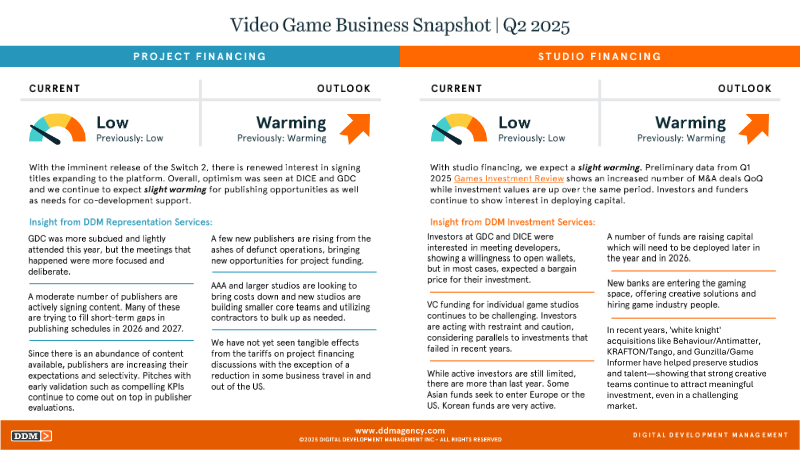
The global gaming industry experienced a significant resurgence in financial activity during the first quarter of 2025, marked by a substantial rebound in mergers, acquisitions, and private placements. Total deal value for the quarter reached $4.4 billion across 48 announced transactions, representing the highest quarterly valuation in nearly two years. This momentum was primarily driven by large-scale strategic consolidations, such as the $3.5 billion acquisition of Niantic’s games division by Scopely and AppLovin’s $900 million studio spin-off. Simultaneously, private investment surged to $3.5 billion across 149 deals, anchored by a landmark $3 billion investment into Infinite Reality at a $12.25 billion valuation.
Investment trends during this period shifted toward AI-driven entertainment and mobile user acquisition technologies. Strategic players like Savvy Games Group and Tencent maintained leadership roles in capital deployment, while venture capital firms such as BITKRAFT and Andreessen Horowitz remained the most prolific investors by volume. Geographically, the Asian developer market demonstrated steady stability with a median revenue growth of 9%, while the hardware and tools sector outperformed broader segments with a 20% average revenue increase. This growth was heavily influenced by the dominance of NVIDIA, which saw a 114% year-over-year revenue surge, positioning it as a cornerstone of the industry’s infrastructure with a $2.6 trillion market capitalization.
Despite the overall recovery reflected in the 16.37% return of the Drake Star Gaming Index, the market exhibited extreme volatility among individual public companies. While Sea Limited experienced a dramatic 223% increase, established entities like Unity and Ubisoft faced significant downturns, with valuations falling by over 50%. This divergence highlights a period of intense transition where hardware providers and AI-integrated platforms are capturing the majority of market gains, while traditional software developers and engine providers navigate a more challenging and fragmented economic landscape.
Drake Star Partners · 2026
Drake Star Partners · 2025
Drake Star Partners · 2025

Drake Star · 2025

Drake Star Partners · 2025
Drake Star Partners · 2025
Drake Star Partners · 2025
Drake Star Partners · 2024
Drake Star Partners · 2024
Drake Star Partners · 2024
Drake Star Partners · 2024

Drake Star Partners · 2024
Aream & Co · 2026
Modern Times Group · 2026
DDM · 2025
Digital Development Management · 2025
DDM · 2025

Thunderful · 2025
DDM · 2025
Aream & Co · 2025
InvestGame · 2025
Drake Star · 2025