Global reports and market data
Documents



Flujo de Bolsillo [Pocket Flow]: A Board-Game Simulation for Financial Decision-Making
Pocket Flow, a physical board-game simulation of an annual financial cycle encompassing income, compulsory expenses, saving, consumption, and financial shocks, was developed to examine whether low-cost analogue play can support financial decision-making education.
- Pocket Flow is a low-cost physical board game simulating an annual financial cycle of income, compulsory expenses, saving, consumption, and financial shocks, refined through three Design-Based Research cycles with 62 participants, mostly university students.
- Of 18 valid post-game surveys drawn from 40 participants, 94.4% rated their perceived gains in financial knowledge and saving awareness positively, while motivation received a lower but still favourable rating of 72.2%.
- Gameplay observations documented recurring behaviours including planning, impulsive spending, and risk-taking, and participants revised their strategies after setbacks.



Masterpolis: Simulating Urban Planning Decisions Through a Boardgame Learning Environment
Masterpolis is a low-cost physical board game designed to simulate urban planning decisions, developed through a Design-Based Research approach at a Colombian university.
- Masterpolis is a low-cost physical board game for simulating urban planning decisions, developed through Design-Based Research at a Colombian university and positioned as a Global South alternative where digital simulation tools are limited or costly.
- The game was refined across eight sessions with 35 undergraduate architecture and engineering students and two urban planning experts, with sessions lasting 40 to 90 minutes.
- Observers reported active negotiation, collaborative decision-making, and improving rule comprehension as rules were simplified, while early sessions showed difficulties with rule complexity that required facilitator support and shaped later design revisions.



Finding the Target Solution and its Concentration: A Chemistry Escape Room
This paper describes a physical chemistry escape room designed as an inquiry-based learning activity, developed at the University of Applied Sciences Upper Austria.
- The chemistry escape room asks players to identify a target solution among four colourless liquids that is pH-neutral and highly conductive, then determine its concentration, with the activity lasting about 15 to 25 minutes.
- The target solution is aqueous sodium chloride, identified by eliminating a vinegar-like acidic sample by smell, a baking-soda basic sample by pH testing, and distilled water by its near-zero conductivity.
- The target solution shows a conductivity reading of roughly 4,000 µS, while its measured density of about 1.070 g/mL corresponds to a concentration of 10% on a density-concentration diagram.



Exploratory Study of the Relationship Between HEXAD Player Types and Cognitive Learning Objectives
This exploratory study examines whether the six player types of the HEXAD gamification model relate to success at different cognitive levels of the Anderson and Krathwohl taxonomy, a link the author argues has been largely unexamined in prior research, which has focused mainly on motivational and affective outcomes.
- The study tested whether HEXAD player types relate to success at different levels of the Anderson and Krathwohl cognitive taxonomy, an angle the author argues prior research has largely neglected in favor of motivational and affective outcomes.
- Player types did not excel uniformly: Players were most represented among successful participants at the procedural application level and declined as complexity rose, while Philanthropists led at the analytical and evaluative levels.
- Achievers responded positively to escalating difficulty, whereas Socialisers showed a marked performance drop at the evaluative level.



Learning Through Consequence: Entrepreneurial Learning in a Games-Based Simulation
This study examines how postgraduate business analytics students perceived SimVenture Evolution, a games-based entrepreneurship simulation, as a vehicle for learning through consequence.
- The study surveyed 33 postgraduate business analytics students at a single institution about SimVenture Evolution, a games-based entrepreneurship simulation, using post-only, self-reported perceptions with no pre-test or comparison group.
- Headline figures show 93.9% reported improved decision-making confidence, 87.9% felt better prepared for entrepreneurial challenges, and 97.0% would recommend the tool, but these are perception measures rather than evidence of actual learning gains.
- The authors caution that participants' high prior entrepreneurial interest and professional experience may have inflated favourable ratings, limiting the generalisability of the results.



CyberYuruGu: An Interpretative Gameplay Model Grounded in African Epistemology for Explainable Cybersecurity Reasoning and Human-AI Sense-Making
The paper introduces CyberYuruGu, a cybersecurity serious game that draws on Dogon Fox divination from West African cosmology and Bachelard's notion of epistemological rupture to frame uncertainty as a generative source of insight rather than a deficit to be eliminated.
- CyberYuruGu is a cybersecurity serious game that frames uncertainty as a generative source of insight, drawing on Dogon Fox divination and Bachelard's epistemological rupture, and uses an LLM as a judge to reconstruct attack and defence paths from gameplay traces.
- The principal empirical finding is a protective-reasoning bias: defence paths scored a cumulative 8 versus 5 for attack paths, and defensive reasoning was more consistent and complete across participants.
- The authors estimate over 16 billion possible attacker-defender configurations on a 32-cell board, which they use to justify LLM-assisted evaluation over exhaustive deterministic computation.
Designing an Integrated-Reality Megagame for Lifelong Learning Competency Development
The paper presents the design and implementation status of an Integrated-Reality Megagame inspired by Formula 1, intended to support lifelong competency development.
- The paper presents a design architecture, not an evaluation: its Integrated-Reality Megagame, inspired by Formula 1, has been run in eight formative demonstrations with groups of 10 to 20 people (about 100 participations), but no recordings or performance data have been analysed.
- The paper makes no claims about engagement, competency development, or learning outcomes, so its contribution is positioned as an explicit architecture and a basis for future empirical study.
- The design rests on four connected layers (learning design, physical interface, virtual interface, and social interaction), combining a Carrera Digital track, SmartRace telemetry, role-specific digital interfaces, and team role-play.
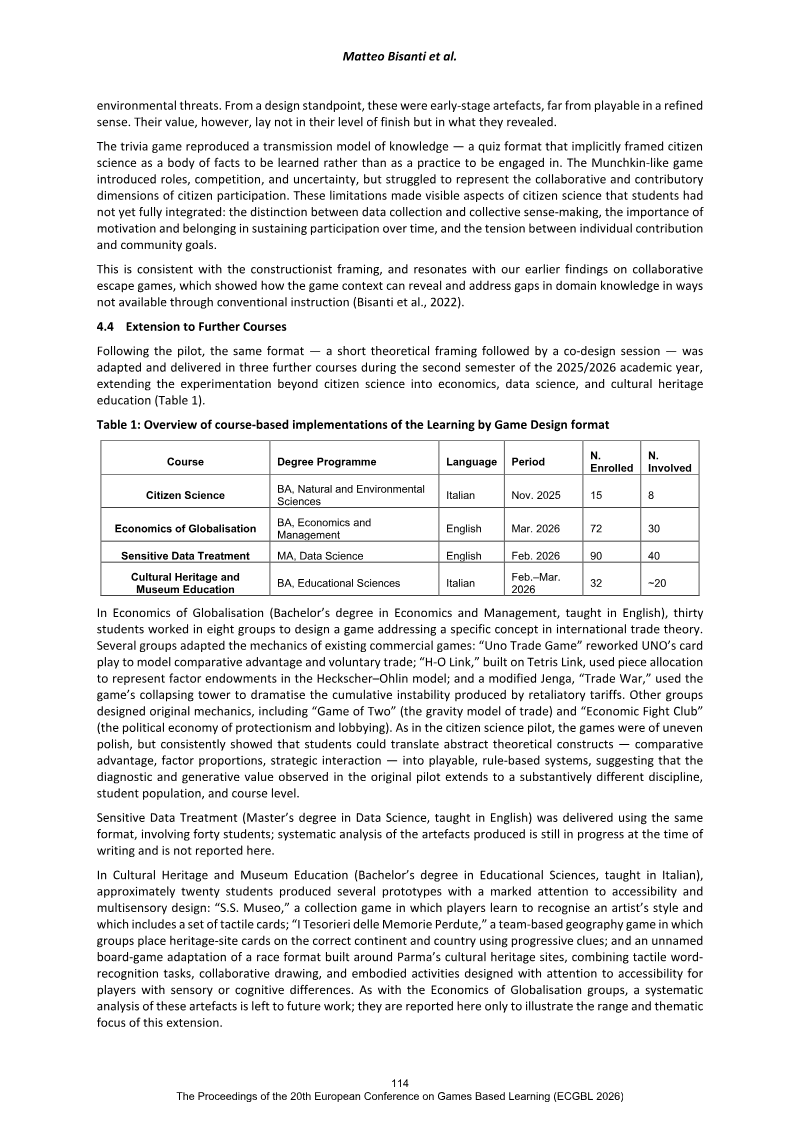
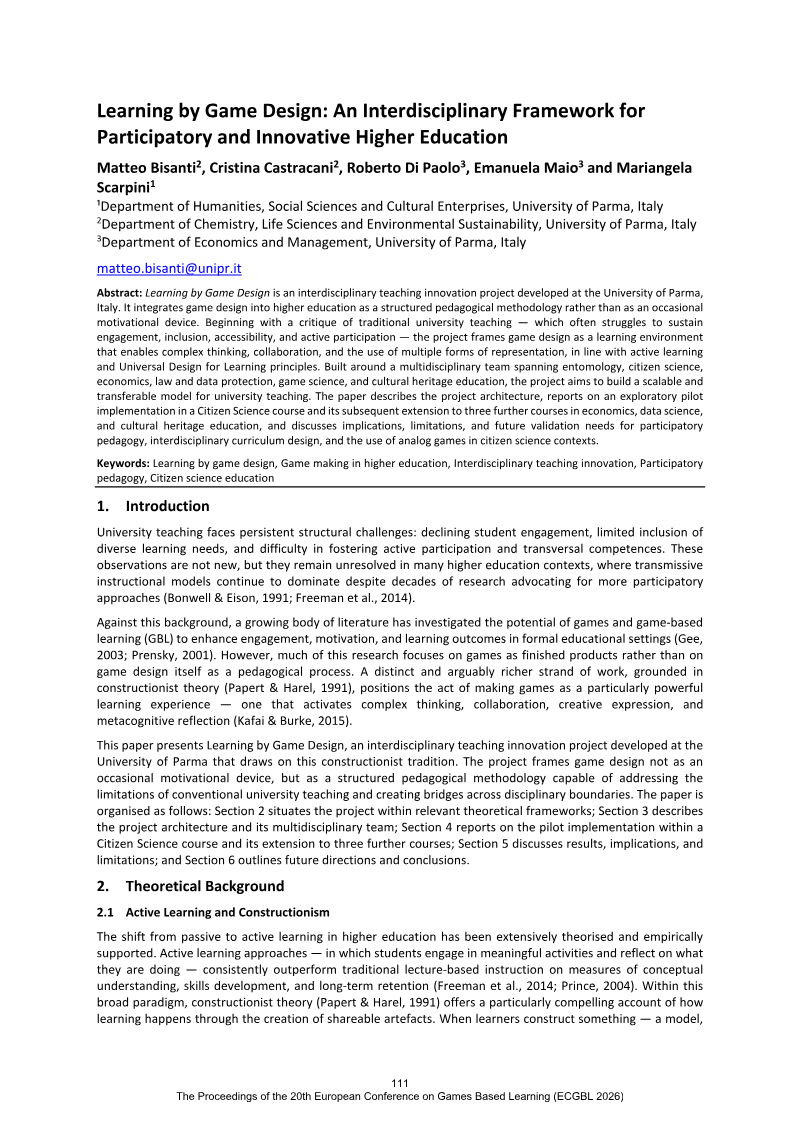
Learning by Game Design: An Interdisciplinary Framework for Participatory and Innovative Higher Education
The Learning by Game Design project, developed at the University of Parma, proposes game design as a structured pedagogical methodology for higher education rather than an occasional motivational device.
- Learning by Game Design is proposed as a structured pedagogical methodology for higher education, grounded in constructionist theory, Universal Design for Learning, and the Games for Social Change tradition, rather than as an occasional motivational device.
- The project is built around a multidisciplinary team spanning entomology, citizen science, economics, law, game science, and cultural heritage education, with the aim of producing a scalable and transferable model for university instruction.
- The initial pilot involved eight students in a Bachelor's-level Citizen Science elective, who produced two early-stage board game prototypes.
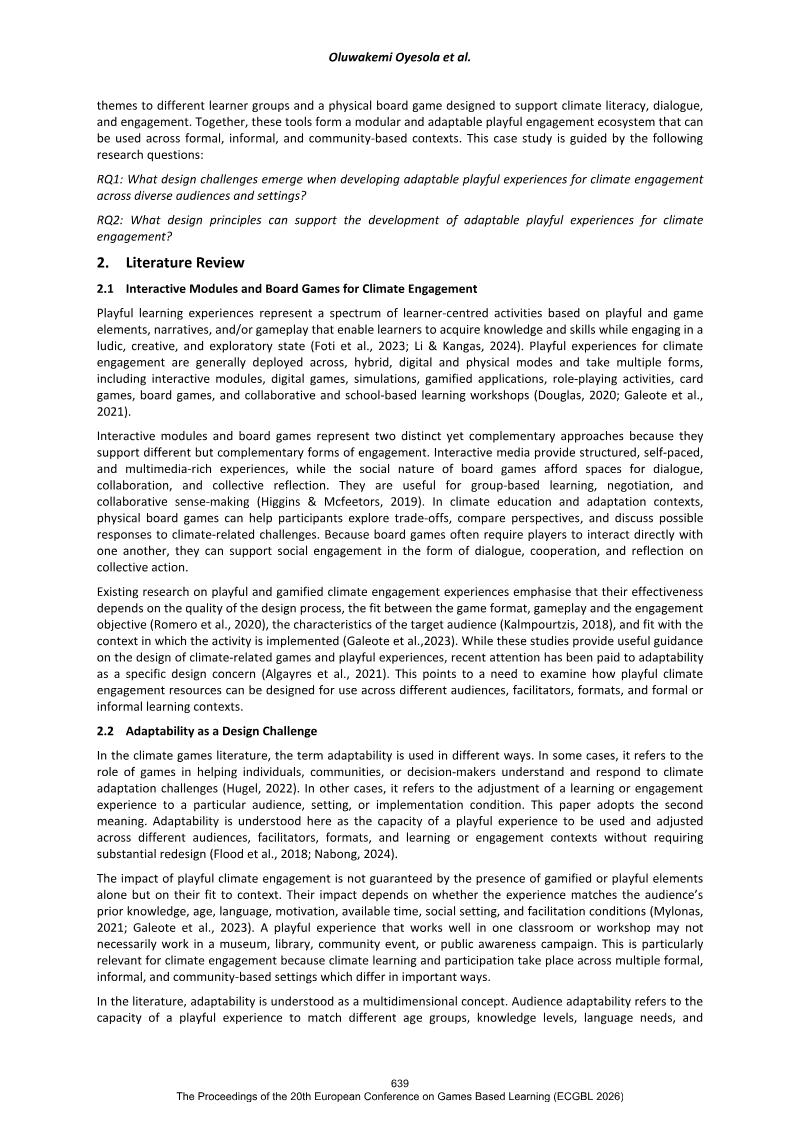
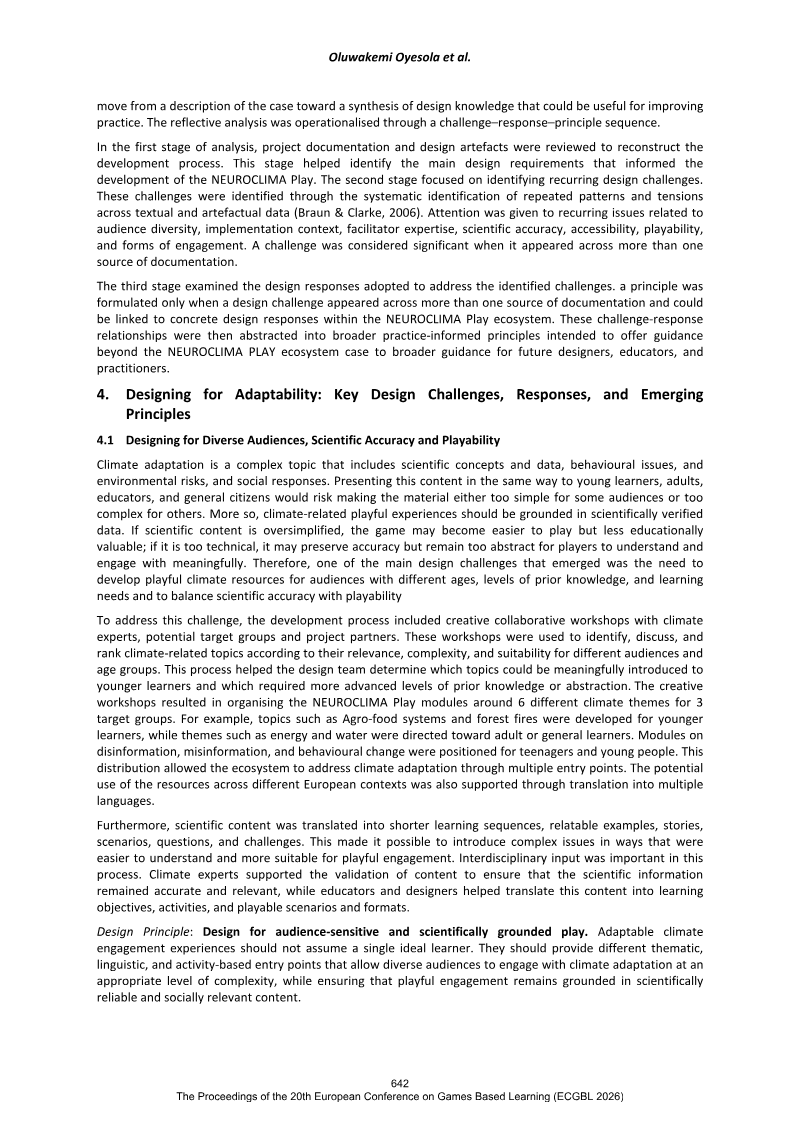
Designing Adaptable Playful Experiences for Climate Engagement: Lessons from NEUROCLIMA Play Ecosystem
The NEUROCLIMA Play ecosystem, a playful climate engagement tool combining six interactive learning modules with the ClimateQuest board game, serves as the basis for a reflective design case study on what makes such resources adaptable.
- Adaptability across audiences, contexts, facilitators, content, and engagement modes, rather than the mere presence of game elements, is the central factor determining whether playful climate education can move between formal classrooms, informal settings, and community programs.
- The study identifies four core design challenges: reconciling scientific accuracy with playability for diverse audiences, enabling reuse across formal, informal, and community contexts, supporting facilitators without specialist expertise, and treating adaptability as a central rather than peripheral design concern.
- Derived design principles include audience-sensitive design, modular and contextual reuse, and facilitation flexibility, drawn from development practice of the NEUROCLIMA Play ecosystem (six interactive learning modules plus the ClimateQuest board game).
Emotion Detectives: Co-Designing Inclusive SEL Games with Preschool Children
This study reports on "Emotion Detectives," an exploratory co-design workshop within a broader Educational Design Research project aimed at building an inclusive digital educational game for preschool children.
- Young children are rarely treated as genuine co-designers of digital learning tools, and the authors argue this exclusion stems from methodological choices rather than developmental limits.
- The workshop involved seven children aged three to six (six with a diagnosed disability) and eleven caregivers recruited through a single disability support association in Portugal, with each family group assigned one CASEL-5 social-emotional competency dimension.
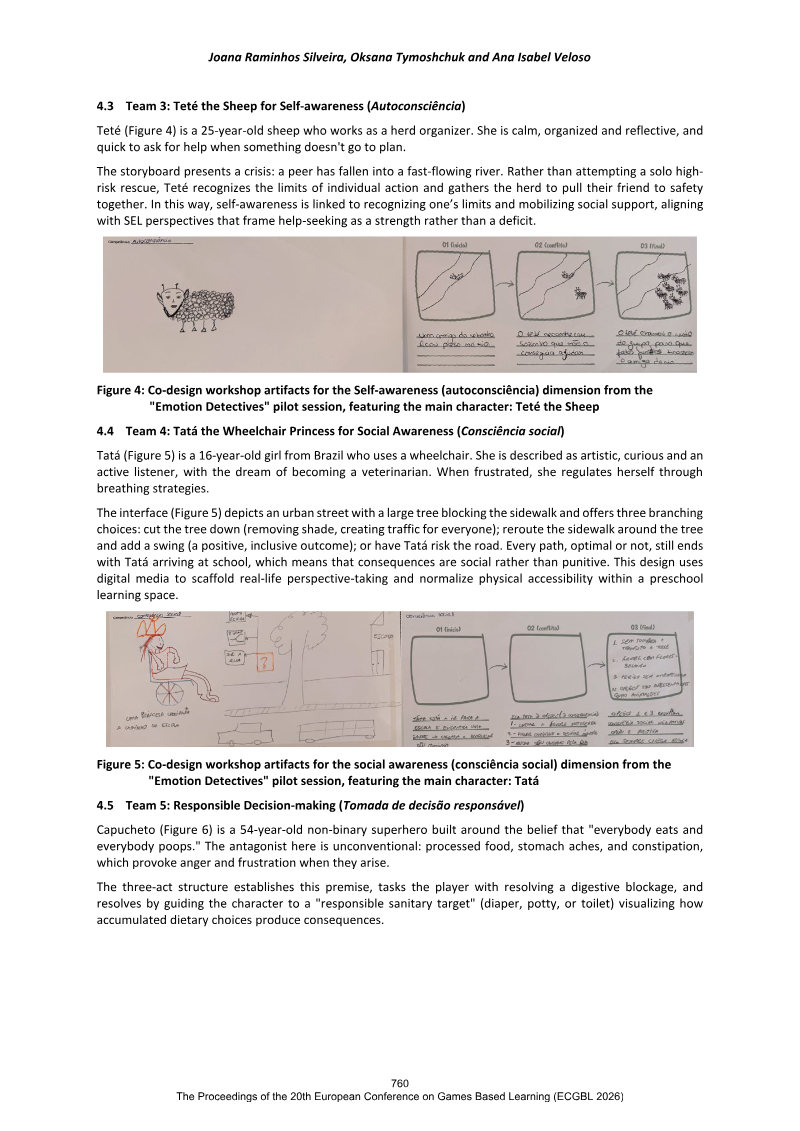
- Families produced protagonist biographies, three-act narrative storyboards, and low-fidelity interface sketches, yielding five prototypes with non-human protagonists resolving emotional struggles through relational repair, cognitive redirection, help-seeking, accessibility-aware branching, and bodily-care guidance.



Mission Profiles and Interaction Patterns in Gravitas: Evidence from a Simulation-Based Physics Learning Game
This study examines whether self-selected mission profiles in Gravitas, a simulation-based physics learning game, relate to how lower-secondary students interact with the game and perform on reflection tasks.
- Self-selected mission profiles (Adventurer, Researcher, Tactician, Tinkerer) explained little about how 272 lower-secondary students interacted with the physics game Gravitas or how they performed, with no statistically significant differences in game progress, exploration time, conceptual support use, reflection duration, or reflection scores.
- The strongest signal was a marginal, non-significant tendency (p = .055) for Researchers and Tacticians to reset the simulation more often than other profiles.
- Reset frequency showed a weak but significant negative correlation with reflection performance (ρ = -.18, p = .006), suggesting more frequent resets are modestly associated with poorer reflection outcomes.
Investigating Learning Progress of Children Aged 6-12 in the Kidedu Digital Environment: A Comparative Analysis of Three Age Groups
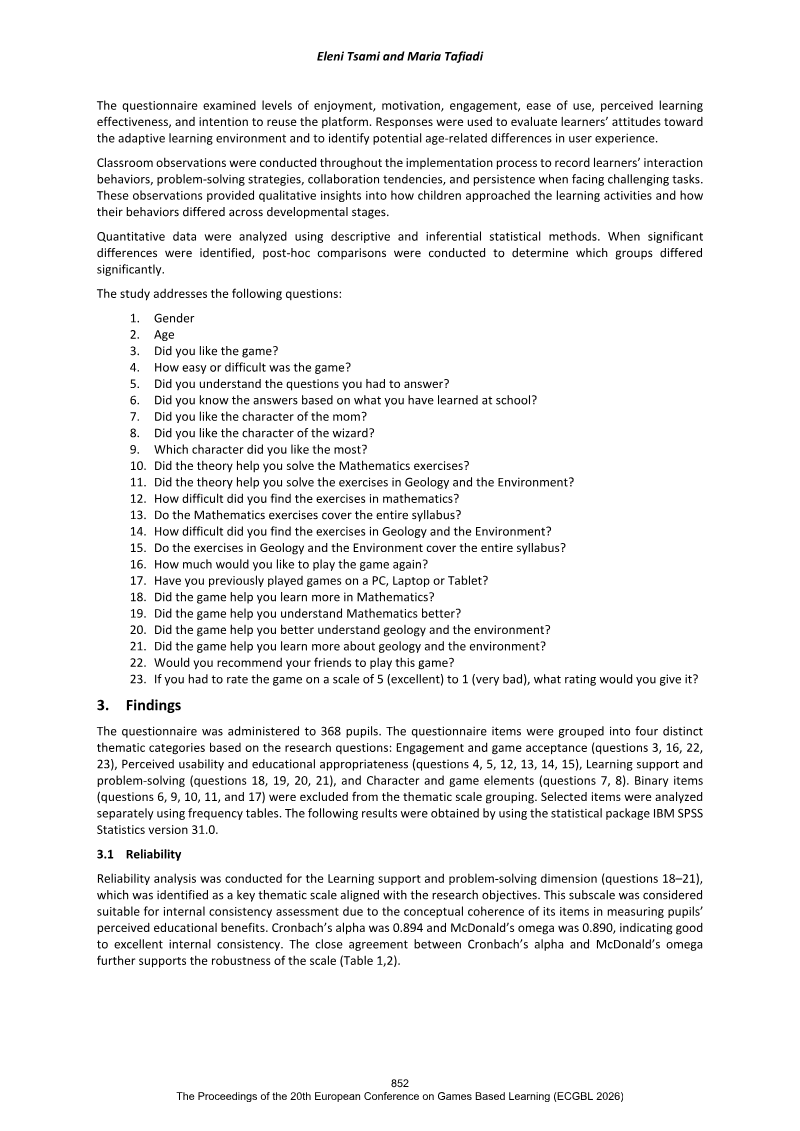
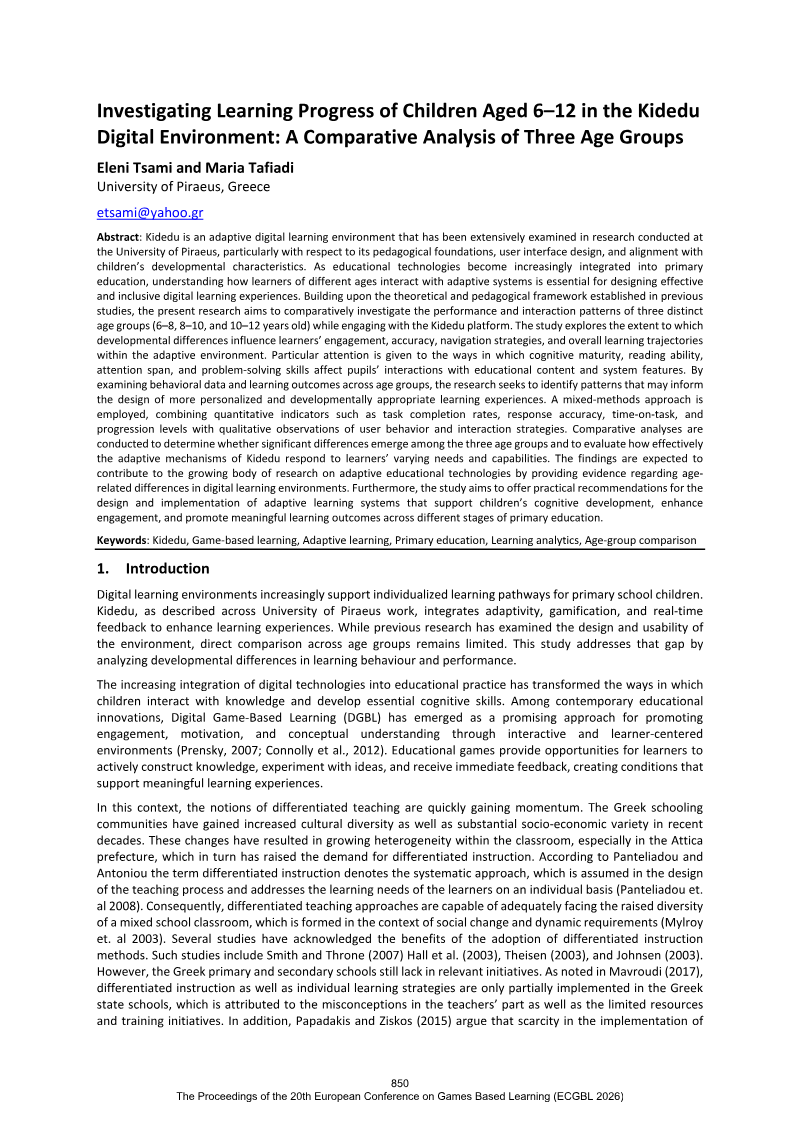
This study, conducted by researchers at the University of Piraeus, examines how children aged 6 to 12 engage with KIDEDU, an adaptive digital learning platform for mathematics and natural sciences, and whether their age group shapes their experience.
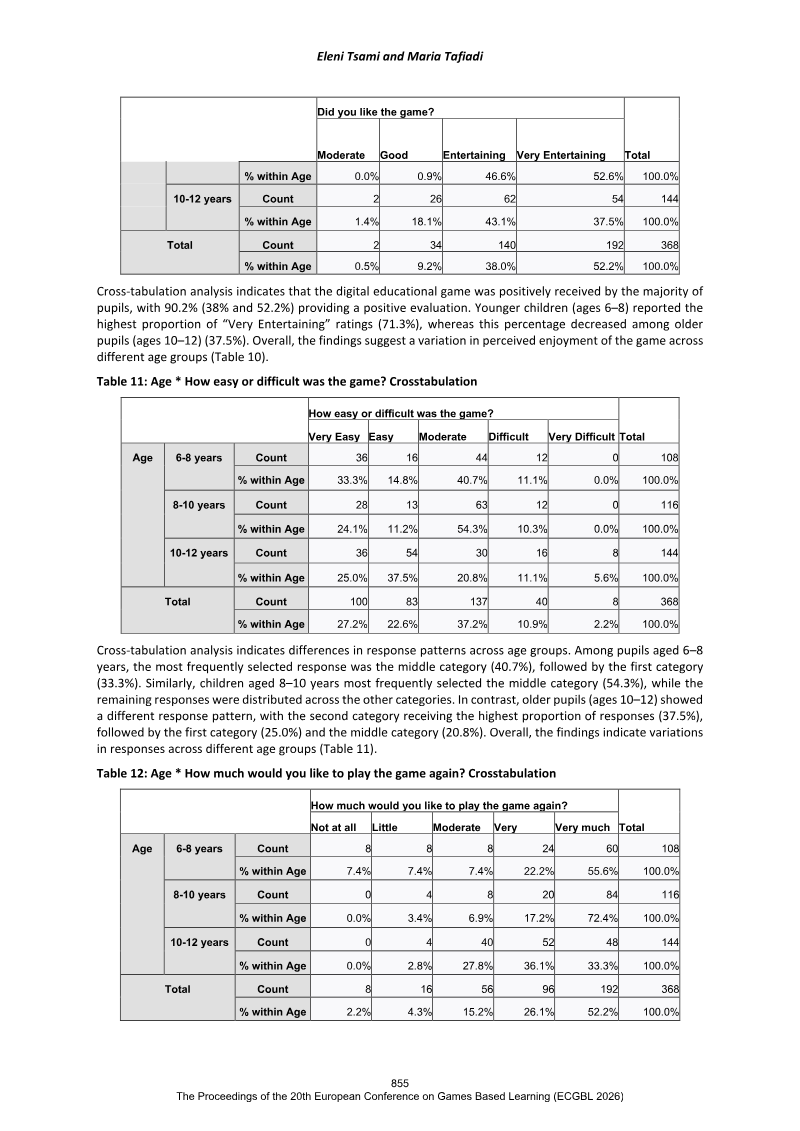
- Roughly 90% of the approximately 368 Greek primary pupils rated KIDEDU entertaining or very entertaining, and about 78% expressed strong willingness to replay it, with 76% rating its overall quality good or excellent.
- Majorities reported that the game's theory helped them solve mathematics exercises (88%) and geology and environment exercises (78%), though these figures are self-reported rather than measured.
- Age significantly shaped responses: pupils aged 8-10 showed the highest enjoyment, replay intent, and recommendation rates, while pupils aged 10-12 gave more moderate and dispersed ratings, including more 'average' and 'difficult' responses.