Game Studies reports and market data
Documents
Delicate Subjects: Vulnerability and Validation in Action Adventure Games
Diane Carr's paper examines the protagonists of action adventure games and the tension between their vulnerability and the validation they receive through play.
- Diane Carr argues that action adventure protagonists endure spectacular suffering while their ability is continually quantified through achievements, points, progression and collectables, creating a tension between vulnerability and validation.
- The paper's central claim is that protagonists hold privileged positions in game fictions, but this privilege is conditional on continual demonstration of ability, making their status anxious and fragile.
- The analysis uses Thomson's concept of the "normate" from critical disability theory, which describes how unmarked, privileged bodies are sustained by everyday institutions while other bodies are constructed as marginal or deviant.
Enter the Disagreement Matrix or "Let's Talk Ontology, Game Studies"
This paper argues that game studies needs a clearer account of its own foundational assumptions, proposing a "disagreement matrix" as a way to map its disciplinary landscape.
- The paper argues game studies needs explicit accounts of its foundational assumptions, proposing a "disagreement matrix" that crosses disciplines against one another to locate where scholars actually disagree, shifting the core question from "what is a game?" to "what kinds of enquiry are we performing and what assumptions underlie them?".
- Mapping the field's five broad disciplines (humanities, social sciences, design, computer programming, game production) yields a 5 x 5 matrix of about 25 cells, versus roughly 121 cells if the 11 sub-disciplines from Quandt et al. (2015) were crossed, making the broad version more tractable.
- The central issue the paper identifies is whether game studies has a unitary or fragmented academic identity, and the matrix is proposed as a way to answer that question.
Emptiness Beckons: The Allure of Space in Speculative Game Fictions
This paper proposes applying Graham Harman's concept of "allure," drawn from Speculative Realism and specifically Object-Oriented Ontology, to explain why in-game spaces attract players and function as attractive elements of games in their own right.
- The paper applies Graham Harman's Object-Oriented Ontology concept of 'allure' (objects signalling hidden depths that withdraw from full comprehension) to explain why in-game spaces attract players as attractive elements in their own right.
- Its central claim is that the Mass Effect trilogy's distinctive strength lies less in its characters or narrative than in the sense of vastness invested in its universe.
- The author identifies specific settings as producing this allure, including empty moons and planets, abandoned bases and warehouses, and the protagonist's apartment, despite games' tendency to conservatively circumscribe locations.
Squeezing and Extending the Platform: The Case of the Sinclair ZX Spectrum
This paper examines how users sustained the commercial life of the Sinclair ZX Spectrum in early 1990s Czechoslovakia, long after the platform had been declared obsolete in Western markets.
- The Sinclair ZX Spectrum became the most popular 8-bit platform in early 1990s Czechoslovakia, sustained largely by unofficial Western imports and by domestic manufacturer Didaktik Skalica's Spectrum clones, even as it was declared obsolete in Western markets.
- The paper argues that manufacturer-driven launch-and-replace cycles fail to capture how user communities actively maintain, modify, and upgrade hardware, challenging the logic of perpetual obsolescence in platform histories.
- Owners pursued three recurring strategies: treasuring (preserving and modifying classic games to affirm the platform's place in national computing history), squeezing (exploiting undocumented features as programmers kept extracting more capability), and extending (hardware modifications, peripherals, and interfaces often beyond the designers' intentions).
Hidden Paratextuality: Concealing the Factual Aspects of Video Games
Jan Švelch's paper introduces the concept of "hidden paratextuality," arguing that the absence of expected factual information about video games can itself carry meaning and shape how players interpret a game.
- Jan Švelch's paper introduces "hidden paratextuality," arguing that missing factual information about video games, such as developer identity, price, and system requirements, can itself carry meaning and shape player interpretation.
- Building on Gérard Genette's paratext theory, the paper contends that game studies has focused on explicit paratexts like trailers, manuals, patch notes, and credits while overlooking what is conspicuously absent.
- The author argues that the unavailability of factual paratexts creates a distinct paratextual quality that establishes its own threshold of interpretation.
Lineages: Historicising the Videogame
This paper argues that game studies must historicise the videogame by situating it within cultural and material contexts, rather than only asking what the videogame essentially is.
- The paper argues that game studies should historicise the videogame by situating it within cultural and material contexts, asking when it emerged and through which lineages it should be understood, rather than only asking what it essentially is.
- Its central aim is to propose a theoretical framework for historicising the videogame, built by adapting methods from media historians in other fields.
- The framework draws on Thomas Elsaesser's idea that image and sound technologies form 'family relations' rather than a single family tree, with technologies grouped together without being causally or teleologically linked.
Towards Normative Validity in the Evaluation of Game-Based Learning
This paper argues that evidence-based research on digital game-based learning (DGBL), while methodologically rigorous, is insufficient on its own for guiding educational decisions, and that researchers must also attend to normative validity, asking whether they are measuring what is actually valued in education.
- Evidence-based DGBL research, though methodologically rigorous, is insufficient on its own to guide educational decisions; researchers must also assess normative validity, i.e., whether they measure what education actually values.
- Media comparison studies struggle to select representative games, define appropriate control conditions, and control for the many contextual variables present in classrooms.
- Value-added studies isolate specific game mechanics but often rely on self-developed games of lower quality than commercial titles, ignore interactions among design elements, and are slow relative to fast-changing technology.
Metagaming and Subversive Play in League of Legends
This study examines metagaming practices among high-level players of League of Legends, focusing on how competitors navigate a strategic metagame that shifts constantly because of frequent game patches.
- Metagaming in League of Legends, as examined in this study, goes beyond mechanical skill to include community-enforced strategic norms governing how players approach their roles and positions on entering a match.
- Frequent game patches constantly shift the metagame, and interviewed players reported that updates disrupted their established position and role combinations.
- Based on interviews with 13 high-level players from the Korean and Oceanic servers at the close of the 2015 competitive season, most players responded to patches by either switching to other pre-existing combinations or maintaining their habitual style even when it reduced their enjoyment.
BioGraphr: Science Games on a Biotic Computer
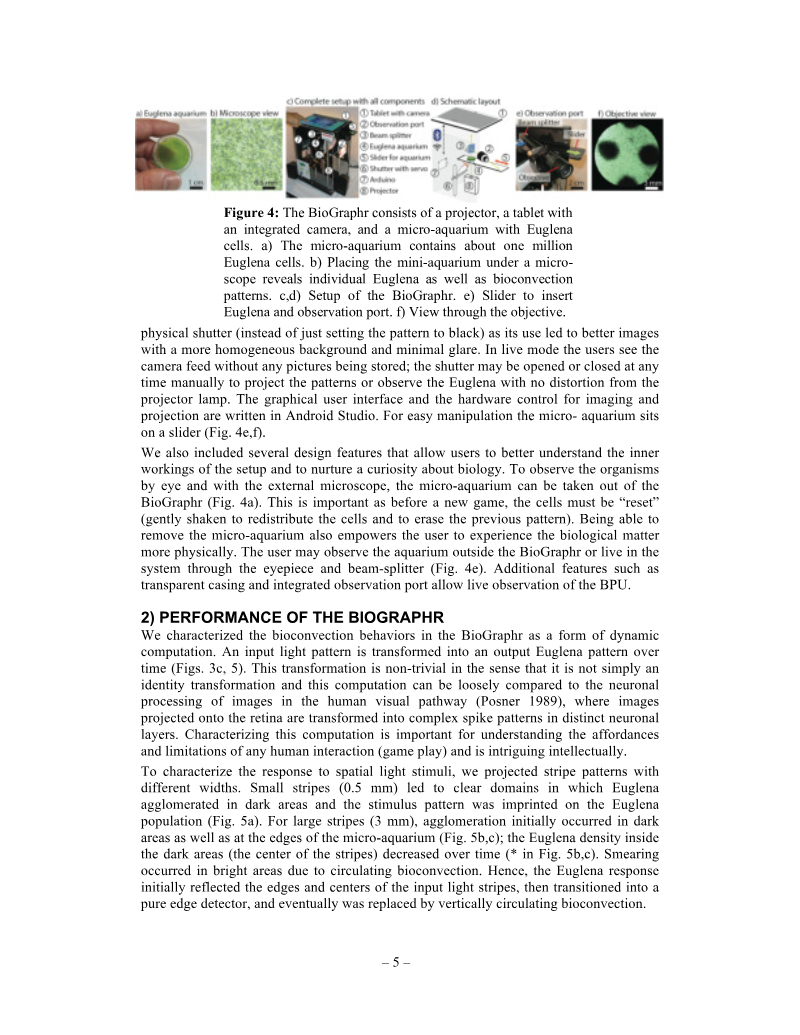
BioGraphr is a tabletop biotic computing platform that uses roughly one million phototactic Euglena cells in a 3 mm micro-aquarium to generate bioconvection patterns in response to projected light.
- BioGraphr is a tabletop biotic computing platform in which roughly one million phototactic Euglena cells in a 3 mm micro-aquarium generate bioconvection patterns in response to projected light, with a tablet camera closing the loop between players and living organisms.
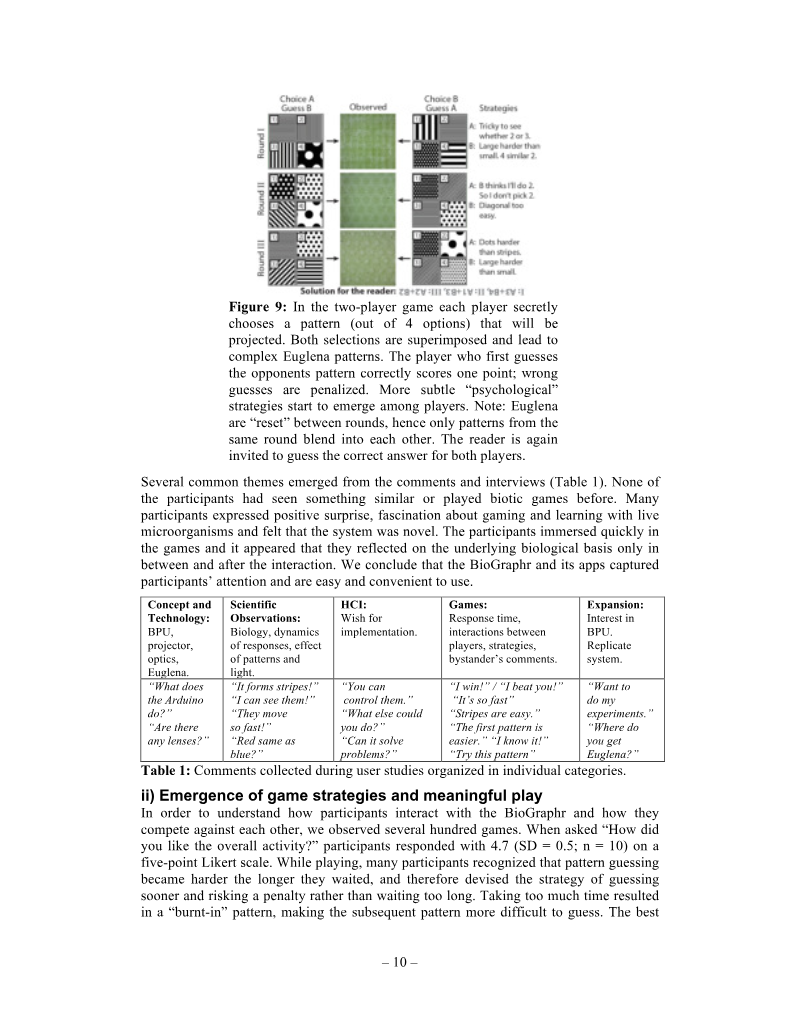
- Across 43 participants, two prototype games (a one-player pattern-guessing game and a two-player game) were rated 4.7/5 (n=10), and players developed strategies such as rapid guessing to avoid burnt-in patterns and choosing hard-to-recognize patterns for opponents.
- Players measurably improved with repeated play: completion time fell from 38.8 s to 30.3 s and errors dropped from 9 to 2 (p < 0.001).
Good Violence, Bad Violence: The Ethics of Competition in Multiplayer Games
Nguyen and Zagal's paper argues that competition in multiplayer games constitutes a form of "mere violence," in the sense that it frustrates an opponent's in-game plans, yet this violence can be transformed into an ethically positive experience.
- Competition in multiplayer games is framed as 'mere violence': it frustrates an opponent's in-game plans, but it can be transformed into an ethically positive experience.
- The authors reject the 'magic circle' idea that games are insulated from moral consequence, arguing that the ethics of competitive play depend on design, mutual consent, and psychological fit between opponents rather than on fixed rules.
- The central thesis is that competitive games can be 'competitive in their individual moments but collaborative as a whole,' which requires deliberate effort from both designers and players.
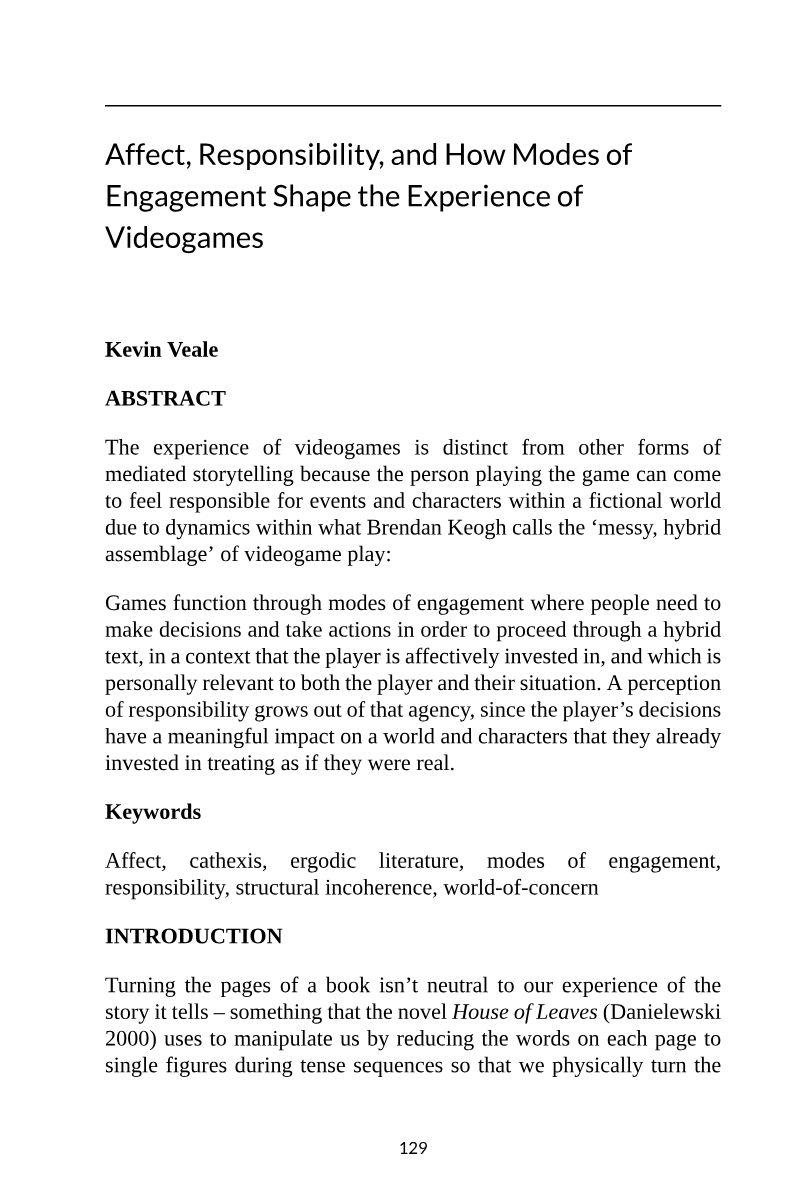
Affect, Responsibility, and How Modes of Engagement Shape the Experience of Videogames
Videogames occupy a unique position within narrative media by fostering a distinct sense of player responsibility rooted in hybrid engagement.
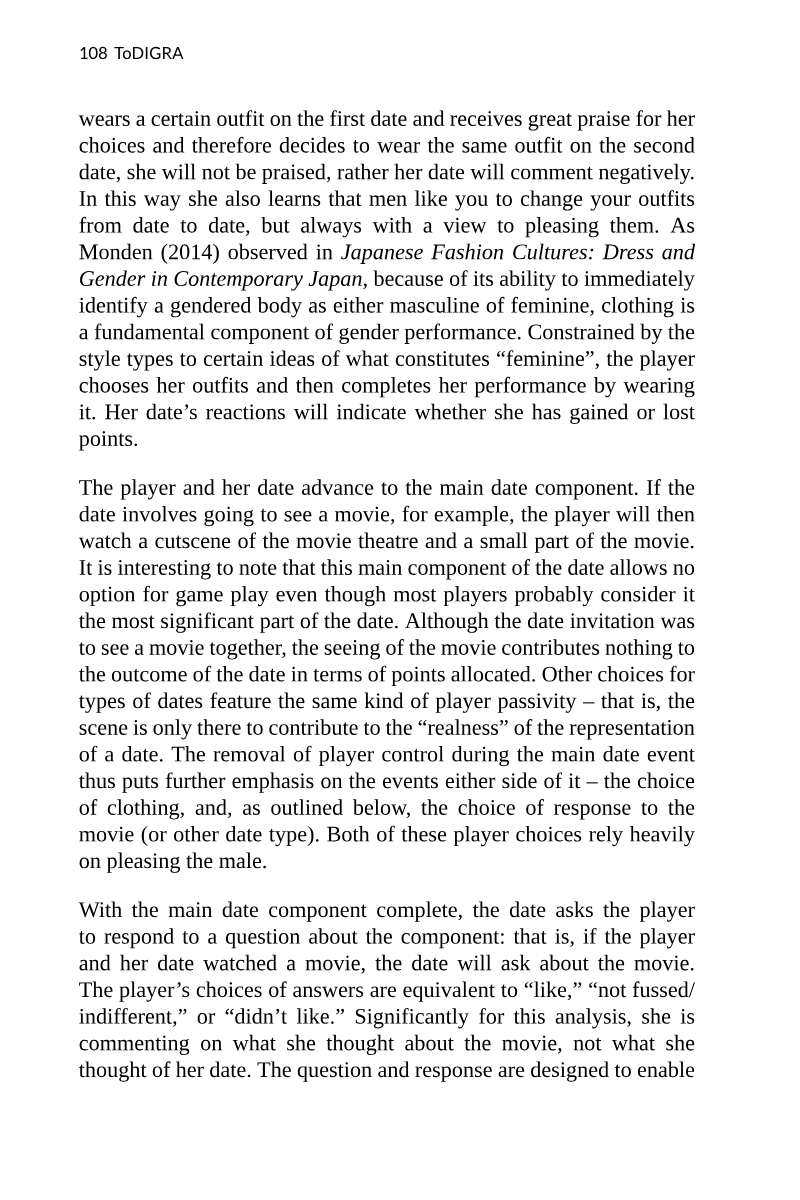

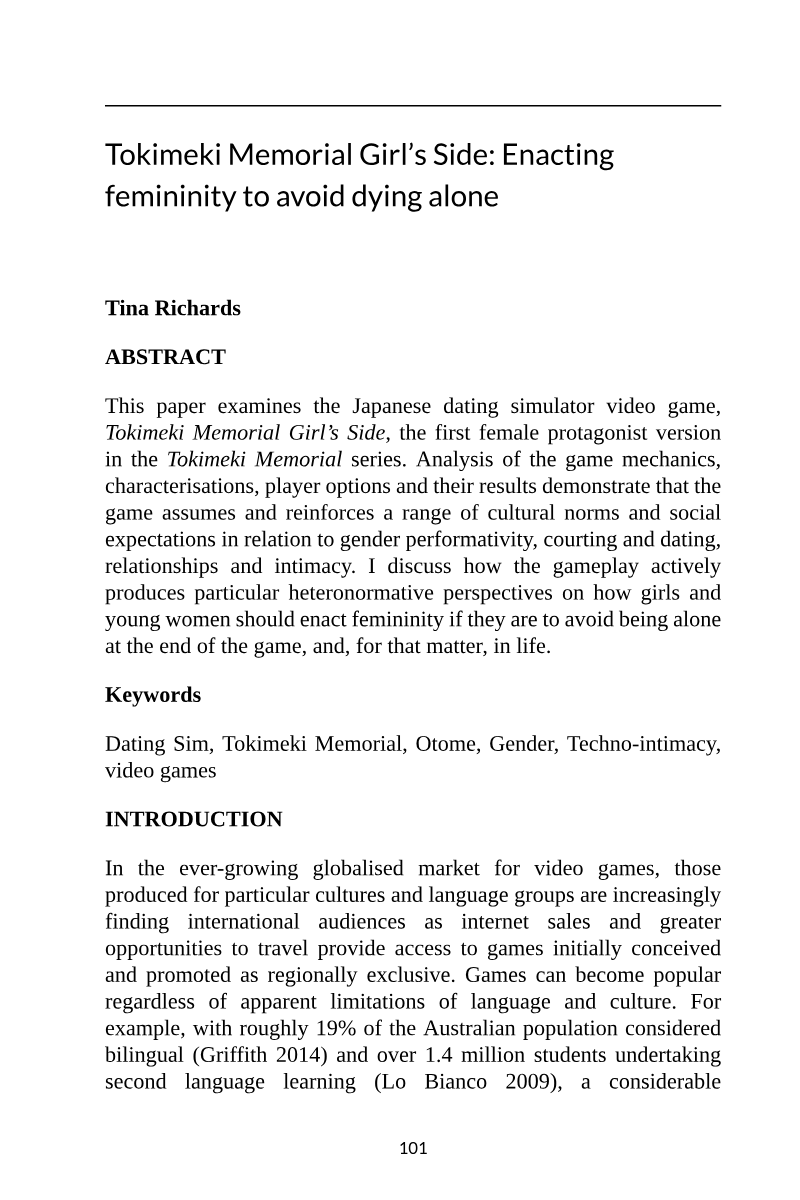
Tokimeki Memorial Girl's Side: Enacting Femininity to Avoid Dying Alone
Tokimeki Memorial Girl’s Side functions as a digital training ground that reinforces heteronormative social expectations and traditional Japanese gender roles.