Game Studies reports and market data
Documents
How to Play Academia: Conceptual and Methodological Observations
This paper, "How to Play Academia," argues that game studies scholars should contribute more actively to debates about the gamelike dimensions of contemporary higher education, which are often framed in terms of a "publication game," funding applications as rule-bound play, and the gaming of performance metrics that illustrates…
- The paper argues that game studies should engage more actively with the gamelike dimensions of higher education, such as the publication game, funding applications as rule-bound play, and the gaming of performance metrics illustrating Goodhart's law.
- The authors contend that existing scholarship on academic gaming focuses narrowly on negative consequences and propose an activism-oriented approach examining the goals, rules, strategies, and tactics of academic life.
- The central thesis is that game concepts such as optimization, counterplay, co-creation, the magic circle, and lusory attitude offer richer analytical resources than the dominant resource-management view of academic careers.
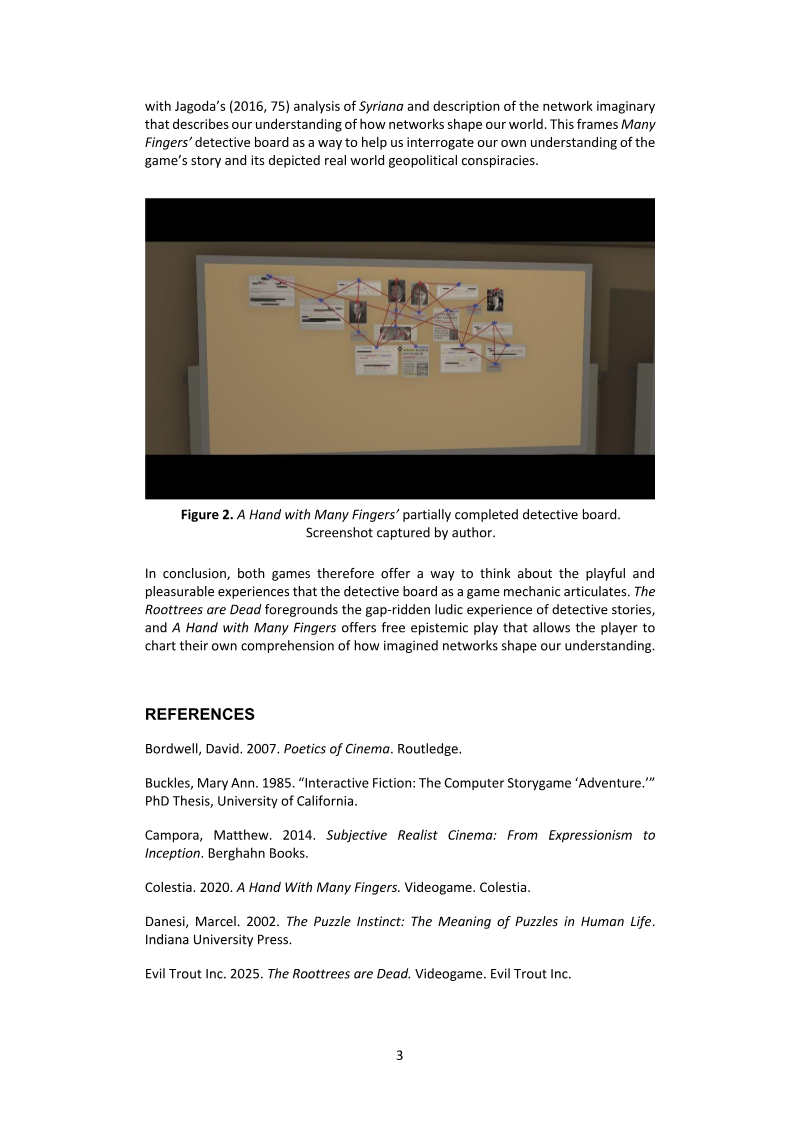
The Playful Pleasures of the Videogame Detective Board
This paper, by Cassandra Barkman of the University of Melbourne, examines the detective board as a dual ludic and narrative device in videogames.
- The paper argues that the detective board is both a ludic and narrative device, shaping player behaviour and narrative sensemaking, and reveals a close relationship between videogame narrative design and detective fiction.
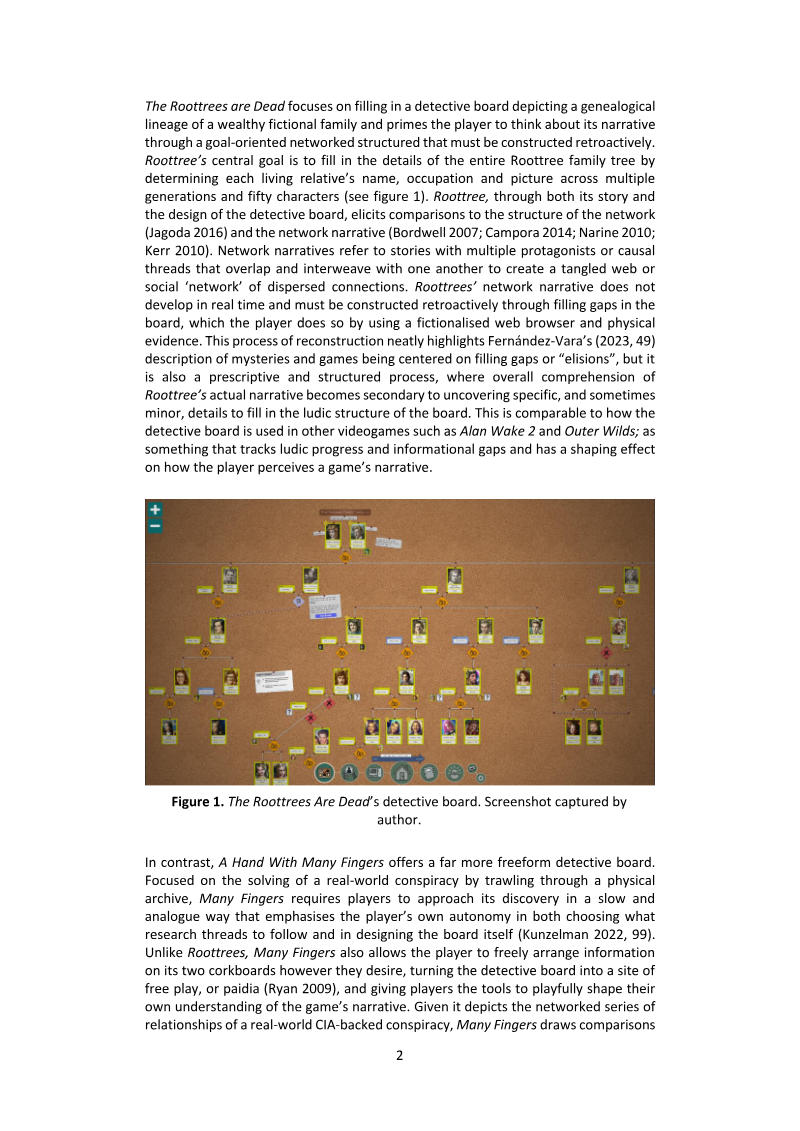
- The Roottrees are Dead uses a structured, goal-driven board: a genealogical network of roughly fifty relatives across several generations that players must reconstruct retroactively by identifying names, occupations, and images.
- The paper contends that the Roottrees board's prescriptive structure can make overall narrative comprehension secondary to uncovering minor details needed to complete the board.
Unplayable Encounters with the Anthropocene: Rethinking Scale and Agency in Game Studies
Paolo Ruffino's paper critically examines the dominant approaches to studying videogames in relation to the Anthropocene and proposes an alternative framework centred on non-scalability.
- Ruffino argues that the dominant approaches to games and the Anthropocene, the instrumental (games as tools for pro-environmental behaviour) and the representational (games depicting nature), share an unexamined assumption that ecological messages scale up through repeated exposure to shift player behaviour at population level.
- The paper contends this scalability paradigm offers false reassurance that the climate crisis is being addressed through games, when it may not be.
- Drawing on Anna Tsing's non-scalability and friction, Timothy Morton's hyperobjects and subscendence, and Joanna Zylinska's minimal ethics of the Anthropocene, the author proposes studying meaningful game engagement as situated, contradictory encounters that resist aggregation into unified political messages.



Slow Gaming: Applying Slow Movement to Post-anthropocentric Play
This paper introduces "slow gaming," an approach to play that draws on the broader slow movement, which champions mindful, sustainable alternatives to fast, consumption-driven life.
- Slow gaming applies the broader slow movement's ethos of mindful, sustainable pacing to play, resisting the speed, efficiency, and constant progression expected of contemporary media.
- The paper's central analysis compares Journey (2012) and Stray (2022) as two games depicting post-human worlds, using them to test how slow play operates in practice.
- Journey is presented as an example of coherent coziness, where visual harmony, fluid movement, and minimal conflict sustain a near-meditative atmosphere.



Changing the Game Forever: MapleStory's Big Bang as a Climate Change Event
This paper reads the 2010 Big Bang update to MapleStory as a climate change event, arguing that the game's player-inhabited world rehearses how the climate crisis is experienced by its inhabitants.
- The paper reads MapleStory's 2010 Big Bang update as a climate change event, arguing the game's player-inhabited world rehearses how the climate crisis is experienced, with its history split into pre- and post-Big Bang sensibilities mirroring the spatiotemporal rupture of the Anthropocene.
- The Big Bang overhaul introduced faster traversal, a reduced experience-point requirement for leveling, and a new narrative centered on the revival of the Black Mage, shifting players' perception of the game from slower and communal to individualized, fast-paced, and power-centered.
- Pay-to-win mechanics and aggressive cosmetic marketing are associated with the post-update shift and have fueled documented player resistance, though the update did not introduce them directly.



Why Do We Suffer for Fun? Ordeal Pleasure in Souls-like Games
This paper introduces the Ordeal Pleasure Framework (OPF), a model explaining why repeated failure in Souls-like games such as Dark Souls, Elden Ring, and Hollow Knight can become satisfying rather than merely frustrating.
- The paper proposes the Ordeal Pleasure Framework (OPF), which explains why repeated failure in Souls-like games such as Dark Souls, Elden Ring, and Hollow Knight can feel satisfying rather than merely frustrating.
- OPF rests on three interacting mechanisms: Ludic Cultivation (trust built through fair, learnable difficulty), Aspirational Deferment (reading present frustration as investment in future competence, which depends on that trust), and Communal Mythopoesis (shared ordeal stories that amplify but do not cause the experience).
- The paper frames its central claims as hypotheses requiring causal and empirical testing, and its quantitative support is deliberately modest: a 95-participant survey of Dark Souls III players (Petralito et al., 2017) and an analysis of a 2,363-comment Elden Ring Reddit thread (Czauderna et al., 2024).
Time in Digital Games: A Comparative Map of Temporal Constructs
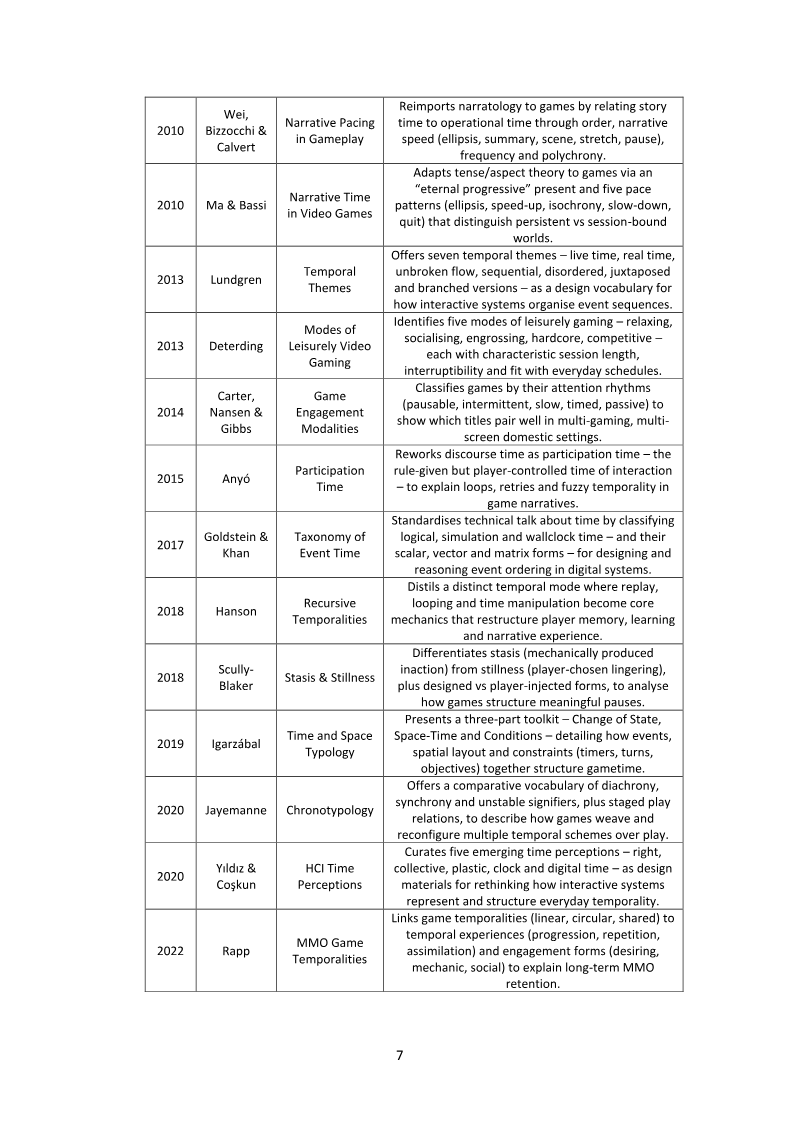
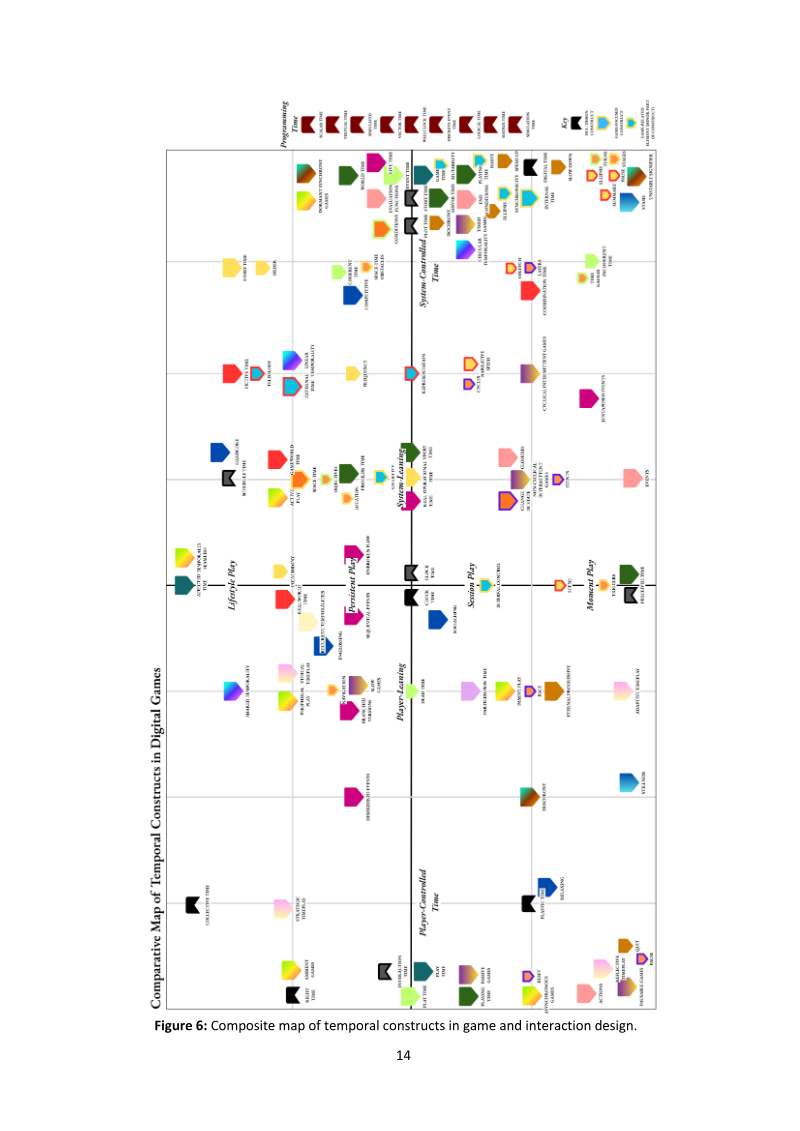
"Time in Digital Games: A Comparative Map of Temporal Constructs" presents a cartographic synthesis of 22 named temporal constructs from digital game studies, spanning 2003 to 2025, rather than a new master theory of game time.
- The report maps 22 named temporal constructs in digital game studies, spanning 2003 to 2025, as a cartographic synthesis rather than a new master theory of game time.
- Constructs are arranged along two axes: temporal control (player-controlled to system-controlled) and temporal scale (moment-level, session, persistent, and lifestyle play), with clock time as a neutral origin point.
- The conceptual landscape is imbalanced: system-controlled constructs, such as the many engineered "X time" labels, are densely represented, while player-organised and affective temporal concepts are sparsely populated.
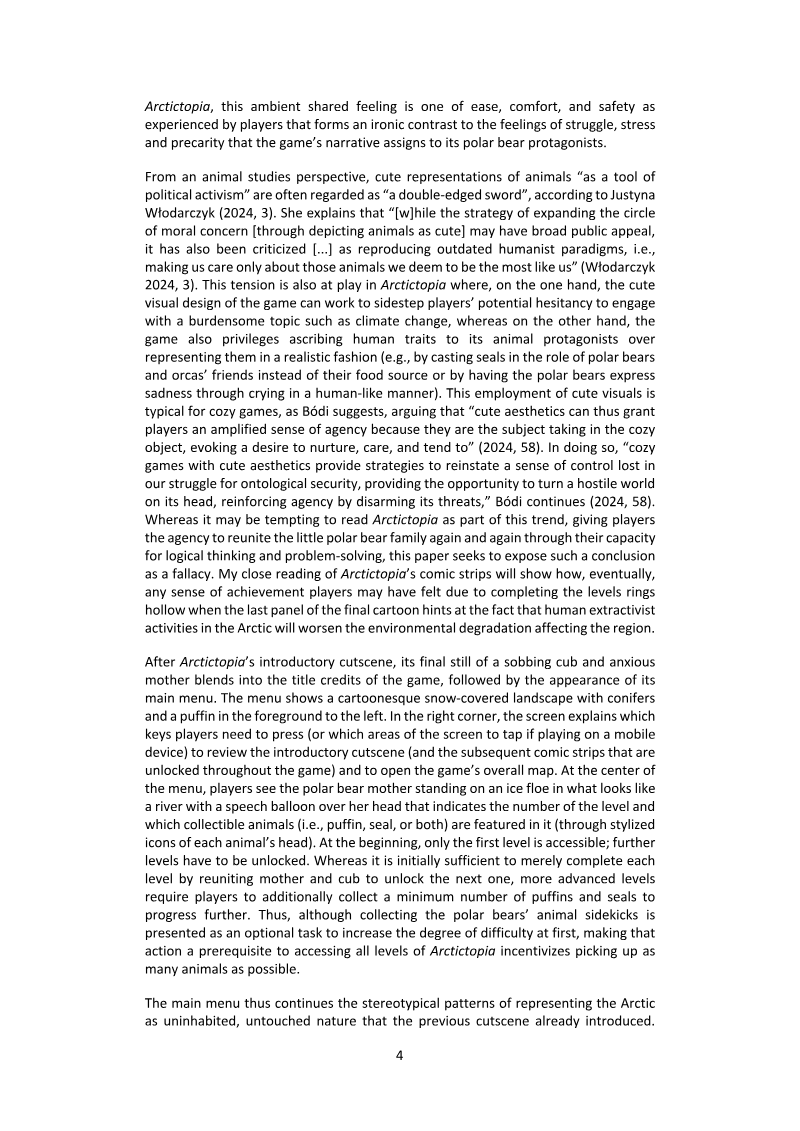
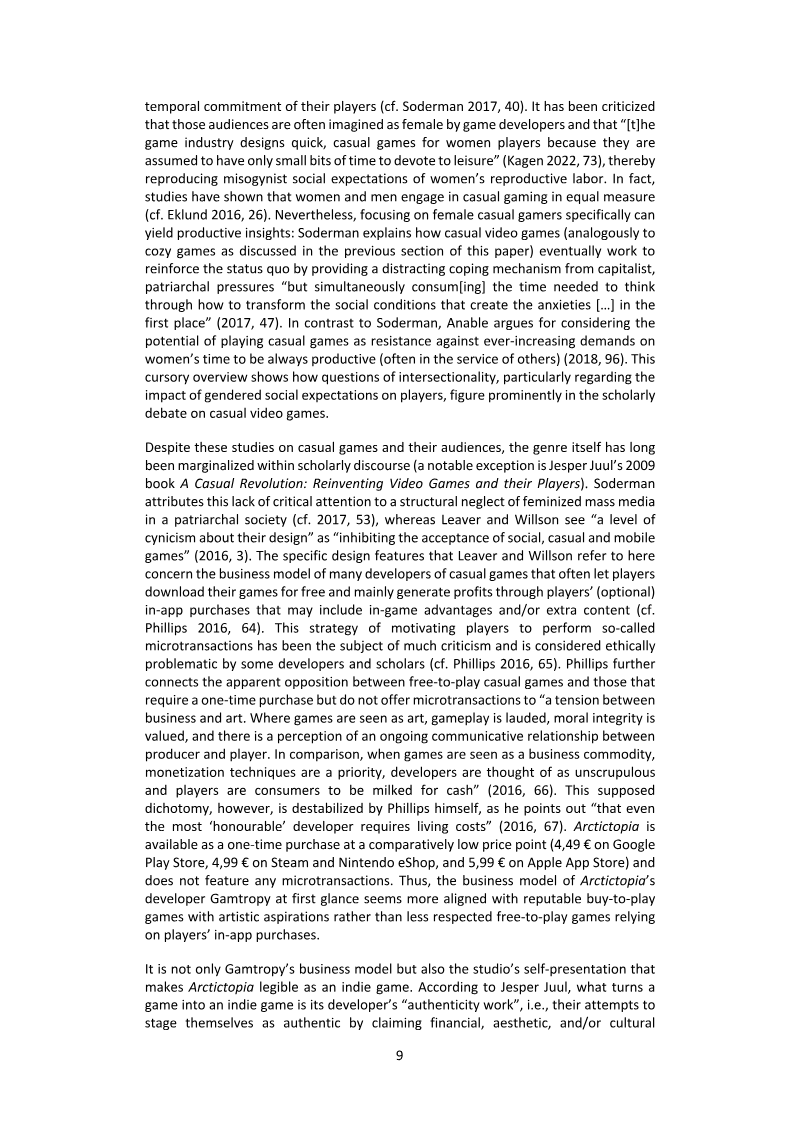
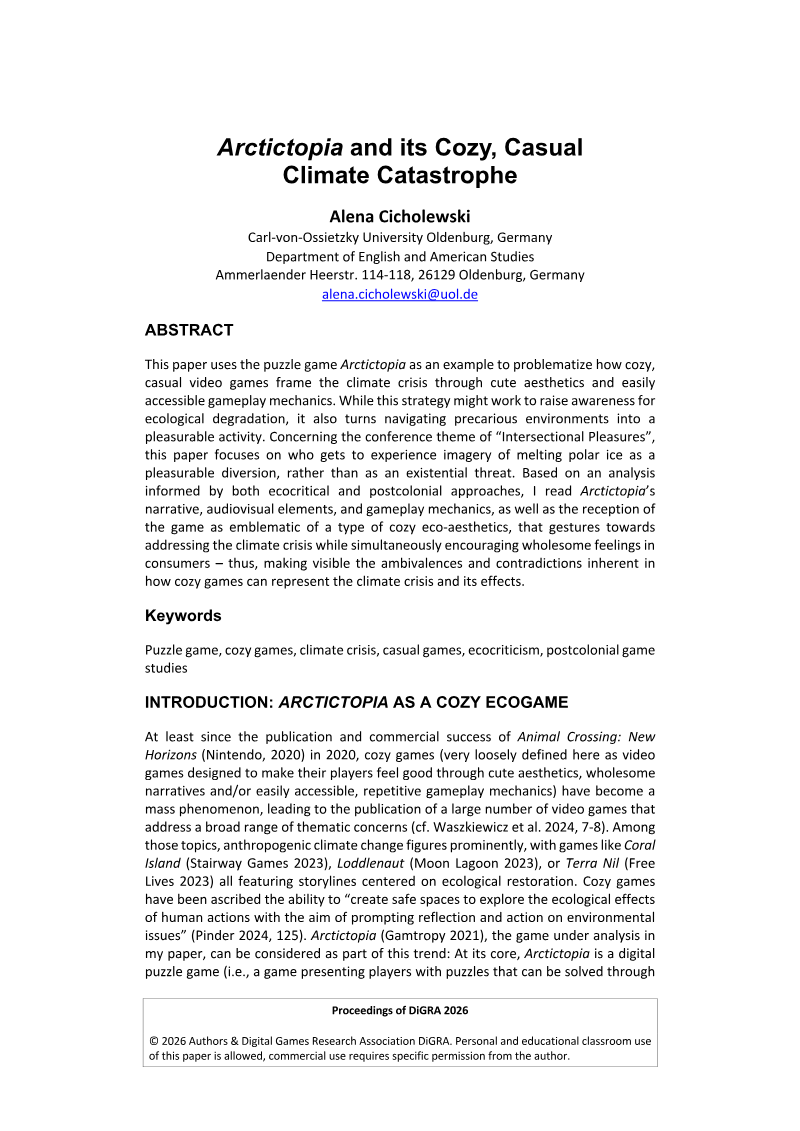
Arctictopia and its Cozy, Casual Climate Catastrophe
"Arctictopia" and Its Cozy, Casual Climate Catastrophe examines how a cozy puzzle game about Arctic ecology uses soft, picture-book aesthetics to frame the climate crisis, and whether that framing makes the threat more approachable or less serious.
- The game's cozy aesthetics, calm soundscape, and accessible mechanics make Arctic climate threats pleasurable and approachable, potentially sidestepping their existential stakes.
- Its collection-based progression (accumulating seals and puffins), ice-melting mechanics, and ability to undo mistakes sit in tension with its environmentalist message, reinforcing individualist and growth-oriented logics.
- Background imagery of ghost nets, tires, and industrial ships critiques extractive industry, but the sole human figure, an Inuit-coded angler, is reduced to passive scenery, raising questions about whose suffering is made visible.
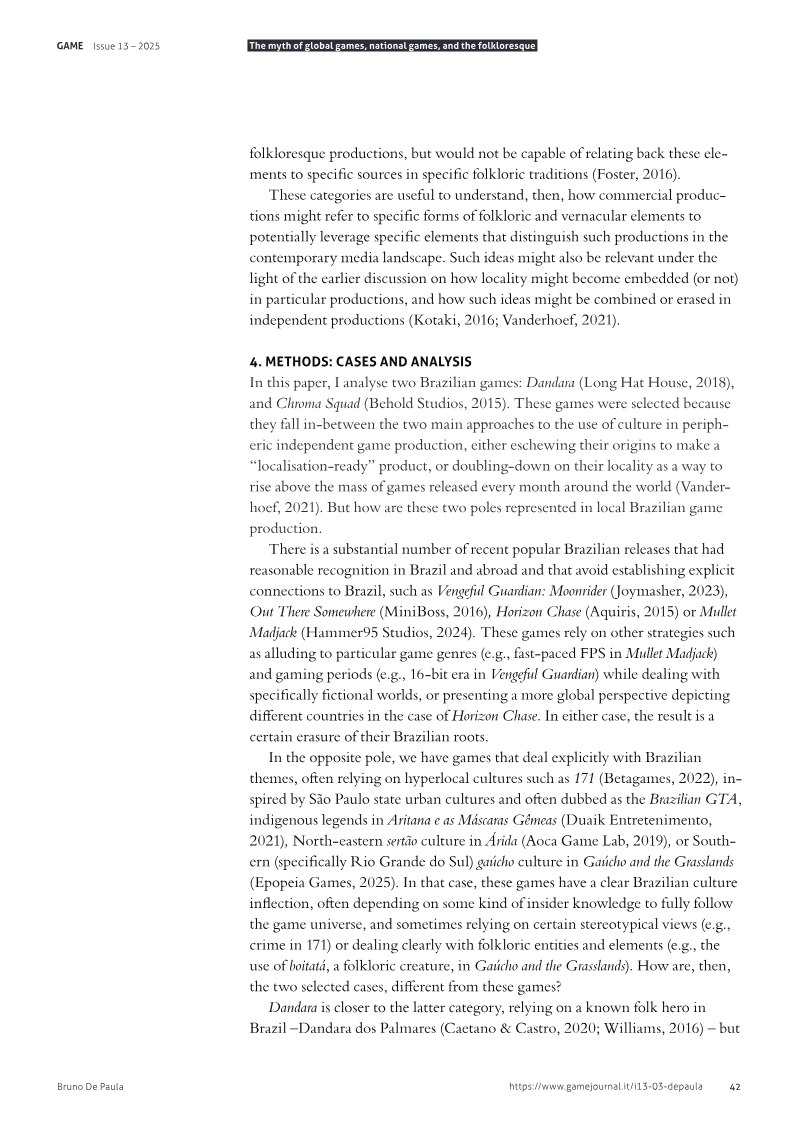
The Myth of Global Games, National Games, and the Folkloresque: Reflections from Brazil
This paper challenges the "global games" myth by arguing that national and regional cultures continue to shape how games are made, marketed, and read.
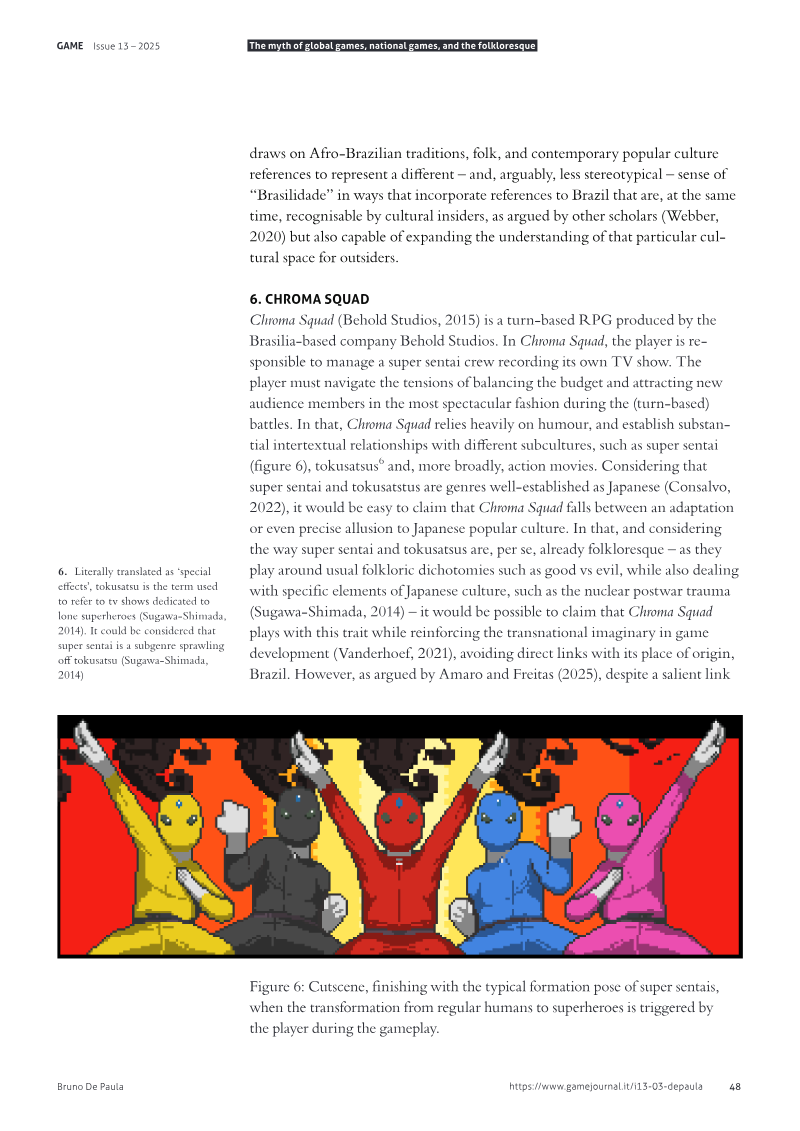
- The 'global games' myth is challenged: national and regional cultures continue to shape how games are made, marketed, and interpreted, with Brazilian indie titles as the case study.
- The author introduces the 'folkloresque,' a term for commercial appropriation of folklore that retains a sense of authenticity, as a lens for analysing these dynamics.
- Brazilian games fall into a typology: some (Vengeful Guardian, Horizon Chase, Mullet Madjack) obscure their Brazilian roots through fictional worlds or genre conventions, while others (171, Árida, Gaúcho and the Grasslands) make Brazilian culture explicit, sometimes relying on stereotype or assuming insider knowledge.



Ritual Elements in Souls Games: Liminality and Communitas in Elden Ring
Elden Ring and the broader Souls series are examined here as hybrid spaces that combine the transformative qualities of ritual with the structures of commercial play.
- The report frames Elden Ring and the Souls series as a "ritual machine" that produces rite-like transformation within a commercial entertainment product, drawing on van Gennep and Turner's theories of liminality.
- Boss arenas are analysed as liminal thresholds where players are temporarily severed from ordinary progression and exposed to risk, while the wider play session is described as a voluntary, market-based liminoid experience.
- Repeated combat cycles, flow states, gestures, and the ghostly presence of other players (understood via Schechner's restored behavior) generate a recurring sense of shared ordeal.
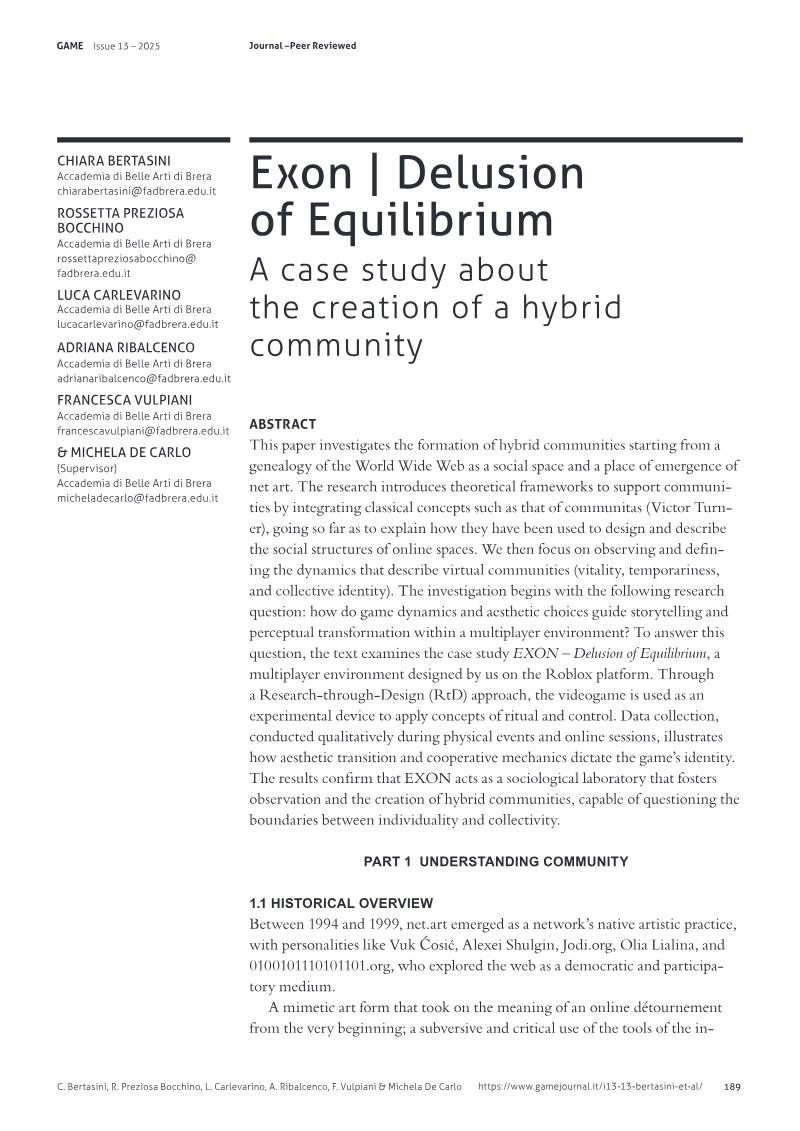
Exon: Delusion of Equilibrium
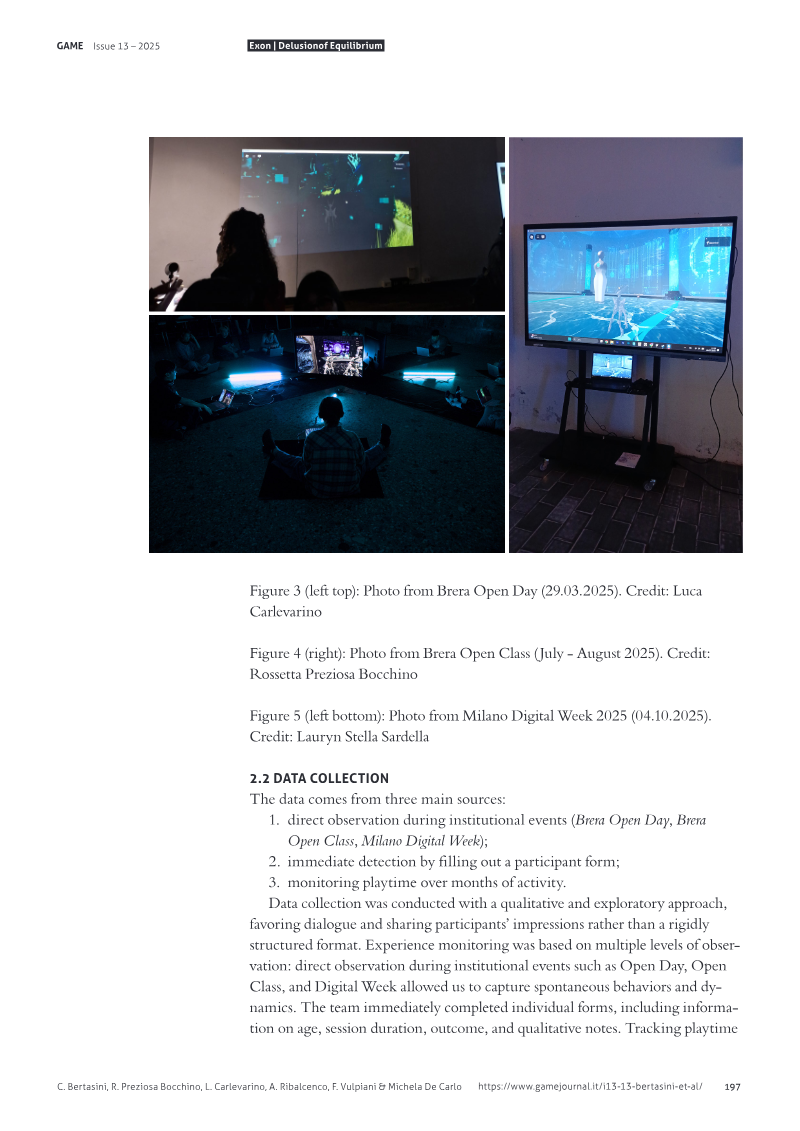
The document presents a Research-through-Design case study of EXON – Delusion of Equilibrium, a cult-themed game built on the Roblox platform and designed to examine the formation of hybrid online-offline communities.
- EXON – Delusion of Equilibrium is a cult-themed Roblox game used as a Research-through-Design instrument to study the formation of hybrid online-offline communities, with themes of communitas, belonging, ritual, and control.
- The empirical core is a single event, Milano Digital Week 2025, where 103 participants played over three hours, with children making up 48% of participants and being the most engaged group.
- Only 37% of sessions reached completion, mainly due to multiplayer constraints and waiting times.
The Role of the Cosmographer
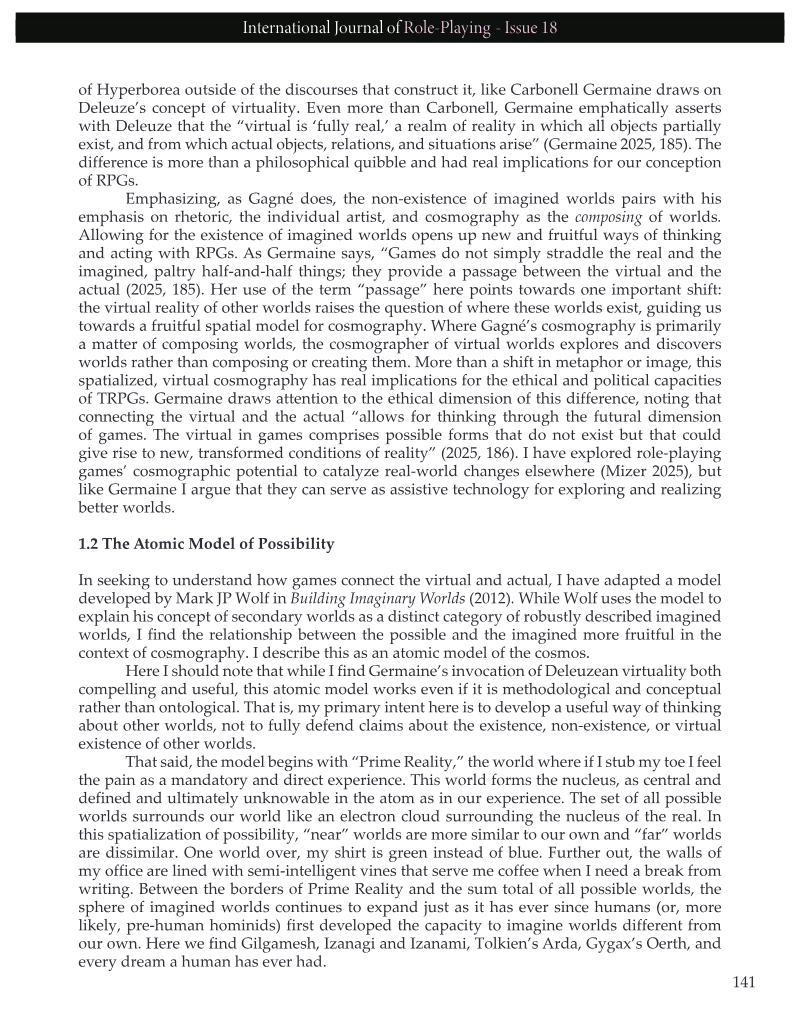
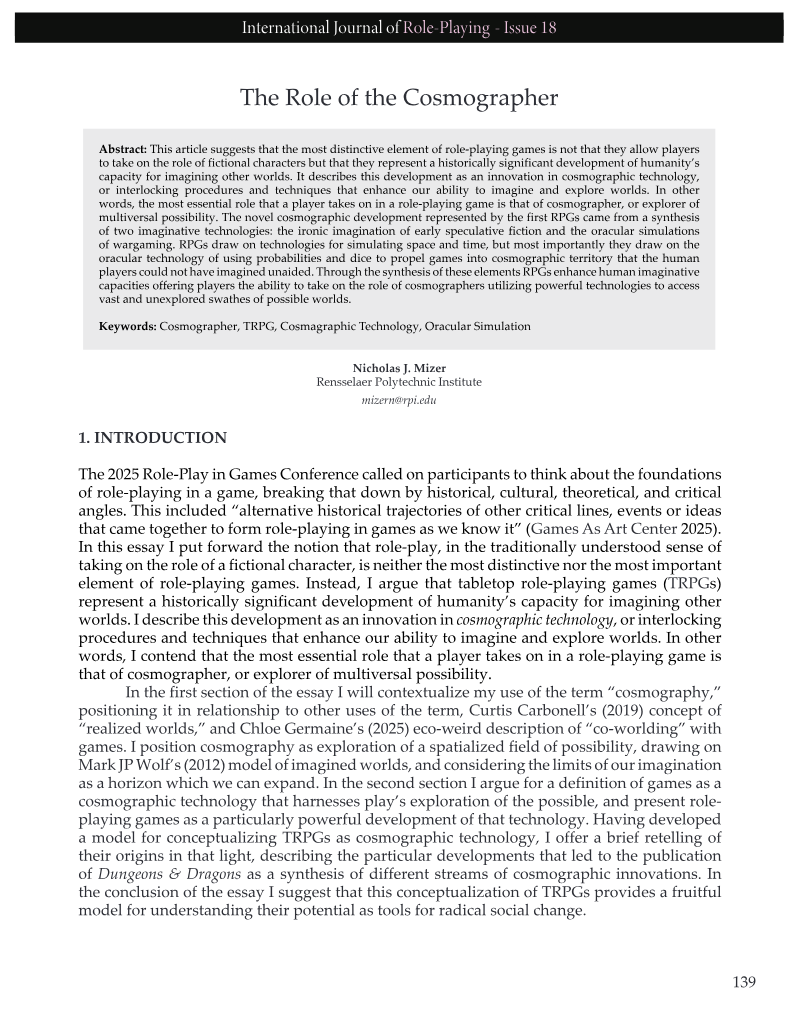
Tabletop role-playing games function as sophisticated cosmographic technologies, serving as collaborative frameworks that extend human capacity to imagine and navigate alternative realities.
- Tabletop role-playing games function as collaborative worldbuilding technologies that allow participants to simulate and navigate alternative realities beyond existing ideological constraints.
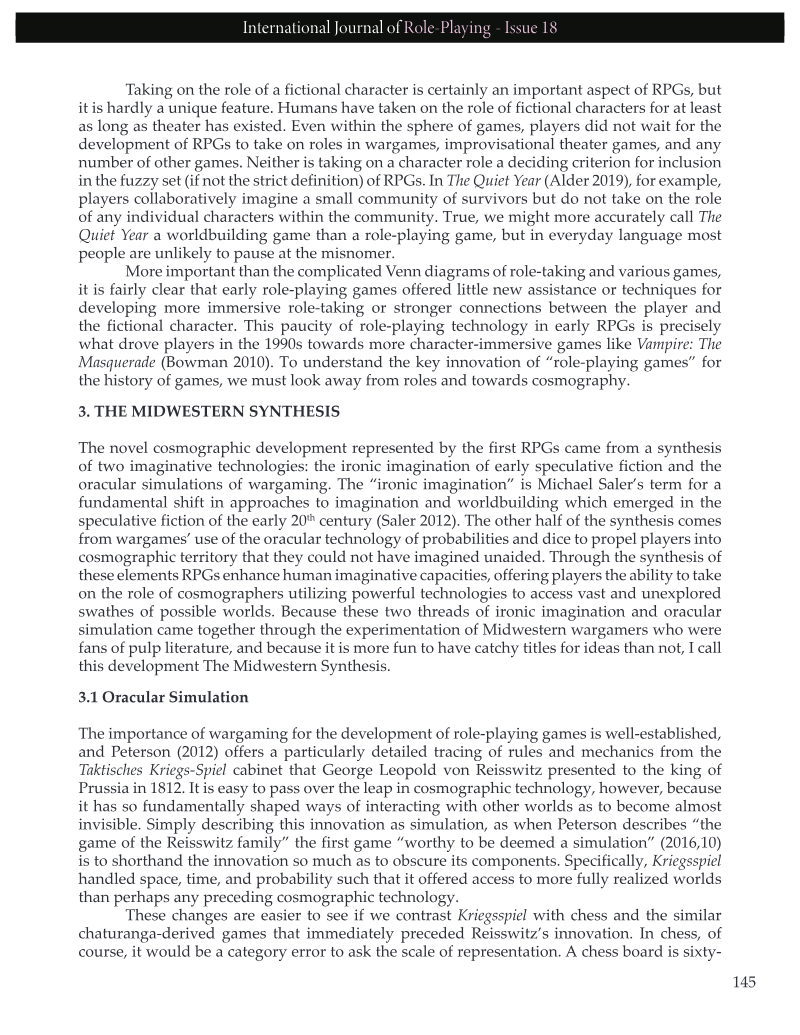
- The medium evolved from the 'Midwestern Synthesis,' a historical convergence that transitioned probability-based wargaming into a structured framework for speculative inquiry.
- Modern role-playing systems prioritize systemic world-construction over individual character performance, acting as a laboratory for testing complex social and environmental possibilities.