Game Development reports and market data
Documents
Learning While Developing a Game: The Case of an Introductory Course on Industrial Engineering and Management
This paper presents a case study of first-year students in the Industrial Engineering and Management (IEM) undergraduate program at the University of Aveiro, Portugal, who designed non-digital educational games as a core assignment in the Introduction to Industrial Engineering and Management course during the 2024/2025 academic…
- A case study of 78 first-year Industrial Engineering and Management students at the University of Aveiro, Portugal (2024/2025) found that designing non-digital educational games as a core assignment was highly successful, with grades ranging from 14 to 19 out of 20.
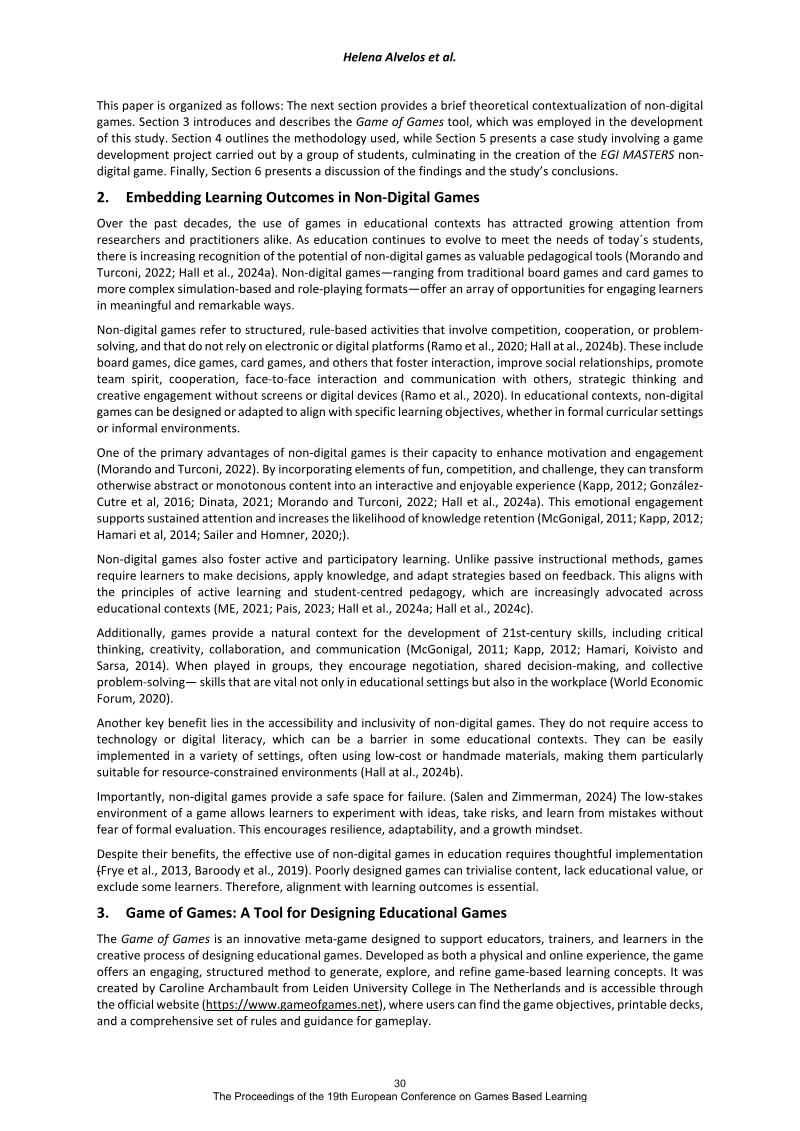
- The assignment marked the first time the course shifted from its traditional Challenge-Based Learning approach to Game-Based Learning, with students working in groups of four or five to create games introducing high school audiences to the IEM program.
- Students reported growing enthusiasm and deeper knowledge of IEM subject areas and the university, while developing written and oral communication skills.
Enhancing Cybersecurity Education Through Multi-Opposing-Role Gameplay and Simulations
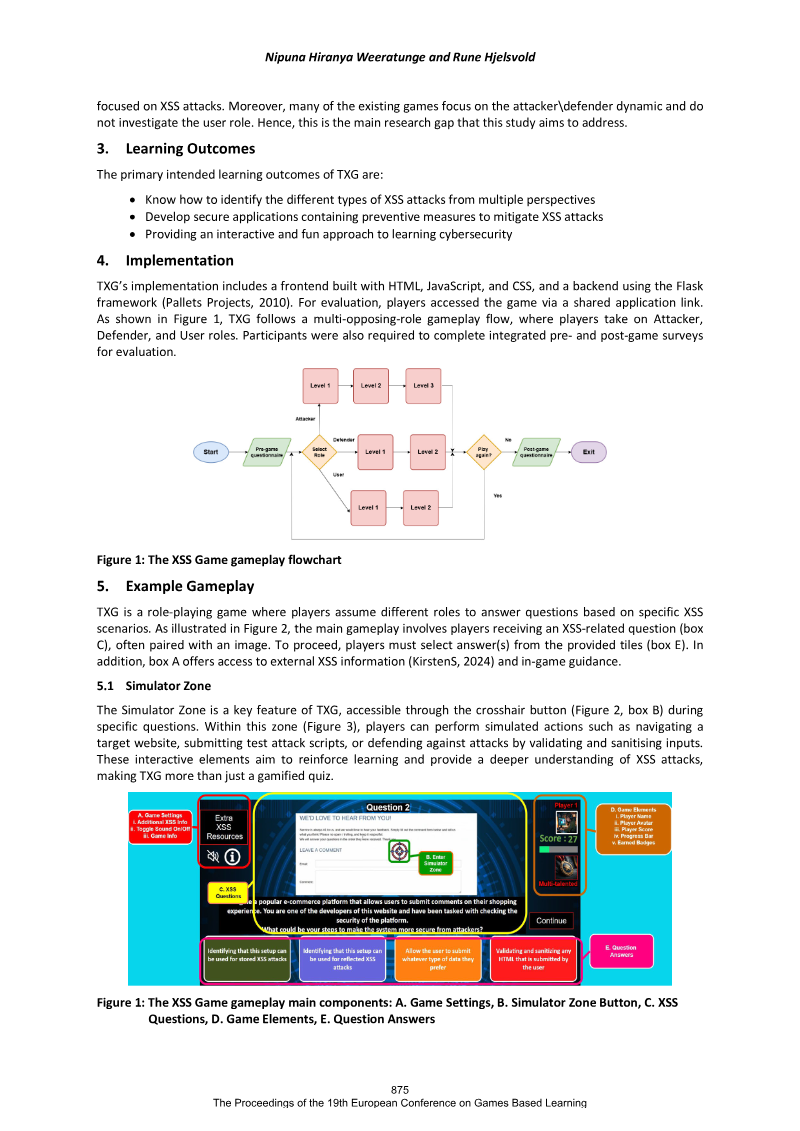
"The XSS Game" (TXG) is a web-based educational game designed to teach Cross-Site Scripting attacks through a multi-opposing-role structure featuring Attacker, Defender, and User perspectives, supplemented by a Simulator Zone for hands-on experimentation.
- The XSS Game (TXG), a web-based game teaching Cross-Site Scripting through Attacker, Defender, and User roles plus a Simulator Zone, produced a statistically significant knowledge gain among 162 second-year computer science students (Wilcoxon Z = 3.40, p = 0.00067, effect size r = 0.52), a moderate effect the authors call practically meaningful.
- Most existing cybersecurity games neglect the user's perspective and rarely combine narrative quizzes with hands-on simulations, a gap TXG was designed to address.
- Roughly 75% of participants expressed positive sentiment toward gaming as a learning medium, with players especially valuing the multi-opposing-role format and immediate feedback.
Enhancing Learning Through VR Game Design in Higher Education
This paper examines whether building virtual reality mini-games can enhance learning and engagement in higher education software engineering courses.
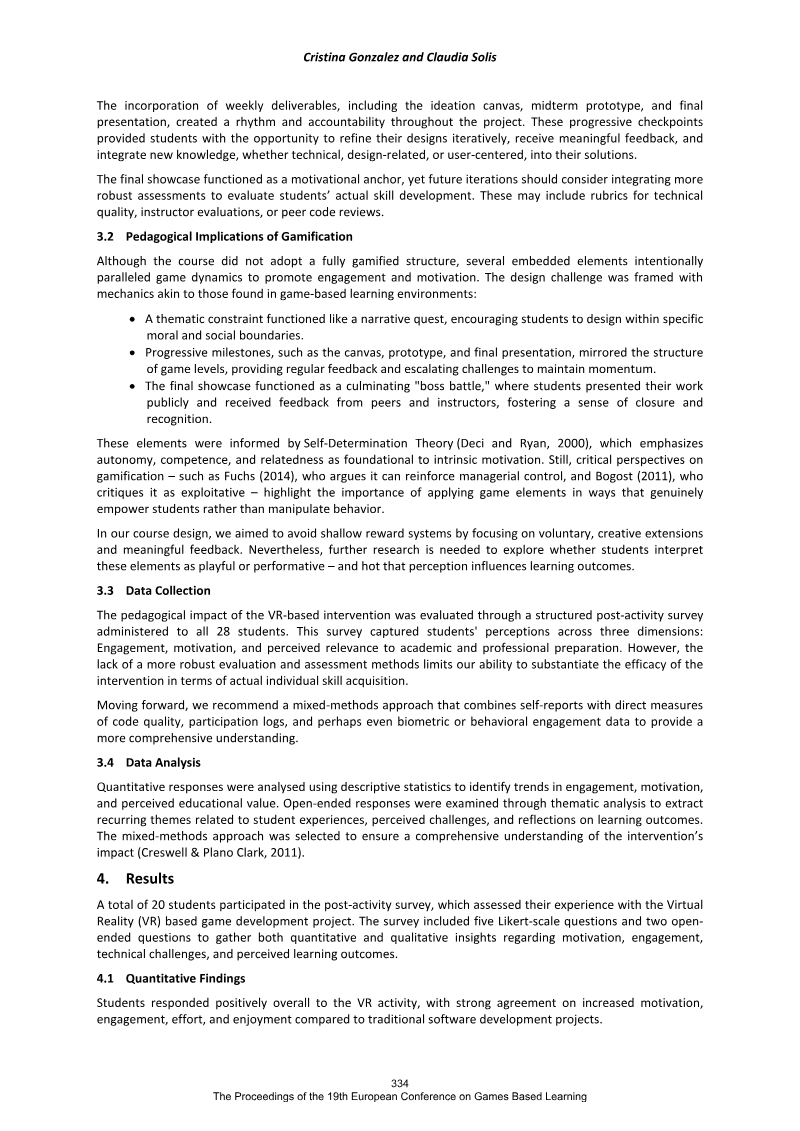
- A two-week VR game development activity was tested with 28 undergraduate software construction students organized into 14 GPA-matched pairs using Meta Quest headsets and Unity.
- About 75 percent of the 20 students who responded to the survey rated motivation, engagement, effort, and enjoyment highly on a five-point Likert scale.
- All 14 pairs produced functioning VR games, each scoring above 90 out of 100.
Teaching the Solar System with a Video Game
"Teaching the Solar System with a Video Game" presents Wentian, a Unity-based educational game designed to teach solar system astronomy by combining scientific accuracy with engaging gameplay grounded in game-based learning theory.
- Wentian is a Unity-based educational game teaching solar system astronomy, built on a 1:10,000 km scale with NASA textures and Kepler's and Newton's laws for orbital motion.
- The authors argue that existing tools (Universe Sandbox, Kerbal Space Program, NASA Eyes on the Solar System) each lack some combination of interactivity, structured objectives, or accessible content that Wentian aims to provide.
- A user study with 13 participants, mostly males aged 20 to 30, found statistically significant positive feedback on all ten questionnaire items under one-sided binomial tests (p < 0.05).
SOL977: Ingenious Revival, a Martian Simulation Game for STEM Engagement and Space Education
The paper presents SOL977: Ingenious Revival, a simulation-based game built in Unity and Blender that places players in the role of a field technician tasked with replacing a damaged rotor blade on NASA's Ingenuity Mars helicopter, a scenario inspired by the rotor damage the vehicle sustained in January 2024.
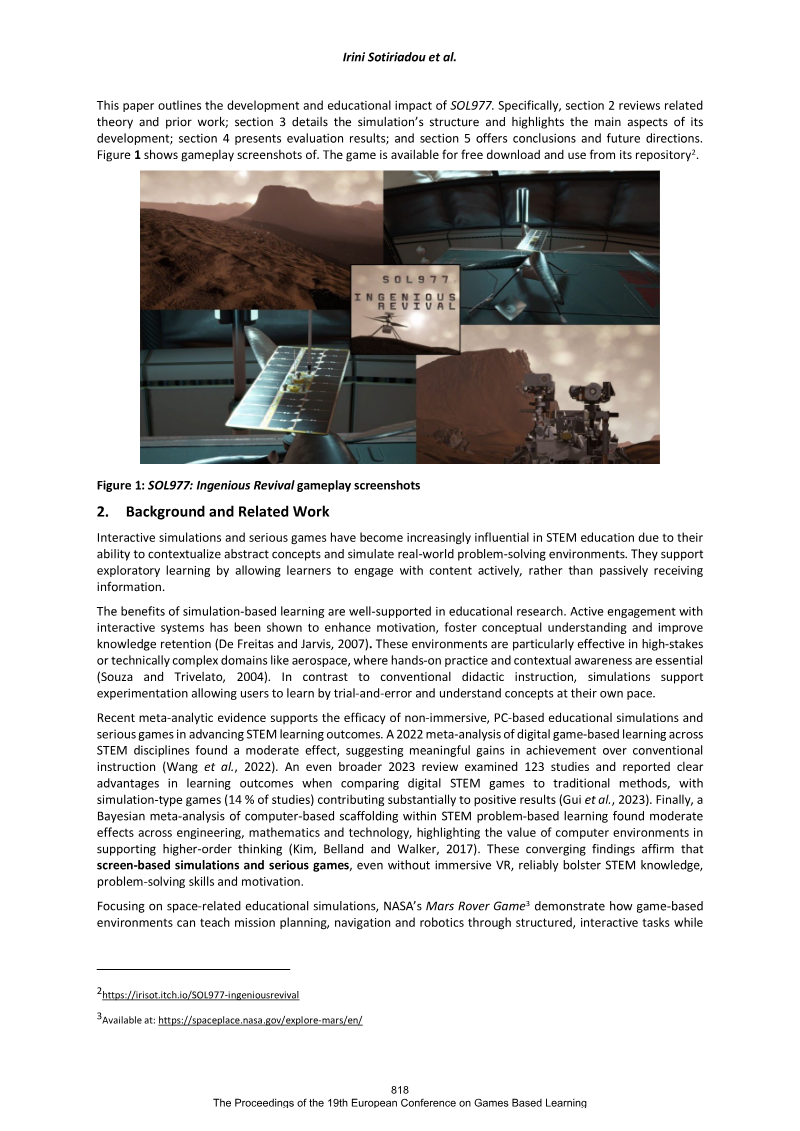
- SOL977: Ingenious Revival is a Unity- and Blender-built simulation in which players act as field technicians replacing a damaged rotor blade on NASA's Ingenuity Mars helicopter, a scenario inspired by the rotor damage the vehicle sustained in January 2024.
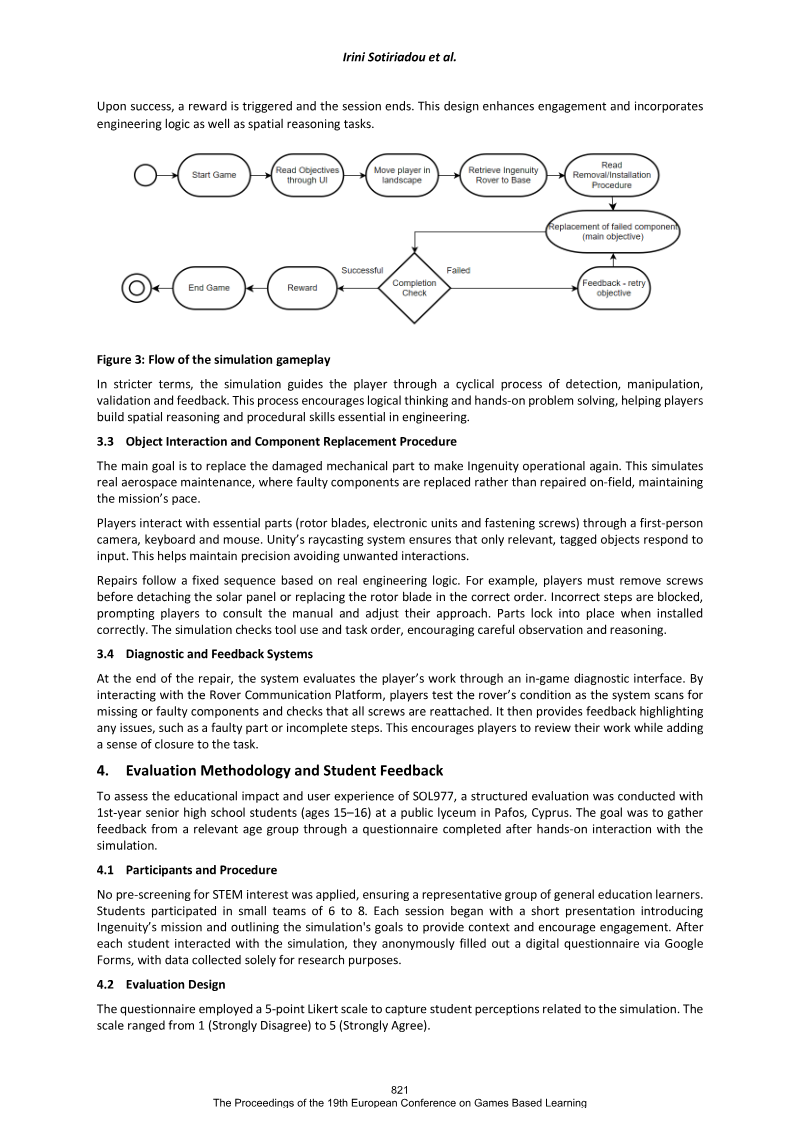
- The game uses high-resolution Digital Terrain Models of Mars and scanned models of Mars-origin meteorites, and requires players to follow authentic repair procedures in a fixed order with correct tools and trial-and-error feedback.
- The design is grounded in situated cognition, cognitive apprenticeship, problem-based learning and experiential learning theory, with the authors arguing that realistic workflows can bridge theoretical STEM knowledge and hands-on practice.
CiteSaga: Lessons Learned in Serious Game Development for Academic Integrity Education
CiteSaga is a serious game designed to teach academic integrity, specifically citation practice, to higher education students.
- CiteSaga is a serious game teaching citation practice and academic integrity to higher education students, developed at North-West University in South Africa from 2023, and designed as a resource-conscious intervention for large, multilingual cohorts with uneven infrastructure and varied digital access.
- The authors frame the project as a response to student disengagement, since learners often see citation as an arbitrary compliance burden rather than a meaningful scholarly practice.
- Key analogue-phase findings: embedding citation tasks directly into gameplay mechanics works, a low-tech format supports equitable access, and structured debriefing is needed so in-game learning transfers to students' academic writing.
Creating the Foundation for a Virtual Game-Based Learning Lab to Stimulate Distance Education
The paper argues for building a virtual game-based learning lab to support distance education, filling a gap where physical campuses have board game collections but online courses lack digital equivalents aligned to academic subjects.
- The paper proposes a virtual game-based learning lab to fill a gap where physical campuses have board game collections but online courses lack digital equivalents aligned to academic subjects.
- Its central requirement is user-friendly access to both commercial-quality games and educational games tailored to course content, with licensing of commercial games and usability identified as the primary concerns.
- The work is framed as the first phases of a design science project (problem explication and requirements definition) and does not involve empirical testing of the lab itself, with conclusions explicitly described as provisional.
Design of a 2D Rhythm-Based Shooting Game for Skill Development
This paper presents Echo, a 2D top-down shooter that integrates rhythm-based mechanics to explore how games can support cognitive skill development, particularly rhythmic precision, hand-eye coordination, and sustained engagement.
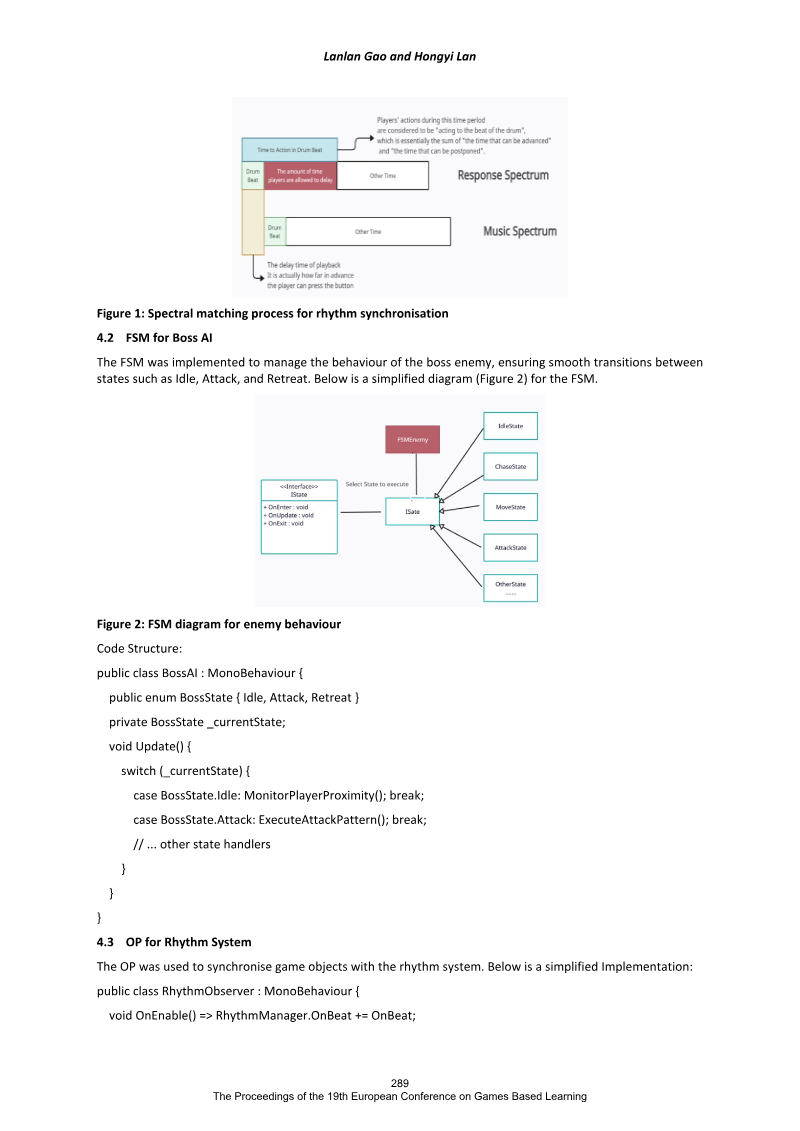
- Echo is a 2D top-down shooter built in Unity with the Kore plugin, using a rhythm-triggered shooting mechanics (RTSM) system that aligns shooting and evasion actions with musical beats.
- Players who synchronised their actions with beats achieved roughly 23% higher timing accuracy than non-rhythmic conditions, with error rates falling about 22% across five sessions.
- Beat-matching consistency correlated with session duration at r=0.74, and retry rates declined in rhythm-synchronised groups.

Survivor's Guilt in the Game Industry | Games ReCAP
The global game industry is currently undergoing a significant structural shakeout characterized by mass layoffs, with over 35,000 jobs lost since 2022 and an estimated 100,000 years of collective professional experience projected to exit the sector by the end of 2025.
- The game industry has shed over 35,000 jobs since 2022, with estimates suggesting a permanent loss of 100,000 years of collective professional experience by the end of 2025.
- Remaining developers are experiencing significant morale and productivity issues, with GDC 2025 data indicating a 20% drop in productivity and 10% of the workforce actively planning to exit the industry.
- AAA development costs have surged by 200% in recent years, while investor confidence has waned following failed investments in the metaverse and NFT sectors, leading to a 15% dip in the console and PC segments through 2025.

Crunching to Death in Games | Games ReCaP
The game industry is currently experiencing a severe crisis of workplace culture characterized by intense, mandatory overtime and chronic burnout.
- The game industry is experiencing a surge in mandatory overtime, with 60% of developers reporting mandatory crunch, rising to 70% at AAA studios compared to 25% at indie studios.
- Chronic overwork and job insecurity are reaching critical levels, exemplified by the death of a 35-year-old Microsoft engineer in August 2025 following reports of extreme stress and 2 a.m. work hours.
- Industry-wide burnout currently affects 45% of developers, with standard crunch periods defined as 65 to 80-hour work weeks over several months.
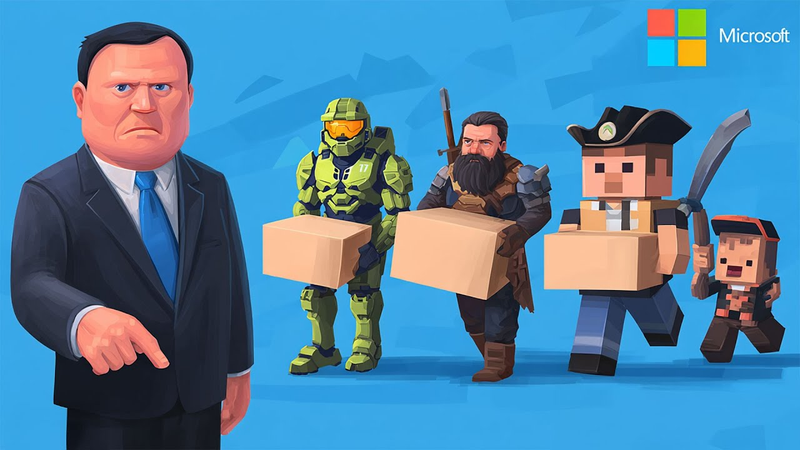
Crunch Deaths, Mass Layoffs, Political Firings, and Global Shifts | Games ReCap | 367
The global gaming industry is currently navigating a period of profound instability characterized by mass layoffs, systemic burnout, and a fundamental shift in operational strategy.
- The game industry is experiencing a massive talent drain, with over 35,000 jobs lost since 2022 and a significant portion of experienced, 'old-school' game designers permanently exiting the sector.
- Mandatory overtime remains a systemic issue, with GDC 2025 data indicating that 60% of developers face mandatory crunch, a figure that rises to 70% at AAA studios compared to 25% at indie studios.
- The tragic death of a 35-year-old Microsoft engineer, linked to chronic stress and overwork on Azure projects, has intensified industry-wide scrutiny regarding the health risks of extreme crunch culture.
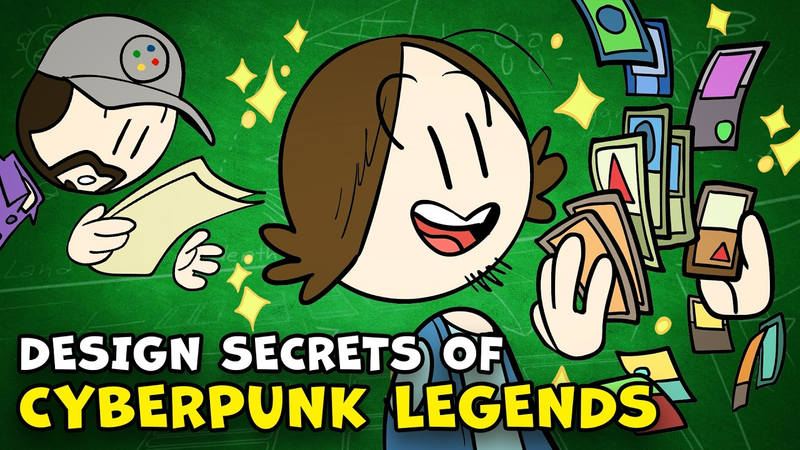
Tips for Making a Game You'll ACTUALLY Finish | Extra Credits Gaming
The design process for creating a tabletop game from scratch is best approached by leveraging constraints as creative fuel rather than viewing them as limitations.
- Start the design process by defining your constraints, such as budget, skill set, and available time, to ensure the project remains manageable and achievable.
- Establish clear design goals early—such as setup time, learning curve, and player experience—to serve as a benchmark for evaluating every future design decision.
- Identify market gaps by comparing your personal strengths against existing titles to find a niche, such as the lack of co-op, narrative-driven card games.