Game Development
Documents
Capital Markets Event 2025: Coffee Stain Group
Capital Markets Event 2025 showcases the Coffee Stain Group’s strategy of building a portfolio around small, autonomous teams that prioritize gameplay quality and community engagement. Ninety percent of net sales derive from a handful of flagship titles—most notably Goat Simulator, Deep Rock Galactic and Satisfactory—which consistently achieve high review scores (above 96 %) and generate lifetime sales up to SEK 2 bn. The company’s partnership model, publishing and investing in niche‑focused games, sustains long‑term value through continuous content updates and a symbiotic developer‑player relationship.
The global gaming market is projected to grow at 3 % CAGR across all platforms, driven by rising consumer spend and the expansion of Steam, mobile, Game Pass and PlayStation Plus. Despite saturation and increased competition for player attention, Coffee Stain maintains a strong presence; its titles enjoy high review counts (over 500 k for Goat Simulator) and retain players through regular updates, platform expansions and community‑driven development. Innovation, creative gameplay and long‑term support are core to the firm’s approach.
Strategic collaborations reinforce this model. The partnership with Tuxedo Labs leverages the proprietary Teardown physics engine, producing a highly engaged community (10 000+ mods, 20 major updates) and peak concurrent users of 60 k for Deep Rock Galactic seasons. The studio’s headcount grew from six to 47 FTEs over five years, illustrating the scalability of open development and a “make happy decisions” culture that drives both critical acclaim (e.g., 9.5/10 reviews) and commercial success.
Coffee Stain’s Roblox title, Welcome to Bloxburg, exemplifies a successful free‑to‑play transition. With 791 k daily active users and SEK 1.35 bn in lifetime net sales, the monetization mix of currency purchases, optional unlocks and a premium subscription maintains a non‑pay‑to‑win stance while rebuilding player trust. The company’s lean cost base and strong cash generation are amplified by launch‑driven sales spikes from new content releases and strategic stakes such as its 30 % share in Iron Gate’s Valheim publishing.
Financially, the group reports a net‑sales CAGR of 34 % to SEK 1.2 bn and a cash EBIT margin of 44 %. Cash reserves reach SEK 472 m in 2025, with no external debt, providing flexibility for capital allocation and potential M&A. The lean, autonomous team model underpins low overheads, high cash conversion (≈120 %) and a focus on developing existing IPs while selectively pursuing new opportunities across platforms and partnerships.
- Coffee Stain Group maintains strong financial health with a 34% net-sales CAGR to SEK 1.2 bn, a 44% cash EBIT margin, and 120% cash conversion.
- The company holds SEK 472 m in cash reserves with zero external debt, providing significant flexibility for future M&A and capital allocation.
- Ninety percent of net sales are generated by a core portfolio of flagship titles—Goat Simulator, Deep Rock Galactic, and Satisfactory—which consistently maintain review scores above 96%.
- The Roblox title Welcome to Bloxburg has achieved 791,000 daily active users and SEK 1.35 bn in lifetime net sales following its transition to a free-to-play model.
- Strategic partnerships and investments, such as a 30% stake in Valheim publisher Iron Gate and the collaboration with Tuxedo Labs, serve as key drivers for long-term value and IP expansion.
Playing for the Planet: Untangling the Carbon Complexities of the Video Gaming Industry
The analysis demonstrates that the video‑gaming sector remains fragmented in its approach to carbon accounting, with only a minority of companies—12 out of 222 surveyed—committed to science‑based targets. This shortfall stems largely from uncertainty around measuring Scope 3 emissions, particularly in categories such as purchased goods and product use. The report underscores a growing industry momentum: the Playing for the Planet Alliance now includes 42 members, and initiatives like the Green Games Guide and Ubisoft’s Climate School illustrate a shift toward embedding climate action within both operations and game content. Concrete progress is evident, for example, the Games Consoles Voluntary Agreement’s 54 TWh energy savings and the documented dominance of Scope 3 categories 1 (purchased goods) and 11 (use of sold products) in studios’ footprints.
Carbon intensity across the supply chain varies markedly by hardware, display technology, and regional electricity mix. Current‑generation consoles draw 150–200 W during gameplay, while PCs can reach 100–300 W; mobile devices consume only a few watts. A high‑end 4K TV can match console power when running HDR, and the carbon intensity of 200 Wh ranges from ≈13 gCO₂e in France to ≈81 gCO₂e in the United States. These disparities highlight opportunities for reducing emissions through hardware efficiency, extended device lifetimes, and the adoption of renewable electricity or green tariffs.
The report calls for consistent, industry‑aligned reporting frameworks—particularly the GHG Protocol Scope 3 categories—and greater granularity by business unit or product. It recommends iterative, data‑quality‑driven methods for estimating Category 1 and 2 emissions, prioritising primary supplier data for high‑spend items while applying spend‑based factors elsewhere. For Category 7 (employee commuting) and Category 11 (use‑phase emissions), detailed calculation examples illustrate the need to account for lifetime usage, regional grid intensity, and potential double‑counting. Real‑time accounting of use‑phase emissions is identified as a critical research gap, with cloud and CDN providers’ inconsistent reporting underscoring the need for standardized data.
Overall, the sector is moving toward greater transparency and actionable climate messaging, yet significant gaps remain in measurement, reporting consistency, and the integration of emerging technologies such as cloud gaming and AI. Addressing these challenges will be essential for credible net‑zero pathways across the global video‑gaming industry.
- Only 12 out of 222 surveyed gaming companies have committed to science-based carbon reduction targets, highlighting a significant industry-wide gap in formal climate accountability.
- Scope 3 emissions—specifically purchased goods (Category 1) and the use of sold products (Category 11)—represent the dominant share of the industry's total carbon footprint.
- Energy consumption during gameplay varies significantly by hardware, with current-generation consoles drawing 150–200W and PCs reaching up to 300W, compared to only a few watts for mobile devices.
- The carbon intensity of gaming is highly dependent on regional electricity grids, with 200Wh of consumption resulting in approximately 13gCO2e in France versus 81gCO2e in the United States.
- The Games Consoles Voluntary Agreement has successfully achieved 54 TWh in energy savings, demonstrating the efficacy of hardware efficiency standards.
The Rise and Reset of Sweden's $19B Gaming Capital Machine
The analysis demonstrates that Sweden’s gaming sector has evolved into a $19 billion capital ecosystem, with 1,100 companies and 202 firms engaging in tracked transactions since 2014. Sweden contributes roughly 20 % of Steam’s projected 2025 gross revenue, and its developers produced five of the platform’s global top‑10 bestsellers in 2024–25. Capital flows have shifted from early‑stage seed rounds to late‑stage growth and acquisition deals, reflecting a maturation of the pipeline. Private investment rebounded in 2024 after a pullback; late‑stage rounds now dominate, with Aonic’s $157 million growth round and Arrowhead’s $80 million investment illustrating investor preference for studios with proven commercial traction. Early‑stage deal counts have normalized from 2021’s peak, indicating a steady but active pipeline.
M&A activity peaked in 2021–22, with ESL’s $1.05 billion sale to Savvy marking the cycle’s apex; subsequent deals have become more selective. Three transactions—King ($5.9 billion), Mojang ($2.5 billion), and ESL ($1.05 billion)—account for 93 % of total M&A value, underscoring the premium paid by global acquirers for Sweden’s IP and engineering talent. Public market activity has shifted from equity‑fueled growth to defensive debt financing; Embracer’s $4.4 billion raised through fixed income and PIPE in 2020–22 exemplifies this trend. Capital concentration is high, with the top ten private rounds comprising over $495 million of an $811 million total.
The data, sourced from InvestGame and market‑cap records through December 2025, cover Sweden’s entire gaming industry—mobile, PC & console, VR/AR, esports, and platforms—from 2014 to the present. Methodology includes tracking VC rounds, public offerings, PIPEs, and M&A transactions across all segments. The findings illustrate a resilient ecosystem that has transitioned from early‑stage bootstrapping to mature, high‑value capital flows driven by proven studios and strategic consolidation.
- Sweden’s gaming sector has matured into a $19 billion ecosystem comprising 1,100 companies, with Swedish developers producing five of Steam’s global top-10 bestsellers in 2024–25.
- Swedish studios contribute approximately 20% of Steam’s projected 2025 gross revenue, cementing the country's status as a dominant global gaming hub.
- M&A activity is highly concentrated, with three major deals—King ($5.9 billion), Mojang ($2.5 billion), and ESL ($1.05 billion)—accounting for 93% of the total transaction value.
- Investment trends have shifted toward late-stage growth, evidenced by significant 2024 capital injections such as Aonic’s $157 million round and Arrowhead’s $80 million investment.
- Capital concentration remains high, as the top ten private funding rounds account for $495 million of the $811 million total tracked investment.

What Good Are AI NPCs?: Lessons from a Large-scale Player Study
The study demonstrates that generative AI‑driven non‑player characters can deliver deeply engaging, emotionally resonant gameplay. In a 122‑hour experiment with 68 participants, the “Dead Meat” demo achieved high immersion scores—97 % UES reward and 94 % focused attention—while keeping mental demand low (NASA‑TLX scores of 64.7 for demand and 52.7 for performance). Qualitative interviews consistently cited the NPCs’ human‑like dialogue and narrative depth as key contributors to player enjoyment.
Quantitative data confirm widespread satisfaction: 96 % of players rated overall enjoyment as high, and 90 % praised the creative freedom afforded by the open‑ended design. Subscale analysis of the GUESS instrument revealed that 60 % achieved a top score for Creative Freedom, 65 % for Personal Gratification, and 80 % for Play Engrossment. Thematic coding identified freedom of expression, challenge‑driven motivation, and immersive conversation as primary drivers of satisfaction, indicating that the game successfully balances agency with sufficient guidance.
Player behavior analysis uncovered seven distinct strategic approaches—such as “Good Cop/Bad Cop” interrogation, “Rule Bender End Justifies the Means,” and “Smart Arse” manipulation—often combined within a single session. Participants responded equally to voiced and text‑based NPCs, and the 20‑minute session length encouraged replayability through role‑playing different characters. Although the brief duration limited long‑term insight, emergent strategies were viewed as a feature rather than a flaw. Future research will explore how authorial adjustments influence player responses across demographic groups, reinforcing the potential of AI NPCs to enrich narrative gameplay on a broad scale.
- Generative AI NPCs drive high player engagement, with 97% of participants reporting high immersion and 96% rating their overall enjoyment as high.
- The integration of AI NPCs maintains a balance between agency and guidance, as evidenced by 80% of players achieving top scores for play engrossment and 90% praising the creative freedom of the open-ended design.
- Cognitive load remains manageable during AI-driven interactions, with participants reporting NASA-TLX mental demand scores of 64.7 and performance scores of 52.7.
- Players adopt diverse, emergent interaction strategies, including interrogation, manipulation, and rule-bending, which suggests that AI NPCs support complex, role-playing-heavy gameplay.
- Player satisfaction is consistent across communication formats, as participants responded equally well to both voiced and text-based AI NPC interactions.
The 2026 State of Web Gaming Report: A Study of Developer and Gamer Perceptions
The study demonstrates that web gaming has evolved from a niche, low‑quality outlet into a central discovery and revenue engine for the industry. Across 2,000 gamers and 400 developers surveyed in 2026, data reveal that 62 % of players discover new titles via the web and 53 % spend more than $50 monthly on games, underscoring a highly engaged, high‑spending audience. Ninety percent of players find games online, yet only 53 % of studios plan to port mobile titles to browsers within a year, highlighting a perception gap between consumer enthusiasm and developer adoption.
Web games thrive in an attention‑saturated media environment because they are short, low‑friction, and can be updated instantly to capture cultural moments. More than half of players listen to music or watch shows while gaming, and 38 % use social media simultaneously, positioning web games as a complementary entertainment layer. Developers cite discoverability (46 %) and gateway potential to other platforms (44 %) as key strengths, while rapid iteration and zero‑install access drive engagement and revenue. Monetisation maturity remains a barrier, yet the medium’s ability to reach players at the top of the purchase funnel is clear.
The data also show that web gaming no longer represents a low‑quality channel; 92 % of players rate HTML5 titles as high quality, and 37 % play multiple times a day. Web platforms drive discovery for 62 % of players, and high‑spending consumers are increasingly found online. Consequently, developers who omit web distribution risk missing a growing, engaged, and monetisable audience that now sits at the forefront of the purchase funnel.
- Web gaming is a significant discovery channel: 62% of web gamers have downloaded or purchased a game after discovering it on the web, and 53% of developers see it as a means to reach new players.
- Web gamers are highly engaged and valuable: 37% play multiple times per day, 86% play at least a few times a week, and 53% spend over $50 on gaming purchases monthly.
- Developers are increasingly embracing web gaming, with 27% planning to port mobile games to browsers in the next 12 months, and 56% agreeing it's a growing channel.
- There's a disconnect between some developer perceptions and reality: 32% of developers believe web gaming is a 'low-quality channel' despite 92% of consumers rating HTML5 web games as 'quite' or 'very' high quality.
- Web gaming offers low-friction access and high convenience, with 71% of respondents reporting stable or increasing web gaming time relative to social media, and 58% playing because games are free.

AI in MTG: Moving Beyond Theory
The document argues that artificial intelligence has become a strategic asset in mobile game development, transforming every phase of the lifecycle from ideation to live operations. It claims that AI enables teams to prototype, test, and launch content at a fraction of the time previously required, citing examples such as concept‑art generation in days instead of months and single‑person prototype teams that reduce sunk costs. The thesis emphasizes that the combination of trillions of player data points, world‑class creative teams, evergreen intellectual property, and AI as a workflow enabler creates a competitive moat that is difficult to scale for rivals.
Key findings include a 99 % cost reduction in marketing asset creation, an 80 % time saving on influencer spotlights, and a 75 % reduction in analyst turnaround times when querying data through AI agents. The document reports that five new games launched in 2026 adopted an “AI‑first” approach, allowing rapid iteration and simultaneous development of specialized content. It also highlights that AI agents can analyze A/B tests, suggest optimizations, and generate localized UGC‑style assets to lower CPI and improve player engagement.
The scope covers the global mobile gaming market, focusing on mid‑core titles with large player bases. Methodology is implied through internal tooling: 50+ AI platforms (e.g., Claude, Cursor, ComfyUI) and BigQuery‑based agents that process terabytes of data daily. The analysis suggests that AI integration not only accelerates production but also democratizes data insights, freeing analysts to tackle higher‑level strategic questions.
- Adopting an 'AI-first' development approach enabled the launch of five new mobile games in 2026, facilitating rapid iteration and simultaneous production of specialized content.
- AI integration has achieved significant operational efficiencies, including a 99% reduction in marketing asset costs and an 80% time saving on influencer spotlight production.
- Data analysis turnaround times have been reduced by 75% by utilizing AI agents to query large-scale datasets, allowing analysts to focus on high-level strategy.
- AI tools, including Claude, Cursor, and ComfyUI, have transformed production timelines, enabling concept art generation in days rather than months.
- The combination of AI-driven workflows, proprietary player data, and evergreen intellectual property creates a significant competitive moat in the mid-core mobile gaming market.
CESA Game Industry Report 2025: Launch Seminar Report
The CESA Game Industry Report 2025 Launch Seminar, held in Tokyo on February 20, 2026, served as a platform to analyze the evolving landscape of the Japanese gaming sector. The event introduced the updated 2025 industry report, which features expanded data sets and enhanced international market research to better support the global expansion of Japanese firms. The seminar aimed to address industry needs for technical knowledge sharing, talent development, and cross-sector networking among corporate and academic stakeholders.
Key findings highlight a significant shift toward the integration of generative AI, with approximately half of domestic game companies now utilizing these tools within their development pipelines. While internal production workflows show high adoption rates, industry experts noted a more cautious approach regarding AI-generated content visible to end-users. Legal discussions emphasized the importance of navigating copyright frameworks, specifically distinguishing between AI learning and generation phases, while balancing innovation with intellectual property risks.
Government representatives from the Ministry of Economy, Trade and Industry and the Agency for Cultural Affairs outlined strategic support for the content industry, targeting 20 trillion yen in overseas sales by 2033. Policy initiatives focus on multi-year funding, tax incentives, and robust talent development programs to ensure long-term competitiveness. Furthermore, legal experts underscored the increasing complexity of global regulatory environments, noting that Japanese companies must proactively manage diverse international requirements regarding data privacy, monetization, and rating systems. By synthesizing perspectives from government, legal, and development sectors, the seminar emphasized that strategic investment and regulatory compliance are essential for the sustainable growth of Japan’s gaming industry in a globalized market.
- The Japanese government has set a strategic target to reach 20 trillion yen in overseas content industry sales by 2033.
- Approximately 50% of domestic game companies have integrated generative AI into their internal development pipelines.
- Industry adoption of generative AI remains bifurcated, with high usage in production workflows but a cautious, risk-averse approach toward AI-generated content delivered to end-users.
- Legal frameworks are currently prioritizing the distinction between AI learning and generation phases to mitigate intellectual property risks while fostering innovation.
- Government policy initiatives to support industry competitiveness include multi-year funding, tax incentives, and dedicated talent development programs.
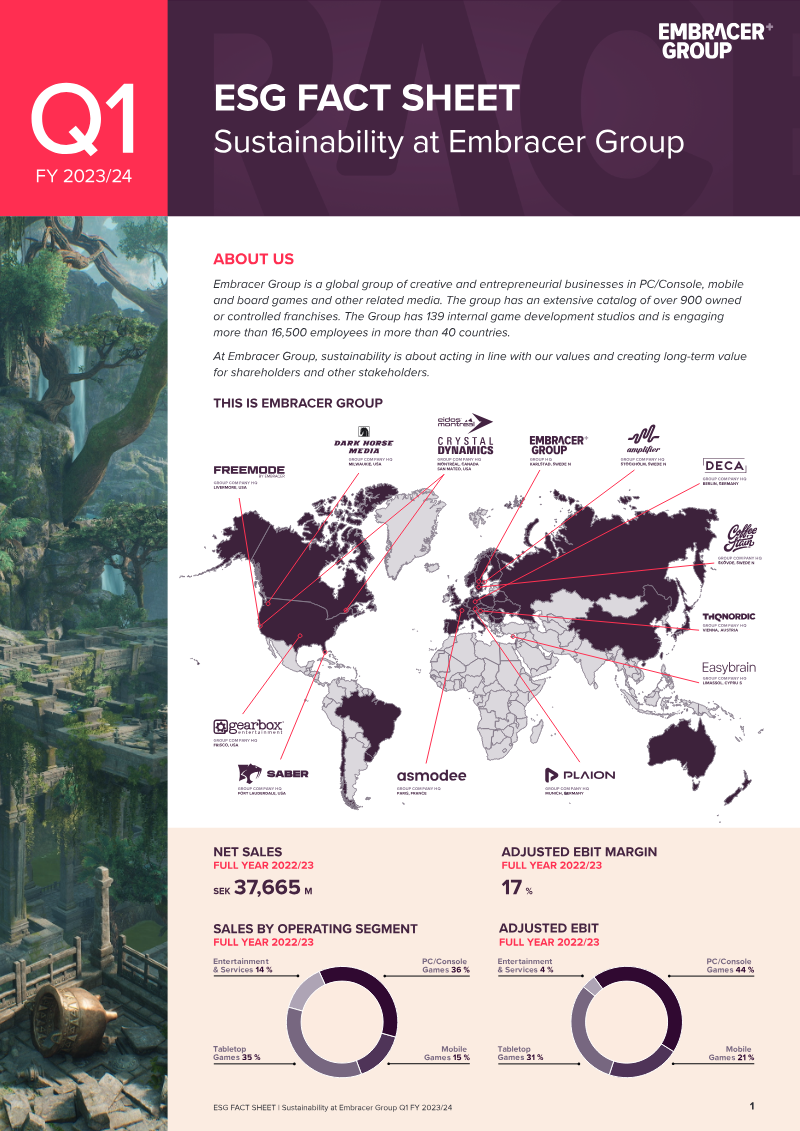
ESG Fact Sheet: FY 2023/24
Embracer Group’s FY 2023/24 ESG Fact Sheet outlines the company’s sustainability framework, titled Smarter Business, which focuses on three core pillars: Great People, Solid Work, and Our Planet. Operating across more than 40 countries with 139 internal studios, the organization aims to integrate ethical governance and long-term value creation into its global operations. The company’s sustainability strategy is supported by 16 group policies and 12 guidelines, with oversight provided by the Audit and Sustainability Committee and an internal Ambassador Group.
Key performance indicators for the 2022/23 financial year highlight both progress and areas for development. Within the Great People pillar, the company reported a 26% female representation rate and an employee satisfaction score (eNPS) of +29. To foster leadership diversity, the board has committed to doubling the number of female managing directors and studio heads by 2025. Regarding environmental impact, the company has conducted a comprehensive greenhouse gas inventory, reporting total emissions of 687,102 tCO2e. The firm has aligned its climate strategy with the Paris Agreement, targeting a 45% reduction in carbon emissions by 2030 compared to a 2021/22 baseline.
The company utilizes a structured methodology for tracking progress, including annual global employee surveys and standardized sustainability due diligence during acquisitions. Furthermore, the organization actively participates in industry-wide initiatives such as the UN Global Compact, Women in Games, and PlayCreateGreen. By integrating these partnerships with internal training programs on privacy and ethics, the company seeks to manage operational risks while promoting digital well-being and accessibility across its portfolio of over 900 franchises.
- Embracer Group has committed to a 45% reduction in total carbon emissions by 2030, using the 2021/22 financial year as its baseline.
- The company reported total greenhouse gas emissions of 687,102 tCO2e for the 2022/23 financial year.
- Female representation across the organization stands at 26%, with a board-level mandate to double the number of female managing directors and studio heads by 2025.
- The organization maintains an employee satisfaction score (eNPS) of +29 across its 139 internal studios.
- Sustainability oversight is managed through 16 group policies and 12 guidelines, with governance provided by an Audit and Sustainability Committee and an internal Ambassador Group.
Modern Slavery Statement
Everplay, a global video game developer and publisher, maintains a firm commitment to preventing modern slavery and human trafficking across its operations and supply chains. Covering the financial year ending December 31, 2025, this statement fulfills the requirements of the Modern Slavery Act 2015. The organization operates with approximately 370 employees across the UK, Ireland, Germany, the USA, and Canada, maintaining a business model that relies primarily on intellectual property and digital services rather than physical manufacturing, which inherently limits its exposure to modern slavery risks.
The company’s supply chain is primarily composed of third-party development partners, royalty recipients, and external service providers for localization and quality assurance. While the overall risk profile is considered low, the organization identifies quality assurance and localization as areas requiring heightened vigilance. To mitigate these risks, Everplay mandates that all new and renewing contracts include specific clauses requiring supplier compliance with the Act, granting the company the right to terminate agreements in the event of a breach.
Governance of these efforts is overseen by the Audit Committee, which reports to the Board of Directors at least twice annually. The company utilizes a multi-layered approach to risk management, incorporating internal policies, annual risk register reviews, and an external third-party whistleblowing hotline to ensure transparency and accountability. To date, these measures have proven effective, with no reported incidents of modern slavery. Everplay continues to prioritize employee and stakeholder awareness through ongoing training and the integration of anti-slavery protocols into its broader corporate governance framework.
- Everplay employs approximately 370 staff across the UK, Ireland, Germany, the USA, and Canada, operating a business model focused on intellectual property and digital services.
- The company mandates that all new and renewing contracts include specific anti-slavery compliance clauses, granting Everplay the right to terminate agreements for breaches.
- While the overall risk profile is considered low, the company identifies third-party localization and quality assurance providers as the primary areas requiring heightened vigilance.
- Governance of anti-slavery efforts is managed by the Audit Committee, which reports to the Board of Directors at least twice annually.
- Risk management is supported by annual risk register reviews and an external third-party whistleblowing hotline to ensure transparency.
Ubisoft announces a major organizational, operational and portfolio reset to reclaim creative leadership and restore sustainable growth
Ubisoft announces a comprehensive reset aimed at restoring creative leadership and sustainable growth amid a more selective AAA market. The strategy centers on three pillars: a new operating model, a refocused portfolio with an updated three‑year roadmap, and organizational rightsizing. The operating model introduces five Creative Houses—each genre‑focused, fully responsible for development, publishing, and financial performance—supported by a Creative Network of studios and shared Core Services. This structure is intended to accelerate decision‑making, deepen specialization in Open World Adventures and GaaS‑native experiences, and embed generative AI initiatives.
Portfolio adjustments include discontinuing six titles that fail new quality thresholds, extending development timelines for seven games to meet higher standards, and reallocating resources toward high‑potential IPs such as “March of Giants.” These changes are expected to reduce net bookings for FY26 by roughly €330 million and push non‑IFRS EBIT into the negative, reflecting one‑off depreciation costs. Free cash flow is projected between –€400 million and –€500 million, with net debt rising to €150–250 million.
Cost‑reduction efforts target a total fixed‑cost savings of approximately €500 million since FY22, with an accelerated €100 million cut already achieved by March 2026 and a further €200 million planned over the next two years, bringing fixed costs to about €1.25 billion by March 2028. The reset is set to take effect in early April, with a revised FY26–27 financial outlook to be released in May.
- Ubisoft is restructuring into five genre-focused 'Creative Houses' to accelerate decision-making and specialize in Open World Adventures and GaaS-native experiences.
- The company is discontinuing six titles and extending development timelines for seven others to meet new quality thresholds, resulting in a projected €330 million reduction in FY26 net bookings.
- Financial projections for FY26 include negative non-IFRS EBIT, free cash flow between –€400 million and –€500 million, and a net debt increase to €150–250 million.
- Fixed-cost reduction targets aim to bring total costs to approximately €1.25 billion by March 2028, with an additional €200 million in cuts planned over the next two years.
- The organizational reset includes the integration of generative AI initiatives and a strategic resource reallocation toward high-potential IPs such as 'March of Giants.'
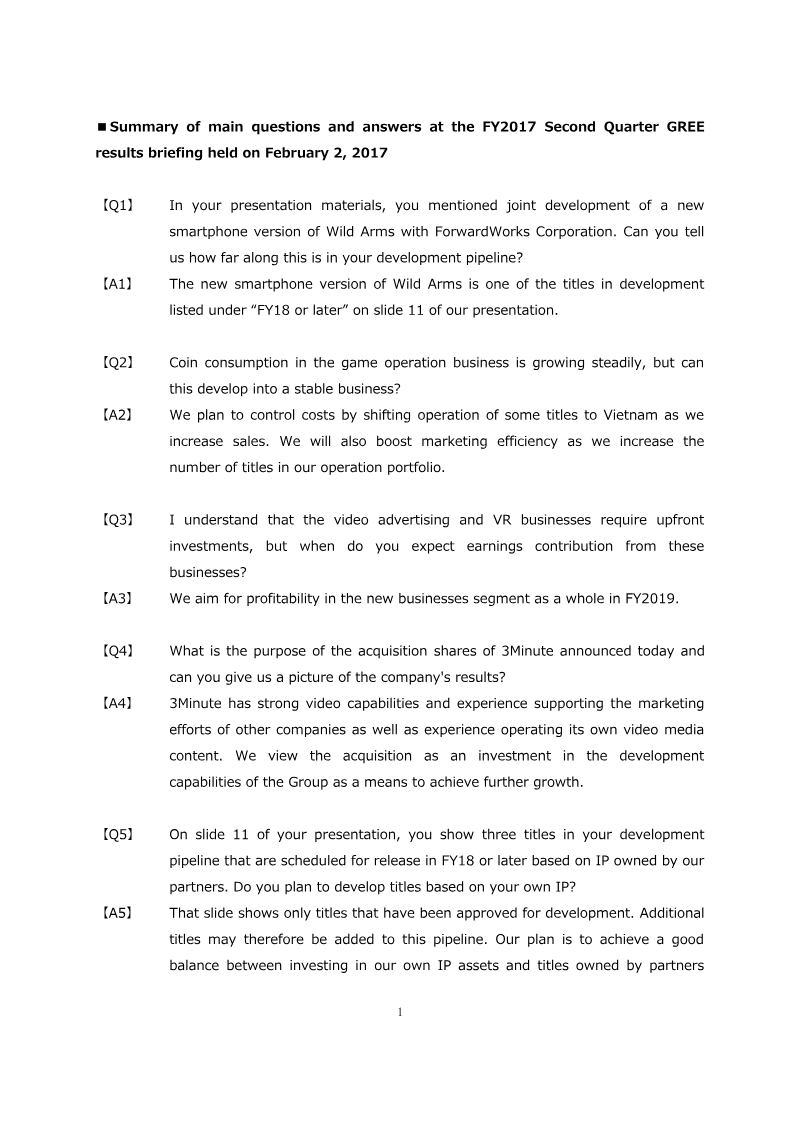
Summary of Questions and Answers: FY2017 2Q GREE Results Briefing
The briefing clarified GREE’s strategic focus for FY2017 and beyond. The company confirmed that a smartphone adaptation of Wild Arms, developed with ForwardWorks Corporation, remains in the FY18‑later pipeline. To stabilize coin‑consumption revenue from its game operation segment, GREE plans to shift operations of select titles to Vietnam and enhance marketing efficiency as its portfolio expands. New ventures in video advertising and virtual reality are expected to reach profitability by FY2019, while the acquisition of 3Minute is positioned as an investment in video‑content capabilities to support broader growth.
Regarding intellectual property, GREE indicated that its development pipeline includes both partner‑owned IP and its own assets, aiming for a balanced mix. The company highlighted Rara‑MAGI’s strong launch performance and noted that coin consumption for other overseas native titles has declined quarter‑over‑quarter, though a new title is slated for late second half release. Seven titles scheduled for the latter half of the year will see roughly half released in Q3 and the remainder in Q4, with Rara‑MAGI already live.
Operating income is projected to dip in Q3 due to increased fixed costs from new releases. GREE will evaluate ongoing titles, closing those unlikely to grow while reallocating resources to high‑potential games. Poor performance is attributed mainly to insufficient content depth or breadth at launch, and lessons learned will inform future development.
- GREE expects Q3 operating income to decline due to increased fixed costs associated with a pipeline of seven new game releases scheduled for the second half of the fiscal year.
- The company is shifting operations for select titles to Vietnam and improving marketing efficiency to stabilize coin-consumption revenue within its game segment.
- New business ventures in virtual reality and video advertising are targeted to reach profitability by FY2019.
- GREE acquired 3Minute to bolster its video-content capabilities as part of a broader growth strategy.
- The smartphone adaptation of Wild Arms, developed in partnership with ForwardWorks Corporation, is confirmed for release in FY2018 or later.
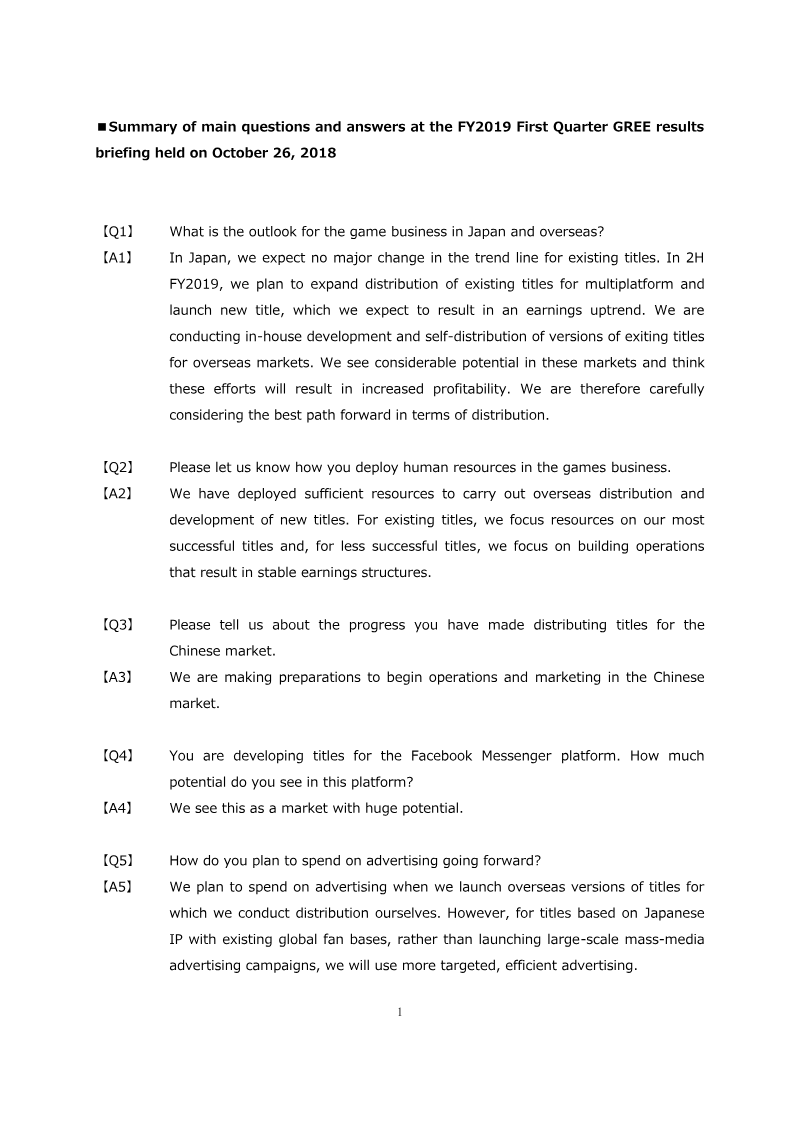
Summary of main questions and answers at the FY2019 First Quarter GREE results briefing held on October 26, 2018
The briefing clarified GREE’s strategic outlook for FY2019, emphasizing a steady domestic game portfolio while pursuing growth overseas. In Japan, the company expects no major shift in performance for existing titles but plans to broaden multiplatform distribution and launch new releases in the second half of FY2019, projecting an earnings uptrend. Internationally, GREE is developing and self‑distributing overseas versions of current titles, targeting markets with high profitability potential. Human resource allocation reflects this focus: sufficient staff are dedicated to overseas distribution and new title development, while existing titles receive concentrated support for top performers and operational stability for less successful ones.
China is identified as a priority market, with preparations underway to initiate operations and marketing. The company also highlights the Facebook Messenger platform as a high‑potential channel for new titles, indicating an expansion into social media gaming. Advertising strategy will be selective; overseas launches of self‑distributed titles will receive targeted, efficient campaigns rather than broad mass media spend.
Regulatory compliance and consumer protection are addressed through company‑wide measures to prevent gacha system issues, including strengthened evaluation protocols and employee training. The REALITY livestreaming platform for VTubers is in an exploratory phase, with ongoing data collection on technology, planning, and marketing to build know‑how for future content expansion. Overall, GREE’s FY2019 strategy balances domestic stability with aggressive international diversification and platform innovation.
- GREE is prioritizing international expansion by self-distributing existing titles in high-profitability markets, with China identified as a key target for upcoming operations and marketing.
- The company plans to drive an earnings uptrend in the second half of FY2019 through new title releases and expanded multiplatform distribution in Japan.
- GREE is diversifying its distribution channels by targeting social media gaming, specifically highlighting Facebook Messenger as a high-potential platform for new releases.
- Advertising strategy for overseas launches will shift away from mass media spend in favor of targeted, efficient campaigns for self-distributed titles.
- Human resource allocation is being restructured to concentrate support on top-performing domestic titles while maintaining operational stability for lower-performing ones.