Updated Apr 30, 2026 by Everplay
Report
Published by Everplay
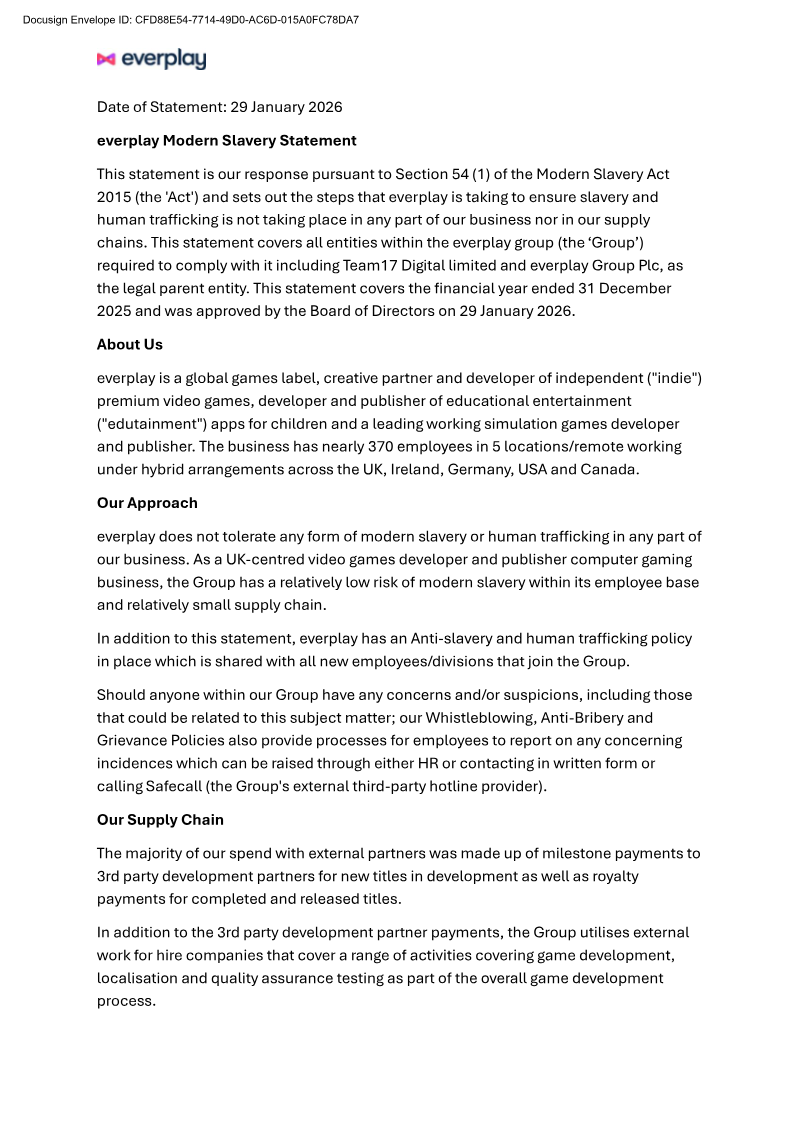
Everplay, a global video game developer and publisher, maintains a firm commitment to preventing modern slavery and human trafficking across its operations and supply chains. Covering the financial year ending December 31, 2025, this statement fulfills the requirements of the Modern Slavery Act 2015. The organization operates with approximately 370 employees across the UK, Ireland, Germany, the USA, and Canada, maintaining a business model that relies primarily on intellectual property and digital services rather than physical manufacturing, which inherently limits its exposure to modern slavery risks. The company’s supply chain is primarily composed of third-party development partners, royalty recipients, and external service providers for localization and quality assurance. While the overall risk profile is considered low, the organization identifies quality assurance and localization as areas requiring heightened vigilance. To mitigate these risks, Everplay mandates that all new and renewing contracts include specific clauses requiring supplier compliance with the Act, granting the company the right to terminate agreements in the event of a breach. Governance of these efforts is overseen by the Audit Committee, which reports to the Board of Directors at least twice annually. The company utilizes a multi-layered approach to risk management, incorporating internal policies, annual risk register reviews, and an external third-party whistleblowing hotline to ensure transparency and accountability. To date, these measures have proven effective, with no reported incidents of modern slavery. Everplay continues to prioritize employee and stakeholder awareness through ongoing training and the integration of anti-slavery protocols into its broader corporate governance framework.
so confidentiall Date of Statement: 29 January 2026 everplay Modern Slavery Statement This statement is our response pursuant to Section 54 (1) of the Modern Slavery Act 2015 (the 'Act') and sets out the steps that everplay is taking to ensure slavery and human trafficking is not taking place in any part of our business nor in our supply chains. This statement covers all entities within the everplay group (the ‘Group’) required to comply with it including Team17 Digital limited and everplay Group Plc, as the legal parent entity. This statement covers the financial year ended 31 December 2025 and was approved by the Board of Directors on 29 January 2026. About Us everplay is a global games label, creative partner and developer of independent ("indie") premium video games, developer and publisher of educational entertainment ("edutainment") apps for children and a leading working simulation games developer and publisher. The business has nearly 370 employees in 5 locations/remote working under hybrid arrangements across the UK, Ireland, Germany, USA and Canada. Our Approach everplay does not tolerate any form of modern slavery or human trafficking in any part of our business.
mulation games developer and publisher. The business has nearly 370 employees in 5 locations/remote working under hybrid arrangements across the UK, Ireland, Germany, USA and Canada. Our Approach everplay does not tolerate any form of modern slavery or human trafficking in any part of our business. As a UK-centred video games developer and publisher computer gaming business, the Group has a relatively low risk of modern slavery within its employee base and relatively small supply chain. In addition to this statement, everplay has an Anti-slavery and human trafficking policy in place which is shared with all new employees/divisions that join the Group. Should anyone within our Group have any concerns and/or suspicions, including those that could be related to this subject matter; our Whistleblowing, Anti-Bribery and Grievance Policies also provide processes for employees to report on any concerning incidences which can be raised through either HR or contacting in written form or calling Safecall (the Group's external third-party hotline provider). Our Supply Chain The majority of our spend with external partners was made up of milestone payments to 3rd party development partners for new titles in development as well as royalty payments for completed and released titles. In addition to the 3rd party development partner payments, the Group utilises external work for hire companies that cover a range of activities covering game development, localisation and quality assurance test
new titles in development as well as royalty payments for completed and released titles. In addition to the 3rd party development partner payments, the Group utilises external work for hire companies that cover a range of activities covering game development, localisation and quality assurance testing as part of the overall game development process.
so confidentiall To continue our efforts, all new contracts and those renewing, will include a clause requiring that our suppliers, and their subcontractors, comply with the Act, and include the relevant company’s right to terminate in the instance of any breach of this obligation. Due Diligence everplay will make reasonable endeavours to ensure all employees and agents within our Group supply chain are not subject to any form of forced, compulsory/bonded labour or human trafficking by implementing this statement. This includes conducting reasonable levels of due diligence on new suppliers and employees to identify and manage any risks of modern slavery. Adequate resources will be made available to ensure slavery and human trafficking are not taking place within our organization or to the best of our knowledge within our supply chains. Risk Assessment As a game developer business, everplay does not have significant physical inputs into its business operations, but we understand that no supply chain is risk-free, and that greater risk may be present further down the supply chain. We continue to follow a riskbased approach to our supply chain. The majority of our supply chain retained a low risk of modern slavery however, a couple of areas were considered to carry a slightly higher risk which are QA testing and localisation, and we will continue to assess and manage the risks in these areas on an ongoing basis as part of the Group's overall risk register assessment review process which is carried out annually. Our risk assessment process has shown to be effective no reports of incidents of modern slavery have been received.
e will continue to assess and manage the risks in these areas on an ongoing basis as part of the Group's overall risk register assessment review process which is carried out annually. Our risk assessment process has shown to be effective no reports of incidents of modern slavery have been received. The Group views this as a key metric in measuring its compliance with the Act. Additionally, we emphasize the importance of transparency and accountability. Therefore, our annual report, which includes the assessment of risks and our approach to support our internal teams and each of our stakeholders is published on our company's website. We believe that this regular reporting contributes to our commitment to combat modern slavery and ensure responsible practices throughout our businesses and supply chain. Governance Operational responsibility for reviewing our approach to modern slavery sits with our Audit Committee, which reports into the Board at least twice per year. For employees, suppliers, clients and third parties our whistleblowing policy encourages and enables reporting on anything of concern and explains how they can do
so confidentiall so confidentially. Concerns by employees can be raised through our HR teams or contacting our external third party provider in written form or calling directly. Awareness and Training We raise awareness among our employees, suppliers, and stakeholders of the risks of modern slavery and human trafficking, and the steps we are taking to prevent it. We are committed to providing necessary and appropriate training to all employees and suppliers to ensure that they understand their responsibilities effectively and how to appropriately identify and report any potential instances of modern slavery or human trafficking. We have adapted and re-promoted our existing corporate policies to address modern slavery and human trafficking where relevant, including our whistle blowing policy which allows employees to report any concerns confidentially. Our Commitment everplay continues to take positive steps to improve transparency within our divisions. The Board of Directors believe that the Group operates with a very low inherent risk of slavery and human trafficking potential. Nevertheless, this assessment is kept under continual review. The Board of Directors are responsible for the ongoing review of this statement as well as the Anti-Slavery and Human Trafficking Policy . This will be carried out annually or when any organisational changes arise that may impact the way the Group operates.
The Supplier Code of Conduct for Take-Two Interactive Software, Inc., updated in April 2023, establishes the ethical, legal, and professional standards required of all third-party partners. The primary thesis is that all suppliers, consultants, and vendors must mirror the company’s internal commitment to honesty, integrity, and human rights. This mandate extends globally to any entity providing goods or services, including distribution, marketing, and manufacturing, and requires these partners to ensure compliance among their own subcontractors and employees. The document outlines specific legal requirements across several critical domains. Suppliers must strictly adhere to competition and antitrust laws, anti-bribery and corruption statutes such as the US Foreign Corrupt Practices Act and the UK Bribery Act, and anti-money laundering regulations. Furthermore, the scope includes strict compliance with trade sanctions and export controls, specifically highlighting high-risk regions such as Iran, Cuba, Syria, North Korea, and certain areas of Ukraine. Partners are also prohibited from engaging in insider trading based on non-public information gained through their relationship with the company. Beyond legal compliance, the standards emphasize social responsibility and operational integrity. Key provisions include the prohibition of child or prison labor, the protection of fundamental human rights, and the maintenance of a work environment free from discrimination and harassment. Suppliers are required to maintain accurate financial records, protect intellectual property, and avoid conflicts of interest. To ensure adherence, the company reserves the right to conduct periodic audits and requires immediate notification of any legal investigations or violations. A global reporting infrastructure is provided, featuring a 24-hour ethics hotline available across more than twenty countries, supported by a non-retaliation policy for those reporting grievances in good faith.
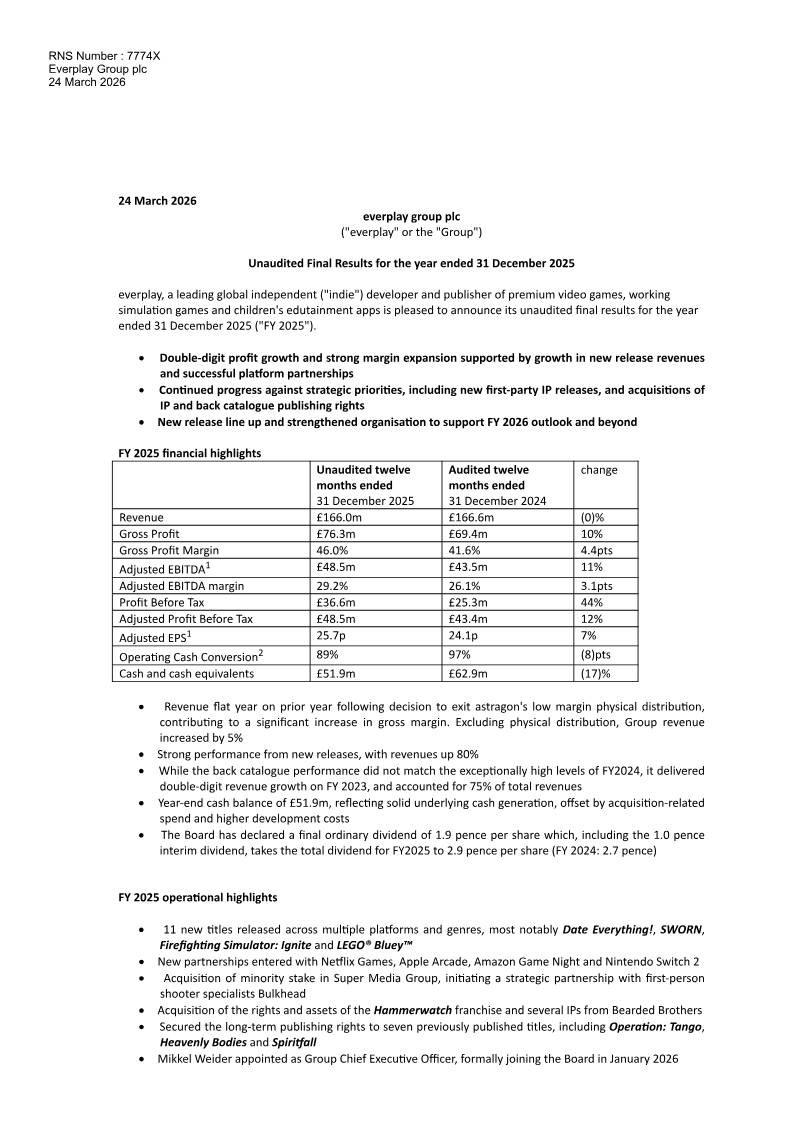
Everplay Group plc delivered unaudited FY 2025 results that demonstrate resilient profitability amid flat headline revenue. Total sales held steady at £166.0 million, a slight decline from the prior year, yet underlying revenue grew 5 % when excluding the impact of Astragon’s exit from physical distribution. Gross profit rose to £76.3 million, achieving a 46.0 % margin, while adjusted EBITDA increased 11 % to £48.5 million (29.2 % margin). Profit before tax surged 44 % to £36.6 million, driven by higher gross margins and reduced royalty expenses. The Group’s performance was underpinned by robust new‑release activity, with an 80 % revenue increase from fresh titles and a 75 % share of income derived from its back catalogue. Strategic initiatives—such as securing platform partnerships with Netflix Games, Apple Arcade and Amazon Game Night, exiting low‑margin physical distribution, and acquiring additional IP rights—position the company for future growth. Astragon’s revenue fell 33 % to £29.5 million after the distribution exit, yet its first‑party IP share climbed to 83 % of sales; StoryToys expanded revenue by 25 % to £30.4 million, buoyed by high‑profile licenses like LEGO® Bluey and Netflix Games. Share‑based remuneration expanded, with 317,970 options granted to Executive Directors, 349,805 to other employees and 87,957 to Non‑Executive Directors in FY 2025. The Long‑Term Incentive Plan now covers senior divisional leaders, and an All‑Employee Share Incentive Plan remains active. Outlook for FY 2026 highlights a pipeline of over 15 new games, including five first‑party IP titles, and anticipates H2‑weighted EBITDA growth. Financially, the Group reports a single aggregated segment comprising Games Label, Simulation and Edutainment. Revenue in 2025 split evenly between first‑party (£56.13 m) and third‑party IP (£109.86 m), with major platforms such as Steam, Microsoft, Sony, Nintendo and Apple each contributing over 10 % of sales. Operating profit benefited from amortisation of development costs (£14.16 m) and publishing rights, while tax expense rose to £9.35 million from £5.13 million in 2024 due to higher current and deferred tax adjustments. Goodwill impairment testing revealed no shortfalls except for the Astragon Simulation CGU, where recoverable amounts exceed carrying value by £78.5 million (2024: £31.0 million). Sensitivity analysis indicates that a 25 % decline in unreleased title revenues would bring the Astragon CGU to breakeven, but no other reasonable changes trigger impairment. Cash balances remained robust at £51.9 million in 2025, with operating cash flow of £57.7 million slightly below the prior year’s £59.9 million, underscoring solid liquidity and a foundation for continued profitable expansion.
The 2025 Game Developer Survey captures the technology preferences and strategic shifts of game studios worldwide, focusing on platform targets, engine adoption, 3D creation tools, backend services, analytics, user‑acquisition solutions, and generative‑AI usage. By segmenting respondents across six studio‑size categories—from solo developers to enterprises with over 100 employees—the survey reveals how development priorities evolve as companies scale and as pricing models change. Unity remains the most widely used engine, yet studios of all sizes report a notable decline in planned future use, driven by Unity’s revised pricing that introduced a 25 % increase for enterprise licenses and an $2,200 per‑seat fee for pro users. Open‑source alternatives such as Godot and Defold are gaining traction, while Unity’s ProBuilder and SideFX’s Houdini emerge as the fastest‑growing 3D modeling and level‑design tools, especially among studios under 100 employees focused on PC and web titles. Conversely, Adobe’s suite and Autodesk products experience the steepest drop‑offs, with declines ranging from 4 % to 10 % in anticipated usage. Backend infrastructure shows a shift away from Photon, whose hybrid‑plus offering has sparked a modest decline, toward Edgegap, which leverages bare‑metal and cloud resources to deliver cost‑effective matchmaking. Xsolla’s recent rollout of loyalty programs, regional tiering, and cloud‑gaming integration underscores a broader move toward web‑based delivery and progressive‑web‑app capabilities, particularly in the MENA region. Analytics remain dominated by Google, but Mixpanel records a 120 % surge in interest, buoyed by a new startup‑focused pricing tier that promises over $150 k in value for qualifying studios. User‑acquisition trends indicate a universal retreat from Apple Search Ads after its shift to a cost‑per‑tap model, while privacy‑centric platforms such as Tenjin and Branch experience rapid adoption, leveraging OpenAI‑enabled features and enhanced compliance tools. Generative AI is employed across a spectrum of development stages—from storyboarding to performance optimization—but studios report a consistent decline in its use for content creation, with smaller teams showing a 7 % drop and larger teams a 5 % reduction. Overall, the survey highlights a diversification of technology stacks, a cautious response to pricing reforms, and an accelerating embrace of open‑source, cloud‑native, and AI‑augmented solutions as the industry navigates
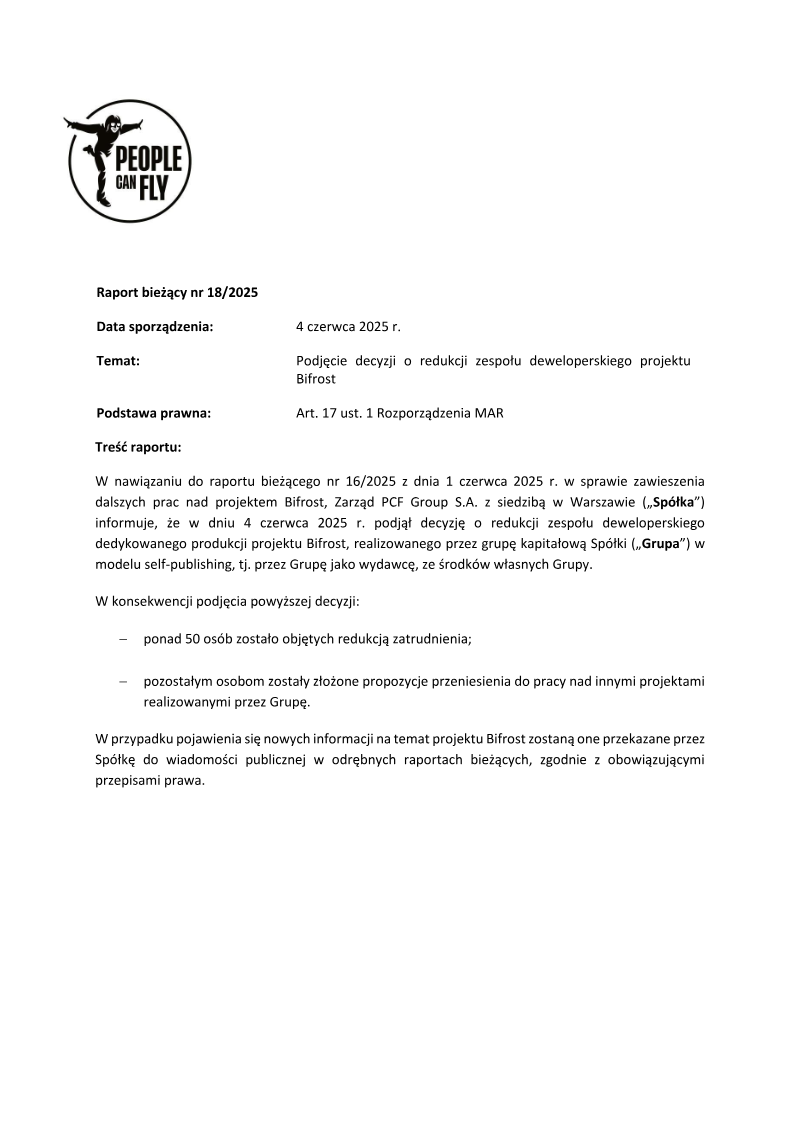
The decision to downsize the development team for the Bifrost project was formally adopted on 4 June 2025 by the board of PCF Group S.A., headquartered in Warsaw, invoking the authority granted under Article 17, paragraph 1 of the MAR Regulation. The primary objective of the decision is to align the project’s staffing levels with the company’s strategic shift toward self‑publishing, financed entirely from the Group’s own resources. Implementation of the decision will affect more than fifty employees, who are subject to termination of employment. Remaining staff members have been offered relocation to other ongoing projects within the Group, reflecting an effort to retain talent while consolidating development activities. The action follows an earlier suspension of work on Bifrost reported on 1 June 2025, indicating a continued reassessment of the project’s viability. The scope of the announcement is limited to PCF Group’s internal operations, covering its Warsaw‑based corporate entity and its self‑publishing development model. No external market or geographic data are presented, and the report does not rely on survey methodology; instead, it is based on internal governance procedures and legal compliance requirements. Future updates concerning Bifrost will be communicated through separate current reports in accordance with applicable legal provisions.