Game Design reports and market data
Documents

Let's Review Your Games — Ep. 048
Indie game development requires a delicate balance between atmospheric polish and clear player direction.
- Well-executed, low-budget games with an edgy, mature, or unsettling aesthetic can achieve commercial success with estimated earnings between $700,000 and $1 million.
- Market trends on Steam show a clear preference for darker, grittier, and haunting atmospheres over playful or family-friendly designs.
- Technical polish is mandatory for success, as issues like screen tearing, camera jitter, and missing settings menus actively undermine player engagement and streamer appeal.

Slay the Spire II Early Access Review Bombing | Design Club
The recent backlash against Slay the Spire II highlights a growing friction between iterative development practices and consumer expectations within the modern Early Access model.
- Slay the Spire 2 is currently experiencing review bombing in Early Access, primarily driven by player frustration over balance changes—specifically the removal of 'infinite' deck loops—introduced in the game's opt-in beta branch.
- MegaCrit provides an in-game feedback tool accessible via the F2 key, which was recently expanded to allow up to 8,000 characters per report to facilitate direct communication between players and developers.
- The developers have implemented a voluntary, opt-in beta branch for the Early Access title to test major balance adjustments, including character card changes and complete reworks of end-game bosses, separate from the live build.

Let's Review Your Games — Ep. 047
Indie game development often suffers from a disconnect between mechanical intent and player perception, particularly in puzzle-oriented titles.
- Developers must prioritize clear visual language and structured, grid-aligned environments to reduce player cognitive load and prevent disorientation.
- Ambiguous environmental cues, such as non-functional assets that mimic UI elements like buttons, should be replaced with standardized interaction logic to prevent player frustration.
- To improve player retention, developers should implement consistent systems like color-coding keys to receptacles and using distinct, snap-in-place mechanics.

Watch us chat with British comedian and Taskmaster star Maisie Adam
The comedy and gaming industries share a fundamental structural challenge: the necessity of balancing creative evolution with the preservation of core elements that initially fostered fan loyalty.
- Success in both comedy and gaming requires balancing creative evolution with the preservation of core elements that initially established fan loyalty.
- Iterative development, similar to the software industry's early access model, allows creators to refine material through direct audience feedback before final release.
- Creators must manage the tension between maintaining a unique artistic voice and adapting to the shifting expectations of a diverse, global audience.

Let's Review Your Games — Ep. 045
Indie game development requires a delicate balance between aesthetic polish and functional player feedback to ensure long-term engagement.
- Developers must prioritize 'juice'—reactive elements like particle effects, dynamic audio, and responsive animations—to ensure game mechanics feel tactile rather than disconnected.
- Successful survival and exploration games require narrative context and sensory feedback to ground the player and provide a necessary sense of urgency.
- Intuitive UI indicators, clear goal tracking, and responsive mechanics are essential to bridge the gap between a functional prototype and a polished, immersive product.

The First AI Game Creator's Brutal Truth About Game Dev
Modern game development is undergoing a fundamental shift where the focus is moving away from technological novelty toward the mastery of player-centric design.
- In the gaming industry, the difference between an 80% finished game and a 100% polished, high-quality product is not linear; the 100% version can generate $100 million in revenue while the 80% version may only earn $10,000.
- AI is highly effective for non-creative technical tasks like writing SQL queries and managing data dashboards, providing a 20–30x speed increase in those specific workflows.
- Using AI for core game architecture is a high-skill endeavor because the probabilistic nature of AI can introduce technical debt and broken code if the developer lacks deep knowledge of the underlying interfaces and system constraints.

Let's Review Your Games — Ep. 044
The indie game development landscape requires a rigorous focus on technical polish, atmospheric cohesion, and precise marketing to succeed in a crowded marketplace.
- Marketing materials must feature a 'trinity hook' that integrates mechanical, visual, and narrative elements within the first few seconds of a trailer to capture player interest.
- Technical friction, such as unresponsive movement, inconsistent lighting, and poor navigation, must be eliminated to prevent player frustration and maintain engagement.
- Steam presence requires high-quality, legible screenshots and immediate communication of narrative stakes rather than relying on ambiguous capsule art or slow-paced exposition.

He Knew Nothing About Making Games... Then Sold 67,000 Copies (w/ Sebastian Drews) — Ep 64
The successful launch of the Metroidvania title Constance, which achieved over 67,000 copies sold and an 86% positive rating on Steam, serves as a case study for balancing creative ambition with the practical constraints of independent game development.
- Sebastian Drews successfully launched the Metroidvania game 'Constance' and sold 67,000 copies despite having no prior professional game development experience.
- Marketing a new title by comparing it to established hits like 'Hollow Knight' can drive initial interest, but developers must clearly differentiate their unique mechanics to avoid negative reviews from players expecting a direct clone.
- Development teams should prioritize formal Quality Assurance (QA) early in the production cycle rather than delaying it until the final stages, as late-stage testing often leaves insufficient time to address critical issues.

Want To Make Games? You MUST See This Graph First...
The development of a video game often follows a non-linear trajectory characterized by a prolonged period of stagnation followed by a sudden, exponential increase in quality and cohesion, a phenomenon described as the Frankenstein moment.
- Game development often follows a 'Frankenstein moment' trajectory, where a project feels stagnant and low-quality for an extended period before suddenly reaching a threshold of viability and life.
- The development process is akin to an archaeological dig, characterized by cycles of finding small, exciting features followed by periods of doubt and declining confidence.
- To accelerate development and improve quality, developers must seek feedback from two specific sources: real players who identify usability issues and seasoned industry veterans who provide high-impact, 'explosive' solutions.

The Secret Trick To Instantly Make Your Game FUN
The primary objective is to demonstrate how to enhance the "fun factor" of a game through iterative, low-level adjustments to game feel and presentation, rather than altering core mechanics.
- Prioritize player movement feel early in development, as adjusting variables like bounce and speed can significantly enhance the 'fun factor' without altering core mechanics.
- Maintain consistent scale by ensuring the character controller height is exactly twice the size of a primitive cube to ensure platforming feels intuitive.
- Use animator trees to centralize control over movement states, jump animations, and sound triggers, allowing for iterative fine-tuning of game feel.
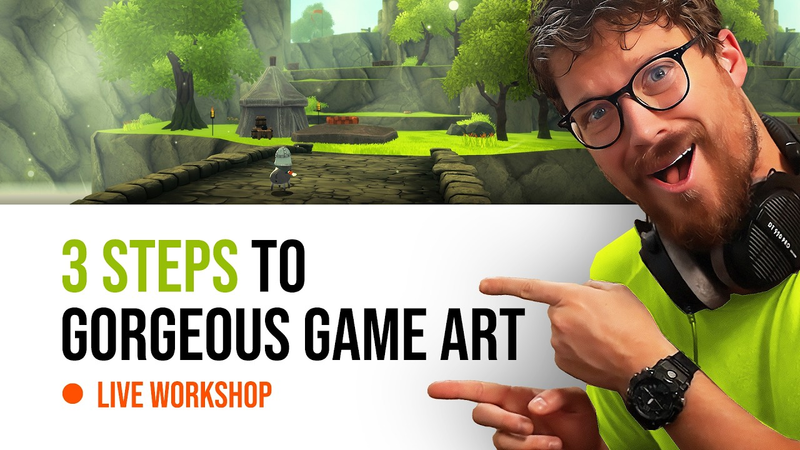
3 Steps To Gorgeous Game Art (With NO Modeling Skills) - Live Workshop
High-quality game environments are achievable without advanced 3D modeling skills by prioritizing foundational design principles over technical complexity.
- Effective game art relies on five core principles: scale, asset distribution, color, lighting, and sound, all of which can be applied to simple primitive shapes like cubes and spheres to create a polished aesthetic.
- Proper scale is essential for defining the player's relationship to the environment; using consistent reference objects, such as a humanoid character or standardized furniture, prevents visual confusion regarding world size.
- Avoid uniform spacing by arranging assets in natural clusters or groups, as this mimics organic environments and prevents the unnatural appearance of isolated, 'socially distanced' objects.

Want To Make Indie Games? Fix These 10 Things In Your Game NOW
Retention is the most critical metric for the success of indie games, as it directly influences platform algorithms and overall sales.
- The median playtime for Steam game demos is only 14 minutes, making early player retention the most critical metric for driving algorithm visibility and sales.
- Onboarding must be intuitive and avoid walls of text; players should learn mechanics through gameplay without feeling overwhelmed or unintelligent.
- Developers should front-load their games with 'triggered sequences'—frequent, reactive environmental events—to keep players engaged during the critical first 14 minutes.