1 free read left. Create a free account for unlimited reading + AI research.
Create free accountWhitepaper DiGRA
1 free read left. Create a free account for unlimited reading + AI research.
Create free accountWhitepaperDiGRA
The paper notes that existing work on time in games has paid comparatively little attention to historical time.
This paper examines how Japanese Roleplaying Games (JRPGs) that use time travel as a narrative or gameplay mechanic represent history, and what those representations imply for both players and scholars of Historical Game Studies. Its central argument is that fantasy games can shape how we understand history rather than simply being interpreted through modernist academic frameworks. The author draws on a close reading of a range of titles, including Final Fantasy XIII-2, Radiant Historia, Chrono Trigger, Chrono Cross, Final Fantasy XIV: Heavensward, Tales of Phantasia, and Tales of Destiny 2, to explore how history is acted upon, changed, or restored within these temporal plots. The paper frames its inquiry within a wider body of scholarship on time in games, noting that existing work has paid comparatively little attention to historical time and that JRPGs, despite being caricatured as linear, show a sustained interest in non-linear storytelling.
The analysis is organised around several guiding questions: what history means within these games, how change to it is represented, and what moral implications follow. The paper introduces the concept of chrononormativity, which describes conventional linear expectations about time, and asks whether departing from these norms leads players to view history as fractured and in need of repair, or whether the tension reflects a conflict between narrative needs and time travel as a method. It positions JRPG time travel as a site where history appears variously as narrative structure, conceptual framework, or moral structure.
The scope is primarily conceptual and interpretive, drawing on the author's qualitative engagement with a selected set of games rather than on a large dataset or survey. The paper's contribution lies in bringing game-based perspectives into debates among historiographers and philosophers of history about the nature of historical time, a question the author suggests remains largely unresolved.
 Chrono TriggerGame · Bird Studio · 1995 · 4 documents
 AtlusCompany · Japan · founded 1986 · 14 documents
 Square EnixCompany · Japan · founded 2003 · 400 documents
 Dragon QuestGame · Matrix Software · 2004 · 193 documents
 DestinyGame · Bungie · 2014 · 212 documents
 Destiny 2Game · Bungie · 2017 · 136 documents
 Final Fantasy XIVGame · Square Enix Product Development Division 3 · 2013 · 107 documents
 Final Fantasy XIIIGame · Square Enix Product Development Division 1 · 2009 · 15 documents
Each row is a game or company this document names, each column a document, oldest first. A mark means that document names it. Select a row to see those documents.
DiGRA · 2026

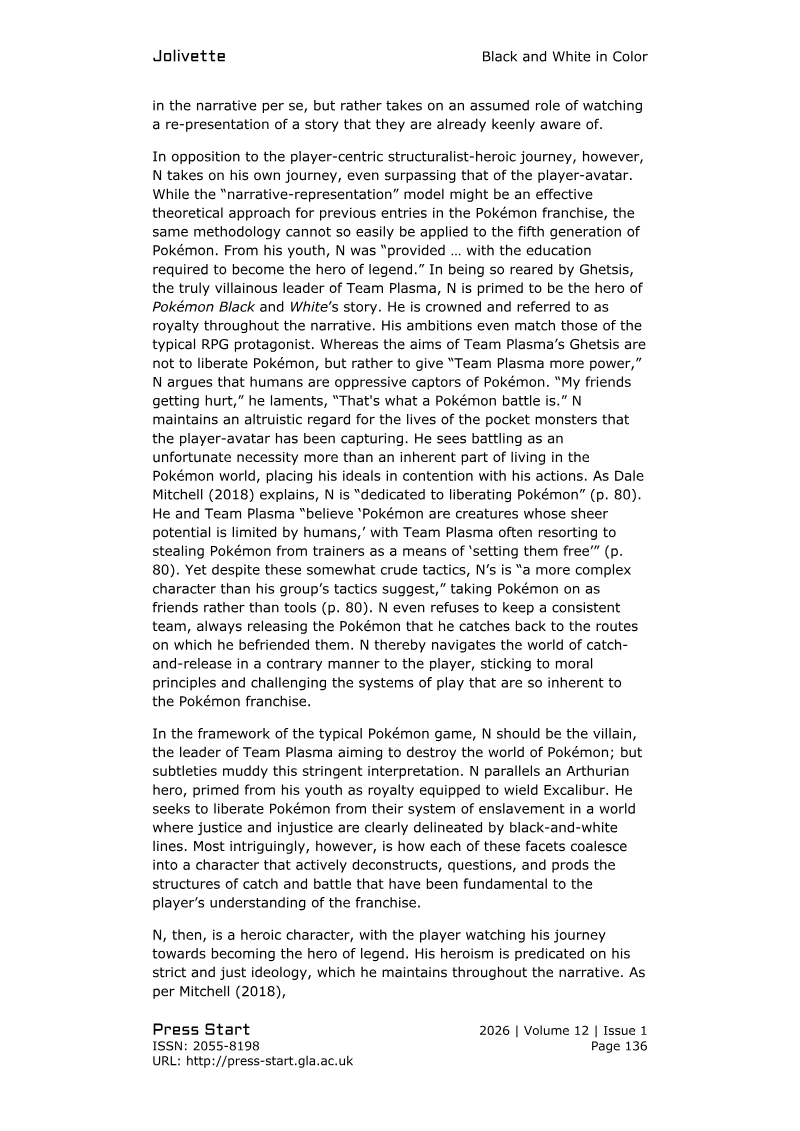
Press Start · 2026
DiGRA · 2026
Press Start · 2022
DiGRA · 2005
International Journal of Role-Playing · 2026
DiGRA · 2026
game · 2026
International Journal of Role-Playing · 2026
International Journal of Role-Playing · 2026
DiGRA · 2025
Journal of Games Criticism · 2025

Digital Games Research Association · 2024





























