Europe
Documents
Dutch Games Monitor 2022: Factsheet
The Dutch Games Monitor 2022 provides a comprehensive analysis of the Netherlands' video game industry, covering the period from 2018 to 2021. The primary objective is to evaluate the sector's growth, maturity, and structural evolution. The research methodology incorporates desk research, roundtable discussions, and a survey of approximately 500 companies, yielding nearly 200 responses. The analysis focuses on two distinct domains: entertainment games and applied (serious) games, which serve sectors such as healthcare and education.
The industry demonstrates significant maturation, characterized by a shift from an initial increase in the number of companies to a more recent surge in revenue and employment. By the end of 2021, the sector comprised 630 companies, generating between €420 million and €440 million in annual revenue. This represents an average annual revenue growth of nearly 18%, outpacing global industry averages. Employment also expanded, reaching 4,560 jobs with an annual growth rate exceeding 5%. This job creation is particularly concentrated in larger organizations, with the number of scale-ups employing over 50 people doubling to 12 companies over the three-year period.
Geographically, the Greater Amsterdam region leads in total employment, while Utrecht maintains the highest concentration of applied game developers. Although the number of dedicated game education programs has slightly decreased, the industry is seeing a rise in diversity, with the percentage of women in the workforce reaching 23% by 2021. Furthermore, the sector is increasingly characterized by international expansion, a rise in external investments, and a growing number of mergers and acquisitions, signaling that the Dutch games industry is successfully transitioning into a more mature and globally competitive market.
- The Dutch games industry generated between €420 million and €440 million in annual revenue by the end of 2021, achieving an average annual growth rate of nearly 18%.
- Total employment in the sector reached 4,560 jobs by 2021, reflecting an annual growth rate of over 5%.
- The industry is scaling up, with the number of companies employing more than 50 people doubling to 12 firms between 2018 and 2021.
- The sector comprised 630 companies by the end of 2021, with the Greater Amsterdam region leading in total employment and Utrecht hosting the highest concentration of applied game developers.
- Workforce diversity has improved, with women accounting for 23% of the industry's employees by 2021.
Key Insights Into German Gamers
Germany represents a significant pillar of the global gaming industry, ranking as the largest games market in the European Union and the fifth largest worldwide by revenue. As of 2022, the German gaming landscape is characterized by a high level of engagement, with 71% of the online population aged 10 to 65 identifying as game enthusiasts. This engagement extends beyond active play to include viewing gaming video content, social interaction, and community participation.
The demographic profile of German players is nearly balanced by gender, consisting of 52% males and 48% females. While gaming is popular across all age groups, the 21-35 age bracket represents the largest segment at 31%. Motivation for play is primarily driven by the desire to relax and unwind, followed by the pursuit of achievement and social connection. Among the various gamer personas, Time Fillers and Mainstream Gamers are the most prevalent, reflecting a mix of casual mobile play and more dedicated multi-platform engagement.
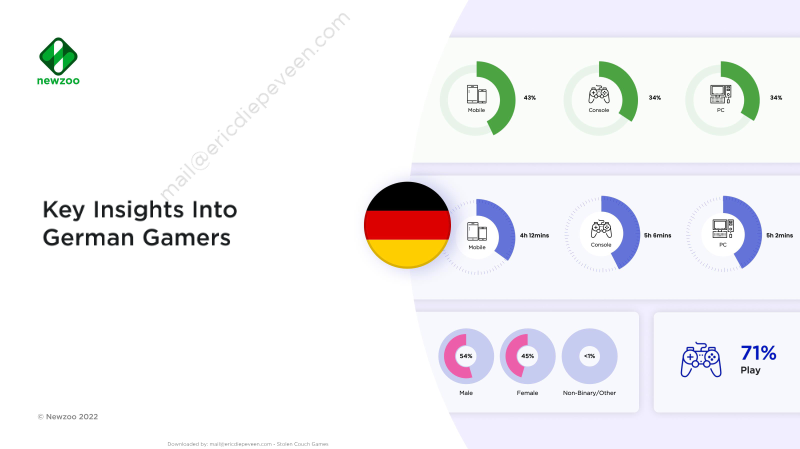
Platform preferences show that mobile gaming has the highest reach, utilized by 43% of the online population, followed by console and PC at 34% each. Despite the higher reach of mobile, PC and console players demonstrate higher average weekly play times, exceeding five hours. Popular titles in the market include Minecraft, Roblox, and Grand Theft Auto V, with Adventure and Action genres leading in popularity.
Monetization remains strong, with 63% of players spending money on games. The primary driver for spending is the availability of sales or special offers, though a significant portion of consumers also pays to unlock exclusive content or to personalize their in-game experience. These findings are based on a 2022 survey of 2,057 online consumers in Germany, forming part of a broader global research initiative covering 36 markets.
- Germany is the largest gaming market in the EU and the fifth largest globally, with 71% of the online population aged 10 to 65 identifying as game enthusiasts as of 2022.
- Mobile gaming has the highest market reach at 43%, though PC and console players demonstrate higher engagement with average weekly play times exceeding five hours.
- The German gaming demographic is nearly gender-balanced at 52% male and 48% female, with the 21-35 age bracket serving as the largest segment at 31%.
- Monetization is robust, as 63% of players spend money on games, primarily driven by sales, special offers, and the desire to unlock exclusive content or personalization options.
- Adventure and Action are the leading genres in the market, with Minecraft, Roblox, and Grand Theft Auto V identified as popular titles.
Video Games Development Industry in Romania – 2022 (Summary & Key Insights)
Video Games Development Industry in Romania – 2022 (Summary & Key Insights)
1. Industry at a Glance
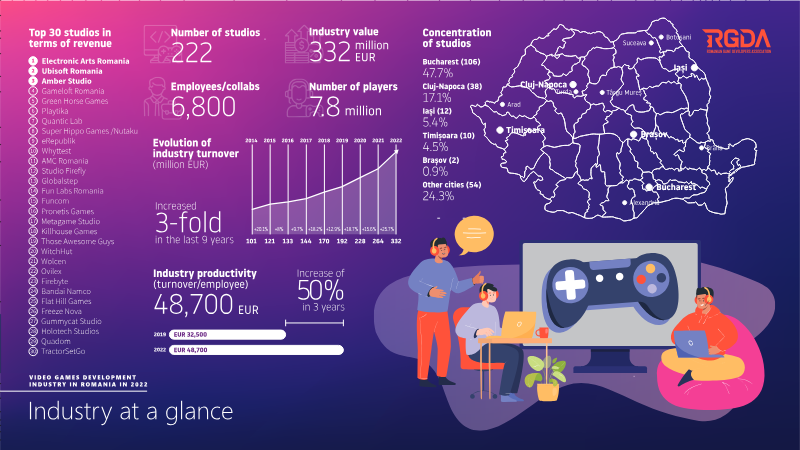
| Metric | Figure (2022) | Comments | |--------|---------------|----------| | Total industry value | ≈ €222‑332 million (range reported) | The spread reflects different sources/segments (e.g., studio revenue, B2B services). | | Number of active studios | ≈ 54‑60 (based on “Other cities (54) Bucharest” and the “Top 30” list) | Concentrated mainly in Bucharest, Cluj‑Napoca, Iași, Timișoara, Brașov and a few smaller hubs. | | Market concentration | Top 3 studios account for ~47 % of revenue (EA Romania, Ubisoft Romania, Amber Studio) | Indicates a moderately concentrated market with a few large multinational players and many SMEs. | | Growth trend (2021‑2022) | +15 % – +25 % for several mid‑size studios (e.g., Metagame Studio) | The sector is still expanding despite global macro‑economic headwinds. | | Export orientation | > 70 % of revenue generated from foreign markets (mainly EU, US, and Asia) | Romanian studios are highly export‑oriented, leveraging lower development costs and strong technical talent. |
2. Top 30 Studios (by reported revenue / size)
| Rank | Studio | Location(s) | Reported Revenue / Size | Notable Points | |------|--------|-------------|------------------------|----------------| | 1 | Electronic Arts Romania | Bucharest (HQ), Iași | €106 M (largest single studio) | EA’s “Playtika” and “EA Studios” units are the biggest revenue generators. | | 2 | Ubisoft Romania | Bucharest, Cluj‑Napoca, Iași | 47.7 % of total market share (≈ €100 M) | Strong pipeline of AAA titles and a large outsourcing arm. | | 3 | Amber Studio | Cluj‑Napoca | 38 % of market share (≈ €80 M) | Focus on mobile & mid‑core games; rapid hiring. | | 4 | Gameloft Romania | Turda, Târgu Mureș | €6.8 M (6,800 k) | Mobile‑first, strong presence in EU & LATAM. | | 5 | Green Horse Games | Arad | €? (data missing) | Indie‑focused, growing export sales. | | 6 | Playtika | Iași | €12 M (approx.) | Social
- The Romanian video game industry generated between €222 million and €332 million in 2022, driven by a highly export-oriented model where over 70% of revenue comes from foreign markets.
- Market concentration is high, with the top three players—Electronic Arts Romania, Ubisoft Romania, and Amber Studio—accounting for approximately 47% of total industry revenue.
- Electronic Arts Romania is the largest single entity in the sector, reporting €106 million in revenue, followed by Ubisoft Romania and Amber Studio, which represent significant market shares of 47.7% and 38% respectively.
- Despite global economic headwinds, the sector maintained a growth trend of 15% to 25% for several mid-size studios during the 2021–2022 period.
- The industry comprises approximately 54 to 60 active studios, with operations primarily clustered in major hubs including Bucharest, Cluj-Napoca, Iași, Timișoara, and Brașov.
Llibre Blanc de la Indústria Catalana del Videojoc 2022
The 2022 white paper evaluates the state of Catalonia’s video‑game sector, arguing that while the region has become an increasingly attractive hub for development, persistent structural constraints—particularly in talent supply and financing—limit its growth potential. By mapping the ecosystem’s performance against recent trends, the analysis highlights the urgent need for coordinated policy action to sustain the momentum generated by recent investment inflows.
A striking 59 % of Catalan studios report difficulty recruiting qualified personnel, a proportion that, although lower than in 2019‑2020, remains markedly high. Financing emerges as the foremost ongoing obstacle, closely followed by challenges in attracting and retaining skilled staff and the absence of competitive fiscal incentives. Despite these constraints, foreign direct investment surged, with five new projects injecting €39.5 million into the local economy and creating 377 jobs, representing a 32 % year‑on‑year increase in employment opportunities within the sector.
The findings suggest that reinforcing fiscal support mechanisms, expanding specialised training programmes, and fostering stronger links between academia and industry are essential to convert Catalonia’s investment appeal into durable, high‑value growth. Strengthening these levers would not only alleviate the talent bottleneck but also enhance the region’s capacity to attract further capital, positioning Catalonia as a leading European centre for video‑game development in the medium term.
- Catalonia's video-game sector faces a significant talent bottleneck, with 59% of studios reporting ongoing difficulties in recruiting qualified personnel.
- Foreign direct investment in the region saw a major surge, with five new projects injecting €39.5 million into the local economy.
- Employment opportunities within the Catalan video-game industry grew by 32% year-on-year, resulting in 377 new jobs.
- Financing remains the primary obstacle to industry growth, followed closely by the challenge of retaining skilled staff and a lack of competitive fiscal incentives.
- To sustain current momentum, the report identifies the expansion of specialized training and stronger academia-industry links as essential requirements for long-term growth.
Construyendo un Sector del Videojuego en Igualdad
The Spanish video‑game market now serves more than 18 million players, with women representing 48 % of the audience, yet women occupy only about 20 % of development roles across Europe’s roughly 90 000‑person sector. This persistent gender gap, amplified by the COVID‑19 pandemic and Brexit‑related uncertainties, motivates a coordinated push for equality that links industry associations, NGOs such as Women in Games, and policy makers. The central thesis is that genuine gender parity requires systemic change across recruitment, workplace culture, product design, and community moderation, supported by transparent data and legally anchored standards.
Key findings show that inclusive branding, gender‑neutral job ads, transparent salary bands and multi‑reviewer hiring processes can increase women’s entry and retention, while mentorship programmes, employee‑representative groups, regular engagement surveys and equitable parental‑leave schemes produce measurable improvements in pay‑gap closure and promotion rates. Companies that have instituted unconscious‑bias training, “inclusion nudges,” and data‑driven KPIs—such as Wooga—report higher retention and greater representation of women in senior positions. Community‑level interventions, including robust codes of conduct, verified‑identity requirements and AI‑enhanced chat filters, have already cut toxic messages by 5 % in pilot environments, demonstrating the effectiveness of proactive moderation.
The analysis covers the European context, drawing on data up to 2022 from Spain,
- Women comprise 48% of the 18 million players in the Spanish market, yet they hold only 20% of development roles within the 90,000-person European industry.
- Systemic hiring reforms—including gender-neutral job advertisements, transparent salary bands, and multi-reviewer processes—are essential to increasing the entry and retention of women in development roles.
- Companies such as Wooga have achieved higher retention and increased female representation in senior leadership by utilizing unconscious-bias training, inclusion nudges, and data-driven KPIs.
- Proactive community moderation, including verified-identity requirements and AI-enhanced chat filters, has successfully reduced toxic messaging by 5% in pilot environments.
- Internal workplace initiatives like mentorship programs, employee-representative groups, and equitable parental-leave schemes are proven to improve pay-gap closure and promotion rates for women.

Uso de Videojuegos Didácticos en el Aula: Pautas para el Éxito del Aprendizaje
The central aim is to furnish educators with an evidence‑based framework for selecting, deploying and assessing video‑games that serve pedagogical goals, arguing that, when moderated and integrated with clear learning objectives, digital games can substantially enrich cognition, spatial‑motor development, ICT competence and student motivation. The thesis contends that well‑designed, age‑appropriate games are not merely supplementary tools but can function alongside—or in some cases replace—traditional textbooks, provided that implementation follows structured guidelines and post‑play debriefing.
Empirical studies cited across the material demonstrate that personalization of difficulty and immediate feedback sustain engagement and translate into measurable gains in mathematics, geography, health, ethics and language outcomes. Serious‑game applications range from mobile‑AR health simulators to environmental awareness titles, while game‑jam events are shown to boost technical confidence, collaborative skills and coding proficiency. A detailed taxonomy links specific genres—action, puzzle, RPG, simulation—to targeted competencies, and a practical checklist emphasizes low‑spec technical requirements, PEGI age ratings, intuitive interfaces and progress monitoring. Accessibility adaptations for visual, auditory, cognitive and physical impairments are outlined, though further development is needed for visually‑impaired learners.
The scope encompasses Spanish‑language initiatives and broader international examples, covering primary to secondary education and spanning the period up to the early 2020s. It addresses multiple industry segments, including educational software, serious‑game developers, AR/VR health applications, learning‑management systems and community‑driven game‑jam platforms. Data from national campaigns such as “The Good Gamer” indicate adoption in over a thousand schools, with documented improvements in engagement metrics, competency tracking and interdisciplinary learning.
Conclusions stress that balanced, safe play—limited by time, monitored for health concerns, and anchored by teacher‑led debriefs—maximizes the cognitive, affective and behavioral benefits of game‑based learning. The provision of curated lesson plans, MOOCs, and extensive resource lists equips teachers to integrate games effectively, fostering creativity, empathy and social interaction while supporting academic achievement and well‑being.
- Structured integration of video games into curricula—supported by teacher-led debriefing and clear learning objectives—significantly improves student performance in mathematics, geography, health, ethics, and language.
- National initiatives like 'The Good Gamer' have successfully scaled game-based learning to over 1,000 schools, demonstrating measurable gains in student engagement, competency tracking, and interdisciplinary learning.
- Effective pedagogical deployment relies on selecting age-appropriate titles based on PEGI ratings and utilizing a taxonomy that matches specific genres, such as RPGs or simulations, to targeted cognitive and technical competencies.
- Game-jam events serve as a proven method for increasing student technical confidence, coding proficiency, and collaborative skills.
- Maximizing cognitive and behavioral benefits requires a balanced approach that includes time-limited play, health monitoring, and the use of curated lesson plans to anchor digital experiences in academic goals.
Campo da Gioco Equo
The guide argues that gender equity is both a commercial necessity and a social responsibility for the European video‑game sector, which employs roughly 90 000 people while women constitute only about 20 % of developers despite half of Europe’s population being gamers. It frames equitable hiring, compensation, and workplace culture as strategic imperatives that can unlock talent, improve product relevance, and enhance profitability across development, publishing, and community‑management functions.
Key findings reveal a persistent 14.1 % gender‑pay gap within the EU and a pronounced promotion disparity linked to biased “potential” assessments. Transparent salary bands, gender‑bias‑checked job descriptions, and data‑driven monitoring are shown to narrow these gaps, as illustrated by Outplay’s partnership with InGAME, which produced a policy kit aligning compensation, career growth, and flexible work with equity goals. Hybrid‑flexible work models, mental‑health support, and targeted health initiatives—such as menopause pledges—further sustain inclusion, with Wooga’s five‑year parity programme cited as a successful example.
The document outlines concrete actions for building inclusive cultures: senior‑leadership commitment, merit‑based hiring, regular employee surveys, and zero‑tolerance harassment policies. Effective employee‑resource groups, exemplified by Take‑Two’s “Women in Gaming” ERG, amplify under‑represented voices and drive mentorship, innovation, and retention. Community‑safety measures, including AI‑enhanced moderation and diversified moderator teams, reduced toxic chat by 5 % in a pilot, demonstrating the impact of proactive, data‑driven interventions.
Education and pipeline initiatives span Europe, from the AWS GetIT programme that has reached over 23 000 students to national diversity pledges in France, Germany, Spain, Sweden, and the UK. These efforts aim to address the projected need for 500 000 software engineers and double girls’ interest in technical careers through early exposure and role‑model visibility. The guide stresses that measurable KPIs, positive‑action hiring practices, and compliance with EU legal frameworks are essential for tracking progress and ensuring lasting gender‑parity across the games industry.
- Women currently represent only 20% of the 90,000-person European video-game workforce, despite comprising half of the continent's gaming population.
- A persistent 14.1% gender-pay gap exists within the EU gaming sector, exacerbated by promotion disparities rooted in biased assessments of employee potential.
- Proactive, data-driven interventions—such as AI-enhanced moderation and diversified teams—successfully reduced toxic in-game chat by 5% in pilot programs.
- Industry-wide pipeline initiatives, such as the AWS GetIT programme, have reached over 23,000 students to address a projected demand for 500,000 software engineers.
- Companies like Outplay and Wooga have demonstrated that formalizing salary transparency, flexible work models, and long-term parity programmes effectively narrows gender gaps and improves retention.
Gaming in Europe: Key Facts 2022
The European video game industry demonstrated significant economic resilience and social expansion in 2022, generating €24.5 billion in revenue and achieving a 5% year-on-year growth rate. This sector now engages approximately 126.5 million people, representing 53% of the population aged 6 to 64. Demographic shifts indicate a maturing and diversifying market, as women now comprise nearly 47% of the player base and the 45-64 age group has emerged as the largest playing demographic. While engagement has stabilized at an average of 8.8 hours of weekly playtime, the industry’s economic footprint is bolstered by a workforce of over 110,000 employees, which saw a 12% increase in staffing levels.
Despite this robust growth, the industry faces a critical talent shortage that threatens future expansion. Projections suggest a widening digital skills gap, exemplified by Sweden’s anticipated deficit of 25,000 developers by 2031. To sustain its trajectory, the sector is increasingly focusing on workforce diversity—where women currently hold 23.7% of roles—and the implementation of comprehensive social responsibility frameworks. These include the expansion of the PEGI rating system and the deployment of advanced parental control tools to ensure a safe environment for the evolving player base.
Environmental sustainability has also become a central pillar of the European gaming landscape. Through collaborative efforts like the Games Consoles Voluntary Agreement, the industry achieved a reduction of 54TWh in energy consumption across previous console generations. Major publishers and trade associations across 18 countries are now prioritizing carbon neutrality, with sector-wide initiatives successfully offsetting significant carbon footprints. These combined economic, social, and environmental strategies reflect a maturing industry that is balancing rapid commercial growth with long-term ecological and demographic responsibilities.
- The European gaming industry generated €24.5 billion in revenue in 2022, marking a 5% year-on-year growth rate and supporting a workforce of over 110,000 employees.
- The player base has reached 126.5 million people, with the 45-64 age group now representing the largest demographic and women accounting for 47% of all players.
- A critical talent shortage threatens future expansion, highlighted by a projected deficit of 25,000 developers in Sweden alone by 2031.
- Industry staffing levels grew by 12% in 2022, though women remain underrepresented in the workforce, currently holding only 23.7% of roles.
- Environmental initiatives, such as the Games Consoles Voluntary Agreement, have successfully reduced energy consumption by 54TWh across previous console generations.
Video Games – A Force for Good: Europe's Video Game Industry
This analysis provides a comprehensive overview of the European video games industry as of 2021, detailing its economic impact, demographic reach, and social contributions. Jointly produced by ISFE and EGDF, the findings highlight a sector that remained stable following the pandemic-induced surge of 2020, maintaining a market value of €23.3 billion across key European territories. The industry supports a significant workforce, employing over 98,000 people across Europe, with 74,000 located within the EU. Data is primarily sourced from Ipsos, GameTrack, and GSD, covering major markets including France, Germany, Italy, Spain, and the United Kingdom.
The demographic data reveals that video gaming is a mainstream cultural activity, with 52% of the European population aged 6 to 64 participating. The average player age is 31.3 years, and women represent nearly 48% of the total player base. While engagement remains high, average weekly playtime returned to pre-pandemic levels of nine hours. The digital ecosystem dominates the market, accounting for 81% of total revenue, driven largely by app-based gaming and in-game extras.
A significant portion of the analysis focuses on industry responsibility and social impact. It underscores the effectiveness of the PEGI age rating system and the prevalence of parental control tools, noting a sharp decline in unsupervised in-game spending by minors. Furthermore, the industry is positioned as a driver for digital literacy and mental well-being, with specific initiatives targeting STEM education for girls and climate change through the Green Game Jam. The report concludes that the sector is a vital component of Europe’s digital economy, increasingly recognized for its pedagogical value and commitment to diversity and environmental sustainability.
- The European video game market maintained a stable value of €23.3 billion in 2021, following the initial pandemic-driven surge.
- The industry employs over 98,000 people across Europe, with 74,000 of those roles based within the EU.
- Digital revenue dominates the sector, accounting for 81% of total market value through app-based gaming and in-game purchases.
- Video gaming is a mainstream activity in Europe, engaging 52% of the population aged 6 to 64 with an average player age of 31.3 years.
- Gender representation in gaming is nearly balanced, with women accounting for 48% of the total player base.
Prezentacja Wyników Q3 2021
The financial results for PCF Group (People Can Fly) through the third quarter of 2021 reflect a period of significant scaling and strategic expansion. The group reported a 66.2% year-over-year increase in revenue, reaching 131.8 million PLN, while net profit rose by 112.6% to 46.4 million PLN. This growth was accompanied by a substantial increase in cash reserves, which grew by 262.6% to 149.8 million PLN, and a 62.7% expansion of the workforce to over 450 employees across global hubs including Warsaw, New York, and Montreal.
The operational focus centered on the continued development of the Outriders franchise and the diversification of the production pipeline. Following the release of the New Horizon update, the game saw a significant resurgence in player engagement, including a peak of over 10,000 concurrent users on Steam and an increase in positive player sentiment to 80%. Looking forward, the group is developing several major projects: Project Gemini with Square Enix and Project Dagger with Take-Two Interactive, both slated for 2024, alongside a self-published original IP and two additional projects in the conceptual phase.
The updated corporate strategy aims to establish the group as a leading independent developer capable of releasing at least one game annually starting in 2024. This roadmap includes expanding into new genres and the "compact AAA" segment. Financial stability is supported by a shift in revenue structure, where development services remain the primary driver, supplemented by royalties. The group’s methodology for these results follows IFRS standards, with adjusted EBITDA figures accounting for IPO costs and stock-based compensation to provide a normalized view of operational performance.
- PCF Group achieved significant financial growth in Q3 2021, with revenue increasing 66.2% year-over-year to 131.8 million PLN and net profit rising 112.6% to 46.4 million PLN.
- The company is executing a strategic roadmap to release at least one game annually starting in 2024, focusing on the 'compact AAA' segment and genre diversification.
- Development is underway for major titles including Project Gemini with Square Enix and Project Dagger with Take-Two Interactive, both targeted for 2024 release.
- Cash reserves grew by 262.6% to 149.8 million PLN, while the workforce expanded by 62.7% to over 450 employees across global hubs in Warsaw, New York, and Montreal.
- The Outriders franchise saw a resurgence in engagement following the New Horizon update, reaching a peak of over 10,000 concurrent users on Steam and achieving an 80% positive sentiment rating.
Omówienie wyników H1 2021
PCF Group S.A. presents a comprehensive financial and operational overview for the first half of 2021, highlighting a period of significant scaling and strategic evolution. The group reported a 47% year-over-year increase in revenue, reaching 77.3 million PLN, while EBITDA rose by 36.5% to 28.8 million PLN. Net profit for the period grew by 25.4% to 21.7 million PLN. This financial growth was accompanied by a substantial expansion of the workforce, which increased by nearly 42% to over 420 employees across global hubs including Warsaw, New York, and Montreal.
The strategic focus centers on transitioning toward a dual-model production cycle involving both major publisher partnerships and self-publishing. Key projects include continued support for Outriders, despite publisher reports indicating no royalties were earned in the first quarter post-launch. Future growth is anchored by Project Gemini with Square Enix and Project Dagger with Take-Two Interactive, both slated for 2024 releases. Additionally, the group is developing a new proprietary IP funded internally and exploring two conceptual projects.
Geographically, the group has strengthened its North American presence, with 120 employees now based in that region. This expansion is supported by a robust cash position of 150.3 million PLN, representing a 263.9% increase from the end of 2020. The long-term objective is to achieve a position as a leading independent global developer, targeting annual game releases starting in 2024 through the development of the PCF Framework and potential future acquisitions.
- PCF Group achieved strong H1 2021 financial growth, with revenue rising 47% to 77.3 million PLN, EBITDA up 36.5% to 28.8 million PLN, and net profit increasing 25.4% to 21.7 million PLN.
- The company is scaling its global operations, increasing its workforce by 42% to over 420 employees and significantly strengthening its North American presence with 120 staff members.
- Strategic growth is anchored by two major publisher-partnered titles, Project Gemini with Square Enix and Project Dagger with Take-Two Interactive, both scheduled for release in 2024.
- The group is transitioning toward a dual-model production strategy that combines major publisher partnerships with internal self-publishing of new proprietary IP.
- Financial stability is supported by a robust cash position of 150.3 million PLN, representing a 263.9% increase compared to the end of 2020.
People Can Fly 2020 – Omówienie Wyników
This financial and operational analysis details the performance of PCF Group (People Can Fly) for the 2020 fiscal year, a period marked by significant scaling and preparation for major releases. The group reported a 23.6% increase in revenue, reaching 103.8 million PLN, driven primarily by development work for Square Enix on Outriders and Project Gemini, as well as work for Take-Two Interactive on Project Dagger. Adjusted EBITDA saw a substantial rise of 76.7% to 32.6 million PLN, while net profit grew by over 400% to 24.6 million PLN.
The group’s operational scope expanded globally during this period, with the workforce growing by 28.3% to 281 employees across studios in Poland, the United States, the United Kingdom, and Canada. This growth was supported by strategic acquisitions in early 2021, including Phosphor Games in Chicago and Game On Creative in Montreal, the latter specializing in motion capture and animation. These moves were intended to bolster internal production capabilities and secure new intellectual property rights, particularly under the agreement with Take-Two Interactive where PCF retains IP ownership.
The production pipeline is centered on a multi-project strategy. Following the April 2021 launch of Outriders—which became Square Enix’s largest Steam debut—the group shifted focus to Project Gemini and Project Dagger. The latter is an action-RPG with a projected budget of 40-60 million EUR. To align interests with its primary publishing partner, Square Enix holds investment warrants that could represent up to 18.1% of the company, contingent on reaching specific revenue milestones.
Financially, the group maintained a strong liquidity position, ending 2020 with 36.7 million PLN in net cash. This figure does not include the proceeds from a January 2021 share issuance. Capital expenditures increased to 6.6 million PLN in 2020, largely directed toward finishing a new headquarters in Warsaw and upgrading IT infrastructure to support concurrent AAA game development.
- PCF Group achieved significant financial growth in 2020, with revenue rising 23.6% to 103.8 million PLN and net profit increasing over 400% to 24.6 million PLN.
- Adjusted EBITDA grew by 76.7% to 32.6 million PLN, supported by development work for major partners including Square Enix and Take-Two Interactive.
- The company is executing a multi-project strategy that includes the action-RPG 'Project Dagger,' which has a projected budget of 40-60 million EUR and allows PCF to retain IP ownership.
- To scale production capabilities, the workforce grew by 28.3% to 281 employees, complemented by the 2021 acquisitions of Phosphor Games and Game On Creative.
- Square Enix holds investment warrants in PCF Group that could represent up to 18.1% of the company, contingent upon the achievement of specific revenue milestones.