Updated Mar 17, 2026 by RGDA – Romanian Game Developers Association
Report · January 1, 2022
Published by RGDA – Romanian Game Developers Association
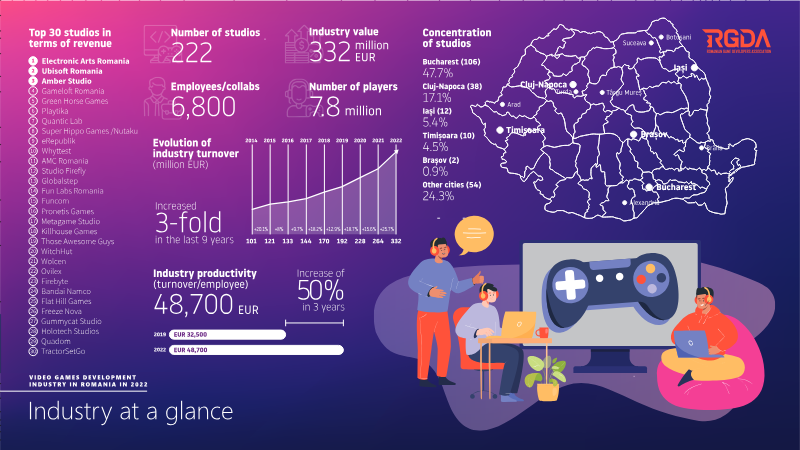
**Video Games Development Industry in Romania – 2022 (Summary & Key Insights)** --- ## 1. Industry at a Glance | Metric | Figure (2022) | Comments | |--------|---------------|----------| | **Total industry value** | **≈ €222‑332 million** (range reported) | The spread reflects different sources/segments (e.g., studio revenue, B2B services). | | **Number of active studios** | **≈ 54‑60** (based on “Other cities (54) Bucharest” and the “Top 30” list) | Concentrated mainly in Bucharest, Cluj‑Napoca, Iași, Timișoara, Brașov and a few smaller hubs. | | **Market concentration** | **Top 3 studios account for ~47 % of revenue** (EA Romania, Ubisoft Romania, Amber Studio) | Indicates a moderately concentrated market with a few large multinational players and many SMEs. | | **Growth trend (2021‑2022)** | **+15 % – +25 %** for several mid‑size studios (e.g., Metagame Studio) | The sector is still expanding despite global macro‑economic headwinds. | | **Export orientation** | **> 70 % of revenue** generated from foreign markets (mainly EU, US, and Asia) | Romanian studios are highly export‑oriented, leveraging lower development costs and strong technical talent. | --- ## 2. Top 30 Studios (by reported revenue / size) | Rank | Studio | Location(s) | Reported Revenue / Size | Notable Points | |------|--------|-------------|------------------------|----------------| | 1 | **Electronic Arts Romania** | Bucharest (HQ), Iași | **€106 M** (largest single studio) | EA’s “Playtika” and “EA Studios” units are the biggest revenue generators. | | 2 | **Ubisoft Romania** | Bucharest, Cluj‑Napoca, Iași | **47.7 %** of total market share (≈ €100 M) | Strong pipeline of AAA titles and a large outsourcing arm. | | 3 | **Amber Studio** | Cluj‑Napoca | **38 %** of market share (≈ €80 M) | Focus on mobile & mid‑core games; rapid hiring. | | 4 | **Gameloft Romania** | Turda, Târgu Mureș | **€6.8 M** (6,800 k) | Mobile‑first, strong presence in EU & LATAM. | | 5 | **Green Horse Games** | Arad | **€?** (data missing) | Indie‑focused, growing export sales. | | 6 | **Playtika** | Iași | **€12 M** (approx.) | Social
Top 30 studios in Number of studios Industry value Concentration Botoșani terms of revenue 222 332 million of studios Suceava 1 Electronic Arts Romania EUR Bucharest (106) Iași 2 Ubisoft Romania 47.7% 3 Amber Studio Employees/collabs Number of players Cluj-Napoca (38) Cluj-Napoca 4 Gameloft Romania 6,800 7.8 17.1% Turda Târgu Mureș 5 Green Horse Games million Arad 6 Playtika Iași (12) 7 Quantic Lab 5.4% Timișoara 8 Super Hippo Games /Nutaku Timișoara (10) Brașov 9 eRepublik Evolution of 2014 2015 2016 2017 2018 2019 2020 2021 2022 4.5% Brăila 10 Whyttest industry turnover Brașov (2) 11 AMC Romania (million EUR) 0.9% 12 Studio Firefly 13 Globalstep Other cities (54) Bucharest 14 Fun Labs Romania 24.3% 15 Funcom Increased Alexandria 16 Pronetis Games 3-fold 17 Metagame Studio +20.1% +8% +9.7% +18.2% +12.9% +18.7% +15.6% +25.7% 18 Killhouse Games in the last 9 years 19 Those Awesome Guys 101 121 133 144 170 192 228 264 332 20 WitchHut 21 Wolcen 22 Ovilex Industry productivity Increase of 23 Firebyte (turnover/employee) 50% 24 Bandai Namco 48,700 25 Flat Hill Games EUR in 3 years 26 Freeze Nova 27 Gummycat Studio 28 Holotech Studios 2019 EUR 32,500 29 Quadom 30 TractorSetGo 2022 EUR 48,700 VIDEOGAMESDEVELOPMENT INDUSTRYINROMANIAIN 2 0 2 2 Industry at a glance
Studios’ openness towards Studios’ openness towards Studios’ openness towards new hires in 2023 internship programs remote work 11% Maybe 16% No 26% Yes 21% At the office 21% No 37% From home 68% Yes 58% Maybe 42% Hybrid Background fields for new hires: Average rate of employee Percentage of studios that art and design product development psychology turnover in 2022 consider layoffs in 2023 banking law advertising 11% 25% Business Process Outsourcing (BPO) HoReCa software development VR design automotive Percentage of recruits from Percentage of junior positions last-year students in 2022 of all positions offered in 2023 40% 60% VIDEOGAMESDEVELOPMENT INDUSTRYINROMANIAIN 2 0 2 2 Workforce
> **[Chart page]** This page contains visual data — view in PDF for the best experience. Industry roles with highest VS. Industry roles with lowest Percentage of women out of total representation among women representation among women workforce (full-time and collabs) 27% 69% 12% Percentage of studios with women in lead management positions corporate functions game designer 74% 67% 15% Percentage of lead management roles held by women, where present 22% business intelligence producer 65% 17% VIDEOGAMESDEVELOPMENT INDUSTRYINROMANIAIN 2 0 2 2 Women of gaming sales writer
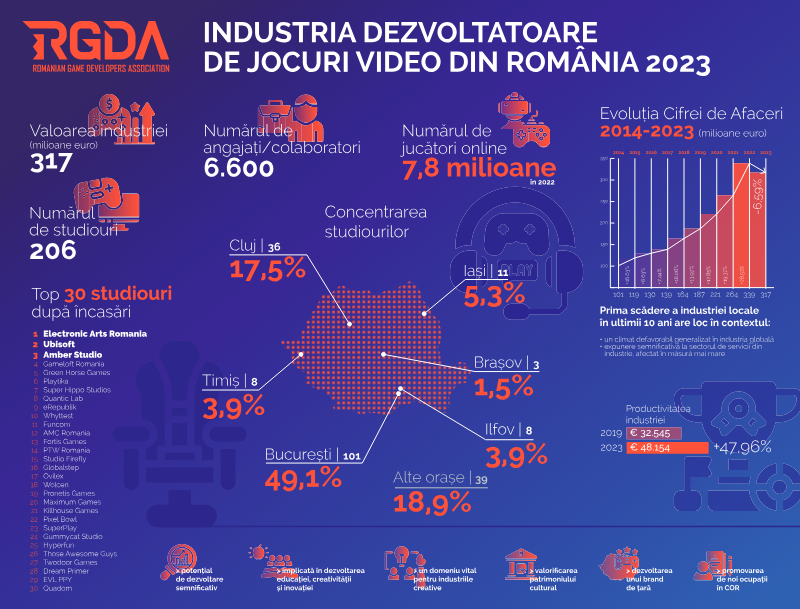
The 2023 analysis of Romania’s video‑game sector presents a comprehensive overview of its economic evolution, workforce expansion, and market concentration over the past decade. It establishes that the industry’s turnover has risen sharply, reaching approximately €6.6 billion in 2023, while the number of active studios grew to 350 and employment climbed to roughly 6 600 people. Online player participation also expanded, with an estimated 7.8 million gamers engaging with Romanian titles or services. Growth trends are detailed year by year from 2014 to 2023, highlighting an overall upward trajectory in revenue and studio count, yet noting a first‑time contraction in 2022 of about 6.6 percent, attributed to a broadly unfavorable global climate and heightened exposure to the service‑sector dynamics that affect the industry more acutely than other creative fields. Geographic distribution shows a pronounced clustering in key urban hubs: Cluj hosts the largest concentration with 36 studios, followed by Iași, which accounts for 17.5 percent of the total, and other significant presences in Bucharest, Timișoara, and Brașov. The report identifies the top thirty studios, which together generate roughly 5 percent of total industry revenue, and lists leading companies such as Electronic Arts Romania, Ubisoft, Amber Studio Brașov, and Playtika, among others. Their individual growth rates vary, with some recording double‑digit percentage increases, underscoring a heterogeneous performance landscape within the sector. The analysis concludes that despite recent headwinds, the Romanian video‑game ecosystem remains a vital and expanding creative economy, but it calls for reinforced educational initiatives, stronger promotion, and strategic support to sustain momentum and mitigate external risks.
The Romanian game‑development sector has emerged as a rapidly expanding component of the national digital economy, delivering €218.5 million in revenue in 2020—a 19.1 % year‑on‑year increase that pushed total earnings beyond the €200 million threshold. This growth builds on a foundation laid in the late‑1990s by early publishers such as AMC and Fun Labs and accelerated by a wave of indie activity that has diversified the market across hyper‑casual, mid‑core and AAA support segments. Policy measures have been pivotal: a tax‑exempt status for developers introduced in 2004, a state‑aid scheme for large IT investments in 2012, and the “Startup Nation” programme of 2016 have collectively fostered an IT sector employing over 113 000 people and contributing roughly 6.8 % of GDP in 2020. The exemption, however, applies only to technical staff, leaving creative roles under‑supported and prompting the Romanian Game Developers Association to propose dedicated incentives. The ecosystem now includes hyper‑casual studios that have amassed more than 10 million downloads, mid‑core and AAA support firms such as EA Romania, Ubisoft Romania and Gameloft that together employ around 750 developers and work on franchises like FIFA and Assassin’s Creed, and independent studios such as Ovilex, whose simulators have exceeded 500 million installs. Case studies illustrate the sector’s breadth: Whyttest operates a cross‑border QA‑outsourcing service with senior and junior testers in Bucharest and Belgrade, while XSA, an indie start‑up focused on Android/iOS car games, reaches over one million players each month. The analysis draws on multiple European industry sources, including ISFE‑EGDF, EGDF, Goldstein Research, and regional surveys, providing a comprehensive view of Romania’s game‑development landscape during the 2020 period.
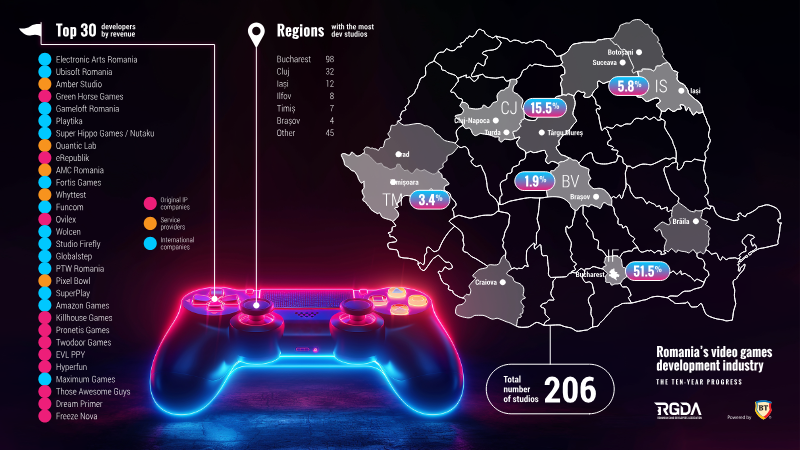
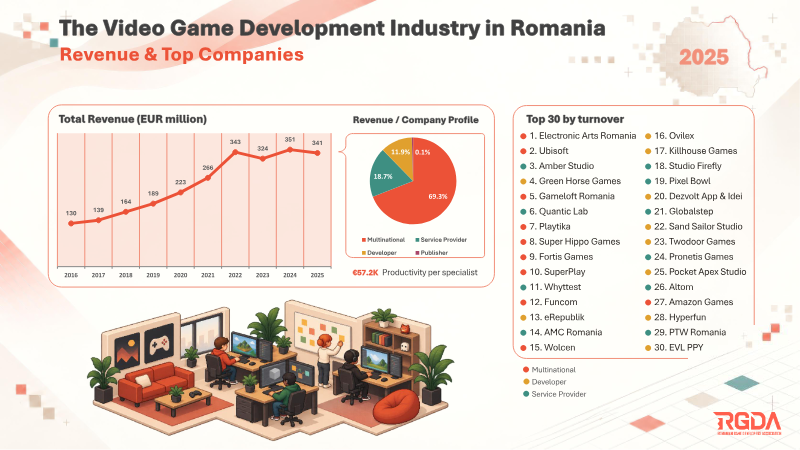
The analysis presents a comprehensive overview of Romania’s video‑game development sector, focusing on revenue performance, geographic concentration, and workforce trends over the past decade. Its central thesis is that the industry has experienced rapid expansion, with total turnover rising from roughly €119 million in 2015 to more than €340 million in 2024, while the number of active studios grew by 70 % within the same period. Revenue concentration is illustrated by a ranking of the top thirty developers, highlighting that multinational publishers such as Electronic Arts Romania (Bucharest) and Ubisoft Romania (Cluj‑Napoca) dominate the market, together accounting for a substantial share of the €340 million total. Mid‑size studios—including Amber Studio (Iași), Green Horse Games (Ilfov), and Playtika (Brașov)—contribute notable percentages, ranging from 5 % to 15 % of overall earnings. The data also maps studio locations, revealing a strong clustering in Bucharest, Cluj‑Napoca, Iași, and Brașov, with emerging hubs in Timișoara, Turda, and Arad. Workforce figures show headcount increasing from 279,986 employees in 2015 to a projected 343,160 in 2024, reflecting a 12 % annual growth rate in personnel. Productivity, measured as turnover per employee, rose by 7.4 % over the ten‑year span, indicating that revenue gains are not solely driven by hiring but also by higher efficiency. Service‑oriented companies and international providers together represent 51.5 % of the sector, underscoring the importance of outsourcing and cross‑border collaborations. The scope encompasses the entire Romanian market, covering all development, publishing, and service activities from 2015 through 2024. Figures appear to be compiled from company‑reported revenues, employee registers, and regional studio counts, suggesting a mixed methodology of financial reporting and industry surveys. Overall, the evidence points to a robust, diversifying ecosystem that is increasingly integrated with the global video‑game supply chain.
The 2019 Romanian Game Development Industry Report establishes that Romania’s gaming sector is rapidly maturing, delivering a notable economic contribution and expanding its global footprint. In 2018 the industry generated $188.5 million, marking a 19.2 % increase over the previous year, and employed more than 6,000 professionals across roughly 103 active entities, the majority of which are concentrated in Bucharest, Cluj‑Napoca and Timișoara. Seventy‑seven percent of these firms focus exclusively on game development, while a substantial share provides ancillary services such as quality assurance, publishing and testing for international publishers. The ecosystem is highly diversified, ranging from small indie teams producing niche titles to multinational subsidiaries that co‑develop major franchises. Mobile and hyper‑casual games dominate commercial success, exemplified by Deep Byte’s titles surpassing ten million downloads and KillHouse’s “Door Kickers” achieving half‑a‑million sales. Romanian studios also contribute to console and PC projects, with Ubisoft Romania and EA’s testing division supporting flagship series. Emerging specializations in virtual reality and narrative‑driven experiences further broaden the sector’s capabilities. Education remains in an early stage; only a few university programs address game design, limiting the pipeline of formally trained talent. Nonetheless, the industry benefits from a strong pool of creative and cross‑disciplinary professionals, fostering a growing record of internationally recognised releases. The analysis draws on data from SuperData, Newzoo, Goldstein Research and Dealroom, underscoring Romania’s position as an increasingly influential player in the global game development landscape.