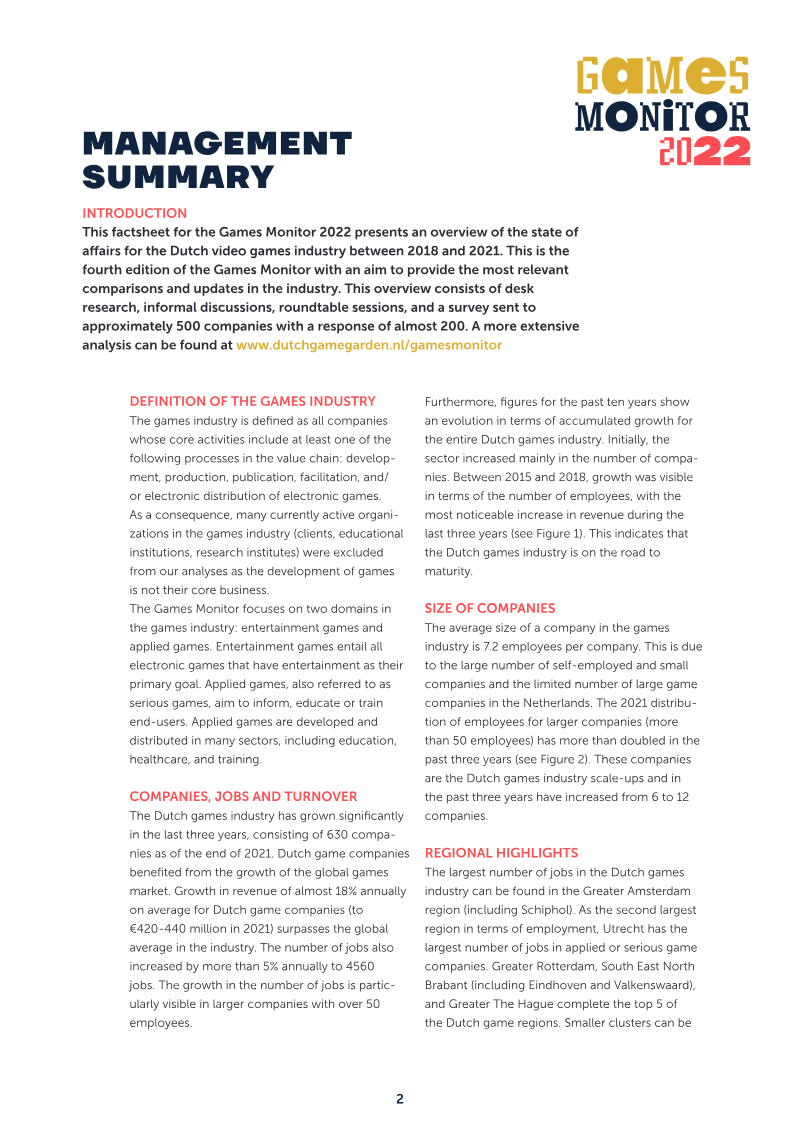
The Dutch games industry generated between €420 million and €440 million in annual revenue by the end of 2021, achieving an average annual growth rate of nearly 18%.
See it on page 2Total employment in the sector reached 4,560 jobs by 2021, reflecting an annual growth rate of over 5%.
See it on page 3The industry is scaling up, with the number of companies employing more than 50 people doubling to 12 firms between 2018 and 2021.
See it on page 3The sector comprised 630 companies by the end of 2021, with the Greater Amsterdam region leading in total employment and Utrecht hosting the highest concentration of applied game developers.
See it on page 2Workforce diversity has improved, with women accounting for 23% of the industry's employees by 2021.
See it on page 5The market is transitioning toward global competitiveness, evidenced by increased international expansion, external investments, and a rise in mergers and acquisitions.
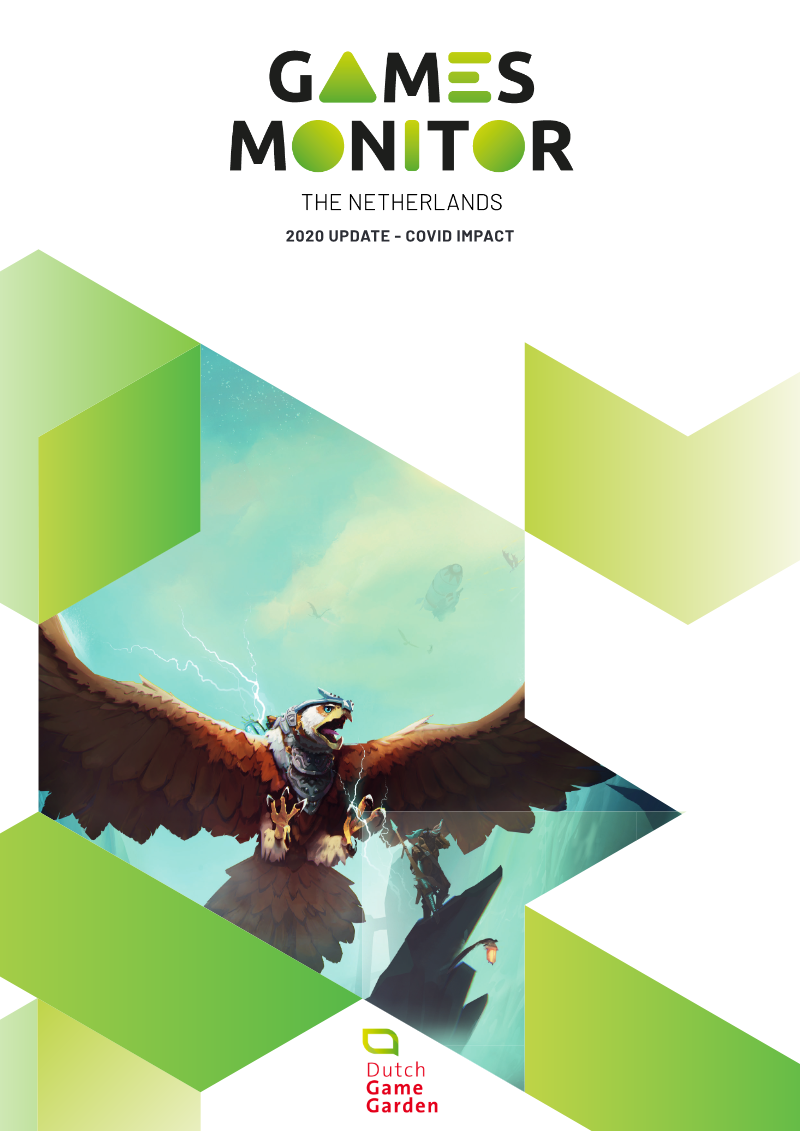
See it on page 5The Dutch Games Monitor 2022 provides a comprehensive analysis of the Netherlands' video game industry, covering the period from 2018 to 2021. The primary objective is to evaluate the sector's growth, maturity, and structural evolution. The research methodology incorporates desk research, roundtable discussions, and a survey of approximately 500 companies, yielding nearly 200 responses. The analysis focuses on two distinct domains: entertainment games and applied (serious) games, which serve sectors such as healthcare and education.
The industry demonstrates significant maturation, characterized by a shift from an initial increase in the number of companies to a more recent surge in revenue and employment. By the end of 2021, the sector comprised 630 companies, generating between €420 million and €440 million in annual revenue. This represents an average annual revenue growth of nearly 18%, outpacing global industry averages. Employment also expanded, reaching 4,560 jobs with an annual growth rate exceeding 5%. This job creation is particularly concentrated in larger organizations, with the number of scale-ups employing over 50 people doubling to 12 companies over the three-year period.
Geographically, the Greater Amsterdam region leads in total employment, while Utrecht maintains the highest concentration of applied game developers. Although the number of dedicated game education programs has slightly decreased, the industry is seeing a rise in diversity, with the percentage of women in the workforce reaching 23% by 2021. Furthermore, the sector is increasingly characterized by international expansion, a rise in external investments, and a growing number of mergers and acquisitions, signaling that the Dutch games industry is successfully transitioning into a more mature and globally competitive market.