AR reports and market data
Documents

Mobile gaming – We’re not in Kansas anymore!
The mobile gaming industry is undergoing a significant transformation, moving beyond traditional app store downloads toward an immersive, multi-sensory ecosystem.
- The mobile gaming industry reached a significant revenue milestone of $41 billion in 2016, signaling a shift from traditional app store models toward immersive, multi-sensory ecosystems.
- Virtual reality (VR) is evolving into a primary industry driver, expanding beyond gaming into therapeutic applications for bedridden patients and fitness integrations with hardware like stationary bikes.
- Augmented reality (AR) and 360-degree content are gaining traction as essential components for social media platforms and specialized entertainment venues such as theme parks.

Still Logged In: What AR and VR Can Learn from MMOs
The development of virtual and augmented reality platforms represents a fundamental shift from hardware-centric design to the creation of complex, persistent social societies.
- AR and VR platforms must transition from hardware-centric development to prioritizing server-side social infrastructure and behavioral systems to ensure long-term viability.
- Developers should treat every game mechanic as a potential vector for abuse, requiring the implementation of granular permission controls, persistent identity systems, and administrative logging.
- Fostering personal investment through established digital identities is a primary strategy for discouraging griefing and promoting positive social interaction within virtual environments.

Designing for AR: A Postmortem on the Development of 'Woorld'
The development of the augmented reality title Woorld centers on the challenge of creating cohesive virtual experiences within unpredictable, user-defined physical environments.
- Successful AR design requires abandoning fixed, developer-controlled camera perspectives in favor of intuitive guidance systems that allow users to navigate unpredictable physical environments.
- To manage volatile surface data, the development team utilized custom edge-detection algorithms and smoothing processes to ensure virtual objects interacted naturally with noisy real-world spaces.
- Performance optimization for mobile hardware was achieved through low-poly asset modeling, texture atlasing, and asynchronous audio loading to mitigate battery drain and thermal output.
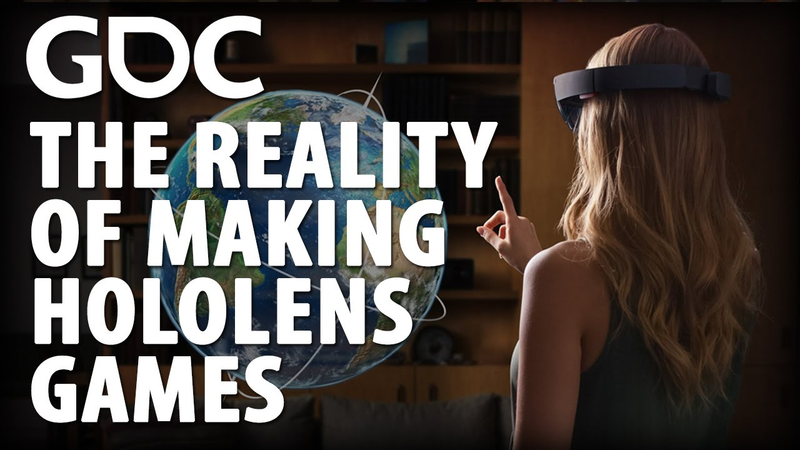
The Reality of Making Hololens Games
Developing for the HoloLens relies on a streamlined integration between the Unity 3D engine and the HoloLens Toolkit, which provides essential prefabs for interface design, gesture recognition, and spatial mapping.
- The HoloLens market is currently restricted to specialized enterprise sectors like logistics and construction, as hardware limitations and a narrow field of view prevent mass-market consumer viability.
- Development relies on the integration of the Unity 3D engine with the HoloLens Toolkit, which provides pre-built modules for gesture recognition, voice commands, and spatial mapping to minimize custom coding.
- Spatial mapping technology allows virtual objects to interact with the physical environment by generating a 3D mesh that supports physics-based collisions and depth-buffer occlusion.

The state of virtual reality and augmented reality in 2016
The year 2016 represents a critical inflection point for virtual and augmented reality, marking a transition from experimental technology to a burgeoning industry.
- In 2016, virtual and augmented reality are transitioning from experimental technology to a burgeoning industry, though mass-market consumer adoption is currently hindered by high hardware costs and a lack of long-term engagement titles.
- Business-to-business applications in sectors like architecture, education, automotive design, and healthcare are currently the primary engines for sustainable revenue growth.
- Gaming serves as the critical testing ground for refining hardware interactions and solving technical challenges such as motion sickness, exemplified by early titles like Bullet Train and Lucky’s Tale.

Pokémon GO - Designing for Good - Extra Credits
Real-world augmented reality games possess significant potential to foster positive societal outcomes by encouraging players to engage more deeply with their physical environments.
- Location-based AR games can foster positive societal outcomes by gamifying physical activity and encouraging deeper engagement with local environments.
- Developers can transform mundane routines into educational experiences by integrating historical context and cultural heritage information into location-based mechanics.
- Small businesses can utilize location-based mechanics to drive foot traffic and customer engagement, though excessive corporate branding risks undermining the game's immersive quality.

Pokémon GO - Designing for the Real World - Extra Credits
The rapid rise of augmented reality games, exemplified by the massive popularity of Pokémon GO, necessitates a fundamental shift in design philosophy to prioritize real-world safety.
- Developers must prioritize real-world safety in augmented reality games to prevent physical hazards and avoid restrictive government legislation.
- Implementing crowdsourced safety tools allows users to flag dangerous terrain, triggering visual alerts that break immersion to restore player situational awareness.
- Developers should integrate robust safety features for vulnerable players, including parental proximity-tracking, panic buttons, and established emergency protocols for law enforcement cooperation.

Improving on Pokemon GO - Making Better Augmented Reality Games - Extra Credits
Augmented reality (AR) games often prioritize technical infrastructure over deep gameplay mechanics, leaving significant room for improvement in player engagement.
- Developers should shift focus from technical AR infrastructure to deep, traditional game design mechanics to improve player retention and long-term engagement.
- Replacing simple collection mechanics with Diablo-style loot systems provides greater variety and longevity than creature-based collection models.
- Combat systems should evolve from basic gestures to turn-based RPG mechanics that incorporate strategic equipment loadouts and character progression.

Prehistoric Spatula lead Stephanie Bazeley talks DinerSaur, AR and accessibility
DinerSaur is an augmented reality (AR) mobile game developed by Prehistoric Spatula that tasks players with feeding food to various dinosaurs within their own physical environment.
- Prehistoric Spatula developed DinerSaur, an AR mobile game built on Unity that integrates physical assets like printable coloring pages to enhance user engagement.
- The studio utilizes a premium business model for DinerSaur to avoid the predatory billing practices and in-app purchase structures common in freemium mobile gaming.
- DinerSaur prioritizes accessibility for younger players by utilizing simple control schemes that intentionally avoid complex virtual joysticks.

How Tekken Card Tournament uses augmented reality physical cards
Tekken Card Tournament integrates physical collectible cards with augmented reality technology to bridge the gap between traditional tabletop gaming and digital mobile play.
- Tekken Card Tournament bridges physical and digital gaming by using QR-style codes on collectible cards to import characters and stats into iOS, Android, and PC platforms.
- The game utilizes augmented reality to project 3D character models onto real-world surfaces, allowing players to visualize their physical deck collection in a digital environment.
- Players can use the AR functionality to capture and share photographs of digital character overlays placed on real-world objects or environments.

ARGs - II: What are Augmented Reality Games? - Extra Credits
Augmented reality games (ARGs) represent a digital overlay on the physical world, functioning in real time to enhance or modify a user's perception of their environment.
- Augmented reality games (ARGs) are evolving from simple GPS-based map overlays into sophisticated systems that integrate real-world data, such as retail product scanning and location-specific information, into gameplay loops.
- The transition from handheld devices to wearable technology is critical for shifting AR from an immersion-breaking activity to an ambient, constant companion in the user's daily life.
- AR design holds the potential to incentivize positive behavioral changes, including increased physical activity, environmental exploration, and educational engagement.