1 free read left. Create a free account for unlimited reading + AI research.
Create free account
ARGs - II: What are Augmented Reality Games? - Extra Credits

Key insights
5 takeaways- 01A significant ethical risk in AR development is the potential for 'people placement,' where gameplay is used as a vehicle for invisible, insidious corporate marketing.
- 02Augmented reality games (ARGs) are evolving from simple GPS-based map overlays into sophisticated systems that integrate real-world data, such as retail product scanning and location-specific information, into gameplay loops.
- 03The transition from handheld devices to wearable technology is critical for shifting AR from an immersion-breaking activity to an ambient, constant companion in the user's daily life.
- 04AR design holds the potential to incentivize positive behavioral changes, including increased physical activity, environmental exploration, and educational engagement.
- 05Developers must balance the use of location-aware mechanics with player volition to ensure that AR remains a tool for personal and social growth rather than a platform for manipulative indoctrination.
Ask AI about this video
Transcript
Okay, so last week we talked about alternate reality games, games that claim to be part of our real world. This week we're going to talk about the other ARGs, augmented reality games. So what is augmented reality? Well, it's really just any digital augmentation of the physical world occurring in real time. So for example, you know when you're watching hockey on TV and sometimes they digitally highlight the puck so you can see it better during a live broadcast? That's an example of reality augmented. And hockey fans may argue about whether it's the best use of augmentation, but it serves as a good example of it. It's a digital overlay on the real world occurring in real time. Another good example would be Terminator vision. But yeah, that probably wasn't the best use of the technology either. Okay, so how is this used in games? Well, we could cite as an early and primitive example the old Eye of Judgment card game where the PlayStation 3 would use the EyeToy to read paper playing cards on a mat and to display the characters or spells they represented as fully animated 3D models
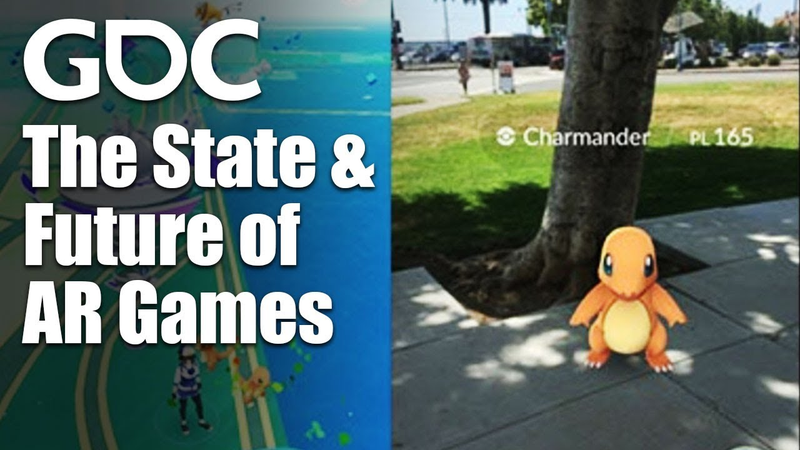
on screen. But the real rise in what's been called augmented reality games has come with the dramatic increase in GPS-enabled smartphone use. Many of the augmented reality games you see today are simply an overlay for Google Maps that lets you play a basic kingdom-building game or a collection game on a map made from your real streets. The problem with this is that creating a map from your real streets generally doesn't add anything to these games. In fact, in general it tends to be like having a terrible random map generator whose parameters aren't built at all around the rules of the game. The other type of augmented reality games that you often see today are games that take advantage of the built-in cameras that are common to many smartphones. These games let you play a standard game on a background that is well, whatever your camera happens to be seeing. If any of you remember Star Wars arcade Falcon Gunner, that was a fairly good example of these type of experiences. The problem is that these games don't tend to use real world locations or interactions in any interesting way. In general, once the novelty of the fact that you're doing quests with street names you know or fighting off tie fighters attacking your front porch has worn off, you're left with a game that would simply be better if it wasn't trying to incorporate reality. Now, using the real world in an engaging way
is no easy task. The first thing most people leap to is to create an incredible adventure in their city. And these could be amazing. Imagine having to fight off aliens as you ride up the Space Needle, or training your skills at the Sydney Opera House. Or if you're willing to be just a little sacrilegious, imagine how amazing it would be to battle your way up the Corcovado Mountain, only to emerge at the end and have the final encounter happen at the Cristo. It'd be a great way to see the world and get outdoors, or just get more familiar with your town. But the problem is it doesn't scale. It's prohibitively to do something like this because you'd have to create custom content for everywhere you launched. Even in the largest cities, that just isn't really viable. But there are other ways to incorporate the real world that don't have you building a unique adventure for every park or monument. Although man, that would be cool if somebody found the funds to do it someday. There's a lot of real world data we can draw on that's more ubiquitous. For example, Google Maps has plenty of tags already in it. Imagine a quest to retrieve an ancient tome that required you to go to the library. Or what about monsters that only spawn in parks? That sort of thing is completely achievable and makes the real world a more exciting place. But there's thousands more things we can do. You want to use the camera? How about using it as a UPC scanner? What if you
had a quest to go scan a copy of Love and Seia to increase your chemical lore? Or the Idols of the King to unlock Arthurian adventures? Heck, you could even be able to scan Band-Aids or health foods once a day to gain health. And that's just the tip of the iceberg. All this stuff can feel pretty clunky and unnatural when you're constantly having to pull out your phone to do it. It has this strange immersion breaking effect of making you very conscious of doing a game activity. Sometimes you're in the game, sometimes you're not in the game. But that may all change soon with affordable wearable technology. We'll see how the Google Glasses turn out, but with a continuous overlay to the real world, one that you have on all the time, it radically changes the experience and merges your real world with your game world. Imagine if you're walking along and an alert popped up that there was a quest or a rare monster in your vicinity. Then imagine if you could follow your Google Maps arrow displayed on your headset as it directs you where you're supposed to go. Imagine if you were in a bookstore and it told you that a tome of power was laying around nearby, and then gave you the name of the book to search out. Eventually, you might even go one step further and project monsters or even whole alternate worlds onto your visual field. But, in my opinion, that's not something you want to do most of the time because that's too distracting. It
takes us too much out of the real world. It might work okay for some games, but in my opinion, augmentation is better used when it simply becomes a constant companion to existence, allowing us ways to enhance our real experiences and quietly becoming a part of them. And as many of you may have noticed at this point, this technology can be used for unimaginable good. There's a reason why examples have involved libraries and healthy food. It's because when you integrate play into life, you can use play as a portal to expose us to all sorts of wonderful things. And when you combine this with the collaborative problem solving that alternate reality games engender, because these two types of games will become one when wearable technology becomes ubiquitous, there's no limit to what you might achieve. But, as usual, there's a serious danger that comes with that, too. The line between exposure and subtle indoctrination is a fine one. And even for things I think to be good, I wouldn't ever want to fool someone into doing them. After all, volition is perhaps our most ennobling aspect. I mean, a good act without volition is merely happy coincidence. A tool this powerful is rife with potential for abuse. I've heard a lot of talk about the declining efficacy of traditional advertising. And the most dystopian part of me sees a future
where, rather than product placement, we do people placement as a yet more insidious form of marketing. Think about it this way. Imagine if you were playing a spy game and you had a quest where you had to ask for documents from a barista at Starbucks because they were undercover and were secretly your contact. A lot of us would probably buy a coffee while we're there. Or what about an RPG where certain monsters only spawn in the middle of Walmart? Now, this might not even seem like advertising to the standard player, and yet I guarantee you the effect of actually getting bodies into a store is something advertisers now can only dream of. There's a ton of awesome potential for this stuff, and it's up to us to make sure this form evolves to match that potential rather than turning into a torpid pit of invisible marketing ploys. Be conscious and cognizant. Try to be aware when your real world self is being manipulated by your game self rather than the other way around, and don't play on those terms. Because if we can do that, if we can keep augmented reality from veering that direction, we have a tool of inestimable power. Games can get us to work together. They can get us to work harder. They can expose us to new material and encourage us to learn. They can help us get over our fear of new things and bring us to
stunning realizations about ourselves. When you bring that to the real world and make that a part of our everyday lives, there's no limit to the good it can do or the joy it can bring. But, you know, with great power and all that. See you next week.
Summary
Augmented reality games (ARGs) represent a digital overlay on the physical world, functioning in real time to enhance or modify a user's perception of their environment. While early iterations relied on primitive camera-based tracking or basic GPS-enabled map overlays, the medium is evolving toward more sophisticated integration. The primary challenge for developers lies in moving beyond superficial gimmicks—such as fighting virtual enemies on a static map—toward meaningful, location-aware experiences that utilize real-world data, such as library locations or retail product scanning, to create cohesive gameplay loops.
The future of this technology is closely tied to the development of wearable devices, which promise to move augmented reality from a handheld, immersion-breaking activity to a constant, ambient companion. By integrating game mechanics into daily life, developers have the potential to encourage positive behaviors, such as increased physical activity, exploration, and learning. However, this power introduces significant ethical risks, particularly regarding the potential for "people placement" as a form of insidious, invisible marketing. By gamifying the act of visiting specific retail locations or interacting with branded environments, developers could inadvertently turn players into tools for corporate influence.
Ultimately, the thesis holds that while augmented reality offers immense potential to enrich human experience and foster collaborative problem-solving, it requires a cautious approach to design. Players must remain cognizant of the fine line between organic engagement and subtle indoctrination. If developers prioritize player volition and meaningful interaction over manipulative advertising, augmented reality can serve as a powerful, transformative tool for personal and social growth.



















Comments