Updated Jun 1, 2026 by InvestGame
Report · February 23, 2026
Published by InvestGame
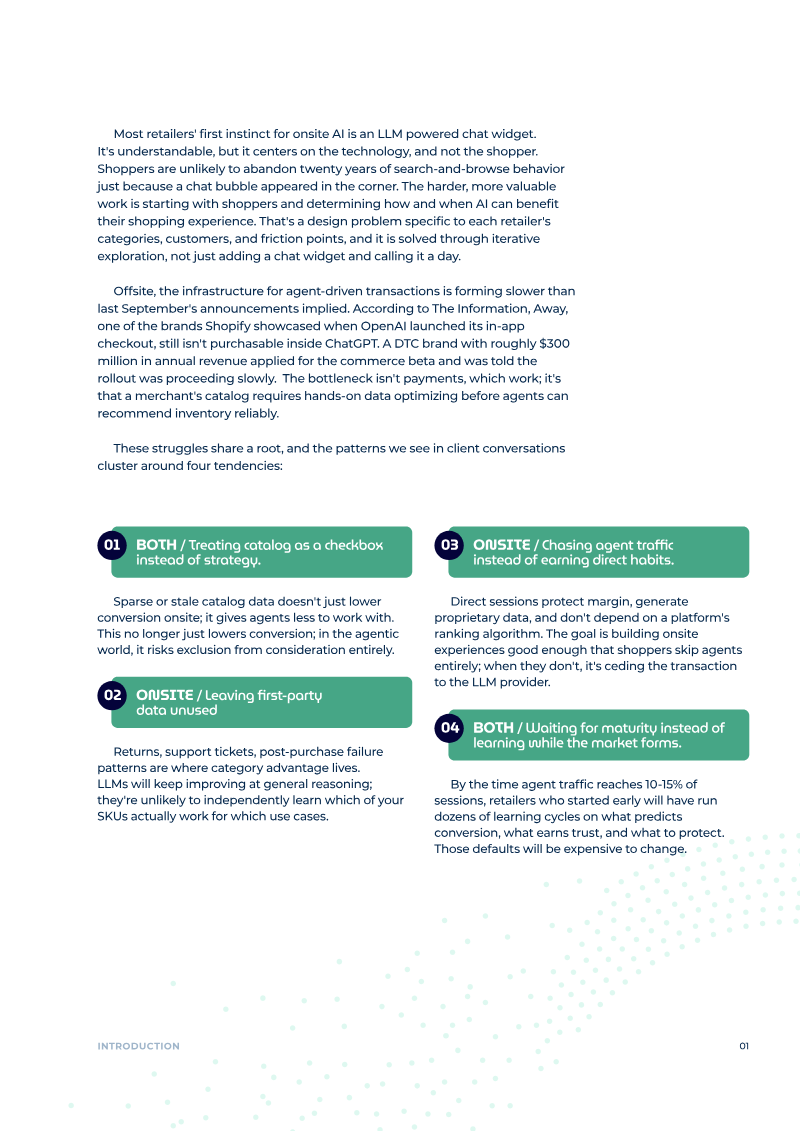
Most retailers' first instinct for onsite AI is an LLM powered chat widget. It's understandable, but it centers on the technology, and not the shopper. Shoppers are unlikely to abandon twenty years of search-and-browse behavior just because a chat bubble appeared in the corner. The harder, more valuable work is starting with shoppers and determining how and when AI can benefit their shopping experience.
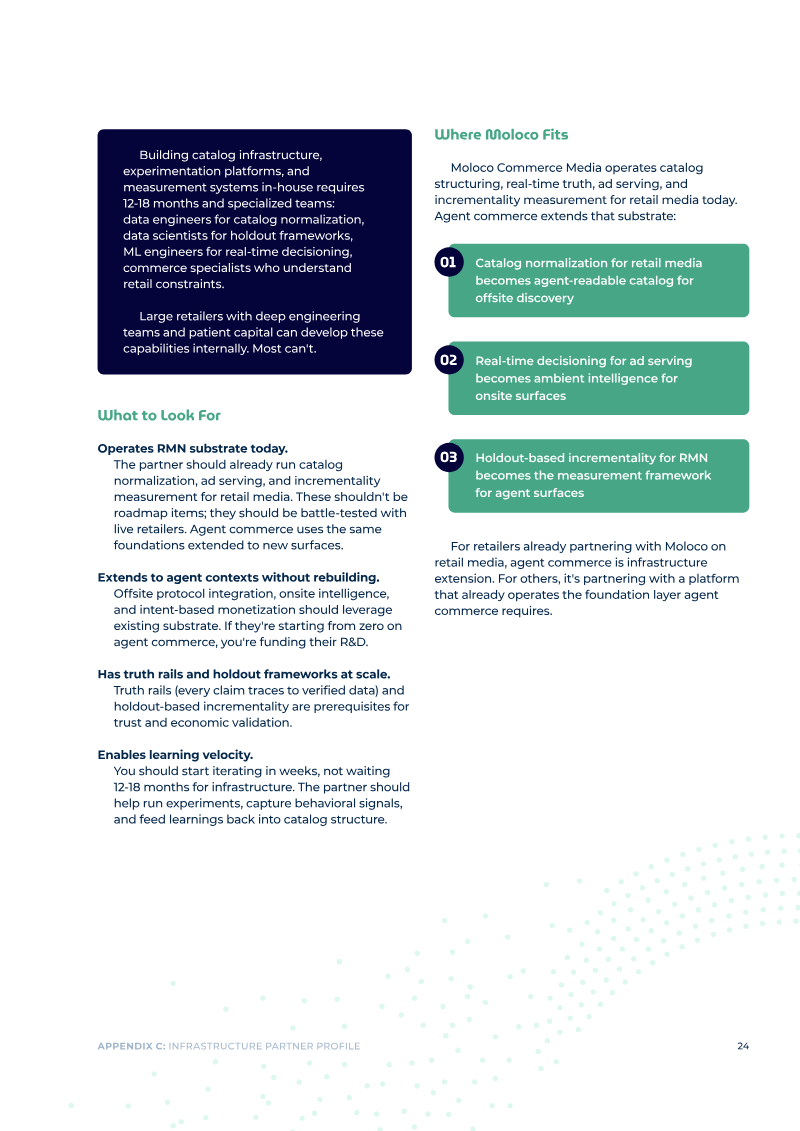
Most retailers' first instinct for onsite AI is an LLM powered chat widget. It's understandable, but it centers on the technology, and not the shopper. Shoppers are unlikely to abandon twenty years of search-and-browse behavior just because a chat bubble appeared in the corner. The harder, more valuable work is starting with shoppers and determining how and when AI can benefit their shopping experience. That's a design problem specific to each retailer's categories, customers, and friction points, and it is solved through iterative exploration, not just adding a chat widget and calling it a day. Offsite, the infrastructure for agent-driven transactions is forming slower than last September's announcements implied. According to The Information, Away, one of the brands Shopify showcased when OpenAI launched its in-app checkout, still isn't purchasable inside ChatGPT. A DTC brand with roughly $300 million in annual revenue applied for the commerce beta and was told the rollout was proceeding slowly. The bottleneck isn't payments, which work; it's that a merchant's catalog requires hands-on data optimizing before agents can recommend inventory reliably. These struggles share a root, and the patterns we see in client conversations cluster around four tendencies: 01 BOTH / Treating catalog as a checkbox 03 ONSITE / Chasing agent traffic instead of strategy. instead of earning direct habits. Sparse or stale catalog data doesn't just lower conversion onsite; it gives agents less to work with. This no longer just lowers conversion; in the agentic world, it risks exclusion from consideration entirely.
ONSITE / Chasing agent traffic instead of strategy. instead of earning direct habits. Sparse or stale catalog data doesn't just lower conversion onsite; it gives agents less to work with. This no longer just lowers conversion; in the agentic world, it risks exclusion from consideration entirely. 02 ONSITE / Leaving first-party data unused Direct sessions protect margin, generate proprietary data, and don't depend on a platform's ranking algorithm. The goal is building onsite experiences good enough that shoppers skip agents entirely; when they don't, it's ceding the transaction to the LLM provider. 04 BOTH / Waiting for maturity instead of Returns, support tickets, post-purchase failure learning while the market forms. patterns are where category advantage lives. LLMs will keep improving at general reasoning; By the time agent traffic reaches 10-15% of they're unlikely to independently learn which of your sessions, retailers who started early will have run SKUs actually work for which use cases. dozens of learning cycles on what predicts conversion, what earns trust, and what to protect. Those defaults will be expensive to change. INTRODUCTION 01
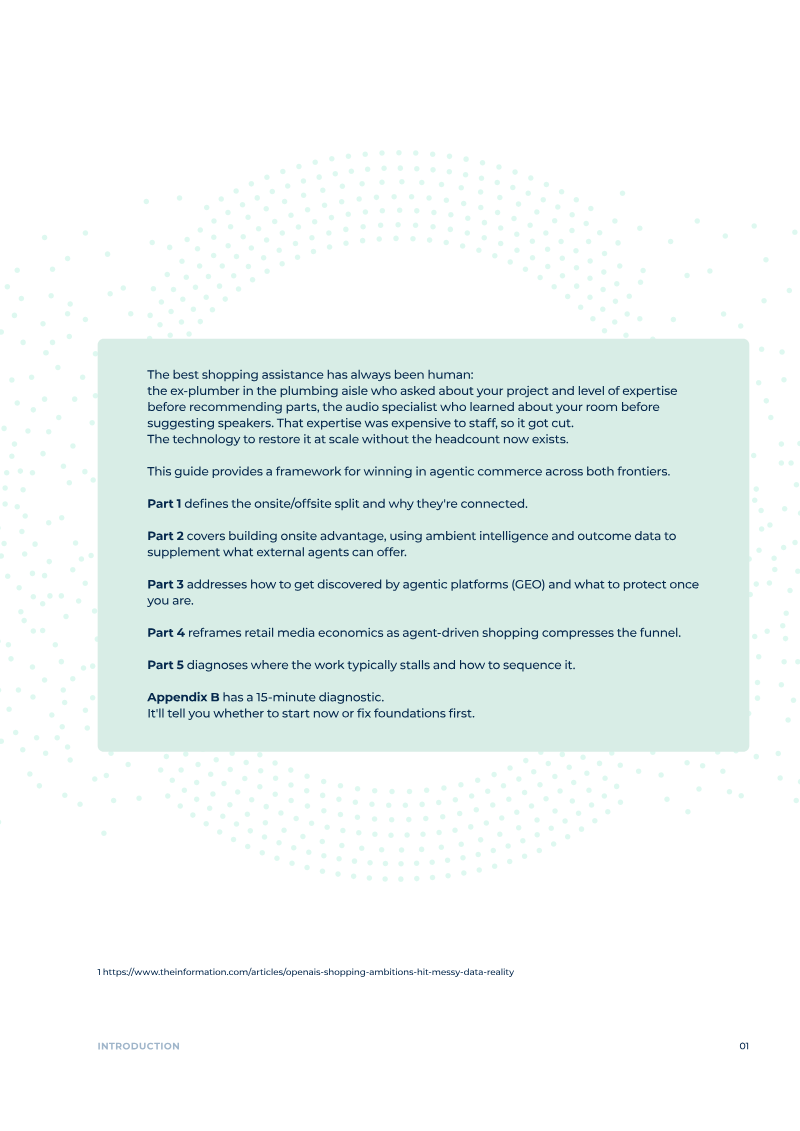
The best shopping assistance has always been human: the ex-plumber in the plumbing aisle who asked about your project and level of expertise before recommending parts, the audio specialist who learned about your room before suggesting speakers. That expertise was expensive to staff, so it got cut. The technology to restore it at scale without the headcount now exists. This guide provides a framework for winning in agentic commerce across both frontiers. Part 1 defines the onsite/offsite split and why they're connected. Part 2 covers building onsite advantage, using ambient intelligence and outcome data to supplement what external agents can offer. Part 3 addresses how to get discovered by agentic platforms (GEO) and what to protect once you are. Part 4 reframes retail media economics as agent-driven shopping compresses the funnel. Part 5 diagnoses where the work typically stalls and how to sequence it. Appendix B has a 15-minute diagnostic. It'll tell you whether to start now or fix foundations first. 1 https://www.theinformation.com/articles/openais-shopping-ambitions-hit-messy-data-reality INTRODUCTION 01
A shopper asks ChatGPT for standing desk Some retailers will benefit (at least initially), others recommendations, gets clear on weight capacity, will get routed around. This splits Agentic commerce cable management, and height range for their setup, across two battlegrounds: then lands on a PDP with a spec sheet and 47 reviews to parse. That gap between the conversation 01 Onsite (your properties): they just had, and the experience offered is where they’re lost. This is the onsite problem: shoppers are forming expectations about what intelligent shopping feels like, and most retail sites are not meeting them. Not because the technology is missing, but because it's implemented wrong…a chat widget that waits to be discovered instead of surfacing when behavior signals confusion. Where you control the experience and hold outcome data no one else has. Where you can build habits that make external agents less necessary. This is the offense: earning direct relationships through intelligence that frontier agents can't replicate. 02 Offsite (agent ecosystems):
ignals confusion. Where you control the experience and hold outcome data no one else has. Where you can build habits that make external agents less necessary. This is the offense: earning direct relationships through intelligence that frontier agents can't replicate. 02 Offsite (agent ecosystems): The offsite problem is different but related. A growing share of shopping journeys will start in Where consideration sets form and where you agent surfaces rather than search queries. need to be discoverable without giving away your ChatGPT, Gemini, Perplexity, and whatever comes differentiation. Open protocols are arriving fast: next will shape consideration sets before shoppers Google's UCP is already live, OpenAI's commerce reach any retailer's site, and increasingly close the integration ACP is onboarding merchants now. transaction without them reaching it at all. These will standardize transactions but not whether Models can reason over unstructured content, but agents recommend you in the first place. What you they won't infer claims for you that could break trust can control: catalog depth, outcome signals, and in them. If your catalog requires guessing on what you share versus protect is covered in Parts 2 allergens, compatibility, or fit, agents will and 3. The goal is staying in the game without recommend someone else. becoming a commodity. These problems share a root: Retailers who treat onsite and offsite as competing frontier models are getting good enough at product priorities will fail at both. Retailers who see them as reasoning that shoppers will use them. two expressions of the same capability will compound advantages in both directions.
ms share a root: Retailers who treat onsite and offsite as competing frontier models are getting good enough at product priorities will fail at both. Retailers who see them as reasoning that shoppers will use them. two expressions of the same capability will compound advantages in both directions. AGENT ECOSYSTEM ONSITE AGENTIC EXPERIENCES PART 1: THE EXPECTATION GAP AND DUAL FRONTIER 03
The mobile gaming industry is entering a period of strategic recalibration, projected to reach $126.1 billion in revenue by 2025. This growth is underpinned by a transition toward hybrid monetization models and the integration of AI-powered personalization to combat persistent retention challenges. While global install volume grew by 4% in 2024, the market exhibits a distinct geographic divide; North American and European markets face stagnation, whereas Latin America and the Middle East and North Africa regions demonstrate robust expansion. Success in this evolving landscape requires developers to move beyond traditional acquisition, favoring diversified channels such as Connected TV and localized, player-centric engagement strategies. Data from early 2025 indicates that user tracking remains a pivotal operational hurdle, with global App Tracking Transparency opt-in rates hovering at 37.9%. Although arcade games have seen notable improvements in opt-in performance, the United States remains relatively static at 32%, underscoring the necessity for refined messaging strategies to maintain visibility. Concurrently, the industry is grappling with a complex financial environment characterized by rising costs per install and declining average revenue metrics. These headwinds are forcing a shift in marketing tactics, as developers increasingly rely on a broader array of acquisition partners and data-informed creative experimentation to sustain growth. Ultimately, the path to profitability in 2025 lies in prioritizing long-term player value over short-term acquisition metrics. By leveraging AI-driven optimization and fostering community-building initiatives, developers can mitigate the impact of declining revenue per user. The industry is clearly moving toward a more sophisticated, data-reliant ecosystem where the ability to measure performance across fragmented channels—including mobile and Connected TV—is essential for maintaining a competitive advantage in a maturing global market.
Decoding the Breakout AI Across Finance, Social, and Health Apps, the 2026 Global Mobile App Marketing Trends White Paper Uncovers the Drivers In 2025, the global mobile app market experienced a fundamental shift. Traffic-driven growth approaches reached their limits, and broad, volume-oriented strategies began to lose traction. Instead, value-led operations, technology-enabled optimization, and deep localization emerged as the primary drivers of sustainable growth.
Early data and actionable insights from 6,000+ sites across Tom Critchlow, EVP Audience Growth March 2026 On February 5, 2026, Google released its first standalone Discover core update, the first time in Discover’s eight-year history that Google has issued an algorithm change targeting Discover specifically. At the same time, AI Overviews are reducing click-through rates on informational queries in Search.
Thebiggest shifts in AI today aren’t technological, Consumer behavior is shifting faster than marketing budgets have been able to follow, New research on AI/LLM disruption1, done in partnership with BCG, dives deep into these behavioral shifts, the current state of play for marketers, and where we go from here.