Action-Adventure reports and market data
Documents
The D&D company is spending $1bn making video games, and none of them are games-as-a-service
Hasbro is currently executing a decade-long, $1 billion investment strategy to expand its footprint in the video game industry.
- Hasbro is executing a $1 billion, decade-long investment strategy to expand its video game footprint, explicitly rejecting the games-as-a-service (GaaS) model in favor of premium, single-player experiences.
- The company is prioritizing high-quality, 40-to-50-hour traditional PC and console titles to avoid the high volatility and low success rates associated with GaaS.
- Hasbro’s portfolio strategy divides development between internal studios for core brands like Dungeons & Dragons and Magic: The Gathering, and external partnerships for casual or mobile properties like Monopoly Go.

We talk 007, Amazon, Switch 2, Hitman and MindsEye with IO Interactive boss Hakan Abrak
IO Interactive CEO Hakan Abrak discusses the studio’s current trajectory, focusing on the upcoming release of 007 First Light, the studio’s expansion, and its long-term development strategy.
- IO Interactive is developing '007 First Light' as an original narrative, moving away from movie tie-ins to establish a new franchise identity distinct from the Hitman series.
- The Hitman: World of Assassination trilogy has achieved significant commercial scale, reaching 25 million units sold and 18 million total players.
- The studio is prioritizing performance parity for '007 First Light' on the upcoming Nintendo Switch 2, utilizing its proprietary engine to maintain AAA quality at lower production costs.

The story of Samson: The buggy GTA-style game that just had to launch this month
The global gaming industry is currently navigating a period of significant structural recalibration, characterized by shifting subscription models and volatile market performance.
- The gaming industry is undergoing structural recalibration, evidenced by a 5% increase in U.S. consumer spending and a 69% surge in U.K. hardware sales driven by anticipation for the Nintendo Switch 2.
- Major industry players are adjusting strategies, such as Xbox reducing Game Pass pricing by 23% and delaying the inclusion of flagship titles like Call of Duty.
- The open-world title Samson highlights the risks of independent production, as Liquid Swords was forced to pivot to a self-publishing model in 2025 due to a lack of publisher funding.

Making Beautiful 3D Games Is Easier Than You Think
Creating a high-quality, stylized 3D adventure game—modeled after the aesthetic of titles like The Legend of Zelda: Breath of the Wild—is achievable for independent developers using free assets and a disciplined approach to visual design.
- Achieving a stylized, Breath of the Wild-inspired aesthetic relies on a limited terrain palette of three to four textures, using hue shifting and saturation adjustments to ensure all environmental elements, such as grass, dirt, and stone, remain color-coordinated.
- To avoid visual repetition in terrain, use noise spreads for grass billboards and maintain a consistent tiling scale across all terrain layers to create a unified look.
- High-fidelity assets should be placed strategically to anchor the scene, as the human brain interprets the presence of a few high-resolution objects as an indicator of overall high-quality visual fidelity.
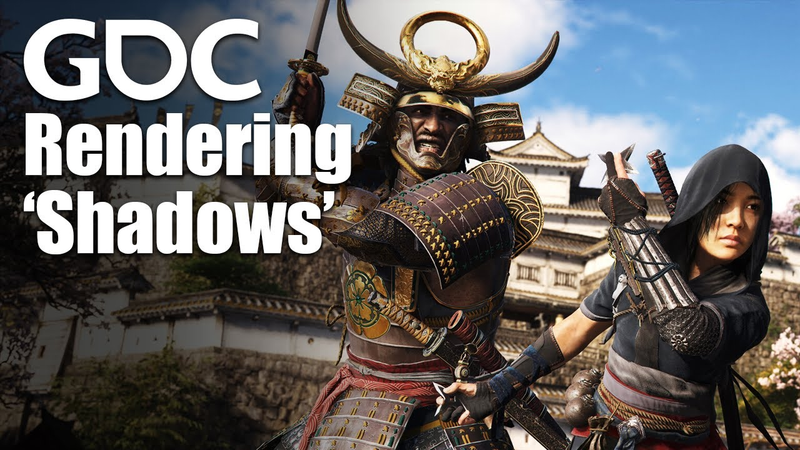
Rendering 'Assassin's Creed Shadows'
Assassin’s Creed Shadows represents a significant technical evolution for the Anvil engine, transitioning to a unified, monorepo codebase designed to streamline development across Ubisoft’s diverse portfolio.
- Assassin's Creed Shadows utilizes a multi-tiered rendering system for its open world, employing LOD meshes up to 4km, point cloud mass-imposter rendering up to 8km, and baked terrain vistas for distances beyond 8km.
- The engine architecture uses a database-driven approach to manage mesh relations and properties, allowing for C++-like data structures that automatically generate getters and setters for both CPU and GPU storage.
- The rendering pipeline incorporates a hybrid approach to Global Illumination (GI), combining baked volumetric GI with hardware and software-accelerated ray tracing to balance performance and visual fidelity.

CD Projekt Red: "Nintendo’s audience is different to what it used to be"
CD Projekt Red’s recent expansion into the Nintendo ecosystem, specifically with the launch of Cyberpunk 2077 on the Nintendo Switch 2, highlights a strategic shift in how major AAA developers view the platform.
- CD Projekt Red is targeting the Nintendo Switch 2 to reach a maturing demographic that values high-quality, open-world RPGs but lacks interest in high-end PC rigs or stationary consoles.
- The studio is prioritizing physical media on the Switch 2 by including the full game on the cartridge to eliminate the friction of large mandatory downloads.
- CD Projekt Red treats the Switch 2 as a primary, distinct platform rather than a secondary porting destination, leveraging its portability to fulfill specific player demand for flexible gaming.

Are Publishers Right to Flee Grand Theft Auto 6? - THE GAME BUSINESS SHOW Episode 1
The global gaming industry is currently undergoing a period of profound transition, characterized by a widening gap between thriving studios and those struggling with funding shortages and labor instability.
- The impending release of Grand Theft Auto 6 is forcing major publishers to aggressively shift their release schedules to avoid being eclipsed by its market dominance, following historical data where its predecessor captured two-thirds of UK game sales in its first three weeks.
- The gaming industry is becoming increasingly fragmented as companies abandon traditional trade shows like GDC in favor of proprietary events, threatening long-term professional networking and collective industry cohesion.
- A widening gap exists between thriving studios and those facing severe labor instability and funding shortages, creating a landscape defined by distinct winners and losers.

How Ubisoft Brought Feudal Japan to Life: Rendering 'Assassin's Creed Shadows' with Nicolas Lopez
The development of Assassin’s Creed Shadows represents a significant technical evolution for the Anvil engine, necessitating a shift from traditional asset-based workflows to highly scalable, systemic solutions.
- The development of Assassin's Creed Shadows required a next-generation overhaul of the Anvil engine, incorporating a new ray-tracing pipeline and micropolyon technology.
- Managing the game's massive scale—which includes dynamic time-of-day, seasonal changes, and systemic weather—necessitated the development of specialized debugging tools, such as generating QR codes to replicate exact in-game environmental parameters for testers.
- Working on an open-world project of this magnitude requires shifting the engineering mindset from pursuing maximum individual asset quality to prioritizing scalable solutions across all production stages.
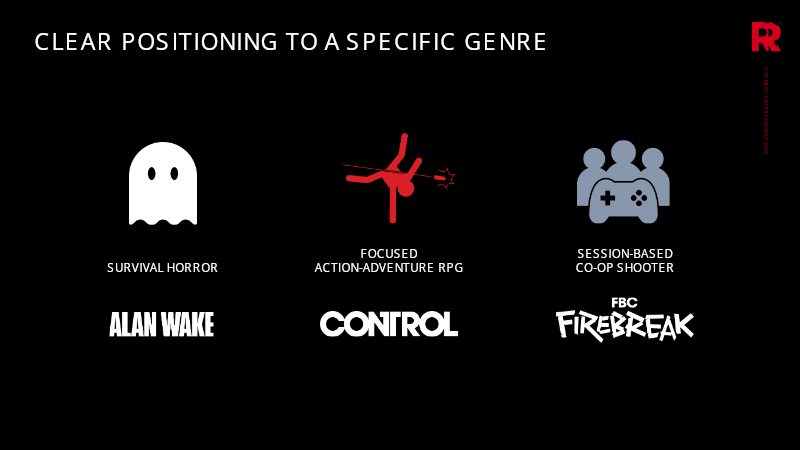

Remedy Capital Markets Day 2024: Remedy’s Games and Self-Publishing
Remedy Entertainment is transitioning toward a self-publishing model to capture greater financial upside and maintain creative control over its intellectual properties.
- Remedy Entertainment is shifting to a self-publishing model to increase financial upside and maintain creative control over its intellectual properties.
- The Alan Wake franchise has reached 15 million players, with Alan Wake 2 selling over 1.8 million units and maintaining a 40% completion rate.
- The Control franchise has achieved 19 million lifetime players with 4.5 million units sold.


Remedy Capital Markets Day 2024: Creative Ambitions
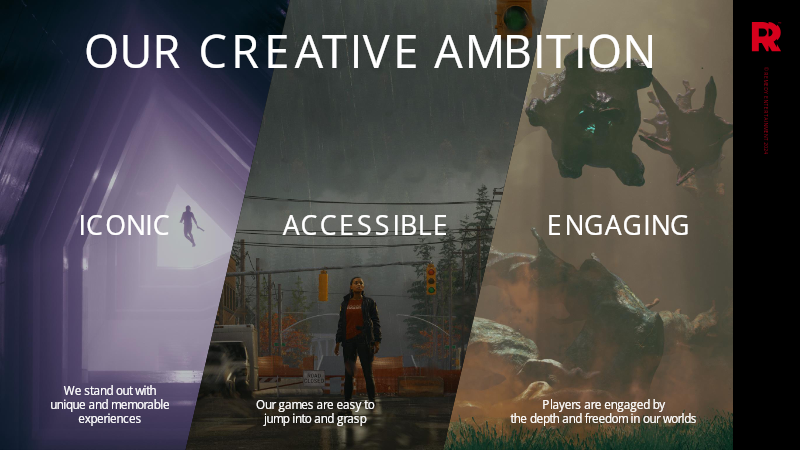
Remedy Entertainment focuses on establishing a distinct market position by prioritizing iconic, accessible, and engaging gaming experiences.
- Remedy Entertainment is positioning itself as a leader in the premium action-adventure segment by focusing on mature, narrative-driven titles that blend familiar settings with supernatural elements.
- The studio’s core creative strategy centers on high-quality storytelling, character development, and emotional depth to ensure its games resonate with a broad, global audience.
- The Alan Wake and Control franchises serve as the primary pillars of the studio's current output, consistently achieving high critical acclaim and major industry awards.
Finding Space For Sound: Acoustics in 'Avatar: Frontiers of Pandora'
The acoustic architecture of Avatar: Frontiers of Pandora represents a significant evolution in planetary-scale sound design, utilizing the Snowdrop Engine to deliver high-fidelity, context-aware audio within complex organic environments.
- Massive Entertainment evolved the Snowdrop Engine's acoustic systems from 'Tom Clancy's The Division 2' to support planetary-scale environments in 'Avatar: Frontiers of Pandora' while maintaining high-fidelity city-scale effects.
- The 'Slapback 4.0' system utilizes a dual-layer emitter strategy that separates early reflections, optimized for rapid response to oncoming geometry, from late reflections, optimized for long-tail diffuse reverberation.
- To manage performance, the engine uses a 'Ring of Local Origins' and emitter cannibalization, where reflection points are dynamically shifted or killed based on the player's movement and raycast sanity checks.

Week in Mobile Games E30 - Ubisoft's woes and Genshin Impact hits $6bn in four years(!)
Ubisoft currently faces a period of profound instability characterized by a 20 percent decline in share price, driven by the strategic delay of Assassin’s Creed Shadows and the underwhelming commercial performance of Star Wars Outlaws.
- Genshin Impact has generated $6.3 billion in lifetime revenue over four years, demonstrating the long-term viability of mobile live-service titles despite a recent dip in annual earnings due to market saturation.
- Ubisoft is facing significant financial instability, marked by a 20 percent share price decline following the delay of Assassin’s Creed Shadows and the poor commercial performance of Star Wars Outlaws.
- Dungeon & Fighter Mobile has emerged as a major revenue driver, securing over $800 million in gross revenue within its first four months in the Chinese market.