Showing 30 of 69 results · 0.14s
Jan 2025
Global Games Market Report 2025
Newzoo
through 2028. The approach excludes taxes, hardware and gambling from revenue calculations and provides detailed platform‑by‑platform forecasts (PC, console, mobile, cloud, VR) alongside analytical tools
Report67 pages
Jan 2023
Gaming Spotlight 2023: The Year in Review
data.ai
China. In contrast, home console and PC/Mac spending are expected to rise by 3% and 4% respectively, driven by increased hardware availability and subscription-based revenue. Geographically
Report33 pages
Jan 2022
State of the Game Industry Report: 2022
GDC
maintains its position as the leading console choice. Conversely, mobile development has experienced a decade-long decline in developer interest. Emerging hardware like the Steam Deck and PlayStation
Report31 pages
Mar 2025
Newzoo’s Games Market Reports & Forecasts Q1 2025 Update
Newzoo
over a third of the console's revenue, a trend accelerating as the industry anticipates the transition to the next generation of hardware. The findings reveal a distinct
Report5 pages
Jan 2021
Beyond 2021: Where Does Gaming Go Next?
Newzoo
cloud gaming are dissolving traditional hardware barriers, a trend reinforced by global semiconductor shortages and game development delays that have hampered the console and PC segments more than
Report19 pages
Mar 2023
Global Gaming Report Q1 2023
Drake Star Partners
Western PC and console firms. The financial landscape remains complex and volatile, marked by modest median revenue growth of 1% for hardware and platforms and negative average profit
Report19 pages
Video Game Market Update: Q2 2026
Aream & Co
resilient PC sector and a stagnant console market. While Steam sustained a 13 percent year-over-year growth trajectory, console revenues remained flat as the successful launch
Report43 pages
Jan 2023
PC & Console Gaming Report 2023
Newzoo
fueled by stabilized hardware supply chains and a dense schedule of highly anticipated blockbuster releases. While PC revenue is expected to grow steadily, console gaming is positioned
Report58 pages
Jan 2025
China Game Industry Report 2025
Meridian Play
domestic console market expanded sharply, reaching RMB 8.362 billion (US$1.18 billion) in 2025, a 37.38% year‑on‑year rise, driven by both software and hardware sales. Global
Report13 pages
Jan 2017
State of the Game Industry 2017
Game Developers Conference
consoles, developers expressed cautious optimism for the Nintendo Switch, with 50% predicting it will outsell the Wii U. However, the industry remains divided on mid-cycle hardware refreshes
Report14 pages
Dec 2025
CESA Game Industry Report 2025
CESA – Computer Entertainment Supplier's Association
strongest platform growth over the past four years, expanding 59.7 % and overtaking console share, while console revenue showed modest contraction. In Japan, the total gaming population stood
Report4 pages
Jan 2025
Games Industry in 2025
Ampere Analysis
into 2026, which is projected to remove $2.7 billion from the 2025 console market. However, the industry is forecast to surpass the $200 billion threshold for the first
Report37 pages
Sep 2023
Gaming Industry Report: Q3 2023
Konvoy
segment, which accounted for 49% of total market share, followed closely by the console and PC sectors. Geographically, the Asia-Pacific region remained the largest market, contributing
Report31 pages
Jan 2025
2025 Half-Year Market Model Update: Asia & MENA
Niko Partners
from proprietary market models that integrate platform-specific data for PC, mobile, and console segments. The analysis highlights the critical role of government intervention, such as the PROG
Report3 pages
Jan 2024
Causal Effect of Video Gaming on Mental Well-Being in Japan 2020–2022
Springer
being and life satisfaction. By leveraging the unique lottery-based distribution of gaming consoles during pandemic-related supply shortages, researchers analyzed data from over 97,000 respondents
Report17 pages
Game no Yakusoku Communication Book
CESA – Computer Entertainment Supplier's Association
that while the technology and accessibility of games have shifted from television-bound consoles to ubiquitous mobile and cross-platform devices, the fundamental need for trust and clear
Report2 pages
Jan 2025
The State of AAA Game Advertising: 2023 Review
Sensor Tower
immediate market share. While YouTube remains the dominant advertising medium for PC and console titles, publishers have increasingly diversified their media mix by integrating Facebook, TikTok, and Instagram
Report65 pages
Jul 2020
Rise of the Player-Fan: The Growing Opportunity of Mobile Esports in Asia
Niko Partners
player engagement and revenue across Asia, signaling a shift from traditional PC and console dominance to a mobile-first competitive landscape. The central thesis posits that Asia
Report12 pages
Jan 2024
Türkiye Game Market Report: 2024
Gaming in Turkey
shifting focus from hyper-casual mobile titles toward more complex PC and console projects, exemplified by the global success of titles like Supermarket Simulator and Liars
Report372 pages
Jan 2025
Video Gaming Report: How Platforms Are Colliding and Why This Will Spark the Next Era of Growth
Boston Consulting Group
from $1.4 billion in 2025 to $18.3 billion by 2030. This shift toward hardware-agnostic play is mirrored in distribution, where 33% of adult gamers have already purchased
Report26 pages
Jan 2025
Gaming 2025 (Epyllion)
Epyllion
titles to gain traction. While the PC ecosystem is gaining momentum over traditional consoles due to its larger libraries and native social tools like Discord, the handheld market
Report224 pages
Jan 2020
2020–2022: The Most Exciting Time in the Gaming Industry
InvestGame
decline of mobile gaming hype post-IDFA and the rising interest in PC, console, and AI-driven startups. The report highlights a stark cooling in Web3 gaming, where
Report29 pages
Jan 2020
For the Win: Breaking Down the Preferences of Asia's Mobile Gamers
Niko Partners
domestic partnerships. In contrast, Japan’s market is defined by a deep-rooted console history and the pervasive influence of anime and manga aesthetics, with RPGs accounting
Report22 pages
Jan 2024
Newzoo PC & Console Gaming Report 2024
Newzoo
The 2024 Newzoo PC & Console Gaming Report presents a cautiously optimistic outlook for the global
Report46 pages
Jan 2020
The Past, Present and Future of Games: Global and Local Opportunities
Newzoo
The global gaming industry is undergoing a generational transformation, evolving from a niche hobby into
Report33 pages
Jan 2024
The PC & Console Market Gaming Report 2024
Newzoo
The PC and console gaming market reached $93.5 billion in 2023, marking a 2.6% increase
Report46 pages
Jan 2023
Global Games Market Report: August 2023
Newzoo
total revenues forecasted to reach $212.4 billion. Regional performance remains uneven, as strong console demand in Western markets contrasts with slower growth in the Asia-Pacific region, where
Report52 pages
Oct 2019
Impact of Cloud Gaming and Other Trends in the Indie Ecosystem: Spain
AEVI
markets and reaching more than 79 million PS4 owners—approximately 0.6 % of the console base—yet its relatively high subscription fee and overlap with PS Plus dilute
Report35 pages
May 2022
Gaming Spotlight: 2022 Review
International Data Corporation
Mobile gaming has emerged as the primary engine of the global games market, projected to
Report32 pages
Jan 2019
Evolution of Mobile Esports for the Mass Market
Niko Partners
Mobile esports is positioned to become the primary catalyst for growth in the digital games
Report45 pages

Global Games Market Report 2025
Jan 202567 pages12k words
Summary
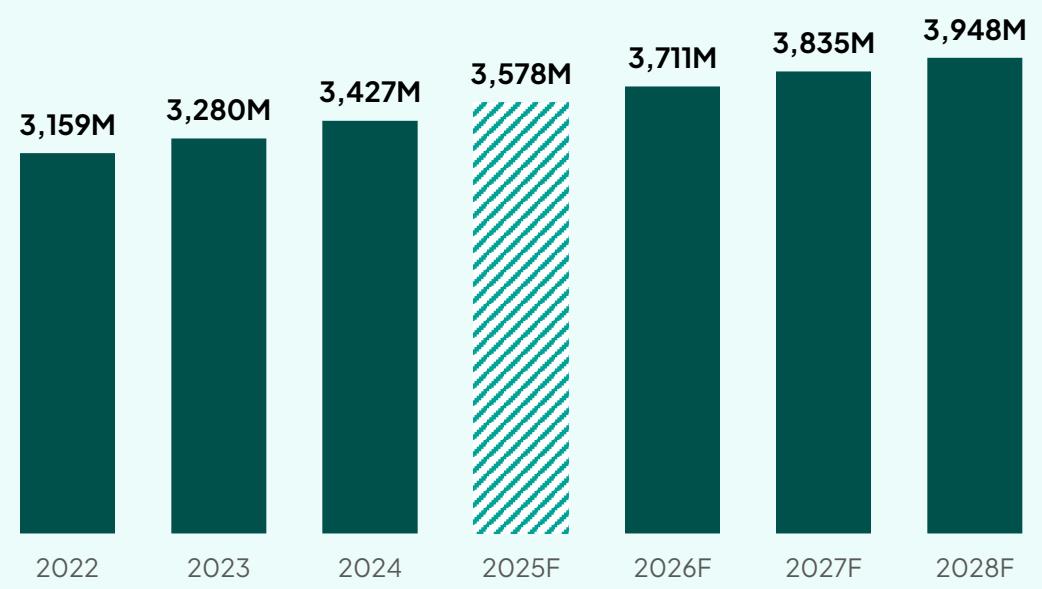
The Global Games Market Report 2025 projects a steady expansion of the worldwide player base to 3.6 billion, with payers rising to 1.6 billion and total revenue reaching $188.8 billion, a 3.4 % increase year‑over‑year. Mobile dominates growth and revenue, contributing $103 billion (55 % of the market) and expanding 4.5 % YoY, while PC and console follow at 3.1 % and 2.5 %. The report notes that average spend per payer is expected to decline slightly through 2028 as the market matures, underscoring the importance of retention, innovative monetization and post‑launch content to sustain growth in an increasingly saturated ecosystem.
Geographically, the Asia‑Pacific region leads with a 4.2 % YoY increase, and North America remains strong for console sales (5.4 %). Key growth drivers include the launch of Nintendo Switch 2, continued success of live‑service titles on PC, and a shift toward direct‑to‑consumer monetization in mobile. Discoverability challenges and content fragmentation are identified as notable hurdles across all platforms.
Single‑player AAA titles released in the February–May window outperform those launched August–November by an average of 34 %, largely due to crowded holiday windows and cannibalization. Early Access titles that transition to full release within 4–9 months generate the highest new‑player lift, while staggered cross‑platform releases capture only about 13 % of the total player base. Player attrition drops sharply in weeks 2–5 and stabilizes after week 12, indicating that longer main‑story content (20–40 hours) and simulation elements help retain players over the long term.
The commercial life of single‑player titles is increasingly driven by post‑launch content, strategic discounting and community engagement rather than initial premium spend. DLC revenue shares evolve over a game’s lifecycle, with genres aligning to specific monetization models and subscriptions gaining influence on long‑term engagement. Post‑launch content is identified as the key determinant of discoverability, retention and profitability across a game’s back catalogue.
Methodologically, the report employs a top‑down, data‑driven model that blends proprietary engagement metrics (Game Performance Monitor, Steam data), public economic indicators and partner insights to forecast platform‑specific player, payer and revenue figures through 2028. The approach excludes taxes, hardware and gambling from revenue calculations and provides detailed platform‑by‑platform forecasts (PC, console, mobile, cloud, VR) alongside analytical tools for market segmentation, genre trends and post‑launch monetization strategies.
Pages


Insights
- The global games market is projected to reach $188.8 billion in 2025, a 3.4% year-over-year increase, with mobile platforms accounting for 55% of total revenue at $103 billion.
- Mobile gaming remains the primary growth engine with a 4.5% year-over-year expansion, while PC and console segments grow at 3.1% and 2.5% respectively.
- Single-player AAA titles launched between February and May outperform those released in the August–November holiday window by an average of 34% due to reduced market cannibalization.
- Player retention is optimized by 20–40 hour main-story content and simulation elements, with attrition rates stabilizing significantly after the 12-week mark.
- Early Access titles achieve the highest new-player lift when transitioning to a full release within a 4–9 month window.