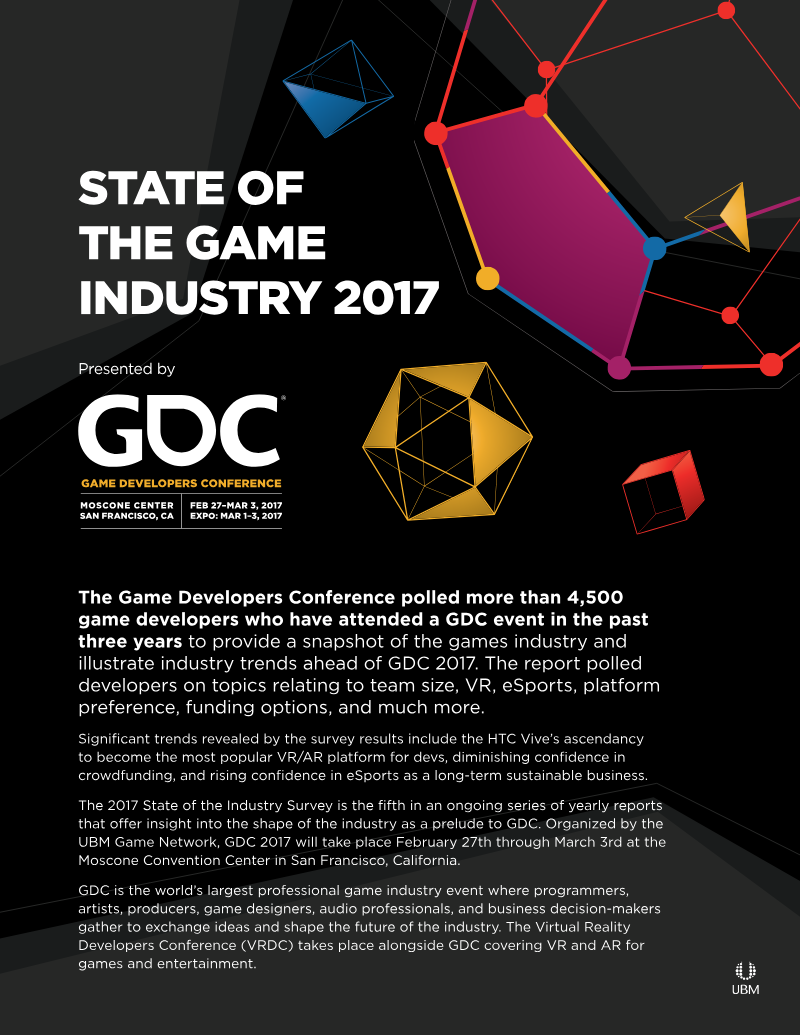
State of the Game Industry 2017
201714 pages~19 min full read
The 2017 State of the Game Industry report provides a comprehensive snapshot of the global development landscape leading into the 31st Game Developers Conference. Based on a survey of over 4,500 professional game developers, the data primarily reflects the perspectives of "journeyman" creators in North America (67%) and Europe (22%), with the largest segment of respondents (37%) possessing three to six years of industry experience.
The findings highlight a significant shift in the immersive technology sector, where the HTC Vive emerged as the leading platform for VR/AR development, surpassing the Oculus Rift in both current usage and future interest. While 61% of developers are not yet involved in VR, those who are have increasingly moved toward the Vive, which 40% of respondents expect to support for their next projects. Despite concerns regarding hardware costs and motion sickness—which affects 83% of developers to some degree—75% of the industry views VR and AR as a sustainable long-term business, with a plurality predicting that augmented reality will be the dominant immersive tech within twenty years.
In the broader platform market, PC (53%) and mobile (38%) remain the primary targets for development. Notably, Android (54%) surpassed iOS (51%) in developer interest for the first time in the survey's history. Regarding consoles, developers expressed cautious optimism for the Nintendo Switch, with 50% predicting it will outsell the Wii U. However, the industry remains divided on mid-cycle hardware refreshes like the PS4 Pro and Project Scorpio; while only 5% view them negatively, 41% remain undecided about their impact on the traditional "fixed-spec" benefits of console development.
Financially, the industry continues to lean toward independence, with 55% of projects funded by internal company resources and 54% of developers operating without a traditional publisher. Confidence in crowdfunding saw a slight decline, with 46% of respondents expressing no interest in the model. Conversely, confidence in eSports reached an all-time high, with 90% of developers affirming its long-term sustainability as it moves toward mainstream social acceptance.
Game Developers Conference · 2026
Game Developers Conference · 2026
Game Developers Conference · 2026
Game Developers Conference · 2026
Game Developers Conference · 2026
Game Developers Conference · 2026

Game Developers Conference · 2026

Game Developers Conference · 2026

Game Developers Conference · 2025

Game Developers Conference · 2025

Game Developers Conference · 2025

Game Developers Conference · 2025
Niko Partners · 2026
Epyllion · 2026
InvestGame · 2025
Aldora · 2025
Vorhaus Advisors · 2025
Stream Hatchet · 2025
Stream Hatchet · 2024
Stream Hatchet · 2023
Konvoy · 2022
Stream Hatchet · 2022
Stream Hatchet · 2022
Newzoo · 2022