Country & Regional Reports·Updated Mar 17, 2026 by Springer
Article · January 1, 2024
Published by Springer
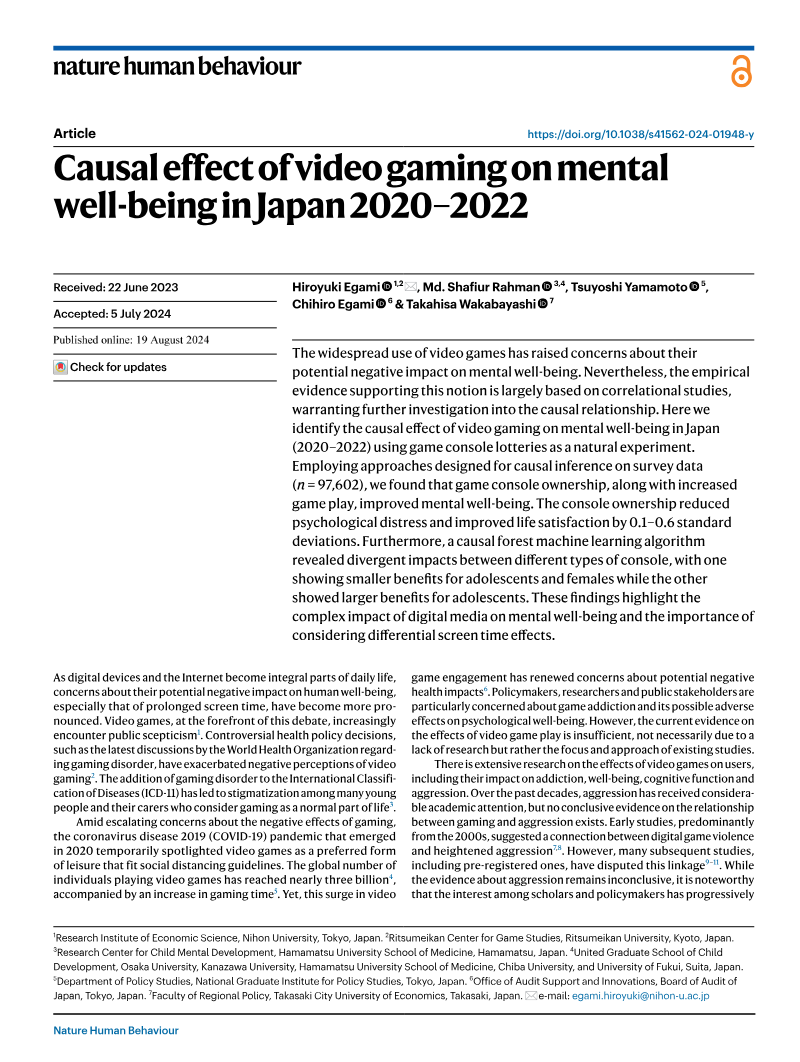
Evidence from a natural experiment conducted in Japan between 2020 and 2022 demonstrates that video game ownership and increased play time exert a positive causal influence on mental well-being and life satisfaction. By leveraging the unique lottery-based distribution of gaming consoles during pandemic-related supply shortages, researchers analyzed data from over 97,000 respondents to isolate the effects of gaming from self-selection bias. The findings indicate that winning a console lottery reduced psychological distress by 0.1 to 0.6 standard deviations, directly challenging traditional correlational studies that often associate gaming with negative mental health outcomes. The magnitude of these psychological benefits varies significantly across different demographic groups and hardware platforms. Machine learning analysis reveals that the Nintendo Switch offers more pronounced well-being improvements for adolescents and female users, whereas the PlayStation 5 provides stronger positive effects for adult males and dedicated gamers. While the overall impact of gaming remains positive, the data suggests a threshold of diminishing returns, as the benefits to mental health and life satisfaction begin to decline after three hours of daily play. The scope of this research is specifically focused on the Japanese market during the COVID-19 pandemic, a period characterized by heightened social isolation and restricted physical activity. These environmental factors may have amplified the observed positive effects, as gaming served as a primary tool for digital engagement and stress mitigation. Despite these contextual considerations, the use of instrumental variable causal forests and propensity score matching provides a rigorous statistical foundation for the conclusion that moderate video game consumption serves as an effective intervention for improving psychological health.
# Causal effect of video gaming on mental well-being in Japan 2020–2022 Received: 22 June 2023 Accepted: 5 July 2024 Published online: xx xx xxxx Check for updates Hiroyuki Egami 1,2 , Md. Shafiur Rahman 3,4, Tsuyoshi Yamamoto 5 , Chihiro Egami 6 & Takahisa Wakabayashi 7 The widespread use of video games has raised concerns about their potential negative impact on mental well-being. Nevertheless, the empirical evidence supporting this notion is largely based on correlational studies, warranting further investigation into the causal relationship. Here we identify the causal efect of video gaming on mental well-being in Japan (2020–2022) using game console lotteries as a natural experiment. Employing approaches designed for causal inference on survey data $( n = 9 7 , 6 0 2 )$ ), we found that game console ownership, along with increased game play, improved mental well-being. The console ownership reduced psychological distress and improved life satisfaction by 0.1–0.6 standard deviations. Furthermore, a causal forest machine learning algorithm revealed divergent impacts between diferent types of console, with one showing smaller benefts for adolescents and females while the other showed larger benefts for adolescents. These fndings highlight the complex impact of digital media on mental well-being and the importance of considering diferential screen time efects. As digital devices and the Internet become integral parts of daily life, concerns about their potential negative impact on human well-being, especially that of prolonged screen time, have become more pronounced. Video games, at the forefront of this debate, increasingly encounter public scepticism1 . Controversial health policy decisions, such as the latest discussions by the World Health Organization regarding gaming disorder, have exacerbated negative perceptions of video gaming2 . The addition of gaming disorder to the International Classification of Diseases (ICD-11) has led to stigmatization among many young people and their carers who consider gaming as a normal part of life3 . Amid escalating concerns about the negative effects of gaming, the coronavirus disease 2019 (COVID-19) pandemic that emerged in 2020 temporarily spotlighted video games as a preferred form of leisure that fit social distancing guidelines. The global number of individuals playing video games has reached nearly three billion4 , accompanied by an increase in gaming time5 . Yet, this surge in video game engagement has renewed concerns about potential negative health impacts6 . Policymakers, researchers and public stakeholders are particularly concerned about game addiction and its possible adverse effects on psychological well-being. However, the current evidence on the effects of video game play is insufficient, not necessarily due to a lack of research but rather the focus and approach of existing studies.
akeholders are particularly concerned about game addiction and its possible adverse effects on psychological well-being. However, the current evidence on the effects of video game play is insufficient, not necessarily due to a lack of research but rather the focus and approach of existing studies. There is extensive research on the effects of video games on users, including their impact on addiction, well-being, cognitive function and aggression. Over the past decades, aggression has received considerable academic attention, but no conclusive evidence on the relationship between gaming and aggression exists. Early studies, predominantly from the 2000s, suggested a connection between digital game violence and heightened aggression7,8 . However, many subsequent studies, including pre-registered ones, have disputed this linkage9–11. While the evidence about aggression remains inconclusive, it is noteworthy that the interest among scholars and policymakers has progressively 1 Research Institute of Economic Science, Nihon University, Tokyo, Japan. 2 Ritsumeikan Center for Game Studies, Ritsumeikan University, Kyoto, Japan. 3 Research Center for Child Mental Development, Hamamatsu University School of Medicine, Hamamatsu, Japan. 4 United Graduate School of Child Development, Osaka University, Kanazawa University, Hamamatsu University School of Medicine, Chiba University, and University of Fukui, Suita, Japan. 5 Department of Policy Studies, National Graduate Institute for Policy Studies, Tokyo, Japan. 6 Office of Audit Support and Innovations, Board of Audit of Japan, Tokyo, Japan. 7 Faculty of Regional Policy, Takasaki City University of Economics, Takasaki, Japan. e-mail: [email protected]
shifted to the connection between video gaming and mental well-being over the past decade12. The examination of the association between gaming and psychological well-being in existing literature has yielded mixed and inconsistent findings13,14. First, negative associations are mainly documented in observational studies6,15–20, while some experimental studies on violent games also indicate adverse relationships21. A substantial part of such observational studies consists of the examination of the effect of screen time, including time spent on video games6,17,19. Second, positive associations are documented in both observational studies and experimental studies22–27. Some experimental studies have specifically employed video games of genres like casual games and exergames as therapeutic tools, indicating an underlying assumption of their beneficial impact on mental well-being before conducting these studies24,28. In contrast, some recent observational studies have found neither positive nor negative associations29,30. Two primary methodological challenges might underlie the conflicting findings in the literature. First, the scarcity of evidence regarding the causal relationship between playing video games and well-being has been a problem; most observational studies depend on association analysis with either cross-sectional or longitudinal data31,32. Second, many experimental studies lack tests for external validity and have faced criticisms26,30,33. Typical experimental studies that invite participants to play video games for a limited time fail to replicate the natural gaming environment. For example, examining the effect of ‘heavy gaming’ (or dysregulated gaming)—a notion lacking consensus34 or even ‘moderate gaming’ on mental well-being in laboratory settings is challenging. Identifying the causal relationship of habitual behaviours like video gaming, much like other lifestyle habits, such as the health effects of moderate alcohol consumption35,36, presents inherent challenges. The difficulties in conducting randomized controlled trials with habitual behaviours, the multifaceted nature of these behaviours coupled with numerous confounders, and the bidirectional relationship between behaviours and health outcomes collectively complicate the identification of causal relationships. Given the substantial disagreement within the literature and the methodological challenges, how video gaming may actually impact psychological well-being remains elusive. A promising approach is to apply causal inference to observational data37 by exploiting a natural experimental design. However, finding a suitable natural experimental situation has been challenging. This study addresses the gap by leveraging a gaming console lottery, which is as close to an ideal natural experiment as possible. By identifying a unique and fitting situation and collecting relevant data in a timely manner, the study moves beyond the constraints of correlation analysis and controlled laboratory settings, offering a more authentic examination of the effect of playing video games on mental well-being in daily life.
ntifying a unique and fitting situation and collecting relevant data in a timely manner, the study moves beyond the constraints of correlation analysis and controlled laboratory settings, offering a more authentic examination of the effect of playing video games on mental well-being in daily life. To this end, we applied a natural experimental study design to the original survey data containing information on video gaming activity and mental well-being indicators for individuals aged 10–69 in Japan, collected at various points between 2020 and 2022 during the COVID-19 pandemic. Supply chain disruptions and surged demands during this time limited the availability of two major gaming consoles: Nintendo Switch (Switch) and PlayStation 5 (PS5). To address these shortages, Japanese retailers used lotteries to assign these gaming consoles to consumers, inadvertently creating a plausibly random distribution of opportunities to play video games. Winning a lottery became the primary determinant of whether one could purchase these consoles; details of the lotteries and the two game consoles are provided in Supplementary Method 1. Leveraging this unique circumstance and using original survey data, we drew causal inferences grounded in this pandemic context. Additionally, by applying a causal forest machine learning algorithm—an algorithm for estimation of heterogeneous treatment effects—to our diverse sample, we investigated the moderating role of sociodemographic factors in the causal link between video gaming and well-being. While this specific intersection remains relatively understudied, there is a growing consensus among digital media scholars about the value of a person-specific approach, viewing it as a pathway towards tailored mental health interventions38. # Results # Participant characteristics Table 1 presents the study participants’ background characteristics. Out of the 97,602 included survey respondents, 8,192 took part in the lottery. Approximately one-fourth of the 97,602 respondents were between 10 and 25 years old, while $3 9 \%$ were between 45 and 69. Around $2 1 \%$ were students, $1 0 . 7 \%$ were unemployed and $3 9 \%$ were full-time employees. Over one-third of the 8,192 lottery participants $( 3 5 \% )$ were hardcore gamers, and around $20 \%$ were core gamers. Time spent playing games was closely related to video gaming preference; hardcore gamers spent more than 1 h 30 min per day (Supplementary Table 1).
%$ were full-time employees. Over one-third of the 8,192 lottery participants $( 3 5 \% )$ were hardcore gamers, and around $20 \%$ were core gamers. Time spent playing games was closely related to video gaming preference; hardcore gamers spent more than 1 h 30 min per day (Supplementary Table 1). # Preliminary association analysis Before our main analysis, we conducted multivariate regression without leveraging our natural experiment, expecting confounded results. This traditional approach shows associations rather than establishing causal relationships. A statistically significant positive correlation between video gaming and psychological distress (PD) (Kessler Psychological Distress Scale, K6) was found for two out of five estimates by a regression model controlling for a comprehensive set of covariates (Supplementary Table 2, model 3). Conversely, a significant positive association between gaming and life satisfaction (Satisfaction With Life Scale, SWLS) was found. Further details are presented in Supplementary Result 1. # Multivariate regression and propensity score matching Moving to our core analysis (Table 2), which aims to establish causal relationships, we present the results derived from our natural experimental framework. The intention-to-treat (ITT) effects of winning game console lotteries, estimated by multivariate regression and propensity score matching approach (PSM), are statistically significant and comparable (Fig. 1). Winning a Switch lottery reduced PD by approximately 0.2 standard deviations (s.d.) (0.18 s.d. with $9 5 \%$ confidence interval (CI) 0.13–0.24, $P { < } 0 . 0 0 1$ by regression; 0.16 s.d. with $9 5 \%$ CI 0.06–0.25, $P { = } 0 . 0 0 1$ by PSM). Similarly, winning a PS5 lottery led to a distress reduction of around 0.1 s.d. (0.08 s.d. with $9 5 \%$ CI 0.02–0.13, $P { = } 0 . 0 1 4$ by regression; 0.07 s.d. with $9 5 \% \operatorname { C l } 0 . 0 1 \substack { - 0 . 1 4 , P = 0 . 0 3 2 }$ ${ P / } = 0 . 0 3 2$ by PSM). Furthermore, winning a PS5 lottery enhanced life satisfaction by around 0.2 s.d. (0.15 s.d. with $9 5 \% \mathrm { C l } 0 . 1 0 – 0 . 2 0 , P < 0 . 0 0 1$ by regression; 0.18 s.d. with $9 5 \% \mathrm { C l } 0 . 1 0 – 0 . 2 5 , P – 0 . 0 0 1$ $P { < } 0 . 0 0 1$ by PSM). Additionally, lottery winners increased their daily video game play time by around $0 . 5 \mathsf { h }$ (0.53 h with $9 5 \% \mathrm { C l } 0 . 4 3 \mathrm { - } 0 . 6 3 , P < 0 . 0 0 1$ $P { < } 0 . 0 0 1$ by regression; 0.57 h with $9 5 \% \mathrm { C l } 0 . 3 5 \mathrm { - } 0 . 7 9 , P \mathrm { < } 0 . 0 0 1$ $P { < } 0 . 0 0 1$ by PSM) but did not increase smartphone game play time (Supplementary Fig. 1).
9 5 \% \mathrm { C l } 0 . 4 3 \mathrm { - } 0 . 6 3 , P < 0 . 0 0 1$ $P { < } 0 . 0 0 1$ by regression; 0.57 h with $9 5 \% \mathrm { C l } 0 . 3 5 \mathrm { - } 0 . 7 9 , P \mathrm { < } 0 . 0 0 1$ $P { < } 0 . 0 0 1$ by PSM) but did not increase smartphone game play time (Supplementary Fig. 1). The lottery winners and non-winners exhibited minor differences in the background characteristics: only one—number of times that the respondents joined the lotteries (as expected, see ‘Statistical analysis’ section in Methods)—out of 30 variables had standardized differences exceeding 0.10 in absolute value for PS5 lottery participants (Supplementary Table 3) and three for Switch lottery participants (Supplementary Table 4 with more details in Supplementary Result 3). Additionally, the ‘ITT effect’ on pseudo-outcomes was small and not statistically significant, confirming unconfoundedness (Supplementary Table 5). Moreover, the covariates’ balance after matching and common support indicated that our PSM analysis was successful in achieving a balance between the treatment and control groups (Supplementary Figs. 2–5 with further explanations in Supplementary Result 4). Additional analyses mitigate concerns over an unadjusted potential confounder: non-winning lottery participations (elaborated in ‘Assessing natural experiment validity’ subsection in Methods), thereby
**Power of Play: Global Report 2023 – Executive Summary** --- ### 1. Scope & Methodology | Item | Detail | |------|--------| | **Survey population** | ≈ 12,847 active (weekly) gamers, ages 16 +, from 12 countries (Australia, Brazil, Canada, France, Germany, Italy, Japan, Poland, South Korea, Spain, United Kingdom, United States). | | **Sampling** | Quota‑based, nationally‑representative panels (AudienceNet). Each country ≈ 1,000 + respondents. | | **Data collection** | Online questionnaire covering motivations, mental‑health impacts, social behaviours, and skill development. | | **Academic triangulation** | Findings cross‑checked against ~10 peer‑reviewed studies (see References, p. 12). | --- ### 2. Why People Play (Top‑3 Reasons – Global) | Rank | Reason | % of respondents (global) | |------|--------|----------------------------| | 1 | **Fun / enjoyment** | 69 % | | 2 | **Pass the time** | 63 % | | 3 | **Stress relief / relaxation** | 55 % | *Country‑level nuances:* - “Fun” dominates in every market (≥ 78 % in most). - “Stress relief” is especially high in Australia (71 %) and Japan (73 %). --- ### 3. Self‑Reported Mental‑Health Benefits | Benefit | Global agreement (average) | Range across countries | |---------|----------------------------|------------------------| | **Reduces stress** | 71 % | 55 % – 87 % | | **Reduces anxiety** | 61 % | 48 % – 78 % | | **Reduces feelings of isolation/loneliness** | 55 % | 45 % – 73 % | | **Provides a healthy outlet for everyday challenges** | 64 % | 52 % – 76 % | | **Makes me feel happier** | 63 % | 45 % – 83 % | | **Helps me get through difficult times** | 52 % | 33 % – 71 % | > **Interpretation:** More than two‑thirds of gamers perceive video games as a stress‑relief tool, and roughly half feel less isolated because of gaming. --- ### 4. Social & Relational Outcomes | Metric | Global % (approx.) | |--------|-------------------| | **Play with others online (≥ weekly)** | 51 % | | **Play with others in‑person (≥ weekly)** | 38 % | | **Met a good friend, spouse, or significant other through games** | 46 % | | **Games helped develop deeper relationships** | 43 % | | **Games helped stay connected to friends/family** | 46 % | | **Games created lasting memories** | 50 % | | **Believe there is a game for everyone** | 75 % | > **Key insight:** Multiplayer and social features are central; almost half of respondents have formed meaningful offline relationships via gaming
Across more than twenty national markets, the majority of gamers report that playing video games reduces stress and enhances happiness, with 70‑90 % indicating lower stress levels and 57‑91 % feeling happier. Respondents also cite diminished anxiety and isolation, while parents observe a positive shift in relationships with their children, ranging from roughly one‑third in Sweden to nearly four‑fifths in Nigeria. Mobile devices dominate the landscape, accounting for 60‑96 % of play sessions, and online multiplayer emerges as the most prevalent social mode. In the United Arab Emirates, United Kingdom and United States, surveys of roughly three thousand gamers reveal consistent benefits: about 70‑80 % experience reduced stress and increased well‑being, and roughly two‑thirds of parents note improved parent‑child interaction. Genre preferences diverge, with UAE players favoring teamwork, collaboration and creativity, whereas UK and US gamers gravitate toward problem‑solving, critical‑thinking and cognitive‑skill development. Approximately half to sixty percent of participants perceive gaming as supportive of career‑related or hobby pursuits, and a similar share report enhancements in professional competencies. Research spanning multiple sectors demonstrates that video‑game‑based training yields measurable gains in cognition, decision‑making speed and technical performance. Gamers outperform non‑gamers in robotic‑surgery simulations, emergency‑response drills and retail‑seasonal‑sales scenarios, with meta‑analyses confirming statistically significant improvements in perception, attentional control and procedural accuracy. These outcomes translate into higher job performance, reduced error rates and stronger return on investment, prompting organizations such as NASA, the U.S. Air Force and elite sports teams to integrate game‑based platforms into their training pipelines.
The 2023 Power of Play survey set out to map the motivations, social impacts and perceived wellbeing benefits of video gaming across a broad international sample. By combining responses from 12,847 active gamers who play at least once a week with findings from ten recent peer‑reviewed studies, the analysis argues that games deliver measurable social, emotional and cognitive value that extends far beyond pure entertainment. Respondents from twelve markets—Australia, Brazil, Canada, France, Germany, Italy, Japan, Poland, South Korea, Spain, the United Kingdom and the United States—identified “having fun” as the top driver (69 % overall), followed by “entertainment” and “stress relief”. More than half of participants reported regular online play, while a third also engaged in face‑to‑face sessions. Nearly 45 % said they had met a close friend, partner or spouse through gaming, and 67 % believed games help them forge new relationships. Across the sample, 71 % felt games reduce stress, anxiety and isolation, 64 % described gaming as a healthy escape from daily problems, and 83 % reported increased happiness when playing. Cognitive and creative gains were also prominent: 69 % linked gaming to improved problem‑solving, 65 % to greater adaptability, 60 % to enhanced communication, and 57 % to better linguistic skills. The report cites academic work that documents superior cognitive performance among gamers, reduced depressive symptoms during the COVID‑19 pandemic, and potential protective effects against age‑related memory decline and dementia. Studies of exergames and therapeutic titles further suggest benefits for pain management, motor coordination and social inclusion in clinical populations. Methodologically, the survey employed an online, quota‑controlled panel designed to reflect each country’s demographic composition, with screening to ensure weekly gaming activity. Data were collected by AudienceNet, a market‑research firm accredited by the Market Research Society and compliant with GDPR standards. The integration of large‑scale consumer data with scholarly evidence provides a comprehensive picture of gaming’s evolving role in mental health, social connectivity and skill development worldwide.
The research surveyed more than 24,000 active gamers from 21 nations on six continents, representing a broad cross‑section of the global gaming population (average age 41, 48 % female). Its central thesis is that video games function as a powerful catalyst for cognitive, social, educational, and mental‑health benefits, extending far beyond entertainment. Across all regions, a majority of players report gaming primarily for fun (56 %), stress relief (55 %) and mental stimulation (46 %). Mobile devices dominate usage (55 % of respondents), followed by PCs/laptops and consoles, while 73 % say gaming reduces feelings of isolation and 81 % view it as mentally stimulating. Perceived skill development is strong: 77 % associate gaming with enhanced creativity, 74 % with problem‑solving, and substantial portions note improvements in teamwork, resilience and social interaction. The survey highlights a professional impact, with 43 % globally—reaching 76 % in Nigeria and 70 % in India—believing gaming positively shaped their education or career. Mental‑health outcomes are equally pronounced; 70‑90 % report reduced stress, increased happiness and a healthier outlet for daily challenges, with the highest well‑being scores in India, Nigeria and Mexico. Online multiplayer is identified as the primary social connector, cited by up to 96 % of respondents. Complementary academic research corroborates these findings, showing that digital games boost learning engagement, reading skills and decision‑making, while immersive technologies such as AR/VR enhance performance in high‑stress professional settings, including medical surgery and aerospace training. Collectively, the evidence positions video games as a validated tool for skill development, education, and mental‑health recovery across diverse global markets.