Market (Overall)·Updated Apr 30, 2026 by Newzoo
Report · January 1, 2023
Published by Newzoo
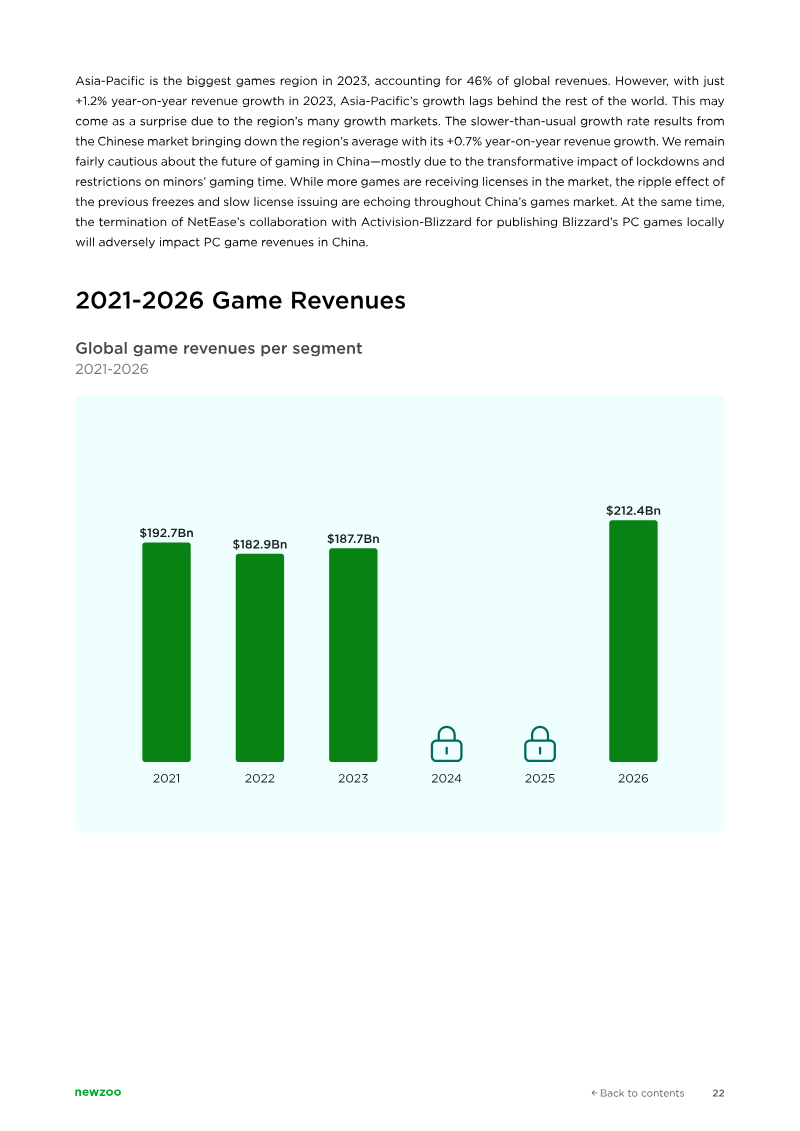
The global games market is entering a period of recovery in 2023, characterized by a projected revenue of $187.7 billion and a total player base of 3.38 billion. This 2.6% year-on-year growth signals a stabilization following the post-pandemic market correction of 2022. While mobile gaming remains the largest revenue segment, console gaming serves as the primary catalyst for this year’s expansion, rebounding significantly from previous development delays. Looking toward 2026, the industry is expected to maintain this upward trajectory, with total revenues forecasted to reach $212.4 billion. Regional performance remains uneven, as strong console demand in Western markets contrasts with slower growth in the Asia-Pacific region, where regulatory challenges in China continue to dampen momentum. To mitigate rising production costs and extended development cycles, studios are increasingly prioritizing live-service monetization models and integrating generative AI into their workflows. While these technologies offer potential for streamlined asset creation and prototyping, their long-term viability is complicated by unresolved legal and ethical concerns regarding copyright and intellectual property. The industry is undergoing a structural shift toward digital-first engagement, evidenced by the continued decline of physical media and the rise of transmedia strategies and influencer-led development. Hardware diversification is also accelerating, with the emergence of complementary handheld devices expanding the reach of traditional platforms. Despite these advancements, specific genres are experiencing shifting player preferences; while adventure and shooter titles remain dominant, the battle royale genre is losing traction. Furthermore, the mobile sector faces persistent headwinds in monetization and user acquisition, largely driven by evolving privacy policies that have impacted the performance of previously lucrative genres like RPGs.
Copyright & Redistribution Notice The content of this report is created with due care by Newzoo and protected by copyrights. This report, or any portion thereof, may not be reproduced, distributed, or transmitted in any form or by any means, including photocopying, recording, or other electronic or mechanical methods, or used in any manner whatsoever, without the express written permission of Newzoo. Reproducing, distributing, and/or transmitting this report, or any portion thereof, for commercial purposes is explicitly not allowed.
Foreword We proudly present the free edition of this year’s Global Games Market Report, the flagship report of Newzoo’s Games Market Reports & Forecasts. This preview version of the report provides a glimpse into the exciting world of gaming in 2023 and beyond. New to this year’s report is how we break down revenues per monetization model. Publishers are experimenting with various monetization strategies across every gaming segment, and we can now split in-game revenues into DLC, microtransaction, and Overarchingly, 2023 will be an exciting year for the global games market. The number of players will surpass 3.3 billion, with more paying gamers also entering the fold. Moreover, the market will generate a staggering $187.7 billion, which is an achievement given the many macroeconomic factors at play. After the market swerved in a corrective direction in 2022 following the pandemic, 2023 will see the market grow once again. in-game subscription revenue on PC and console. We also continue to expand our player numbers cov - erage per gaming ecosystem. We first introduced our Steam player estimates in the January Update to cover seven of today’s largest gaming ecosystems. Now, we have expanded our coverage to include forecasts for 2023. This preview version of the Global Games Market Report 2023 will unpack these topics and more. In
g ecosystem. We first introduced our Steam player estimates in the January Update to cover seven of today’s largest gaming ecosystems. Now, we have expanded our coverage to include forecasts for 2023. This preview version of the Global Games Market Report 2023 will unpack these topics and more. In Many highly anticipated delayed titles launched in the complete edition of the report, we dive far deeper 2023, with more scheduled for release in H2, the supply into the console and PC live-services boom, the pros of new consoles has finally caught up to demand, and cons of generative AI in game development, comand console publishers kept embracing live-service plementary gaming device trends, the state of VR strategies to ensure stable growth. In parallel, mobile (and extended reality), and specific games markets publishers continue to deal with privacy-related mon- making waves across the world. etization and user-acquisition challenges stemming All the data in this report is downloadable and availafrom Apple and Google’s new policies. ble using the Report Data Tools on Newzoo’s Platform.
ic games markets publishers continue to deal with privacy-related mon- making waves across the world. etization and user-acquisition challenges stemming All the data in this report is downloadable and availafrom Apple and Google’s new policies. ble using the Report Data Tools on Newzoo’s Platform. Every year sees gaming become more mainstream, You can access the full report via our Games Market and this year is no exception. Since our first report, Reports & Forecasts. we’ve said that gaming is at the heart of the enter- Thank you for joining us for an exploration of the tainment industry, and it’s never been as easy to back global games market in 2023. We hope you enjoy up this claim as it is now. Gaming’s impact will go reading this report as much as we enjoyed creating it. beyond the number of players and revenue generated within the scope of the industry. Transmedia strategies have showcased the power of games as a business, and that trend is only accelerating. Tom Wijman Alongside a comprehensive overview of the global Lead Games Analyst games market, this report includes special focus topics [email protected] and key trends. In the first special focus topic, we use our data to gauge the performance of gaming’s most significant transmedia experiments, including prominent examples like The Super Mario Bros. Movie and HBO’s The Last of Us.
es market, this report includes special focus topics [email protected] and key trends. In the first special focus topic, we use our data to gauge the performance of gaming’s most significant transmedia experiments, including prominent examples like The Super Mario Bros. Movie and HBO’s The Last of Us. In the second topic, we look at significant trends within the esports and live-streaming markets and provide insights for developers and publishers interested in games as spectacle.
Contributors Analysis Marketing Frank Chen Lester Isaac Simon Jr. Market Analyst Sr. Writer & Editor Michiel Buijsman Rae-Woo Koh Sr. Market Analyst Sr. Graphic Designer Michael Wagner Spyros Georgiou Sr. Market Analyst Lead Visual Designer Rhys Elliott Danjing Zhou Market Analyst & Writer Sr. Digital Marketing Manager Tiago Reis Market Analyst Tianyi Gu Market Lead Telecom & Mobile Services Tomofumi Kuzuhara Market Analyst
The global video game industry is currently undergoing a structural correction following a decade of rapid expansion that concluded in 2021. The primary thesis of this transition is that the industry’s previous growth engines—mobile expansion, live-service models, and pandemic-era engagement—have plateaued, leading to a 12% decline in real-term content spending. This downturn is characterized by widespread commercial underperformance, record-high layoffs, and a significant contraction in venture capital funding. As production budgets for AAA titles balloon toward $500 million, the market has become increasingly polarized, with player engagement and revenue heavily concentrated within a small cohort of long-standing, established franchises that effectively crowd out new releases. Geographically and sectorally, the landscape is shifting as Chinese developers gain significant global market share, rising from 0.5% to 12.5% of non-domestic content spending over the last 13 years. While the mobile sector faces a 23% revenue drop due to privacy-related user acquisition costs and competition from social media, the industry is pivoting toward cross-platform accessibility and hardware-agnostic distribution. Platforms like Roblox and Steam continue to dominate engagement, though developers face increasing pressure from high platform commission fees and the necessity of navigating a saturated market where discovery is increasingly difficult. Looking forward, the industry is attempting to mitigate these challenges through technological and business model innovation. Strategies include the integration of generative AI to enhance NPC behavior, the adoption of cloud-native simulations, and a strategic pivot toward programmatic advertising to supplement stagnant game pricing. Furthermore, regulatory pressures on app stores are expected to improve developer margins, while a resurgence in handheld hardware and cross-platform connectivity aims to unify fragmented ecosystems. Ultimately, the industry is moving toward a risk-averse, multiplatform approach, prioritizing long-term engagement and operational efficiency to survive an increasingly competitive and capital-intensive environment.
The global games market is entering a period of moderate maturation, with total revenue projected to reach $188.8 billion in 2025, a 3.4% increase over the previous year. The industry now serves 3.6 billion players, reflecting a 4.4% year-over-year expansion. While mobile gaming maintains its dominance, accounting for $103.0 billion or 55% of total revenue, console gaming is poised for the strongest growth at 5.5%, reaching $45.9 billion. PC gaming remains a stable pillar with $39.9 billion in revenue. Despite the growth in player counts, average spend per payer is experiencing a slight decline, signaling a strategic pivot toward maximizing engagement and retention within saturated markets rather than relying solely on aggressive monetization. Strategic success in this environment increasingly depends on long-tail engagement and the effective management of post-launch content. Data indicates that releasing single-player titles during the second quarter yields 34% higher engagement compared to the saturated holiday season. Furthermore, simultaneous multi-platform launches significantly outperform staggered releases, and titles exiting Early Access after a six-month window demonstrate superior acquisition results. Developers are also increasingly leveraging remakes and remasters to mitigate rising development costs, while user-generated content platforms like Roblox continue to expand as foundational ecosystems for daily active users. Geographically, the market continues to diversify, with Latin America emerging as a notable growth region projected to reach $8.3 billion, driven primarily by mobile adoption. The industry’s analytical framework, which focuses on consumer spending on software and services, highlights that player attrition typically stabilizes after 12 weeks. Consequently, long-term commercial viability is now inextricably linked to aligning content updates and discounting strategies with this post-launch retention curve, ensuring that community support remains as critical as initial sales performance.
The interactive entertainment market is projected to reach $250.2 billion in consumer spending by 2025, representing a 4.6% year-over-year growth. This recovery follows a period of transition characterized by a significant cyclical downturn in console hardware, which is expected to decline by 31% in 2024 as the industry prepares for next-generation devices. The analysis covers global consumer spending across software publishing, hardware, emerging technology, and live-streaming segments for the period spanning 2023 through 2025. Software publishing remains the primary market driver, with mobile gaming leading as the largest category, forecasted to reach $115.7 billion in 2025. While PC gaming shows the strongest growth rate at 8.1% for 2025, console software spending is also expected to rise in anticipation of new hardware cycles. In contrast, the esports and live-streaming sectors face ongoing profitability challenges; esports revenue is projected to decline by 8.3% in 2025, while streaming platforms struggle with high operational costs despite modest growth in user engagement. Emerging technologies, including virtual reality and blockchain gaming, are identified as latent disruptors fueled by venture capital and platform investments. Virtual reality is expected to grow by 11% in 2025, supported by new hardware like the Apple Vision Pro. Additionally, the market is seeing a strategic shift as major entertainment firms like Sony and Disney evolve into all-round media conglomerates, leveraging established intellectual property across games, film, and virtual storefronts in platforms like Roblox to reach new audiences. Data for these findings is derived from company financials and a proprietary partner network tracking over 200 consumer brands.
The global PC and console gaming market is projected to reach $92.7 billion by 2027, driven by a significant recovery in the console sector. While PC growth remains modest at a 2.6% CAGR, the console segment is expected to expand by 7.0%, fueled by the anticipated launch of the Nintendo Switch 2 and blockbuster releases such as Grand Theft Auto VI. Despite a revenue dip in 2024 due to a lighter premium release schedule, total playtime grew by 6%, signaling robust engagement even as market dynamics shift toward a "near zero-sum" competition for player attention. Player behavior is increasingly characterized by "calcification," where engagement is concentrated into a shrinking pool of established "forever games." Titles aged six years or older now command over 60% of playtime on PC and nearly half on consoles. This consolidation is most visible on PC, where just five legacy titles account for 30% of annual hours. While PlayStation has emerged as a growth leader with a 21% increase in playtime since 2021, the broader trend across all platforms shows players becoming more "unreachable," with a rising share of the audience engaging with only one to three games per year. To combat stagnation, publishers are increasingly leveraging "recursive nostalgia" by reintroducing classic maps and mechanics. While this strategy yielded massive engagement spikes for Fortnite, its effectiveness varies, often serving as a short-term boost rather than a long-term retention tool unless structured as a permanent gameplay mode. Furthermore, the discoverability crisis has intensified as annual releases on Steam approached 19,000 in 2024. With the impact of traditional seasonal sales declining fourfold since 2019, success now requires a shift toward targeted global events, external traffic generation, and product differentiation to break through a market dominated by AAA franchises and entrenched free-to-play titles.