
Report16 pages
Bandai Namco Group Fact Book 2021
1 BANDAI NAMCO Group Outline 01 Consolidated Business Performance / 03 Sales by IPs / Facts & Figures Entertainment Unit (Digital Business) / Entertainment Unit (Toys and Hobby Business) 06 IP Production Unit (Visual and Music Business / Creation Business) / IP Production Unit (Visual and Music Business) / IP Production Unit (Creation Business) / Amusement Unit Entertainment Unit (Digital Business) 07 Game App Market / Top Publishers in the Global App Market / Home Video Game Market ...
- Bandai Namco Group's top-performing IP by sales (worldwide) in FY2021.3 was DRAGON BALL series at ¥127.4 billion, followed by Mobile Suit Gundam series at ¥95.0 billion and ONE PIECE at ¥38.0 billion.
- Network content sales (digital business) grew from ¥200.9 billion in FY2020.3 to ¥207.7 billion in FY2021.3, while home video game sales increased from ¥99.0 billion to ¥118.1 billion in the same period.
- Amusement unit sales declined significantly from FY2020.3 to FY2021.3, with amusement machines dropping from ¥27.1 billion to ¥16.7 billion and amusement facilities from ¥64.7 billion to ¥47.1 billion.
- Bandai Namco Group was ranked 6th globally among app market publishers in 2020, behind Nintendo, Playrix Ireland, Koei Tecmo, Activision Blizzard, and Zynga.
- The company has a strong history of product longevity, with cumulative shipments including 2.65 billion candy toys (since 1995), 101.87 million Ultraman soft figures (since 1983), and 30.89 million Super Sentai series robots (since 1979).
+3
Bandai Namco

Report16 pages
Bandai Namco Group Fact Book 2022
www.bandainamco.co.jp TABLE OF CONTENTS 1 Bandai Namco Group Outline 01 Consolidated Business Performance / Entertainment Unit (Digital Business) 04 Entertainment Unit (Toys and Hobby Business) 06 IP Production Unit (Visual and Music Business / Entertainment Unit (Digital Business) Entertainment Unit (Toys and Hobby Business) 09 Plastic Model Market / Figure Market / Capsule Toy Market / Card Product Market Children’s Lifestyle (Sundries) M...
- Bandai Namco Group's top-performing IPs by sales in FY2022.3 were DRAGON BALL series (¥127.6 billion), Mobile Suit Gundam series (¥101.7 billion), and ONE PIECE (¥44.1 billion).
- The Digital Business segment saw a decrease in network content sales from ¥207.7 billion in FY2021.3 to ¥185.5 billion in FY2022.3, but home video game sales increased significantly from ¥118.1 billion to ¥174.4 billion in the same period.
- As of March 2022, Bandai Namco Entertainment Inc. had 34 game app titles each on Google Play and the App Store, and 5 social media titles in Japan.
- The Toys and Hobby Business unit has achieved substantial cumulative shipment volumes for key products, including 2,699.59 million candy toys (since 1995) and 104.93 million Ultraman soft figures (since 1983).
- The Amusement Unit's sales increased from ¥63.8 billion in FY2021.3 to ¥82.3 billion in FY2022.3, with amusement facilities contributing the majority of sales (¥61.5 billion in FY2022.3).
+3
Bandai Namco

Report16 pages
Bandai Namco Group Fact Book 2023
www.bandainamco.co.jp TABLE OF CONTENTS 01 Consolidated Business Performance / 03 Sales by IPs / Entertainment Unit (Digital Business) 04 Entertainment Unit (Toys and Hobby Business) 06 IP Production Unit / Amusement Unit Entertainment Unit (Digital Business) 07 Game App Market / Home Video Game Market Entertainment Unit (Toys and Hobby Business) 09 Plastic Model Market / Figure Market / Capsule Toy Market / 10 Candy Toy Market / Children’s Lifestyle (Sundries) Mar...
- Bandai Namco Group's history includes the independent founding of Bandaiya in 1950 (later BANDAI) and Nakamura Manufacturing Ltd. in 1955 (later NAMCO), with significant milestones like PAC-MAN's introduction in 1980 and Tamagotchi's launch in 1996.
- The Gundam series is a major IP for Bandai Namco, with cumulative plastic model shipments reaching 761.11 million units by March 2023, including 577.05 million Real series and 1.27 million SD series units.
- Bandai Namco's Toys and Hobby Business saw significant sales from the Gundam series (¥60.5 billion in FY2023.3, up from ¥44.2 billion in FY2022.3) and KAMEN RIDER series (¥23.0 billion in FY2023.3, up from ¥22.8 billion in FY2022.3).
- The company's home video game titles have achieved substantial cumulative shipments, including the TEKKEN series (55.00 million units by March 2023) and the Super Robot Wars series (20.24 million units by March 2023).
- Bandai Namco is actively engaged in ESG initiatives, including sustainability activities utilizing IP to reduce environmental burdens (e.g., clothing donations for upcycling, plastic recycling PR with the Ministry of the Environment) and regional contribution activities like the Gundam Educational Program.
+3
Bandai Namco

Report8 pages
PEGI: European Game Information
The text serves as an educational and promotional overview of the Pan‑European Game Information (PEGI) rating system, using a comic‑style narrative to capture the attention of younger gamers while delivering core information about age‑based content classification. Its central thesis is that PEGI provides the most comprehensive mechanism for informing consumers about video‑game suitability, thereby ensuring safe and informed purchasing decisions across Europe.
Key points emphasize that PEGI operates in more than thirty countries and employs a traffic‑light colour scheme to convey age recommendations: green icons for games suitable for all audiences (ages 3 and 7), amber for intermediate levels, and red for titles restricted to adults (18+). The system also includes content descriptors that clarify specific elements that may affect suitability, reinforcing transparency for parents and players. The narrative illustrates the progression through various “worlds” representing age brackets—3, 7, 12, 16, and 18—highlighting that each tier is tailored to increasingly experienced gamers.
The scope is continental, covering the European video‑game market and all major platforms, with references to the official website and downloadable applications for iPhone, Android, and Windows 7 Phone. No empirical methodology is presented; the piece relies on descriptive exposition and visual storytelling rather than survey data. Overall, the material positions PEGI as a reliable, universally adopted standard that guarantees 100 % informed choice for consumers.
- The PEGI rating system is the standardized age-classification mechanism for video games across more than 30 European countries.
- Age suitability is communicated through a traffic-light color scheme: green for ages 3 and 7, amber for intermediate levels, and red for 18+ restricted titles.
- The system utilizes specific content descriptors alongside age ratings to provide transparency regarding the elements that influence a game's suitability.
- PEGI ratings cover all major gaming platforms and are designed to facilitate informed purchasing decisions for both parents and players.
- The classification framework is structured into five distinct age brackets: 3, 7, 12, 16, and 18.
+1
AEVI
Report5 pages
Nexon Releases Earnings for Fourth Quarter and Full-Year 2025
Nexon reported record-breaking financial results for the fiscal year ended December 31, 2025, driven by a strategic IP growth initiative that balanced the expansion of legacy franchises with successful new global launches. Full-year revenue reached ¥475.1 billion, a 6% increase year-over-year, while operating income remained stable at ¥124.0 billion. The fourth quarter saw a significant revenue surge of 55% to ¥123.6 billion, although net income declined 66% to ¥10.9 billion, primarily due to fluctuations in foreign exchange gains compared to the previous year and higher-than-anticipated costs related to performance bonuses and platform fees.
The growth was spearheaded by the launch of ARC Raiders, which sold over 14 million units within 15 weeks and achieved a peak of 960,000 concurrent users. Simultaneously, the 22-year-old MapleStory franchise delivered its highest annual revenue in history, growing 43% year-over-year. This performance offset a 21% decline in the Dungeon&Fighter franchise, despite a strong recovery in its PC segment in China and Korea. The period was also marked by a significant player trust initiative regarding MapleStory: Idle RPG; a coding error led Nexon to offer full refunds, resulting in a ¥9 billion reduction in Q4 revenue.
Geographically, the results reflect Nexon’s successful diversification beyond its traditional Asian strongholds into Western markets via console and PC platforms. Looking ahead to the first quarter of 2026, the company expects revenue growth between 32% and 44%, supported by sustained momentum from new titles and major updates to core IPs. Nexon remains committed to aggressive shareholder returns, doubling its dividend and completing a ¥100 billion share buyback program during the fiscal year.
- Nexon achieved record full-year 2025 revenue of ¥475.1 billion, a 6% year-over-year increase, with operating income holding steady at ¥124.0 billion.
- The new title ARC Raiders was a major growth driver, selling over 14 million units within 15 weeks and reaching a peak of 960,000 concurrent users.
- The 22-year-old MapleStory franchise reached record annual revenue with 43% year-over-year growth, helping to offset a 21% decline in the Dungeon&Fighter franchise.
- Q4 net income dropped 66% to ¥10.9 billion due to foreign exchange fluctuations, increased platform fees, and performance bonuses.
- A player trust initiative following a coding error in MapleStory: Idle RPG resulted in a ¥9 billion revenue reduction in Q4 due to full customer refunds.
+3
NEXON Co.Feb 2026
Report7 pages
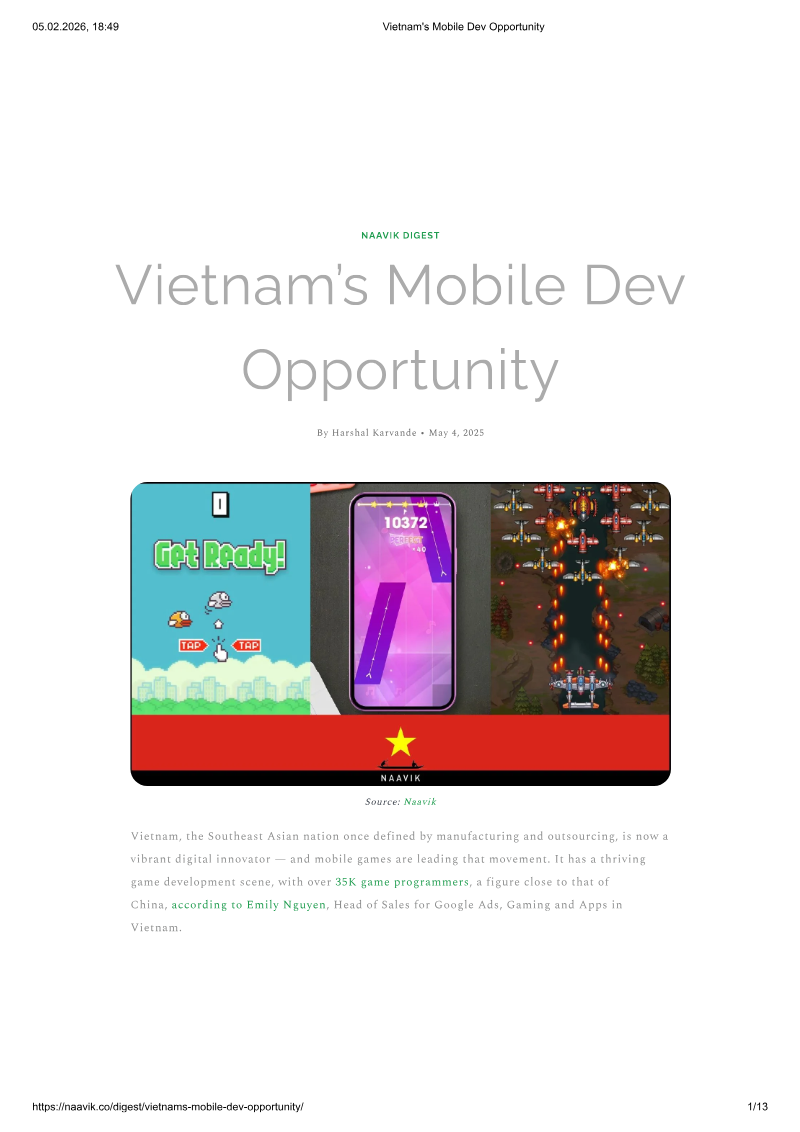
Vietnam's Mobile Dev Opportunity
Vietnam’s mobile game sector has evolved from a consumer‑centric market into a burgeoning production hub, driven by a skilled talent pool forged through outsourcing, stringent regulatory frameworks that forced local publishing entities to emerge, and the explosive rise of mobile gaming. The country now hosts over 35 000 game programmers—comparable to China’s workforce—and more than 300 active mobile publishers headquartered in Vietnam. In 2024, five Vietnamese studios ranked among the world’s top 25 publishers by downloads, contributing nearly 2.4 billion downloads and $133 million in revenue—a 67 % increase in downloads and an 82 % rise in earnings since 2020. Key titles such as Car Race, Wood Nuts & Bolts Puzzle, and Hair Salon: Beauty Salon Game illustrate the domestic IP pipeline, while globally recognized titles like Sky Garden: Farming Paradise, Magic Tiles 3, and Axie Infinity showcase the country’s capacity for high‑impact releases.
The transformation accelerated after 2013 when Vietnamese solo developer Nguyen Ha Dong’s Flappy Bird achieved worldwide chart dominance, proving that local talent could produce globally successful mobile games with limited resources. This success spurred a wave of small studios and startups, many of which transitioned from outsourcing or publishing roles to independent IP creation. Vietnam’s high smartphone penetration (84 %) and a youthful, digitally native demographic further underpin market growth.
Regulatory challenges remain: stricter limits on gaming time for minors, mandatory Ministry of Information and Communications approvals, and content censorship can constrain creative expression and international appeal. Future success will hinge on navigating the shift from hypercasual to more complex casual and social mobile games while adapting to evolving regulatory constraints. Despite these hurdles, Vietnam’s established talent base, rapid growth trajectory, and increasing foreign investment position it as a rising contender for global mobile game leadership over the next decade.
- Vietnam has emerged as a major global mobile development hub with over 35,000 game programmers and more than 300 active local publishers.
- In 2024, five Vietnamese studios ranked among the world’s top 25 publishers, generating 2.4 billion downloads and $133 million in revenue.
- Since 2020, the sector has experienced significant growth, marked by a 67% increase in downloads and an 82% rise in earnings.
- The industry’s transition from outsourcing to independent IP creation was catalyzed by the 2013 global success of Flappy Bird, which proved that local talent could achieve international chart dominance.
- Domestic market strength is supported by a digitally native population and an 84% smartphone penetration rate.
+2
NaavikFeb 2026
Presentation53 pages
Q3 for the Fiscal Year Ending March 2026 Results Presentation
Sega Sammy’s performance through the third quarter of the fiscal year ending March 2026 is characterized by a significant divergence between robust domestic gaming machine operations and substantial financial setbacks in the global consumer and mobile segments. While the Pachislot and Pachinko division exceeded expectations—driven by high-volume unit sales of titles like Smart Pachislot Tokyo Revengers—the broader group faces a projected net loss of 13.0 billion yen for the fiscal year. This downturn is primarily the result of 46.3 billion yen in extraordinary impairment losses related to the acquisitions of Rovio and Stakelogic, the latter of which was impacted by regulatory shifts in the Netherlands.
The Entertainment Contents Business struggled with underperforming new full game launches and a deteriorating user acquisition environment for mobile titles, most notably Sonic Rumble. Consequently, management has pivoted from aggressive expansion to a period of consolidation, suspending large-scale M&A activities in favor of a 20.0 billion yen share buyback program. To restore profitability within the mobile sector, the strategy now emphasizes a "regrowth phase" for Rovio, leveraging AI-driven marketing efficiencies and a transmedia approach that includes major theatrical releases for the Angry Birds and Sonic franchises scheduled through 2027.
Despite current headwinds, the medium-term outlook relies on a robust multi-platform pipeline and the expansion of the Gaming Business, which includes record-high performance at Paradise SegaSammy fueled by Japanese VIP demand. Upcoming releases for the Nintendo Switch 2 and the continued rollout of high-profile intellectual properties like Yakuza and Persona are intended to stabilize the consumer area. Geographically, the company remains focused on global markets while maintaining strict compliance with international gaming regulations in jurisdictions such as Nevada, which govern both corporate operations and shareholder requirements.
- Sega Sammy projects a 13.0 billion yen net loss for the fiscal year ending March 2026, driven by 46.3 billion yen in impairment losses from the acquisitions of Rovio and Stakelogic.
- The Pachislot and Pachinko division is the company's primary financial driver, significantly exceeding expectations through high-volume sales of titles like Smart Pachislot Tokyo Revengers.
- Management has shifted from aggressive M&A to a consolidation strategy, marked by the suspension of large-scale acquisitions and the initiation of a 20.0 billion yen share buyback program.
- The Entertainment Contents Business is underperforming due to weak new full game launches and poor user acquisition for mobile titles, specifically Sonic Rumble.
- The company is pivoting to a 'regrowth phase' for Rovio, utilizing AI-driven marketing and transmedia support from Angry Birds and Sonic theatrical releases scheduled through 2027.
Sega Sammy HoldingsFeb 2026

Presentation20 pages
Results Briefing Materials: Fiscal Year Ending March 2026, Third Quarter
Marvelous Inc. reports a significant increase in financial performance for the first nine months of the fiscal year ending March 2026. Net sales reached 29,121 million yen, a 40.5% year-on-year increase, while ordinary profit grew 28.6% to 2,129 million yen. This growth was primarily driven by the Digital Contents and Amusement segments, alongside foreign exchange gains that bolstered the bottom line.
The Digital Contents business saw revenue jump 69.2% following the successful launches of core titles including Rune Factory: Guardians of Azuma, STORY OF SEASONS: Grand Bazaar, and DAEMON X MACHINA TITANIC SCION. While high development costs for these new titles initially pressured margins, strong sales contributed to earnings ahead of schedule, significantly reducing cumulative operating losses in the segment. In the online space, the company launched Browser Sangokushi Ten, though it noted a slow initial start.
The Amusement business remained a consistent profit driver, with revenue increasing 25.1% due to the continued popularity of Pokémon kids’ amusement machines, such as Pokémon FRIENDA and the overseas expansion of Pokémon MEZASTAR. Conversely, the Audio & Visual business experienced a revenue decline of 11.3% following the liquidation of unprofitable businesses, though segment profit rose sharply by 306.1% due to high-performing stage productions and secondary usage revenue from anime titles.
Geographically, the company is focused on the Japanese, North American, European, and Asian markets across Nintendo Switch, PlayStation 5, and PC platforms. Despite exceeding year-to-date targets for certain profit metrics, the full-year forecast remains unchanged at 35,000 million yen in net sales and 2,000 million yen in operating profit, citing potential future uncertainties in the macroeconomic and industry environment.
- Marvelous Inc. reported a 40.5% year-on-year increase in net sales to 29,121 million yen and a 28.6% rise in ordinary profit to 2,129 million yen for the first nine months of the fiscal year ending March 2026.
- The Digital Contents segment saw a 69.2% revenue surge driven by the releases of 'Rune Factory: Guardians of Azuma', 'STORY OF SEASONS: Grand Bazaar', and 'DAEMON X MACHINA TITANIC SCION', which helped offset initial high development costs.
- The Amusement business grew revenue by 25.1%, fueled by the sustained popularity of 'Pokémon FRIENDA' and the international expansion of 'Pokémon MEZASTAR'.
- The Audio & Visual business saw an 11.3% revenue decline due to business liquidations, but segment profit jumped 306.1% thanks to successful stage productions and anime secondary usage revenue.
- Despite exceeding year-to-date profit targets, the company maintained its full-year forecast of 35,000 million yen in net sales and 2,000 million yen in operating profit, citing macroeconomic and industry uncertainties.
MarvelousJan 2026

Whitepaper16 pages
Beyond the App Store: A Guide to Direct Linkouts and Out-of-App Monetization
The mobile gaming industry is undergoing a structural shift as regulatory changes and legal precedents in the United States, Europe, Asia, and Latin America dismantle long-standing app store monopolies. This transition allows publishers to bypass traditional platform commissions of 15% to 30% by steering users toward direct, out-of-app payment channels. The primary thesis is that recovered margins should not be viewed merely as profit, but as a strategic reinvestment budget to enhance player value, improve live operations, and drive long-term audience growth.
Successful implementation requires a disciplined approach to user segmentation, value proposition, and interface design. Rather than inviting all players to use external payment methods, publishers should target high-propensity users—such as frequent spenders or those at higher game levels—to minimize friction for casual players. Because out-of-app flows inherently introduce more steps than native in-app purchases, publishers must provide a tangible incentive, such as bonus currency, exclusive items, or lower effective pricing, to ensure the external path remains attractive.
Operationalizing this strategy requires robust infrastructure to manage global payment routing, tax compliance, fraud protection, and reconciliation. Attempting to build these capabilities in-house often results in excessive overhead that negates the margin benefits. Data from large-scale deployments indicates that well-executed linkout programs can drive significant incremental growth, with some publishers seeing a 17% increase in webstore revenue and a 78% rise in first-time purchase rates. Ultimately, the transition to out-of-app monetization represents a move toward a more sustainable, publisher-controlled economic model that prioritizes lifetime value over single-transaction margins.
- Global regulatory shifts are dismantling app store monopolies, enabling publishers to bypass 15% to 30% platform commissions by utilizing direct, out-of-app payment channels.
- Well-executed webstore programs have demonstrated a 17% increase in total revenue and a 78% rise in first-time purchase rates for mobile game publishers.
- Publishers should treat recovered margins as strategic reinvestment capital for live operations and audience growth rather than immediate profit.
- To maintain conversion rates, publishers must offer tangible incentives such as bonus currency, exclusive items, or lower pricing to offset the increased friction of external payment flows.
- Targeting high-propensity users, such as frequent spenders or high-level players, is more effective than broad-based rollouts that risk alienating casual users.
+2
CodaJan 2026
Report24 pages
China WeChat Mini Games Industry Report 2026
The WeChat Mini Games industry in China has emerged as a dominant, high-growth sector within the broader digital ecosystem. As of 2026, the market is characterized by a rapid shift from simple casual titles toward mid-to-hardcore genres, including strategy, RPG, and tower defense games. This evolution is underscored by a significant increase in paid user acquisition, with over 51,000 games actively running advertisements in 2025, a figure that substantially outpaces traditional mobile game growth.
Market data indicates that the Mini Games sector generated RMB 53.535 billion (approximately $7.65 billion) in 2025, representing a 34.39% year-over-year increase, with projections exceeding RMB 70 billion for 2026. Revenue is primarily driven by in-app purchases, which account for 68.11% of total earnings, while advertising monetization contributes the remaining 31.89%. WeChat maintains a leadership position among competing platforms, boasting a 51.5% penetration rate and an industry-wide monthly active user base of 571 million as of August 2025.
User engagement remains high, with the average daily playtime exceeding 60 minutes and a daily session frequency of approximately 5.1 times. The core demographic is aged 24–40, with a majority residing in tier-3 cities or below. Successful titles increasingly utilize hybrid gameplay mechanics, such as combining MMORPG elements with idle or strategy features, to maintain player retention.
For international developers, the market presents significant opportunities but requires navigating complex regulatory and technical barriers. Successful entry necessitates partnering with local Chinese publishers to manage ISBN licensing, payment integration, and platform-specific performance optimizations. Technical requirements are stringent, as games must typically load in under 10 seconds and adhere to strict package size limits, often requiring the use of specialized engines like Cocos or Laya to ensure compatibility within the WeChat environment.
- The WeChat Mini Games market reached RMB 53.535 billion in 2025, a 34.39% year-over-year increase, with projections exceeding RMB 70 billion for 2026.
- WeChat dominates the sector with a 51.5% platform penetration rate and 571 million monthly active users as of August 2025.
- Revenue is primarily driven by in-app purchases (68.11%), supplemented by advertising monetization (31.89%).
- The industry is shifting toward mid-to-hardcore genres like RPG and strategy, supported by over 51,000 games actively running paid advertisements in 2025.
- Core user engagement is high, averaging over 60 minutes of daily playtime across 5.1 daily sessions, primarily among users aged 24–40 in tier-3 cities or below.
+2
Meridian PlayJan 2026

Presentation21 pages
Results Briefing Materials: Fiscal Year Ending March 2026, First Half (Semi-annual Period)
Marvelous Inc. reported a significant revenue increase for the first half of the fiscal year ending March 2026, covering the period from April to September 2025. Net sales rose 157.5% year-on-year to 20,281 million yen, primarily driven by the launch of three core video games and robust performance in the amusement sector. Despite the revenue surge, operating profit fell 61.8% to 226 million yen due to high development costs for new titles. However, ordinary profit and net income saw modest gains, aided by a shift from foreign exchange losses to gains.
The Digital Contents business experienced nearly doubled sales, reaching 12,414 million yen. Key performers included Rune Factory: Guardians of Azuma and Story of Seasons: Grand Bazaar, both of which surpassed half a million units sold and contributed to profits ahead of schedule. Conversely, the segment recorded a loss of 1,070 million yen, and sales for Daemon X Machina: Titanic Scion were characterized as sluggish. The Amusement business remained a strong profit driver, growing 36.3% in revenue and 41.2% in segment profit, fueled by the domestic and international success of Pokémon-themed kids' amusement machines like Pokémon Frienda and Pokémon Mezastar.
The Audio & Visual business saw a revenue decline of 16% following the liquidation of unprofitable units, yet segment profit nearly tripled to 483 million yen due to high-performing stage productions and secondary usage of past anime titles. Looking ahead, the company maintained its full-year forecast of 35,000 million yen in net sales and 2,000 million yen in operating profit. Management plans to focus on the continued expansion of its core first-half releases and upcoming titles like The Thousand Musketeers: Rhodoknight for the Nintendo Switch.
- Marvelous Inc. reported a 157.5% year-on-year revenue increase to 20,281 million yen for the first half of FY2026, though operating profit dropped 61.8% to 226 million yen due to high development costs.
- The Digital Contents segment saw sales nearly double to 12,414 million yen, driven by 'Rune Factory: Guardians of Azuma' and 'Story of Seasons: Grand Bazaar' each surpassing 500,000 units sold.
- The Amusement business remains the company's primary profit driver, achieving a 36.3% revenue increase and 41.2% profit growth, largely due to the success of 'Pokémon Frienda' and 'Pokémon Mezastar'.
- Despite revenue growth in Digital Contents, the segment recorded a 1,070 million yen loss, with 'Daemon X Machina: Titanic Scion' noted for sluggish sales performance.
- The Audio & Visual business segment profit nearly tripled to 483 million yen despite a 16% revenue decline, following the liquidation of unprofitable units and strong performance from stage productions and back-catalog anime.
MarvelousOct 2025
Report2 pages
Square Enix Special Feature: Erdrick Trilogy Reimagined
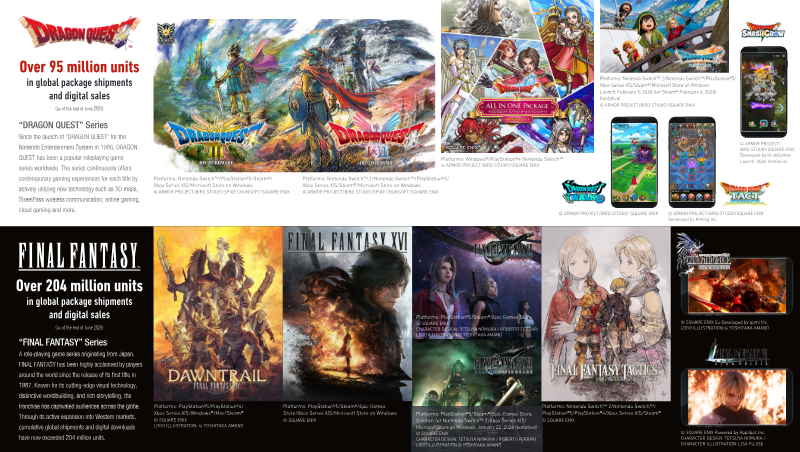
The Dragon Quest franchise continues to expand its global footprint, reaching over 95 million units in total shipments and digital sales as of June 2025. A central focus of the current release strategy is the reimagining of the foundational Erdrick Trilogy through HD-2D remakes. Dragon Quest I & II HD-2D Remake is scheduled for a February 5, 2026, launch on a wide array of platforms, including the Nintendo Switch 2, PlayStation 5, Xbox Series X|S, and PC via Steam and the Microsoft Store. This multi-platform approach reflects a broader commitment to utilizing contemporary technology to modernize classic role-playing experiences for a global audience.
Beyond the core Dragon Quest series, the broader portfolio demonstrates significant market penetration across several flagship intellectual properties. The Final Fantasy franchise has surpassed 204 million units globally as of mid-2025, supported by the ongoing expansion of Final Fantasy XIV: Dawntrail and the continued rollout of Final Fantasy VII Rebirth across various ecosystems. Additionally, the Kingdom Hearts series, a collaborative effort with Disney, has achieved over 38 million units in sales, with new entries currently in development for unspecified launch windows.
The strategic roadmap emphasizes cross-platform accessibility and the revitalization of legacy content. By targeting next-generation hardware like the Nintendo Switch 2 alongside established consoles and PC storefronts, there is a clear intent to maximize reach across diverse geographic markets. This strategy is complemented by a robust pipeline of mobile and niche titles, including Dragon Quest Tact and various entries in the Bravely Default and Octopath Traveler series, ensuring a steady cadence of content across the role-playing game segment through 2026.
- The Dragon Quest I & II HD-2D Remake is scheduled for release on February 5, 2026, across Nintendo Switch 2, PlayStation 5, Xbox Series X|S, and PC.
- The Dragon Quest franchise has reached 95 million units in total shipments and digital sales as of June 2025.
- The Final Fantasy franchise has surpassed 204 million units globally as of mid-2025, driven by Final Fantasy XIV: Dawntrail and Final Fantasy VII Rebirth.
- Square Enix is prioritizing a cross-platform strategy that targets next-generation hardware alongside established consoles and PC storefronts to maximize global market reach.
- The Kingdom Hearts series has achieved over 38 million units in sales, with new entries currently in development.
+3
Square EnixSept 2025

Report104 pages
Annual Report 2025
Annual Report 2025 details a landmark financial year for Games Workshop, characterized by record-breaking growth and the company’s promotion to the FTSE 100. For the 2024/25 period, total revenue rose to £617.5 million, with profit before taxation reaching £262.8 million. This performance was driven by a 14.2% increase in core sales—particularly within the trade channel and North American markets—and a near-doubling of licensing operating profit to £49.5 million, bolstered by the exceptional success of the Space Marine 2 video game.
The company continues to leverage a vertically integrated model, expanding its global footprint to 570 retail stores across 24 countries and an independent retailer network spanning 71 nations. To support this growth, significant capital investments are underway, including the construction of a fourth manufacturing facility by 2026 and a comprehensive IT systems overhaul slated for completion by 2029. While navigating macroeconomic challenges such as projected tariff impacts and supply chain disruptions, the Group maintained a robust liquidity position with £132.6 million in cash and distributed a record £20 million in profit-sharing to its workforce.
Strategic priorities have shifted toward long-term value alignment, evidenced by a new remuneration policy that introduces share-based compensation for executives and a "Triennial Share Award" linked to revenue and profit targets. Sustainability remains a core focus; despite a rise in total emissions driven by global freight, the company surpassed its 2032 reduction targets for Scope 1 and 2 emissions through facility electrification. Looking forward, the Group is prioritizing internal talent development, digital engagement through Warhammer+, and a potential media partnership with Amazon to further scale the brand's global reach.
- Games Workshop achieved record financial results for 2024/25 with £617.5 million in revenue and £262.8 million in profit before taxation, leading to its promotion to the FTSE 100.
- Licensing operating profit nearly doubled to £49.5 million, largely driven by the commercial success of the Space Marine 2 video game.
- Core sales grew by 14.2%, fueled by strong performance in the trade channel and North American markets.
- The company is scaling infrastructure with a fourth manufacturing facility scheduled for 2026 and a major IT systems overhaul targeted for 2029.
- Management has implemented a new executive remuneration policy featuring share-based compensation and a Triennial Share Award tied to specific revenue and profit targets.
+1
Games Workshop GroupAug 2025
Report18 pages
The State of PC Game Distribution
The study aims to map the contemporary PC game distribution ecosystem and evaluate whether Steam functions as a de‑facto monopoly, while outlining alternative channels, associated risks, and growth opportunities for developers and publishers. It positions Steam’s dominance against emerging storefronts, physical media, and gray‑market platforms, offering strategic guidance for navigating a fragmented market beyond 2025.
Steam’s market power is evident: 2024 revenue reached $10.8 billion and concurrent active users rose from 25.4 million in 2021 to 40.5 million by September 2025. Eighty‑eight percent of surveyed studios report that Steam delivers over 75 % of their revenue, with 37 % relying on it for more than 90 %. Consequently, 72 % of respondents view Steam as a monopoly and 53 % express concern over this reliance. Nonetheless, diversification is growing—48 % have launched titles on the Epic Games Store, a similar share on the Xbox PC store, while 10 % and 8 % have used GOG and itch.io respectively. Physical releases persist, with 32 % of developers still issuing boxed copies and 72 % of consumers indicating a continued appetite for them.
Alternative distribution via e‑stores (e.g., Humble, Fanatical) and marketplaces (e.g., G2A, Kinguin) is gaining traction: 38 % of developers sell through e‑stores and 30 % through marketplaces. Seventy‑five percent anticipate at least a 10 % revenue uplift from these channels, and 80 % expect them to become
- Steam maintains a dominant market position, generating $10.8 billion in 2024 revenue with concurrent users increasing from 25.4 million in 2021 to 40.5 million by September 2025.
- Developer reliance on Steam is extreme, with 88% of studios deriving over 75% of their revenue from the platform and 37% relying on it for more than 90%.
- Despite 72% of developers labeling Steam a monopoly, diversification is underway, with 48% of studios utilizing the Epic Games Store and the Xbox PC store for distribution.
- Alternative distribution channels are gaining significant traction, as 38% of developers now sell through e-stores like Humble or Fanatical, and 30% utilize marketplaces like G2A or Kinguin.
- Financial projections for alternative channels are optimistic, with 75% of developers anticipating at least a 10% revenue uplift and 80% expecting these platforms to become increasingly vital.
+2
RokkyJun 2025

Presentation19 pages
People Can Fly Q4 2024 Financial Results Presentation
People Can Fly presents a strategic pivot toward cash flow optimization and a refined production focus as of April 2025. The primary thesis centers on transitioning away from the virtual reality segment to concentrate exclusively on AAA and compact-AAA video games. This shift is driven by changes in the global VR business model, specifically the cessation of platform subsidies. Consequently, the company will conclude its VR publishing activities following the release of Project Bison in late 2025.
Financial data for the 2024 fiscal year shows cumulative revenue of PLN 190.4 million, an increase from PLN 150.1 million in 2023. This growth was supported by work-for-hire contributions from Project Maverick and Project Echo, alongside the launches of Bulletstorm VR and Green Hell VR Co-op. However, the group reported a significant net loss of PLN 175.3 million, largely attributed to one-off write-offs for Project Red, Project Bifrost, and the impairment of the Incuvo subsidiary.
The strategic roadmap emphasizes securing new work-for-hire contracts, including a recently signed project with Sony Interactive Entertainment, with a target of adding two more projects this year. In the self-publishing segment, Lost Rift is scheduled for early access in 2025. Notably, Krafton Inc. has waived its right of first refusal for Projects Bifrost and Victoria, granting the company freedom to seek new publishing partners.
Operational efficiency measures include optimizing team structures and office spaces while limiting disbursements to critical investments. As of late 2024, the group maintained a workforce of 756 employees across global studios in Warsaw, Montreal, Newcastle, and other locations. The company is currently evaluating various scenarios to secure additional financing to support its revised development pipeline.
- People Can Fly is exiting the virtual reality market following the release of Project Bison in late 2025, citing the cessation of platform subsidies as the primary driver.
- The company reported a net loss of PLN 175.3 million for fiscal year 2024, driven by significant one-off write-offs for Projects Red and Bifrost and the impairment of its Incuvo subsidiary.
- Annual revenue grew to PLN 190.4 million in 2024, up from PLN 150.1 million in 2023, bolstered by work-for-hire contributions from Project Maverick and Project Echo.
- The company is prioritizing work-for-hire revenue, having recently signed a new contract with Sony Interactive Entertainment with a goal to secure two additional projects in 2025.
- Krafton Inc. has waived its right of first refusal for Projects Bifrost and Victoria, allowing People Can Fly to seek new publishing partners for these titles.
+2
PCF GroupApr 2025

Report20 pages
Games Industry Region Report: China 2025
China maintains its position as the world’s most lucrative and influential gaming market, generating $48.7 billion in total revenue during 2024. While the domestic landscape has faced challenges such as stringent regulatory licensing, rising production costs, and intense competition, the industry has successfully transitioned from a mobile-centric model toward the development of high-end, triple-A intellectual property. This evolution is underscored by the global success of titles like Black Myth: Wukong and the fact that Chinese companies or their subsidiaries now account for 14 of the top 30 highest-grossing games worldwide.
The financial performance of the sector remains robust, with mobile App Store revenue reaching $15.6 billion and PC gaming experiencing significant growth bolstered by platforms like Steam. Although domestic App Store downloads have receded from their 2020 peak, Chinese publishers have effectively offset this by expanding their international footprint, generating over $18.5 billion in worldwide gross revenue. Furthermore, the ecosystem is diversifying through the rise of accessible platforms such as WeChat Mini Games, which provide unique avenues for engagement alongside traditional gaming segments.
Looking toward the future, the Chinese games industry is poised to lead in the integration of artificial intelligence and the export of original, globally recognized content. As regulatory barriers show signs of easing, the market is increasingly fostering international collaboration, positioning itself as a strategic gateway for Western studios. By balancing domestic market saturation with aggressive global expansion, the region is cementing its role as a primary architect of the modern gaming landscape, moving beyond its historical reliance on mobile titles to become a comprehensive powerhouse of interactive entertainment.
- The Chinese gaming market generated $48.7 billion in total revenue in 2024, maintaining its status as the world's most lucrative region.
- Chinese publishers generated $18.5 billion in international gross revenue, successfully offsetting a decline in domestic App Store downloads from their 2020 peak.
- Chinese companies or their subsidiaries now account for 14 of the top 30 highest-grossing games worldwide, signaling a shift toward high-end, triple-A intellectual property.
- Mobile App Store revenue reached $15.6 billion in 2024, while PC gaming experienced significant growth supported by platforms like Steam.
- The domestic market is diversifying through the rise of WeChat Mini Games, which offer new engagement avenues alongside traditional gaming segments.
+1
PocketGamer.bizJan 2025
Whitepaper19 pages
Monetization Landscape for Video Games in MENA
The gaming market across the MENA-3 region—comprising Saudi Arabia, the United Arab Emirates, and Egypt—is undergoing a period of rapid expansion, with total revenue projected to reach $2.7 billion by 2028. This growth is fueled by a confluence of high internet penetration, significant government investment, and a young, tech-savvy demographic. While the region presents a lucrative opportunity, it remains highly fragmented, necessitating nuanced monetization strategies that account for stark economic differences, such as the preference for premium and subscription models in wealthy Gulf states versus the dominance of free-to-play structures in Egypt.
A critical barrier to entry in this market is the low penetration of traditional credit cards, which has historically hindered revenue conversion. To address this, developers are increasingly shifting toward Direct-to-Consumer platforms. This strategic pivot allows companies to bypass high app store commissions while integrating essential local digital wallets and alternative payment methods. By adopting these flexible, localized payment infrastructures, developers can effectively reach the region’s significant unbanked and underbanked populations, ensuring broader accessibility and higher conversion rates.
Recent performance data underscores the efficacy of this localized approach, as evidenced by a 12.6% increase in regional sales and a 45% surge in games distributed through D2C ecosystems over the past two years. Long-term success in the MENA region depends on a developer’s ability to navigate these complex payment landscapes while simultaneously prioritizing cultural adaptation. By combining region-specific pricing strategies with multi-platform engagement, stakeholders can better capitalize on the region’s burgeoning digital economy and secure a sustainable foothold in this high-growth market.
- The MENA-3 gaming market (Saudi Arabia, UAE, and Egypt) is projected to reach $2.7 billion in total revenue by 2028.
- Direct-to-Consumer (D2C) distribution has surged by 45% over the past two years, helping developers bypass app store commissions and integrate local payment methods.
- Localized payment strategies, including the integration of digital wallets, have contributed to a 12.6% increase in regional sales.
- Monetization models must be bifurcated by economic region, favoring premium and subscription services in wealthy Gulf states while prioritizing free-to-play structures in Egypt.
- Low traditional credit card penetration remains a primary barrier to entry, necessitating the adoption of alternative payment infrastructures to capture unbanked and underbanked demographics.
+1
Niko PartnersJan 2025

Report10 pages
Take Rates in China: Will Quality Development Beat Out Traditional Distribution?
The Chinese mobile gaming market is currently undergoing a significant shift in distribution dynamics as developers increasingly challenge the traditional 50% take rates imposed by domestic Android app stores. While global discourse remains focused on the 30% take rate standard contested in the Epic v. Apple litigation, Chinese developers face a more restrictive domestic environment where smartphone manufacturers and major tech firms consolidate power through the Mobile Hardcore Alliance and the Global Developer Service Alliance. These entities justify high fees by providing integrated marketing and distribution services, yet these costs have become a primary point of contention for major studios.
To circumvent these high fees, prominent developers such as miHoYo, Lilith Games, and NetEase are increasingly adopting direct-to-consumer distribution models. By leveraging high-quality intellectual property, substantial marketing budgets, and community-driven platforms like TapTap and Bilibili, these studios can bypass traditional stores entirely. This strategy allows developers to retain significantly higher gross profit margins—often exceeding 95%—compared to the 50% margin typically realized through standard distribution channels. The success of these titles has begun to force concessions, as evidenced by Xiaomi offering reduced take rates to high-profile games like Genshin Impact.
The industry landscape is bifurcated, as smaller developers often remain dependent on traditional stores for the reach and infrastructure necessary to sustain their operations, viewing the 50% fee as an acceptable cost of doing business. However, the rise of direct distribution and community-centric marketing signals a broader trend where quality content and brand loyalty are becoming more influential than traditional store placement. As developers continue to prioritize direct engagement and alternative platforms, the dominance of traditional Android app stores in China faces mounting pressure, potentially reshaping the economic model of the global mobile gaming industry.
- Major Chinese developers like miHoYo, Lilith Games, and NetEase are bypassing traditional Android app stores to achieve gross profit margins exceeding 95%, compared to the 50% margin typical of standard distribution.
- The Chinese mobile gaming market is dominated by a 50% take rate imposed by smartphone manufacturers and tech firms organized under the Mobile Hardcore Alliance and the Global Developer Service Alliance.
- High-profile titles are successfully leveraging direct-to-consumer models and community platforms like TapTap and Bilibili to circumvent traditional distribution fees.
- The shift toward direct distribution has forced some concessions from traditional stores, such as Xiaomi offering reduced take rates for high-profile games like Genshin Impact.
- The market is bifurcated, as smaller developers remain dependent on traditional stores for necessary infrastructure and reach, accepting the 50% fee as a standard cost of business.
+2
NikoJan 2025

Report17 pages
Taxation in the Video Game Sector: Spain
The guide explains the tax framework that applies to video‑game companies operating in Spain, outlining both mandatory obligations and the range of incentives available to reduce fiscal burdens. It establishes that resident legal entities must pay corporate income tax at 25 % of profit, value‑added tax generally at 21 %, and the Economic Activities Tax, which is exempt for the first two years or for turnover below €1 million. Non‑resident individuals and firms are subject to the non‑resident income tax, with rates of 25 % when a permanent establishment exists and 19‑24 % otherwise, and must file the appropriate IRNR forms within prescribed periods. Personal income tax for self‑employed developers ranges from 19 % to 47 % depending on income level, and withholding obligations apply to employee and contractor payments.
Key fiscal incentives include a research and development and technological innovation deduction that allows a 12 % credit on qualifying expenses, capped at 25‑50 % of the tax liability, and a patent‑box regime that reduces the taxable base on income from patents, utility models, designs, and advanced software. The Start‑ups Law offers a reduced corporate tax rate of 15 % for four periods and defers advance instalments, while small entities with turnover under €10 million benefit from accelerated depreciation, finance‑lease deductions, and an equalisation reserve that can lower the tax base by up to 10 %. Companies located in the Canary Islands can access the REF and ZEC regimes, featuring a 4 % corporate tax rate and exemptions on property‑transfer and IGIC taxes when specific investment and employment criteria are met.
The guide also lists practical tools to support compliance, such as the tax‑agency’s query database, an annual calendar of filing deadlines, virtual assistance services, and a telephone help line. It emphasizes the need for proper registration, reporting of activity start‑up and cessation, and electronic filing using certified certificates, ensuring that video‑game developers can meet statutory requirements while exploiting available tax efficiencies.
- Resident video game companies in Spain are subject to a 25% corporate income tax rate, while qualifying start-ups can access a reduced 15% rate for four tax periods.
- The Canary Islands offer a highly competitive 4% corporate tax rate and exemptions on property-transfer and IGIC taxes for companies meeting specific investment and employment criteria.
- R&D and technological innovation expenses qualify for a 12% tax credit, capped at 25–50% of total tax liability, alongside a patent-box regime that reduces the taxable base for advanced software.
- Small entities with an annual turnover under €10 million are eligible for fiscal benefits including accelerated depreciation, finance-lease deductions, and an equalisation reserve that lowers the tax base by up to 10%.
- Non-resident firms without a permanent establishment face income tax rates between 19% and 24%, while resident entities must generally apply a 21% value-added tax.
+2
AEVIJan 2025

Report13 pages
Interview with Kim Yoo, License Manager at Bandai Namco Korea
The Japanese character market has evolved from a niche subculture into a mainstream value chain driven by a diverse demographic of high-spending fans. While male consumers maintain a strong presence in the traditional collectible figure segment, women in their 20s and 30s have emerged as a dominant force, shifting market demand toward lifestyle goods, customizable plush toys, and shareable social media content. This transformation is fueled by the global reach of streaming platforms, the normalization of fandom culture through K-pop, and an increasing consumer preference for immersive offline experiences such as pop-up stores and collaboration cafés.
Strategic success in this landscape requires a dual-track approach that balances mass-market accessibility with premium, limited-edition offerings. Current growth is heavily concentrated in cross-category collaborations where character intellectual properties intersect with fashion, digital goods, and the music industry. Navigating this market necessitates a deep understanding of multi-tiered licensing structures and a commitment to protecting the narrative integrity, or worldview, of each IP. Establishing long-term credibility through disciplined execution remains a prerequisite for international partners seeking to enter this competitive ecosystem.
Looking toward 2026, the industry is moving toward a hybrid model that prioritizes experiential content and convergence-driven trends. To remain competitive, businesses must develop the agility to identify these shifts early and execute initiatives swiftly. The integration of character IPs into broader cultural sectors like exhibitions and music suggests that the future of the market lies in creating holistic brand experiences rather than simple product manufacturing. This evolution underscores the necessity for strategic flexibility and rapid response to the changing tastes of a globalized fandom.
- The Japanese character market has shifted from a niche segment to a mainstream industry driven by high-spending female consumers in their 20s and 30s.
- Market demand is moving away from traditional collectible figures toward lifestyle goods, customizable plush toys, and content optimized for social media sharing.
- Strategic success requires a dual-track model that balances mass-market accessibility with premium, limited-edition product offerings.
- Growth is increasingly concentrated in cross-category collaborations that integrate character intellectual property with fashion, digital goods, and the music industry.
- The industry is transitioning toward a hybrid model by 2026 that prioritizes experiential, holistic brand experiences like pop-up stores and collaboration cafés over simple product manufacturing.
KOCCA – Korea Creative Content AgencyJan 2025