Major Chinese developers like miHoYo, Lilith Games, and NetEase are bypassing traditional Android app stores to achieve gross profit margins exceeding 95%, compared to the 50% margin typical of standard distribution.
See it on page 5The Chinese mobile gaming market is dominated by a 50% take rate imposed by smartphone manufacturers and tech firms organized under the Mobile Hardcore Alliance and the Global Developer Service Alliance.
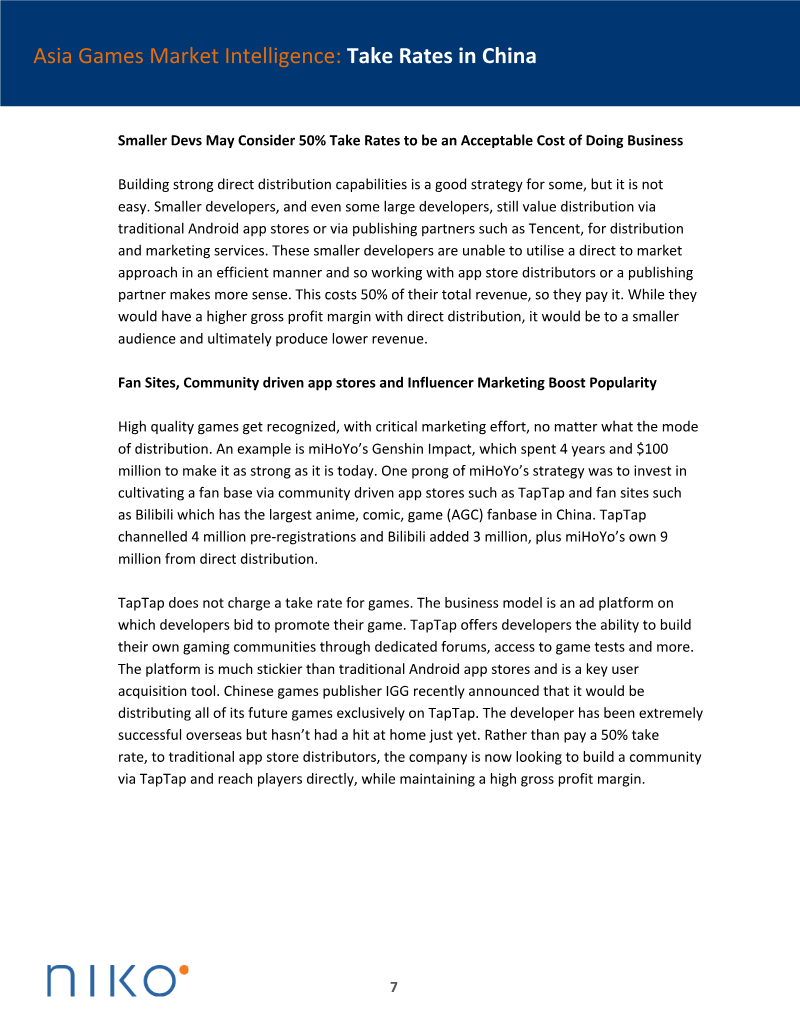
See it on page 4High-profile titles are successfully leveraging direct-to-consumer models and community platforms like TapTap and Bilibili to circumvent traditional distribution fees.
See it on page 7The shift toward direct distribution has forced some concessions from traditional stores, such as Xiaomi offering reduced take rates for high-profile games like Genshin Impact.
See it on page 8The market is bifurcated, as smaller developers remain dependent on traditional stores for necessary infrastructure and reach, accepting the 50% fee as a standard cost of business.
See it on page 7The increasing influence of brand loyalty and quality content over traditional store placement is pressuring the long-standing dominance of Chinese Android app stores.
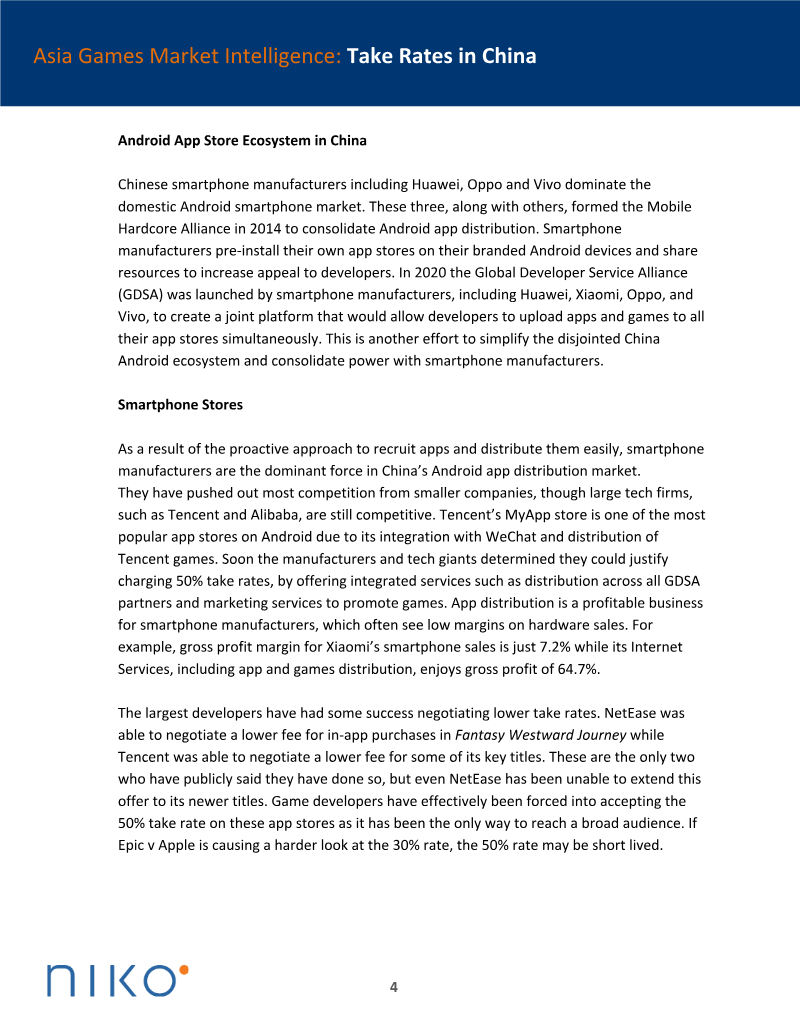
See it on page 4The Chinese mobile gaming market is currently undergoing a significant shift in distribution dynamics as developers increasingly challenge the traditional 50% take rates imposed by domestic Android app stores. While global discourse remains focused on the 30% take rate standard contested in the Epic v. Apple litigation, Chinese developers face a more restrictive domestic environment where smartphone manufacturers and major tech firms consolidate power through the Mobile Hardcore Alliance and the Global Developer Service Alliance. These entities justify high fees by providing integrated marketing and distribution services, yet these costs have become a primary point of contention for major studios.
To circumvent these high fees, prominent developers such as miHoYo, Lilith Games, and NetEase are increasingly adopting direct-to-consumer distribution models. By leveraging high-quality intellectual property, substantial marketing budgets, and community-driven platforms like TapTap and Bilibili, these studios can bypass traditional stores entirely. This strategy allows developers to retain significantly higher gross profit margins—often exceeding 95%—compared to the 50% margin typically realized through standard distribution channels. The success of these titles has begun to force concessions, as evidenced by Xiaomi offering reduced take rates to high-profile games like Genshin Impact.
The industry landscape is bifurcated, as smaller developers often remain dependent on traditional stores for the reach and infrastructure necessary to sustain their operations, viewing the 50% fee as an acceptable cost of doing business. However, the rise of direct distribution and community-centric marketing signals a broader trend where quality content and brand loyalty are becoming more influential than traditional store placement. As developers continue to prioritize direct engagement and alternative platforms, the dominance of traditional Android app stores in China faces mounting pressure, potentially reshaping the economic model of the global mobile gaming industry.