
Report28 pages
InvestGame Deals Report 2020 – Game M&A
The 2020 Game M&A landscape reached a record $33.6 billion in transaction value across 664 deals, with public offerings contributing 45% of the volume and $15.1 billion in 2020 alone, while M&A activity totaled $12.6 billion (potentially $22.2 billion when including recent mega‑deals). The United States dominated the market, accounting for 36% of deal value and hosting four of the top‑10 transactions. Tencent, Embracer, Stillfront, and Zynga were the leading acquirers, together representing 60% of total value. Swedish firms, particularly Embracer and Stillfront, led a domestic acquisition boom that captured 31% of all announced gaming M&A deals.
Investment trends reflected the low‑interest‑rate environment and robust public‑market valuations. Venture capital and corporate funding surged to $5.9 billion, with 363 private deals (55% of transactions) and a pronounced late‑stage focus on multiplatform, mobile, and PC/console titles. Early‑stage VC funding reached $333 million across 82 deals, while late‑stage rounds were concentrated in a handful of large transactions. IPO activity rose to 18 deals ($2.8 billion), led by Asian firms such as Kakao Games and Archosaur, and public PIPE funding exceeded $95 million in the Esports & Other segment.
The Esports & Other sector saw 37 M&A deals totaling $500 million, with control‑type acquisitions dominating (35 of 37). Majority stake takeovers were common, and the segment attracted significant public PIPE funding. Two hardware firms—NACON and Corsair Gaming—raised $350 million through IPOs, while Skillz leveraged a SPAC to achieve a $9 billion market cap. These findings underscore a 2020 environment of heightened M&A activity, concentrated investment in key geographic hubs, and a strategic shift toward multiplatform and esports opportunities.
- The 2020 gaming market hit a record $33.6 billion in total transaction value across 664 deals, driven by $15.1 billion in public offerings and $12.6 billion in M&A activity.
- Tencent, Embracer, Stillfront, and Zynga emerged as the dominant market forces, collectively accounting for 60% of the total M&A value.
- The United States led the global market by capturing 36% of total deal value and hosting four of the year's top-10 largest transactions.
- Swedish firms, specifically Embracer and Stillfront, drove a domestic acquisition boom that accounted for 31% of all announced gaming M&A deals.
- Venture capital and corporate funding reached $5.9 billion across 363 private deals, with a clear strategic focus on late-stage investments in multiplatform, mobile, and PC/console titles.
+1
InvestGameJan 2020
Report16 pages
Spillrapporten 2019/2020
Norsk spillbransje En global bransje Utfordringer og i dag i vekst muligheter «For å få oversikt over potensialet og utviklingen i dataspillbransjen er det viktig med et godt kunnskapsgrunnlag om spillbransjen og markedet, herunder tall og statistikk som er sammenliknbare med andre næringer og andre Sitatet over er hentet fra regjeringens ferske dataspill Vår ambisjon er at denne statistikken skal oppdateres og strategi, «Spillerom», for perioden 2...
- The Norwegian gaming industry's gross turnover from games was 550 million NOK in 2018, with 388 million NOK directly by companies and 162 million NOK through other distribution channels.
- Export revenue from Norwegian games is significant, estimated at 377 million NOK in 2018, substantially higher than the 87.3 million NOK from Norwegian film exports in 2015.
- Funcom is the largest company in the Norwegian gaming industry, a pattern seen in Finland (Supercell accounted for 88% of turnover in 2015) and Sweden, where dominant players drive overall industry growth.
- Access to private capital is a major barrier for growth in the Norwegian gaming industry, as many small companies with low equity struggle to secure funding for long development cycles.
- The Norwegian Film Institute (NFI) provided 23.7 million NOK in grants to data games in 2018, with 13.7 million NOK (58%) going to professional companies, indicating a focus on smaller-scale game development rather than growth-phase companies.
+1
Norsk Spill- og MultimedieforeningJan 2020
Presentation1 pages
Slovak Game Industry Infographic
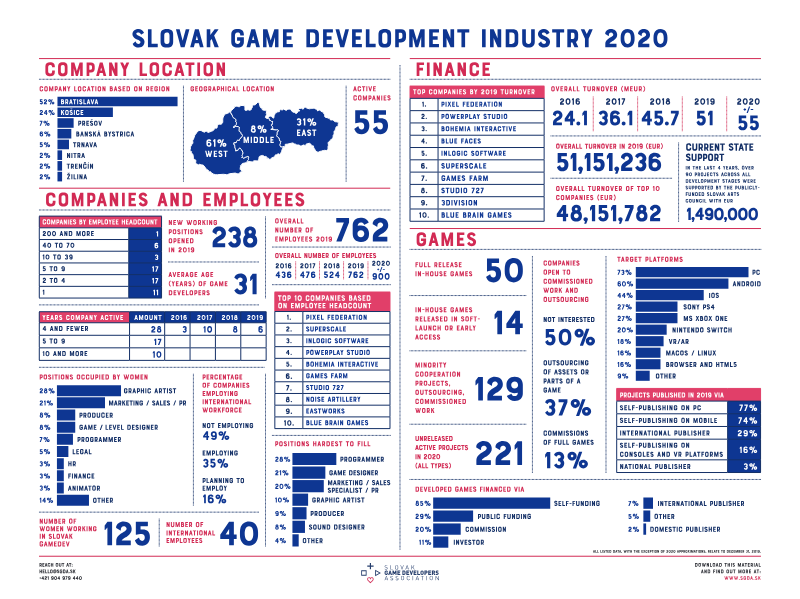
The Slovak game industry demonstrates consistent growth and professional maturation, characterized by a robust increase in both turnover and workforce capacity. As of the end of 2019, the sector comprised 55 active companies, with a significant geographic concentration in Bratislava, which hosts 52 percent of all firms, followed by Košice at 24 percent. The industry’s economic footprint is substantial, with the top ten companies generating over 48 million euros in annual turnover. Workforce development has kept pace with this expansion, as the total number of employees rose from 436 in 2016 to 762 by 2019, supported by the creation of 238 new positions in the final year of the reporting period.
Development activity remains diverse, with a strong emphasis on PC and mobile platforms. PC development leads the market at 73 percent, followed closely by Android and iOS at 60 percent and 44 percent, respectively. While self-publishing remains the dominant business model—utilized by 77 percent of companies for PC and 74 percent for mobile—the industry also leverages a mix of public funding, which supports 29 percent of projects, and commissioned work. Despite this growth, the sector faces talent acquisition challenges, particularly in filling roles for programmers, game designers, and marketing specialists.
The industry maintains a global outlook, with 40 international employees and a significant portion of the workforce engaged in outsourcing and international collaboration. Women represent a notable segment of the industry, occupying 129 positions, primarily within graphic arts, marketing, and production roles. With 221 active projects reported in 2020 and ongoing support from the Slovak Arts Council, the industry is positioned for continued development, balancing in-house creative output with strategic international partnerships and a diversified platform strategy.
- The Slovak game industry experienced significant workforce expansion between 2016 and 2019, growing from 436 to 762 employees.
- The top ten companies in the sector generated over 48 million euros in annual turnover as of 2019.
- The industry is geographically concentrated, with 52 percent of the 55 active companies based in Bratislava and 24 percent in Košice.
- PC development is the primary focus for 73 percent of companies, followed by Android at 60 percent and iOS at 44 percent.
- Self-publishing is the dominant business model, utilized by 77 percent of PC developers and 74 percent of mobile developers.
+1
Slovak Game Developers AssociationJan 2020
Report63 pages
Slovak Game Industry Annual Report 2020/2021
04 Slovak Game Development Industry 2020 59 Outsourcing and Services To currently speak about the games industry without mentioning the unprecedented times we’re all living through is a neary impossible task. I would like to express a huge amount of gratitude towards every single studio’s and individual’s hard work and dedication - continuing not only to create, but also to support our association.
- Slovak game development includes studios like Tater Games (founded 2019, 7 employees, released Nunu Spirits, Cyber Forge), Atomic Realm (founded 2019, 4 employees, released Magnet Run, developing Squabble), and Fatbot Games (founded 2015, 6 employees, released Vaporum).
- Larger studios include Pixel Federation (founded 2007, 220 employees, titles like Diggy's Adventure, TrainStation 2) and Inlogic (founded 2005, 60 employees, titles like Football Championship 2020, Zombie Hill Race 3).
- Several studios focus on specific niches: Incidental Minds (founded 2018, 6 employees) develops 2D illustrated story-driven and strategic games, while Neutraworks (founded 2018, 6 employees) is an independent studio.
- MATSUKO (founded 2016, 10 employees) is a deep-tech company specializing in holographic communication and 3D video games, with experience collaborating with Ubisoft.
- Educational initiatives include OpenLab, a technological accelerator for high school students, and Summer Game Dev, a summer school for game development aimed at moderately experienced and advanced developers.
+1
Slovak Arts CouncilJan 2020
Whitepaper26 pages
White Paper on Spanish Video Game Development 2020
Promoted by: With support from: Promoted by: With support from: LÍNEA Covid-19<sub>CULTURA</sub> One more year, DEV, the Spanish Association of Video Games and Entertainment Software Producers and Development Companies, keeps its commitment to the sector it represents by publishing the White Paper on Spanish Video Game Development, the leading report that makes an in-depth analysis of the video game industry in our The White Paper, this year celebrating its seventh edition, is aimed at dev...
- The Spanish video game industry billed 920 million euros in 2019, a 13% increase from 2018, and is projected to exceed 1.7 billion euros by 2023 with an annual growth rate of 17%.
- Employment in the sector grew by 6.1% in 2019, reaching 7,320 professionals, and is estimated to reach 8,500 direct jobs by 2023.
- Despite being the fifth European and tenth global market, 86% of Spanish studios bill below 2 million euros annually, with 61% billing under 200,000 euros, indicating a prevalence of small companies.
- Catalonia leads in both billing (51%) and employment (46%) within the Spanish video game industry, followed by Madrid (28% billing, 26% employment).
- A significant 66% of the industry's revenue comes from international markets, highlighting its export-oriented nature.
+1
DEV - Spanish Association of Video Games and Entertainment Software Producers and Development CompaniesJan 2020
Report83 pages
Economic Analysis of the Audiovisual Sector in the Republic of Ireland
A Report from Olsberg SPI with A Report from Olsberg•SPI with Economic Analysis of the Audiovisual Sector in the Republic of Ireland Glossary 1 1. Executive Summary 4 1.1. Economic Contribution 5 1.2. Key Strategic Issues and Recommendations 6 2. Introduction 10 2.1.
- The audiovisual and radio sectors contributed over €1 billion in Gross Value Added (GVA) to the Irish economy in 2016, with Film, TV, and animation accounting for the largest share at €692 million.
- The sectors generated an estimated €191 million in export earnings for Ireland in 2016, primarily from film, television, and animation. Inward production of live-action films and TV programs alone contributed €123.3 million to these export earnings.
- Irish animation studios earned an estimated €48.2 million from foreign clients in 2016, representing 74% of their total turnover.
- The Section 481 Tax Relief is crucial for the Irish film and TV industry, enabling local projects, attracting international co-productions, and making Ireland competitive for high-budget inward investment. Its future beyond 2020 requires clarification.
- Ireland faces a shortage of studio capacity, hindering both inward investment and domestic productions. Existing facilities are often booked, too small, or lack local crew support, increasing costs and limiting growth.
+1
Olsberg SPIJan 2020

Report19 pages
Baromètre Annuel du Jeu Vidéo en France: 2020
The 2020 Annual Barometer of the Video Game Industry in France provides a comprehensive analysis of the sector’s economic health, production landscape, and educational ecosystem. Based on a survey of 1,131 industry structures conducted between June and September 2019, the report highlights a robust industry characterized by steady growth, strong entrepreneurial spirit, and significant international reach. The findings underscore France's position as a highly attractive hub for video game development, ranking second globally behind the United States.
Key findings reveal that the industry is heavily focused on production, with half of all sector entities operating as development studios. These studios demonstrate a strong commitment to independence, with 93% identifying as independent and 74% actively creating original intellectual properties. Production remains largely centered on PC platforms, though mobile and console markets remain vital. Financially, the sector relies heavily on self-financing, supplemented by public support mechanisms such as the Video Game Tax Credit (CIJV) and regional aids. Despite this, access to traditional bank credit remains a challenge for many studios.
The report also details a positive outlook for employment, noting a trend toward stable, qualified, and permanent positions, with significant hiring intentions for the coming year. The educational sector is identified as a critical pillar of this growth, with 40 surveyed institutions training a growing pipeline of talent across design, technology, and management roles. While the industry shows resilience and optimism, it faces ongoing industrial transitions, including the rise of cloud gaming, immersive technologies, and new distribution models. Overall, the sector maintains a strong export orientation, with 44% of studio revenue generated internationally, reinforcing the strategic importance of the French video game industry within the global market.
- France ranks as the second-largest global hub for video game development, trailing only the United States.
- The industry is primarily composed of independent development studios, with 93% identifying as independent and 74% focused on creating original intellectual properties.
- International markets are a primary revenue driver, accounting for 44% of total studio income.
- The sector relies heavily on self-financing and public support mechanisms like the Video Game Tax Credit (CIJV), as traditional bank credit remains difficult to access.
- The workforce is characterized by stability and growth, with a trend toward permanent, qualified positions and high hiring intentions.
Syndicat National du Jeu VidéoJan 2020
Report3 pages
The Video Game Industry in France: 2020 Edition Economic Context and Production
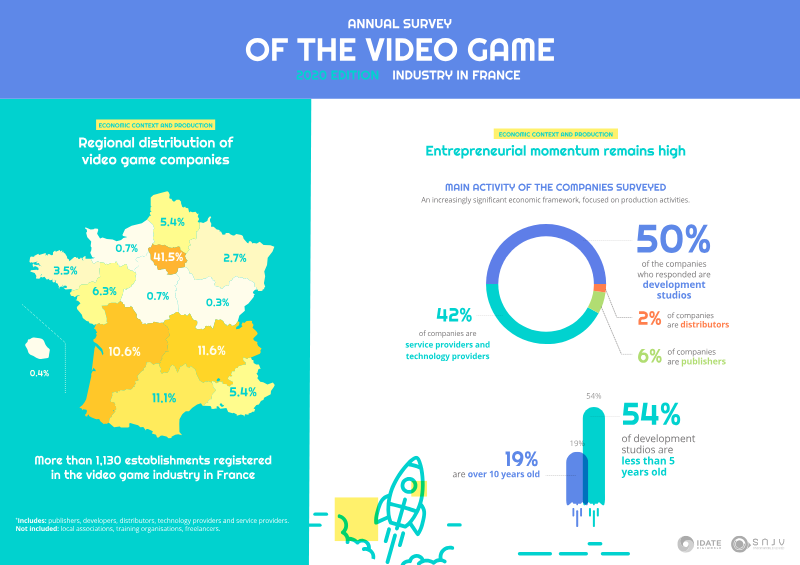
The French video game industry demonstrates robust entrepreneurial momentum and a strong focus on production, characterized by a diverse ecosystem of over 1,130 establishments. The sector is primarily composed of development studios, which account for 50% of industry entities, followed by service and technology providers at 42%, publishers at 6%, and distributors at 2%. This landscape is marked by a youthful demographic, with 19% of development studios having been established within the last five years, while another 19% have operated for over a decade.
Production output remains stable, with 530 titles marketed in 2019 and a significant pipeline of projects in development. Notably, 63% of these titles are based on new intellectual properties, reflecting a strong commitment to original content. Employment trends are equally positive, with 75% of employees working under permanent contracts. The industry is actively expanding, with projections indicating the creation of 800 to 1,200 new jobs by the end of 2019. Despite this growth, gender diversity remains a challenge, as women and non-binary individuals comprise only 16% of the workforce, with women holding just 11% of management roles.
The findings are based on a comprehensive survey conducted between June and September 2019, targeting 1,131 industry entities, including both members and non-members of the French Video Game Trade Association. The data highlights a strong educational pipeline, with a 26% growth in student enrollment and a high placement rate, as one in two graduates secures employment within the video game sector within a year. These metrics underscore the industry's role as a vital economic engine, supported by a specialized talent pool and a clear focus on sustainable, long-term production.
- The French video game industry comprises over 1,130 establishments, with development studios representing 50% of the sector and service/technology providers accounting for 42%.
- The industry demonstrates a strong commitment to original content, with 63% of the 530 titles marketed in 2019 based on new intellectual properties.
- Employment is characterized by stability and growth, with 75% of the workforce on permanent contracts and projections for 800 to 1,200 new jobs created by the end of 2019.
- Gender diversity remains a significant industry challenge, as women and non-binary individuals make up only 16% of the total workforce and women hold just 11% of management positions.
- The sector benefits from a robust talent pipeline, evidenced by a 26% growth in student enrollment and a 50% placement rate for graduates within the industry one year after completion.
+1
Syndicat National du Jeu VidéoJan 2020
Report140 pages
The Game Industry of Poland: 2020
Eryk Rutkowski Polish Agency for Enterprise Development Jakub Marszałkowski Indie Games Poland, Poznan University of Technology Sławomir Biedermann Polish Agency for Enterprise Development Edited by Sławomir Biedermann, Jakub Marszałkowski Ministry of Development Development Ministry of Culture and National Heritage Published by the Polish Agency for Enterprise Development Pańska 81/83, 00-834 Warsaw, Poland www.parp.gov.pl ...
- The Polish game industry has over 440 studios and companies, with 43 of them listed on the Warsaw Stock Exchange (12 on the main floor, 31 on NewConnect).
- Between 2017 and 2020, over 120 studios closed down while over 160 new ones were established, indicating a high variability in the sector, though the rapid growth observed before 2017 has slowed.
- 11 bit studios, founded in 2009 by former Metropolis studio members, developed 'This War of Mine' (the first video game on Poland's official school reading list) and 'Frostpunk', and has 140 employees.
- PlayWay, founded in 2011 by Krzysztof Kostowski, went public five years later and now has 55 subsidiaries incorporating 100 development teams, improving financial performance quarterly and paying out full dividends.
- All in! Games, a Cracow-based company, merged with Setanta in early 2020, went public, and has grown to nearly 60 employees; they are also the naming rights sponsor and strategic partner of the Wisła Cracow e-sport section since 2019.
Polish Agency for Enterprise DevelopmentJan 2020
Report9 pages
Games Monitor: The Netherlands 2020 Update – COVID Impact
This update provides an analysis of the Dutch video game industry’s performance during 2020, specifically examining the operational and economic impacts of the COVID-19 pandemic. The findings are based on a survey of over 100 industry professionals conducted in late 2020, supplemented by desk research and database updates. The report tracks industry growth, employment trends, and the shift in business dynamics necessitated by global lockdowns.
The Dutch games sector demonstrated resilience, growing from 575 companies in 2018 to 615 by the end of 2020, with total employment reaching approximately 4,000 jobs. While the industry largely transitioned to remote work with minimal impact on output quality, the pandemic created a divide between business-to-consumer (B2C) and business-to-business (B2B) entities. B2C entertainment companies generally benefited from increased consumer demand for home-based entertainment. Conversely, B2B and applied game developers faced significant challenges in the spring of 2020 as client projects were paused or canceled, though some firms in the healthcare sector identified new opportunities.
Operational challenges were primarily centered on human resources and networking. While productivity remained stable for most, employee engagement declined due to the loss of informal office culture, and nearly half of respondents reported increased stress levels. The absence of physical industry events hindered the establishment of new business relationships, with one-third of respondents unable to pursue new business opportunities effectively. Despite these hurdles, the industry maintained its growth trajectory, supported by government labor cost subsidies that assisted approximately 85 companies during the initial lockdown phases. Overall, the sector proved adaptable, leveraging digital infrastructure to sustain operations while navigating a volatile market environment.
- The Dutch video game industry grew from 575 companies in 2018 to 615 by the end of 2020, supporting approximately 4,000 total jobs.
- B2C entertainment developers experienced increased consumer demand during the pandemic, while B2B and applied game developers faced project cancellations and delays.
- Operational productivity remained stable despite the transition to remote work, though nearly 50% of industry professionals reported increased stress levels.
- The loss of physical industry events hindered business development, with one-third of surveyed professionals unable to effectively pursue new opportunities.
- Approximately 85 companies in the sector utilized government labor cost subsidies to maintain operations during the initial 2020 lockdown phases.
+2
Dutch Game GardenJan 2020
Report147 pages
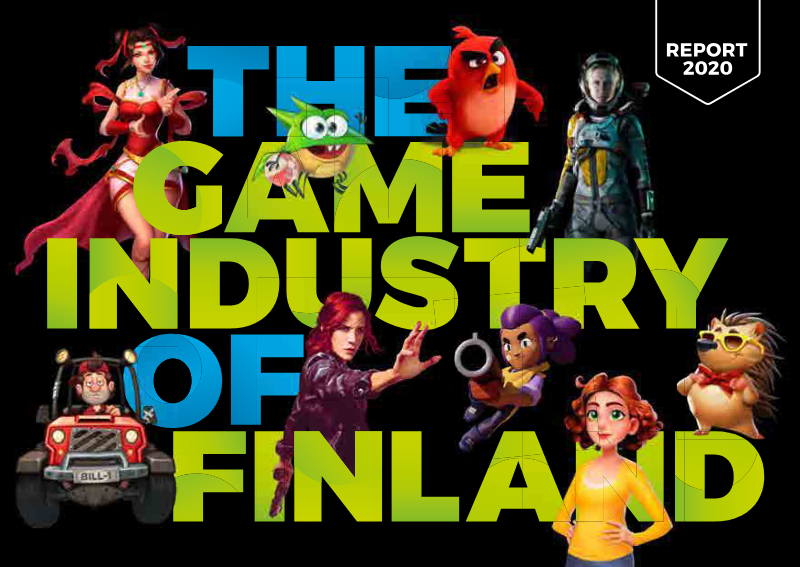
The State of the Finnish Game Industry 2020
The Finnish game industry solidified its position as a cornerstone of the national economy in 2020, maintaining a turnover exceeding €2 billion for the sixth consecutive year. Despite a slight contraction in the total number of active studios to approximately 200, the sector experienced a maturation phase characterized by increased revenue stability and a rise in high-performing firms. With 46 studios now generating over €1 million annually and a collective net profit surpassing €500 million, the industry demonstrated remarkable resilience against the operational disruptions of the COVID-19 pandemic. This economic strength is supported by a workforce of 3,600 professionals, with a persistent demand for hundreds of additional hires, reflecting a healthy, expanding ecosystem.
The industry is currently undergoing a strategic transformation driven by technological shifts toward cloud gaming, artificial intelligence, and Games as a Service models. While developers benefit from a robust network of public funding, private investment, and professional associations, they face mounting pressures from market consolidation, rising user acquisition costs, and regulatory fragmentation. To remain competitive in a saturated global market, Finnish studios are increasingly prioritizing data-driven design, social integration, and the development of strong intellectual property. This shift is accompanied by a positive trend in workforce diversification, with female representation reaching 22 percent.
The Finnish landscape remains defined by a diverse array of entities, ranging from global mobile giants like Supercell and Rovio to specialized indie developers and B2B service providers. These companies successfully balance creative autonomy with sustainable business practices, leveraging both original IP and work-for-hire models. By integrating emerging roles such as content creators and streamers into the development lifecycle, the industry continues to evolve, ensuring that Finnish studios maintain their significant footprint in the global digital entertainment market through innovation in mobile, console, and emerging technology platforms.
- The Finnish game industry maintained a turnover exceeding €2 billion in 2020, marking the sixth consecutive year of achieving this milestone.
- Industry profitability remains strong with 46 studios generating over €1 million annually and a collective net profit surpassing €500 million.
- The sector employs 3,600 professionals across approximately 200 active studios, with a persistent demand for hundreds of additional hires.
- Strategic development is shifting toward cloud gaming, artificial intelligence, and Games as a Service models to combat rising user acquisition costs and market saturation.
- Workforce diversification is improving, with female representation in the industry reaching 22 percent.
Neogames FinlandJan 2020
Report4 pages
Game Developer Index: Sweden 2020
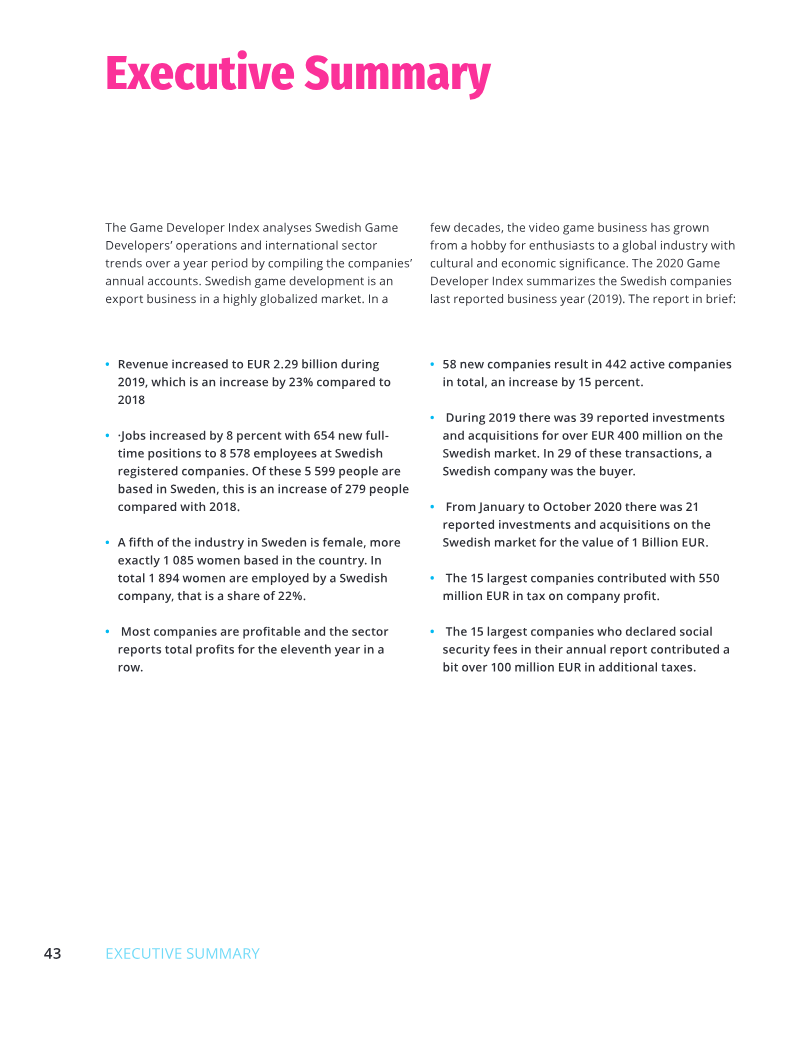
The Swedish game development industry demonstrates robust economic expansion and sustained profitability, functioning as a highly globalized export sector. By analyzing annual accounts from Swedish-registered companies, the industry reports a significant revenue increase to EUR 2.29 billion in 2019, representing a 23 percent growth over the previous year. This marks the eleventh consecutive year of total sector profitability, supported by a 15 percent increase in the number of active companies, which reached 442 by the end of 2019.
Employment trends reflect this upward trajectory, with the workforce growing by 8 percent to a total of 8,578 full-time positions. Of these, 5,599 employees are based within Sweden. While the industry continues to scale, gender diversity remains a focal point, with women comprising 22 percent of the total workforce. The sector’s economic impact extends to significant tax contributions, as the 15 largest companies alone provided EUR 550 million in corporate profit taxes and over EUR 100 million in additional social security fees.
Investment activity highlights the industry's maturity and attractiveness to capital. During 2019, the market saw 39 transactions involving investments and acquisitions totaling over EUR 400 million, with Swedish firms acting as the primary buyer in the majority of cases. This momentum accelerated into 2020, with 21 transactions recorded between January and October valued at EUR 1 billion. Despite these successes, the industry identifies ongoing challenges, particularly regarding the access to specialized talent and the navigation of complex digital market regulations. Future growth is expected to rely on regional clusters, incubators, and a continued commitment to increasing workforce diversity to maintain global competitiveness.
- The Swedish game industry generated EUR 2.29 billion in revenue in 2019, marking a 23 percent year-over-year increase and the eleventh consecutive year of sector-wide profitability.
- Investment activity surged significantly, with 39 transactions totaling over EUR 400 million in 2019, followed by 21 transactions valued at EUR 1 billion between January and October 2020.
- The industry workforce grew to 8,578 full-time positions by the end of 2019, with 5,599 of those employees based in Sweden and women representing 22 percent of the total headcount.
- The sector’s 15 largest companies contributed EUR 550 million in corporate profit taxes and over EUR 100 million in social security fees during 2019.
- The number of active game development companies in Sweden reached 442 by the end of 2019, representing a 15 percent increase from the previous year.
+2
DataspelsbranschenJan 2020

Report64 pages
2020 Mobile Gaming Apps Report
The global mobile gaming market is projected to surpass $100 billion in revenue in 2020, fueled by a 2.6 billion-person player base and a 24% surge in daily in-app payments. While the average cost per install has reached a record low of $1.47, the industry faces a tightening conversion landscape where install-to-purchase costs have risen by 24% and conversion rates have dropped to 3.3%. Midcore and strategy games have emerged as the most efficient segments, offering the highest 30-day return on ad spend at 39.5% while maintaining low acquisition costs, particularly on the Android platform.
Geographic performance varies significantly, with Japan and North America established as the premier markets for user retention and monetization. Japan consistently outperforms global benchmarks, doubling the retention rates of its regional peers and exceeding return on ad spend targets by over 10 percentage points. While the Asia-Pacific region as a whole delivers high returns, it is characterized by the highest acquisition costs. In contrast, the EMEA region, specifically the United Kingdom, provides a high-value alternative by balancing affordable install costs with strong returns. Emerging markets like Brazil offer the lowest entry costs globally but present high risks due to poor long-term retention and low conversion.
The hyper-casual sector is expected to reach $3 billion in 2020, though market saturation is driving a shift toward hybrid monetization models to combat declining long-term engagement. Across all genres, platform choice remains a critical strategic factor; iOS provides a slight advantage in return on investment but requires four times the acquisition spend of Android. Furthermore, while paid user acquisition drives initial engagement in midcore and social casino categories, organic users continue to demonstrate superior long-term loyalty, highlighting the ongoing importance of organic growth strategies in a competitive global landscape.
- The global mobile gaming market is projected to exceed $100 billion in 2020, supported by 2.6 billion players and a 24% increase in daily in-app payments.
- Midcore and strategy games are the most efficient segments, achieving a 39.5% 30-day return on ad spend with low acquisition costs, particularly on Android.
- While the average cost per install has hit a record low of $1.47, the industry faces a 24% rise in install-to-purchase costs and a decline in conversion rates to 3.3%.
- Japan remains the premier market for monetization and retention, doubling regional peer retention rates and exceeding return on ad spend targets by over 10 percentage points.
- iOS offers a higher return on investment than Android but requires four times the acquisition spend, while organic users continue to outperform paid users in long-term loyalty.
+2
LiftoffJan 2020
Report66 pages
Store Intelligence Data Digest: Q2 2020
The global mobile app ecosystem experienced unprecedented growth in the second quarter of 2020, driven primarily by the societal shifts resulting from the COVID-19 pandemic. Worldwide app downloads reached a record 37.8 billion, representing a 31.7 percent year-over-year increase. This surge was characterized by a massive transition toward remote work, digital education, and home entertainment. Zoom emerged as a dominant force, becoming only the third app in history to surpass 300 million quarterly installs, while the business category as a whole saw installations peak at 176 percent above pre-pandemic levels.
The mobile gaming sector served as a primary beneficiary of stay-at-home orders, with Google Play game downloads increasing by over 50 percent to 12.4 billion. Hypercasual titles like Save The Girl led the market in volume, while established titles such as Roblox and Brawl Stars reached new performance milestones in the United States and China, respectively. Revenue trends shifted toward social and simulation genres, with Sandbox and Battle Royale titles flourishing as digital social hubs. Notably, the Casino genre became the top-grossing category in the United States, generating $1 billion in revenue during the quarter.
While productivity and entertainment apps thrived, the travel, navigation, and rideshare sectors faced significant declines due to global lockdowns. However, the end of the quarter showed early signs of recovery in these areas, particularly in domestic travel within Scandinavia and a resurgence in sports app engagement as international leagues resumed play. This period also marked a milestone for mobile publishers, as Google became the first to exceed one billion quarterly downloads, illustrating the massive scale of the mobile economy during the height of the global health crisis.
- Worldwide mobile app downloads reached a record 37.8 billion in Q2 2020, a 31.7 percent year-over-year increase driven by pandemic-related shifts in work, education, and entertainment.
- Google Play game downloads surged by over 50 percent to 12.4 billion, with hypercasual titles leading in volume and Sandbox and Battle Royale genres flourishing as social hubs.
- Business category app installations peaked at 176 percent above pre-pandemic levels, with Zoom becoming the third app in history to surpass 300 million installs in a single quarter.
- The mobile Casino genre became the top-grossing category in the United States, generating $1 billion in revenue during the quarter.
- Google became the first mobile publisher to exceed one billion quarterly downloads, highlighting the massive scale of the mobile economy during the period.
Sensor TowerJan 2020
Report65 pages
Store Intelligence Data Digest: Q1 2020
The first quarter of 2020 marked a transformative period for the global mobile ecosystem, as the COVID-19 pandemic catalyzed an unprecedented surge in digital activity. Worldwide app downloads reached a record 33.6 billion, representing a 20.3% year-over-year increase. This growth was most pronounced in the mobile gaming sector, which surpassed 13 billion quarterly installs for the first time. While hyper-casual titles and established battle royale games maintained high volume, the quarter was specifically defined by a shift toward social and sandbox titles like Roblox and Minecraft, which facilitated remote connection during lockdowns.
The impact of the pandemic was visible across diverse geographic markets and app categories. Major regions including China, Italy, and the United States saw download volumes spike by 40% within two weeks of their respective outbreaks. China experienced the most dramatic immediate shift, with an 89% increase in game downloads following its initial surge in cases. While gaming drove volume, non-gaming categories underwent the most radical structural changes; Business and Education app downloads more than doubled, whereas Travel and Navigation installs plummeted by over 50% as global mobility stalled.
Market leadership shifted as emerging platforms capitalized on the stay-at-home economy. TikTok set a historical record with 315 million quarterly installs, and ByteDance significantly narrowed the gap with industry leaders Facebook and Google. Remote work tools such as Zoom, DingTalk, and Microsoft Teams saw exponential growth, with Zoom entering the U.S. App Store top 20 for the first time. Although global revenue growth was more modest than download growth, markets like France and Italy saw double-digit revenue increases, signaling a fundamental shift in consumer spending habits toward mobile-first entertainment and productivity.
- Worldwide mobile app downloads reached a record 33.6 billion in Q1 2020, a 20.3% year-over-year increase driven by pandemic-related digital activity.
- Mobile gaming installs exceeded 13 billion for the first time, with a notable shift toward social and sandbox titles like Roblox and Minecraft.
- Non-gaming app categories saw radical structural shifts, as Business and Education downloads more than doubled while Travel and Navigation installs fell by over 50%.
- TikTok set a historical record with 315 million quarterly installs, allowing parent company ByteDance to significantly narrow the gap with industry leaders Facebook and Google.
- China experienced an 89% surge in game downloads following its initial COVID-19 outbreak, contributing to a broader trend where major regions saw download volumes spike by 40% within two weeks of local lockdowns.
Sensor TowerJan 2020
Report62 pages
Level Up: A Guide to Succeed in Asia’s Gaming Market
Asia has established itself as the epicenter of the global gaming industry, driven by a mobile-first population exceeding 1.5 billion players. The region’s market is characterized by the dominance of free-to-play models, which account for nearly 99% of mobile revenue and all top-grossing titles. While China and Japan lead in total revenue, Japan maintains the highest value per user with an average revenue per download of $12.84. Growth is increasingly fueled by the female demographic, which expanded to 500 million players by 2019 and contributes nearly 40% of total mobile gaming revenue. This shift necessitates more inclusive storylines and diverse development teams to capture a demographic that is currently outgrowing its male counterpart.
The competitive landscape is defined by the rapid ascent of mobile esports, with Asia generating 68% of the sector's global revenue. Southeast Asia, in particular, has seen a 244% increase in tournament prize pools, signaling a transition from casual play toward complex, competitive genres like MOBAs and Battle Royales. Despite high interest, a significant gap remains between esports viewership and active participation, representing a massive untapped opportunity for developers. Success in these markets requires sophisticated monetization strategies, such as hybrid models combining gacha mechanics, battle passes, and rewarded video ads to accommodate varying income levels across the territory.
Navigating the Asian market demands deep localization that extends beyond language to include cultural customs, religious sensitivities, and technical optimization for diverse hardware. While Japan and South Korea remain dominated by local developers and legacy RPG franchises, India and Southeast Asia offer high-growth potential for international titles that provide "lite" versions for accessible play. To achieve long-term engagement, developers must leverage local influencers and community-driven gameplay, ensuring that titles resonate with the specific pop culture trends and infrastructure capabilities of each unique sub-region.
- Asia’s gaming market is driven by over 1.5 billion mobile-first players, with free-to-play models generating 99% of mobile revenue.
- The female demographic has grown to 500 million players and now contributes nearly 40% of total mobile gaming revenue, necessitating more inclusive content.
- Asia accounts for 68% of global mobile esports revenue, with Southeast Asia experiencing a 244% increase in tournament prize pools.
- Japan leads the region in monetization efficiency, maintaining the highest average revenue per download at $12.84.
- Developers should implement hybrid monetization strategies—combining gacha, battle passes, and rewarded video ads—to address varying income levels across the region.
+1
NewzooJan 2020
Report22 pages
For the Win: Breaking Down the Preferences of Asia's Mobile Gamers
Asia represents the world’s most significant mobile gaming hub, housing over half of the global player base and generating the majority of the industry's mobile revenue. The primary objective of this analysis is to examine the distinct player preferences, cultural influences, and market regulations across five key regions: China, Japan, South Korea, India, and Southeast Asia. By evaluating top-grossing titles and genre shifts through the first half of 2020, the findings illustrate a broader regional transition from casual play toward complex, competitive, and socially-driven experiences.
China remains the largest market, characterized by the successful migration of PC intellectual properties to mobile and a regulatory environment that necessitates domestic partnerships. In contrast, Japan’s market is defined by a deep-rooted console history and the pervasive influence of anime and manga aesthetics, with RPGs accounting for nearly half of its mobile revenue. South Korea leverages its robust 5G infrastructure and "PC bang" culture to sustain a market dominated by high-fidelity MMORPGs. Meanwhile, India and Southeast Asia emerge as high-growth regions where young populations and increasing smartphone accessibility are fueling a massive surge in mobile esports and battle royale titles.
The data reveals that localization involves more than translation; it requires integrating local folklore, respecting religious customs, and optimizing for hardware constraints. For instance, "lite" versions of games are essential for market penetration in India, while community-centric features are vital for success in Southeast Asia. Across all regions, the rise of mobile esports is a dominant trend, with competitive titles increasingly displacing traditional genres in the top-grossing charts.
The methodology utilizes data from Niko Partners, incorporating market models, five-year forecasts, and qualitative surveys from a panel of millions of consumers across Asia. The analysis covers the period from 2016 through June 2020, drawing on data from retailers, app markets, and interviews with industry executives to provide a comprehensive view of the mobile landscape.
- Asia accounts for over 50% of the global mobile gaming player base and generates the majority of the industry's total mobile revenue.
- Mobile esports and competitive, socially-driven titles are displacing traditional genres across all Asian markets, marking a major shift in consumer preference through the first half of 2020.
- China remains the largest market, where success is driven by migrating PC intellectual properties to mobile and navigating a regulatory environment that requires domestic partnerships.
- Japan’s mobile market is heavily influenced by console history and anime aesthetics, with RPGs consistently accounting for nearly 50% of total mobile revenue.
- South Korea’s market is defined by high-fidelity MMORPGs, supported by the country's advanced 5G infrastructure and a culture rooted in PC bang gaming.
+1
Niko PartnersJan 2020
Report15 pages
From Playing to Paying: The Art of Monetizing Games in Asia
This analysis examines the evolving landscape of game monetization across Asia, focusing on how developers adapt revenue models to meet the demands of a maturing market. The central thesis posits that while free-to-play (F2P) remains the dominant force, the rise of hybrid models and advanced mechanics like battle passes and gacha are essential for capturing the increasing purchasing power of Asian gamers. The scope covers major markets including China, Japan, South Korea, India, and Southeast Asia, utilizing 2019 and 2020 data to highlight shifts accelerated by the COVID-19 pandemic.
Key findings underscore the overwhelming success of the F2P model, which accounted for 98.5% of all mobile games revenue in 2019. In China, 100% of the top-grossing mobile titles utilized F2P. However, regional nuances are significant; Japan represents the most valuable mobile market with a revenue per download of $12.84, compared to a regional average of $1.53. While premium models remain a staple in console-heavy Japan, emerging markets like India are "leapfrogging" traditional stages by quickly adopting sophisticated F2P mechanics, such as battle passes, which were featured in half of India’s top-grossing games by early 2020.
The methodology relies on a combination of proprietary consumer panels exceeding four million users, developer interviews, and market modeling. The conclusions suggest that developers must move toward hybrid monetization—blending in-app purchases with rewarded ads—to mitigate economic risks and appeal to diverse player segments. By aligning monetization with core gameplay rather than interrupting it, publishers can sustain long-term engagement in a region where player motivations range from high-spend competition to time-intensive casual play.
- Free-to-play (F2P) is the dominant monetization model in Asia, accounting for 98.5% of all mobile games revenue in 2019 and 100% of top-grossing titles in China.
- Japan is the most lucrative mobile market in the region, generating $12.84 in revenue per download compared to the $1.53 regional average.
- Emerging markets like India are rapidly adopting sophisticated monetization, with battle passes appearing in 50% of the country's top-grossing games by early 2020.
- Developers are increasingly shifting toward hybrid monetization models that blend in-app purchases with rewarded ads to mitigate economic risk and capture diverse player segments.
- To sustain long-term engagement, publishers must integrate monetization mechanics directly into core gameplay rather than using interruptive ad formats.
+1
Niko PartnersJan 2020

Report49 pages
State of Mobile 2020
The mobile industry reached unprecedented milestones in 2019, characterized by 204 billion app downloads and $120 billion in consumer spending. This growth represents a doubling of the market since 2016, establishing mobile as the primary platform for global commerce and entertainment. Mobile-centric companies now command significantly higher IPO valuations than their traditional counterparts, a trend driven largely by the emergence of Gen Z as a dominant demographic. This generation engages with mobile content 60% more frequently than older cohorts, signaling a permanent shift in consumer behavior across global markets, with particularly high engagement levels in the Asia-Pacific region.
Mobile gaming continues to anchor the ecosystem, accounting for 72% of all app store spending and outperforming the combined revenue of PC, console, and handheld gaming platforms. While casual games lead in total downloads, core titles such as RPGs and Action games generate 76% of total consumer spend and capture the majority of user engagement time. This monetization success is mirrored in other sectors; for instance, dating app expenditures doubled to $2.2 billion, and health and fitness apps saw a 130% increase in spending as users migrated from physical gyms to digital wellness platforms.
Beyond entertainment, mobile has become essential to finance and retail. Global finance app sessions surpassed one trillion in 2019, with fintech startups increasingly outperforming traditional banking institutions. In retail, a strong correlation exists between time spent in-app and total sales, exemplified by record-breaking mobile transactions during major shopping events. Furthermore, the rapid rise of short-form video platforms like TikTok and the 240% increase in food delivery sessions since 2017 underscore a broader transformation where mobile serves as the central hub for daily logistics, social interaction, and professional services.
- Mobile gaming remains the industry anchor, generating 72% of all app store spending and outperforming the combined revenue of PC, console, and handheld platforms.
- The mobile market doubled in size since 2016, reaching 204 billion downloads and $120 billion in consumer spending in 2019.
- Core gaming titles, specifically RPGs and Action games, drive 76% of total consumer spend and capture the majority of user engagement time.
- Gen Z is the primary driver of market growth, engaging with mobile content 60% more frequently than older demographics.
- Finance apps surpassed one trillion sessions in 2019, with fintech startups increasingly outperforming traditional banking institutions.
data.aiJan 2020
Report29 pages
2020–2022: The Most Exciting Time in the Gaming Industry
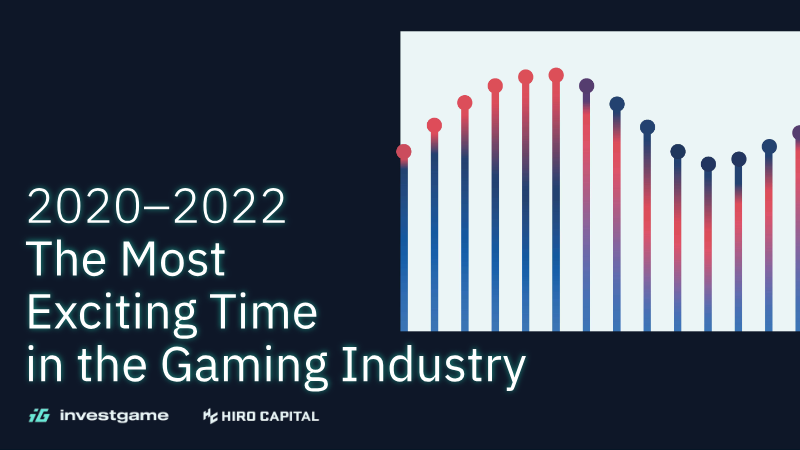
This analysis examines global investment and merger and acquisition (M&A) activity within the video game industry from 2020 through 2022. The primary thesis posits that the industry has passed a historic peak of deal-making and is now entering a "Great Reset" characterized by market cooling, lower valuations, and a shift in investor priorities. While the era of massive public offerings and late-stage venture capital (VC) surges has slowed due to macroeconomic headwinds like inflation and rising interest rates, the industry remains fundamentally strong with significant "dry powder" available for early-stage startups and strategic consolidations.
The data reveals a volatile three-year cycle. M&A activity reached a zenith in 2022 with $37.7 billion in closed deals—a 199% increase in value from 2021—driven by massive consolidations such as Take-Two’s acquisition of Zynga. Conversely, public offerings plummeted by 82% in 2022 as the IPO and SPAC windows effectively closed. Private investments also saw a 16% decline in value in 2022 after doubling the previous year. Despite these drops, early-stage VC remained resilient, with over $6.2 billion raised by gaming-focused funds ready for deployment.
Geographically and segmentally, the scope is global, with specific attention paid to the decline of mobile gaming hype post-IDFA and the rising interest in PC, console, and AI-driven startups. The report highlights a stark cooling in Web3 gaming, where investor "FOMO" has been replaced by a focus on fundamental gameplay and infrastructure. Gender diversity remains a challenge in the sector; 89% of funded or acquired companies were led by men in 2022, a negligible change from 90% in 2021.
Methodologically, the findings are based on tracked closed transactions across video game publishers, developers, and hardware providers. Data was aggregated from public media, S&P Capital IQ, and partner insights, utilizing a weighted ranking system to identify the most active investors. The analysis concludes that while the "peak wave" has passed, the industry is transitioning into a more disciplined phase of the investment cycle.
- M&A activity reached a historic peak in 2022 with $37.7 billion in closed deals, representing a 199% increase over 2021, largely driven by major consolidations like Take-Two’s acquisition of Zynga.
- Public offerings for gaming companies collapsed in 2022, with an 82% decline in value as IPO and SPAC windows effectively closed due to macroeconomic headwinds.
- Private investment value fell by 16% in 2022 following a doubling of investment the previous year, signaling a shift toward a more disciplined, cooling market.
- Despite the broader market slowdown, early-stage venture capital remains robust, with over $6.2 billion in dry powder currently available for deployment into new startups.
- Investor interest has shifted away from Web3 gaming and mobile gaming—the latter impacted by post-IDFA challenges—toward PC, console, and AI-driven development.
+1
InvestGameJan 2020