Updated Mar 23, 2026 by Syndicat National du Jeu Vidéo
Report · January 1, 2020
Published by Syndicat National du Jeu Vidéo
The 2020 Annual Barometer of the Video Game Industry in France provides a comprehensive analysis of the sector’s economic health, production landscape, and educational ecosystem. Based on a survey of 1,131 industry structures conducted between June and September 2019, the report highlights a robust industry characterized by steady growth, strong entrepreneurial spirit, and significant international reach. The findings underscore France's position as a highly attractive hub for video game development, ranking second globally behind the United States. Key findings reveal that the industry is heavily focused on production, with half of all sector entities operating as development studios. These studios demonstrate a strong commitment to independence, with 93% identifying as independent and 74% actively creating original intellectual properties. Production remains largely centered on PC platforms, though mobile and console markets remain vital. Financially, the sector relies heavily on self-financing, supplemented by public support mechanisms such as the Video Game Tax Credit (CIJV) and regional aids. Despite this, access to traditional bank credit remains a challenge for many studios. The report also details a positive outlook for employment, noting a trend toward stable, qualified, and permanent positions, with significant hiring intentions for the coming year. The educational sector is identified as a critical pillar of this growth, with 40 surveyed institutions training a growing pipeline of talent across design, technology, and management roles. While the industry shows resilience and optimism, it faces ongoing industrial transitions, including the rise of cloud gaming, immersive technologies, and new distribution models. Overall, the sector maintains a strong export orientation, with 44% of studio revenue generated internationally, reinforcing the strategic importance of the French video game industry within the global market.
BAROMÉETREANNUEL DU BAROMÈTRE ANNUEL DU JEU VIDÉO EN EN FRANCE FRANCE ÉDITION 2020 UNE COLLABORATION
ESWC, Gaming Group. BAROMÈTRE ANNUEL DU JEU VIDÉO EN FRANCE ÉDITION 2020 SAMING CAMPUS Introduction 4 Sommaire Enseignements clés 5 1<sup>E</sup> PARTIE Entreprises et studios de développement 7 Chapitre 1 Le tissu économique et la production 7 Chapitre 2 L’emploi 19 Chapitre 3 La situation économique et financière des entreprises 23 3 écoles d’enseignement supérieur pour former les talents de demain Chapitre 4 Les perspectives 27 MONÉTISATION / MARKETING / COMMUNICATION / GESTION DE PROJET / 2<sup>E</sup> PARTIE Organismes d’enseignement 30 PROGRAMMATION / GRAPHISTE / SOUND DESIGNER / GAME ARTIST PROGRAMMATION Sources 34 BACHELOR / MBA À propos 35 BACHELOR / MBA G.BS RAPPEL MÉTHODOLOGIQUE Dans le présent rapport, lorsque l’on q u e s t i o n n a i r e ACTIVITÉ PRINCIPALE DES ENTREPRISES mentionne « entreprises », nous faisons auto-administré en IMPLANTÉES EN FRANCE S.BUSINESS C.T référence à l’ensemble des répondants ligne. Ce question- SCHOOL SIGN (studios de développement, éditeurs, naire a été adressé 50% des entreprises ᵃʸᵃⁿᵗ réfprestataires etc.). aux dirigeants des répondu sont des (stl entreprises adhé- studios de pre rentes du Syndicat développement La collaboration L’enquête a été National du Jeu 2% IDATE DigiWorld / réalisée entre le 17 Vidéo (SNJV) ainsi SNJV livre une photo- juin et le 9 qu’aux sociétés, 42% des entreprises sont graphie représenta- septembre 2019 ressortissantes du des distributeurs tive du secteur, qui auprès de 1 131 secteur des jeux des entreprises 6% reflète son activité structures (hors vidéo, non adhé- sont des des entreprises sont (nature et volume), associations, disposi- rentes au SNJV.
rises sont graphie représenta- septembre 2019 ressortissantes du des distributeurs tive du secteur, qui auprès de 1 131 secteur des jeux des entreprises 6% reflète son activité structures (hors vidéo, non adhé- sont des des entreprises sont (nature et volume), associations, disposi- rentes au SNJV. prestataires de des éditeurs sa santé écono- tifs d’accompagne- services et mique et financière ment et établisse- fournisseurs de et sa perception de ments d’enseigne- technologie l’avenir. ment) via un 1 900 M2 AU CŒUR DE LYON www.GamingCampus.fr Chaque graphique est sourcé page 34 (nombre de répondants,
Enseignements clés pour l’année 2019 L’édition 2020 du baromètre du jeu vidéo en France s’inscrit dans un contexte de croissance mondiale du 2019 confirme la secteur et de transitions technolo- giques et industrielles. bonne santé de Au niveau mondial, la provenant des l’industrie en France vente de jeux vidéo équipements et devrait générer près accessoires). de 115 milliards dans un contexte de d’euros de revenus Bien que le secteur (presque 130 milliards connaisse de façon transition globale de dollars US) d’ici fin continue, sinon 2019. C’est 11.3% de régulièrement, des mieux par rapport à transitions technolo- 2018. Le mobile reste giques et industrielles le premier segment imprévisibles, il en est de marché en valeur qu’on sait anticiper. avec 44.9% des Deux des 3 consoles revenus. Grâce au de salon de 8ème développement des génération arrivent en boutiques digitales, fin de cycle. Les les revenus issus de la nouvelles machines vente des jeux sur seront commerciali- RÉPARTITION DES REVENUS consoles retrouvent sées entre 2020 et une dynamique 2021. C’est l’occasion MONDIAUX DU JEU VIDÉO prometteuse (27,4% pour les acteurs de EN 2019 des revenus de 2019). l’édition, du dévelop- Avec 23,5% des pement et les fournis- 4% 0,3% revenus en 2019, le PC seurs de solutions maintient sa place.
S consoles retrouvent sées entre 2020 et une dynamique 2021. C’est l’occasion MONDIAUX DU JEU VIDÉO prometteuse (27,4% pour les acteurs de EN 2019 des revenus de 2019). l’édition, du dévelop- Avec 23,5% des pement et les fournis- 4% 0,3% revenus en 2019, le PC seurs de solutions maintient sa place. technologiques de revisiter leur stratégie La croissance actuelle partenariale, leur 27,4% pourrait conduire les programme de revenus du secteur à production et d’invesavoisiner 165 tissement pour les 44,9% milliards d’euros en années à venir. 23,5% 2023 (hors revenus Le contexte est égale- 8,6 75% 14% 2% ment marqué par la emplois volonté de quelques et acteurs majeurs de la en moyenne en France des emplois salariés de femmes de non-binaires Tech et du Web d’investir ou de dans les studios sont desCDI dans les effectifs des studios réinvestir dans le secteur des jeux de - de 100 salariés de développement vidéo. Google exploite Stadia, un service d’accès illimité multi écrans sur abonnement, à des jeux streamés. Une nouvelle dynamique naît autour de la troisième génération 800 550 de technologies de streaming (ou « cloud gaming » ou « game 1200 800 on demand ») qui à impactera les éditeurs Le secteur recrute à et développeurs de jeux. Apple de son nouveaux emplois côté annonce Apple nouveaux emplois Arcade, service sont prévus dans dans les studios d’accès illimité multi les entreprises écrans sur abonnement, à un catalogue de jeux jouables en ligne et hors ligne. La firme de Cupertino réaffirme ses ambitions dans le dévelop- 93% pement de services et 54% dans les jeux vidéo. des studios se considèrent comme des studios
ans dans les studios d’accès illimité multi les entreprises écrans sur abonnement, à un catalogue de jeux jouables en ligne et hors ligne. La firme de Cupertino réaffirme ses ambitions dans le dévelop- 93% pement de services et 54% dans les jeux vidéo. des studios se considèrent comme des studios Par ailleurs, les millions de casques D’autres défis techno- indépendants ont - de 5 ans Jeux mobiles technologies immer- écoulés dans les logiques et industriels et 74% d’entre eux créent des Jeux PC sives, autrement foyers du monde d’ici font leur apparition : « jeux indépendants appelées XR ou fin 2019. blockchain », « deep Jeux consoles technologies de L’eSport confirme learning », projection Jeux immersifs réalité artificielle, sa bonne santé et holographique… Ils semblent trouver sont d’ores et déjà Jeux streamés progressivement leur son succès média- pris en compte par public. Jeux en réalité tique auprès du nos entreprises, nos Source : Idate Digiworld - Octobre 2019 virtuelle, augmentée jeune public. organismes d’enseiet mixte sont de plus gnement et nos en plus convaincants. laboratoires de 90 26% 1 2 Ce nouveau segment recherche. étudiants étudiant sur de marché du jeu Sa structuration suit vidéo est un relai de son cours et fait émer- Dans ce contexte de croissance intéressant ger des enjeux grandes mutations, la trouve un pour nos entreprises.
The 2018 Annual Barometer of the Video Game Industry in France provides a comprehensive analysis of the French gaming sector’s economic health, employment trends, and production landscape. Produced through a collaboration between the Syndicat National du Jeu Vidéo (SNJV) and IDATE DigiWorld, the study aims to capture the industry's current activity levels and future outlook. The methodology involved an online survey conducted between June and August 2018, targeting both SNJV members and non-member companies, including development studios, publishers, and service providers. Key findings reveal a dynamic and predominantly independent industry, with 93% of studios identifying as independent. The sector is characterized by a strong entrepreneurial spirit, as 56% of development studios are less than five years old. Production remains robust, with 1,200 games in development during 2018, two-thirds of which represent new intellectual properties. Studios show a clear preference for PC development, followed by mobile and console platforms. Financially, the industry relies heavily on self-financing, though there is a growing reliance on public support mechanisms, with 62% of studios utilizing regional, national, or European aid. Employment in the sector is marked by high qualification levels and steady growth. In 2018, the industry supported an average of 9.5 full-time equivalent employees per studio, with 86% of these roles held under permanent contracts. Projections indicate the creation of 650 to 850 new jobs annually, reflecting a positive outlook. Industry leaders express significant confidence in both their individual companies and the broader French gaming ecosystem, with 76% of respondents viewing France as an attractive territory for video game production. The report concludes that the industry is increasingly export-oriented, with 40% of studio revenue generated internationally.
The 2021 Annual Barometer of the Video Game Industry in France provides a comprehensive analysis of the sector’s economic health, employment trends, and production landscape. Conducted between May and June 2021 through an online survey of 1,200 qualified entities, the research captures a representative snapshot of the French video game ecosystem, which is primarily composed of development studios, publishers, and service providers. The study highlights the industry's resilience and growth despite the challenges posed by the global health crisis. Key findings indicate that the French video game sector remains highly productive, with approximately 1,350 games in development during 2021, 92% of which are original creations. The industry is characterized by a strong focus on independent production, with 77% of studios identifying as indie developers. Financially, while the sector shows promise—with 20% of studios reporting annual revenues exceeding €1 million—the landscape remains fragile, as 36.5% of studios reported a deficit in 2020, the highest level since 2014. Despite this, the industry maintains a positive outlook, with 89% of respondents expressing confidence in their company’s future and 94% remaining optimistic about the broader French video game market. Employment remains a cornerstone of the industry, which continues to prioritize permanent contracts, with 80% of salaried positions held as CDI. The workforce is increasingly diverse, with female representation reaching 22%. Furthermore, the sector benefits from robust institutional support, as 41% of companies utilize regional funding and many rely on the national video game tax credit. France is currently ranked as the second most attractive country for video game development globally, trailing only the United States, reflecting the sector's strong international standing and continued potential for expansion.
SYNDICAT NATIONAL DU JEUVIDEO DIGIWORLD X Une vidéo Pictanovo! a production, types d'aide : dedieau jeu ide paprojet, dgdi poes ades ! a egion Hauts-de 20.00€ rprojet. A4 frane lanait te f onds regional COUV Comit de lecture 16/02/18 2E DE May fone.con 1 503/18 Comnite de lecture21/09/18 B A R O M È T R E A N N U E L D U J E U V I D É O E N F R A N C E 08<sup>LE </...
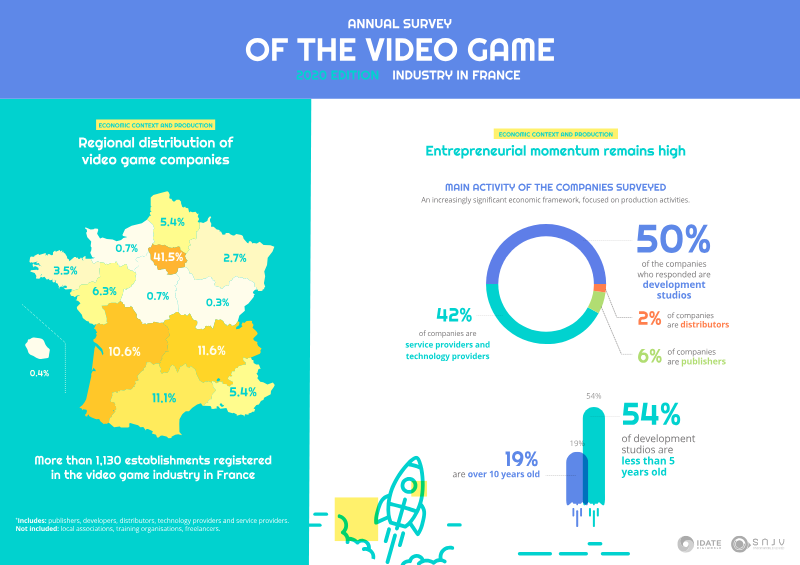
The French video game industry demonstrates robust entrepreneurial momentum and a strong focus on production, characterized by a diverse ecosystem of over 1,130 establishments. The sector is primarily composed of development studios, which account for 50% of industry entities, followed by service and technology providers at 42%, publishers at 6%, and distributors at 2%. This landscape is marked by a youthful demographic, with 19% of development studios having been established within the last five years, while another 19% have operated for over a decade. Production output remains stable, with 530 titles marketed in 2019 and a significant pipeline of projects in development. Notably, 63% of these titles are based on new intellectual properties, reflecting a strong commitment to original content. Employment trends are equally positive, with 75% of employees working under permanent contracts. The industry is actively expanding, with projections indicating the creation of 800 to 1,200 new jobs by the end of 2019. Despite this growth, gender diversity remains a challenge, as women and non-binary individuals comprise only 16% of the workforce, with women holding just 11% of management roles. The findings are based on a comprehensive survey conducted between June and September 2019, targeting 1,131 industry entities, including both members and non-members of the French Video Game Trade Association. The data highlights a strong educational pipeline, with a 26% growth in student enrollment and a high placement rate, as one in two graduates secures employment within the video game sector within a year. These metrics underscore the industry's role as a vital economic engine, supported by a specialized talent pool and a clear focus on sustainable, long-term production.