ReportInvestGame
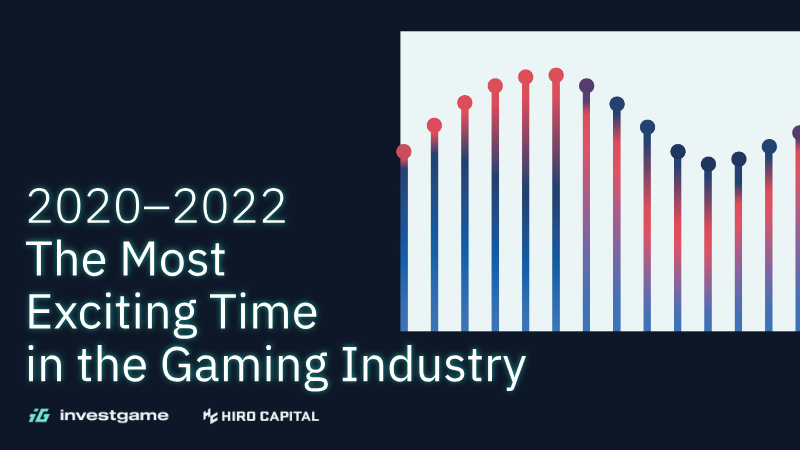
The Most Exciting Time in the Gaming Industry: 2020–2022
202029 pages~25 min full read
Key insights
8 slides
Key number
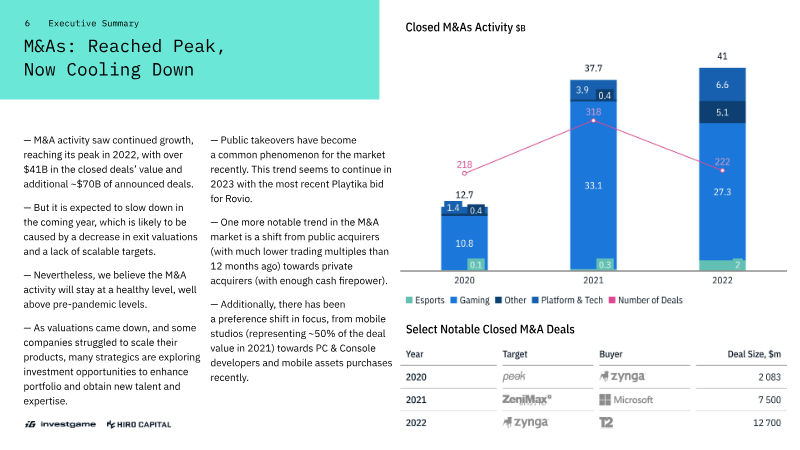
Gaming M&A reached $41 billion in 2021.
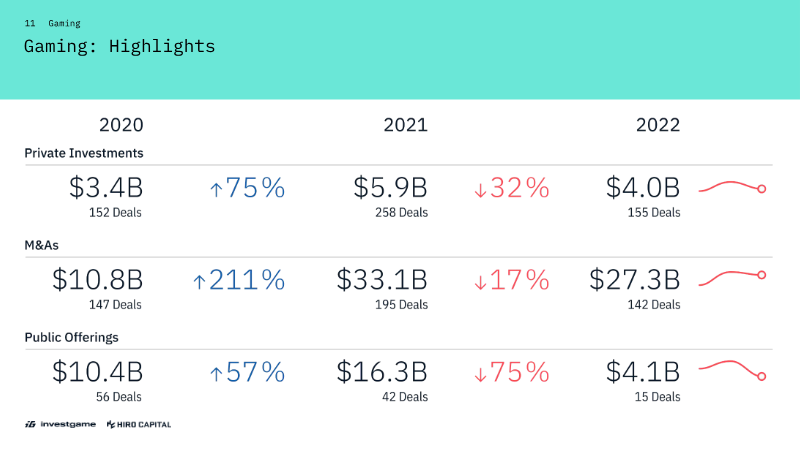
The gaming sector saw a pronounced surge in deal activity between 2020 and 2022. M&A value reached a high of $41 billion in 2021.
Valuation context
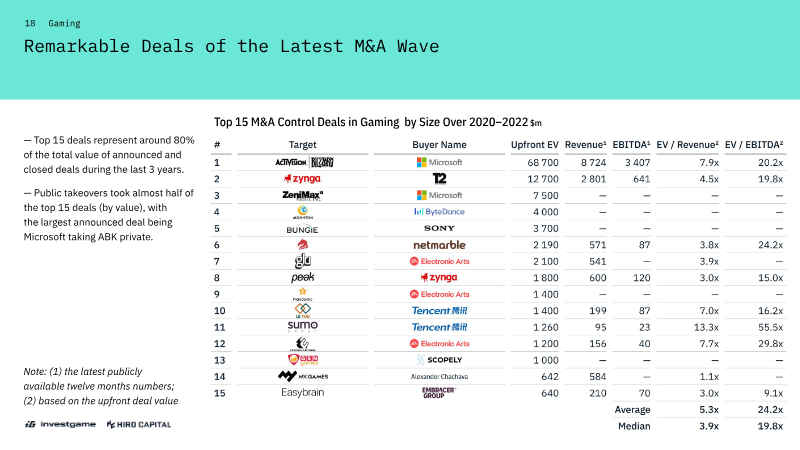
M&A deals achieved EV/EBITDA multiples as high as 55×.
High-valuation trends characterized the peak period. M&A deals achieved EV/EBITDA multiples as high as 55×.
What changed
Public offerings collapsed to $4.6 billion in 2022.
Market activity cooled significantly by 2022. Public offerings collapsed to $4.6 billion amid a macro-economic slowdown projected to continue into 2023.
Page 7 of the report202015.7
202124.5
20224.6
Late-stage decline
Late-stage transaction values dropped four-and-a-half-fold in early 2023.
Late-stage transactions contracted sharply in early 2023, with only sixteen deals versus thirty-one in 2022. Disclosed value dropped four-and-a-half-fold from $4.2 billion to $0.9 billion.
Page 7 of the reportQ1'20381
Q2'200
Q3'201,710
Q4'20381
Q1'21730
Q2'211,323
Q3'211,234
Q4'21922
Strategic focus
Top 15 M&A deals accounted for approximately 80% of announced value.
Strategic acquisitions remain a primary driver of industry value. The top 15 M&A deals accounted for approximately 80% of total announced deal value, dominated by public takeovers.
Venture resilience
Early-stage venture capital remained resilient despite broader contractions.
Early-stage venture capital stayed robust, led by Makers Fund and BITKRAFT Ventures in both deal count and total value. Substantial dry powder is poised for future rounds.
Page 5 of the reportQ1'2026
Q2'2028
Q3'2030
Q4'2021
Q1'2150
Q2'2143
Q3'2139
Q4'2124
Corporate outlook
Corporate investment is expected to rebound as regulatory scrutiny eases.
Corporate investments slowed in 2022 but are expected to rebound as regulatory scrutiny eases. Major players like Epic Games have significant cash reserves, such as their $2 billion fund.
Page 20 of the reportQ1'2021
Q2'206
Q3'20271
Q4'20133
Q1'21102
Q2'21134
Q3'21306
Q4'2116
Global context
The analysis covers all major gaming markets from 2020 through 2022.
The report is framed within a global context, with particular emphasis on the United States, Europe, and Asia. It focuses on public, private, and venture capital transactions across core segments.
1 / 8
Ask AI about this report