Report1 pages
Raport Bieżący Nr 56/2023: Przesunięcie Daty Premiery Gry Bulletstorm VR
The report announces a postponement of the release date for the virtual‑reality title “Bulletstorm VR.” Originally slated for 14 December 2023, the launch has been rescheduled to 18 January 2024. The decision was taken by the board of PCF Group S.A., Warsaw, on 17 November 2023, following consultations with the development team at Incuvo S.A. and the company’s publishing staff. The primary rationale for the delay is to grant additional development time, ensuring that the final product meets player expectations and maximizes commercial potential. The announcement is framed within the legal context of Article 17(1) of Regulation MAR, underscoring compliance with regulatory reporting requirements. The scope is limited to the Polish market and pertains specifically to the VR gaming segment, with no broader geographic or temporal coverage indicated. No quantitative data or survey methodology is provided; the communication focuses solely on the administrative decision and its intended impact on product quality and sales prospects.
- The release date for Bulletstorm VR has been rescheduled from 14 December 2023 to 18 January 2024.
- The decision to delay the launch was finalized by the board of PCF Group S.A. on 17 November 2023.
- The postponement follows consultations between PCF Group S.A., the development team at Incuvo S.A., and internal publishing staff.
- The primary objective of the delay is to provide additional development time to ensure the final product meets player expectations and maximizes commercial potential.
- This announcement was issued in compliance with Article 17(1) of the Market Abuse Regulation (MAR) regarding regulatory reporting requirements.
+3
PCF Group
Report1 pages
Current Report No. 57/2023: Change of Date for Submission of Q3 2023 Quarterly Report
The notice announces a revised deadline for the publication of PCF Group S.A.’s consolidated quarterly report covering the third quarter of 2023. The change follows an earlier current report issued on January 19, 2023, which had set the release date for November 27, 2023. Under Polish financial regulation § 80(2) of the Minister of Finance’s 2018 decree on ongoing and periodic information from securities issuers, the board confirms that the new publication date will be November 29, 2023. This adjustment is communicated to stakeholders and regulatory bodies to ensure compliance with disclosure requirements. The update applies solely to the group’s Q3 2023 consolidated report and does not affect other reporting obligations or financial statements. The announcement is concise, providing the legal basis for the change and the specific new date, thereby maintaining transparency in the company’s reporting schedule.
- PCF Group S.A. has rescheduled the publication date for its Q3 2023 consolidated quarterly report from November 27, 2023, to November 29, 2023.
- The change in the reporting schedule is made in accordance with § 80(2) of the 2018 decree by the Polish Minister of Finance regarding information disclosure for securities issuers.
- This adjustment applies exclusively to the Q3 2023 consolidated report and does not impact any other financial reporting obligations for the group.
- The company issued this update to maintain regulatory compliance and transparency with stakeholders regarding its financial disclosure timeline.
- The revised date of November 29, 2023, supersedes the previous release date established in the company's January 19, 2023, announcement.
PCF Group
Report1 pages
Raport Bieżący Nr 59/2023: Podjęcie Decyzji o Ograniczeniu Zakresu Projektu Dagger
The report announces a temporary reduction in the scope of PCF Group S.A.’s self‑publishing project “Project Dagger.” Following the delivery of a key milestone and an evaluation of the creative concept, management decided to pause plans for a 2025‑2026 AAA release. The decision follows analyses of scenario impacts discussed with the game publisher Square Enix Limited, as detailed in earlier reports. A core team of roughly ten experienced developers will be tasked with redefining the game’s direction and producing a pre‑production version that incorporates feedback from external evaluation. Concurrently, most team members will be offered opportunities to work on other group projects—Maverick, Bifrost, and Victoria. The action aligns with the updated Group strategy communicated in January 2023 and reflects a shift toward more focused resource allocation. The report cites legal grounding under Article 17(1) of the MAR Regulation and references prior interim reports (No. 3/2023 and No. 58/2023) for context. The scope is limited to the Polish‑based PCF Group and its internal development operations, with no geographic expansion noted. No specific survey or external data sources are mentioned beyond the internal evaluation; methodology is implied to be an internal review of creative milestones and strategic alignment. The conclusion underscores a reallocation of talent and resources to projects with higher immediate viability while maintaining the potential for future iteration of Project Dagger.
- PCF Group S.A. has officially paused plans for a 2025–2026 AAA release of 'Project Dagger' following a creative evaluation and milestone review.
- A core team of approximately ten developers will remain on Project Dagger to redefine the game’s direction and develop a new pre-production version.
- The majority of the Project Dagger team will be reallocated to other internal projects, specifically Maverick, Bifrost, and Victoria.
- The decision to scale back the project follows impact analyses conducted in coordination with the game's publisher, Square Enix Limited.
- This strategic shift aligns with PCF Group’s updated corporate strategy from January 2023, which prioritizes more focused resource allocation.
PCF Group
Report1 pages
Raport Bieżący Nr 58/2023: Podjęcie Strategicznych Rozmów na Temat Projektu Gemini
The report announces that PCF Group S.A.’s board has entered strategic discussions with long‑time publisher Square Enix Limited regarding the shape of the “Project Gemini” game and the terms of cooperation for a hire‑model project to be developed in Europe. Current work on Project Gemini continues under the existing contractual framework, but board members assess a high probability that future execution of the project will not follow the present commercial terms. The negotiations have yet to determine a definitive direction or scope for potential changes in collaboration.
Simultaneously, the board is conducting an impact analysis of various scenarios emerging from these talks on the Group’s development plans, aligned with the updated strategy released in the January 2023 current report. Findings on the outcomes of the Project Gemini discussions and any subsequent adjustments to development plans will be communicated in separate future current reports. The document serves as a status update on ongoing negotiations and internal strategic assessment, with no quantitative data or statistical findings presented.
- PCF Group S.A. has entered formal strategic negotiations with Square Enix Limited to redefine the scope and commercial terms of the 'Project Gemini' game.
- The board of PCF Group S.A. considers it highly probable that the future execution of Project Gemini will deviate from the existing contractual framework.
- Current development work on Project Gemini remains active and continues under the terms of the original agreement while negotiations proceed.
- The project is currently structured as a hire-model development initiative to be executed within Europe.
- PCF Group S.A. is conducting an internal impact analysis to determine how potential changes to the project will affect the development plans outlined in its January 2023 strategy.
PCF Group
Report2 pages
Terminy publikacji raportów okresowych: PCF Group S.A. 2024
PCF Group S.A. has established its formal schedule for the disclosure of periodic financial reports throughout the 2024 fiscal year. This disclosure ensures regulatory compliance with the Polish Ministry of Finance requirements regarding the transparency of publicly traded entities. The schedule provides stakeholders with specific dates for the release of annual, semi-annual, and quarterly financial statements, facilitating informed investment decisions and market oversight.
The company will release its standalone and consolidated annual reports for 2023 on April 25, 2024. Regarding the 2024 fiscal year, the consolidated quarterly report for the first quarter is slated for May 27, 2024, followed by the consolidated semi-annual report on September 26, 2024, and the consolidated third-quarter report on November 26, 2024. These filings are limited to consolidated data, as the company has formally opted out of publishing standalone quarterly and semi-annual reports.
In accordance with applicable financial regulations, the company will not issue separate reports for the fourth quarter of 2023, nor will it publish consolidated quarterly reports for the second and fourth quarters of 2024. By consolidating its financial reporting, the company streamlines its disclosure process while maintaining adherence to the reporting standards mandated for issuers of securities. This schedule covers the entirety of the 2024 calendar year and applies to the company’s operations within the Polish capital market.
- PCF Group S.A. will release its 2023 standalone and consolidated annual reports on April 25, 2024.
- The consolidated report for the first quarter of 2024 is scheduled for publication on May 27, 2024.
- The consolidated semi-annual report for 2024 is set to be released on September 26, 2024.
- The consolidated third-quarter report for 2024 will be disclosed on November 26, 2024.
- PCF Group S.A. has formally opted out of publishing standalone quarterly and semi-annual reports, focusing exclusively on consolidated data.
PCF Group
Report2 pages
Current Report No. 59/2023: Decision to Limit the Scope of Project Dagger
PCF Group S.A. has officially announced a strategic decision to limit the scope of Project Dagger, an internal title developed under a self-publishing model. This shift follows the completion of a key development milestone and a subsequent external evaluation of the game’s creative concept. The decision was further informed by strategic discussions regarding the company’s broader portfolio, including ongoing collaborations with Square Enix Limited on Project Gemini.
The primary consequence of this decision is the suspension of plans to release Project Dagger as a AAA title within the 2025–2026 timeframe. To facilitate a pivot in development, a core team of approximately 10 experienced personnel has been tasked with redefining the game’s direction and preparing a new preproduction version that incorporates feedback from the external evaluation. This restructuring allows the company to reallocate the majority of the original development team to other active internal initiatives, specifically the Maverick, Bifrost, and Victoria projects.
This adjustment serves as a correction to previous administrative errors regarding project nomenclature, clarifying that the strategic changes apply specifically to Project Dagger rather than Project Gemini. By narrowing the scope of Project Dagger, the company aims to optimize its resource allocation and align its development pipeline with the updated corporate strategy established in early 2023. The move reflects a broader effort to manage internal development risks while maintaining focus on the company’s remaining high-priority projects.
- PCF Group S.A. has suspended plans to release Project Dagger as a AAA title within the 2025–2026 timeframe following an external evaluation of its creative concept.
- The majority of the original Project Dagger development team is being reallocated to support other internal initiatives, specifically projects Maverick, Bifrost, and Victoria.
- A core team of approximately 10 personnel has been retained to redefine the direction of Project Dagger and develop a new preproduction version.
- The decision to limit the scope of Project Dagger is intended to optimize resource allocation and align the development pipeline with the company's 2023 corporate strategy.
- Strategic development of Project Gemini, a collaboration with Square Enix Limited, remains unaffected by the changes to Project Dagger.
PCF Group
Report1 pages
Current Report No. 2/2024: Conclusion of a Short-Term Executive Agreement for Project Gemini
PCF Group S.A. has entered into a short-term executive agreement with Square Enix Limited to continue development on Project Gemini. This agreement follows the expiration of the previous content rider on January 29, 2024, and serves as a bridge while both parties engage in strategic negotiations regarding the project’s future scope and production parameters. The collaboration remains focused on a work-for-hire model within the European gaming sector, specifically targeting the AAA segment.
The ongoing strategic discussions necessitate a realignment of the project’s development plan, which involves modifying and refocusing specific production areas. While such adjustments are common in high-budget game development, the immediate operational impact includes a significant reduction in the dedicated development team. To manage this transition, the company is reassigning some personnel to other internal projects, while simultaneously implementing a workforce reduction that affects more than 30 employees.
This update clarifies the current status of Project Gemini as of January 30, 2024, following previous disclosures regarding the project's development trajectory. The company intends to maintain confidentiality regarding future routine content riders unless legal requirements dictate otherwise. Further updates concerning the final outcomes of the strategic negotiations with the publisher will be provided as they become available.
- PCF Group S.A. has signed a short-term executive agreement with Square Enix Limited to continue development on Project Gemini following the expiration of their previous contract on January 29, 2024.
- The project is undergoing a strategic realignment that includes a reduction of more than 30 employees within the development team.
- The current agreement serves as a bridge while both companies negotiate the future scope and production parameters of the AAA title.
- PCF Group S.A. is reassigning some affected personnel to other internal projects to manage the transition resulting from the project's modified development plan.
- The collaboration continues to operate under a work-for-hire model within the European AAA gaming sector.
PCF Group
Report2 pages
Podsumowanie kosztów subskrypcji akcji serii D: Raport bieżący nr 3/2024
PCF Group S.A. provides a final accounting of the costs associated with the private subscription of 387,714 series D ordinary bearer shares. This disclosure serves to finalize the financial reporting requirements following the issuance process initiated in June 2021, ensuring transparency regarding the capital expenditure incurred during the offering.
The total costs attributed to the issuance of the series D shares amounted to 393,476.46 PLN. These expenses were exclusively related to the preparation and execution of the offering, with no costs incurred for sub-underwriting, prospectus preparation, or promotional activities, as the transaction was conducted as a private placement. The breakdown of these costs includes 308,553.00 PLN for legal services, 73,423.46 PLN for transactional advisory services, and 11,500.00 PLN for registration and admission to trading on the Warsaw Stock Exchange.
Based on the total issuance volume, the average cost per unit of the series D shares is approximately 1.01 PLN. In accordance with standard accounting practices, the company recognized these issuance costs by reducing the reserve capital created from the share premium, which represents the surplus of the issue price over the nominal value of the shares. This summary confirms the final financial impact of the series D subscription on the company’s capital structure.
- PCF Group S.A. incurred total costs of 393,476.46 PLN for the private subscription of 387,714 series D ordinary bearer shares.
- The average cost per share for the series D issuance was approximately 1.01 PLN.
- Legal services represented the largest expense at 308,553.00 PLN, accounting for over 78% of the total issuance costs.
- Transactional advisory services cost 73,423.46 PLN, while registration and admission to trading on the Warsaw Stock Exchange cost 11,500.00 PLN.
- The company recognized the issuance costs by reducing the reserve capital created from the share premium.
PCF Group
Report2 pages
Raport Bieżący Nr 5/2024: Podsumowanie Kosztów Subskrypcji Akcji Serii F
PCF Group S.A. has finalized the accounting of costs associated with the issuance of 3,343,037 series F ordinary bearer shares. The primary purpose of this disclosure is to provide transparency regarding the financial expenditures incurred during the subscription process, ensuring compliance with regulatory requirements for issuers of securities on the Warsaw Stock Exchange.
The total cost of the series F share issuance amounted to 2,323,824.52 PLN. These expenses are categorized into two main areas: the preparation and execution of the offer, which totaled 2,243,744.52 PLN, and promotional activities, which accounted for 80,080.00 PLN. Within the preparation category, transaction advisory services represented the largest expenditure at 1,747,018.88 PLN, followed by legal costs of 467,464.81 PLN and registration and admission fees of 29,260.83 PLN. The company did not utilize sub-underwriters, and the offer was conducted without the requirement of a prospectus.
On a per-unit basis, the average cost of the subscription amounted to approximately 0.70 PLN per share. In terms of accounting treatment, the total issuance costs were recognized by reducing the reserve capital created from the surplus of the issue price over the nominal value of the shares. This summary covers the financial activities related to the series F issuance as of February 2024, reflecting the final reconciliation of all associated transaction costs.
- PCF Group S.A. incurred total costs of 2,323,824.52 PLN for the issuance of 3,343,037 series F ordinary bearer shares.
- The average cost of the subscription was approximately 0.70 PLN per share.
- Preparation and execution of the offer accounted for 2,243,744.52 PLN, while promotional activities cost 80,080.00 PLN.
- Transaction advisory services were the largest expense at 1,747,018.88 PLN, followed by legal costs of 467,464.81 PLN.
- Issuance costs were accounted for by reducing the reserve capital created from the surplus of the issue price over the nominal share value.
PCF Group
Report4 pages
Current Report No. 4/2024: Summary of Series E Share Subscription
PCF Group S.A. provides a formal summary of the private subscription of Series E ordinary bearer shares, confirming the completion of the issuance process. The primary purpose of the transaction was to finalize the acquisition of shares in Incuvo S.A. through a non-cash contribution, thereby expanding the company's capital base. The subscription was conducted as a private placement, exempt from the requirement to publish a prospectus under European Union regulations.
The issuance involved 136,104 Series E shares, each with a nominal value of 0.02 PLN, issued at an issue price of 46.13 PLN per share. The total value of the offering reached 6,278,477.52 PLN. Two investors, Andrzej Wychowaniec and Radomir Kucharski, subscribed to the shares by contributing equity in Incuvo S.A. as an in-kind contribution, supplemented by minor cash payments to cover the difference between the issue price and the valuation of the aport.
Total costs associated with the subscription amounted to 20,659.72 PLN, resulting in an average cost of approximately 0.15 PLN per share. These expenses, which primarily comprised legal fees and costs related to the registration and admission of shares to the Warsaw Stock Exchange, were settled by reducing the company's supplementary capital from the share premium. The subscription process concluded with the full payment of contributions by February 17, 2023, and the formalization of the share subscription agreements on February 15, 2023.
- PCF Group S.A. completed the issuance of 136,104 Series E shares to finalize the acquisition of Incuvo S.A. through a non-cash contribution.
- The total value of the Series E share offering reached 6,278,477.52 PLN, with each share issued at a price of 46.13 PLN.
- Investors Andrzej Wychowaniec and Radomir Kucharski acquired the shares by contributing equity in Incuvo S.A., supplemented by minor cash payments.
- The subscription process was conducted as a private placement, exempt from the requirement to publish a prospectus under EU regulations.
- Total issuance costs amounted to 20,659.72 PLN, averaging approximately 0.15 PLN per share, which were covered by reducing supplementary capital.
PCF Group
Report1 pages
Current Report No. 7/2024: Settlement of Bulletstorm VR Production Costs and Termination of Production-Publishing Agreement
PCF Group S.A. has finalized the financial settlement and contractual dissolution regarding the production of Bulletstorm VR. Following the game’s release on January 18, 2024, the publisher and its subsidiary, Incuvo S.A., reached an agreement to settle all remaining production milestones. As part of this financial reconciliation, PCF Group charged Incuvo 871,157.59 PLN to cover development and quality assurance costs incurred during the project’s lifecycle.
The decision to terminate the production-publishing agreement, effective January 19, 2024, stems directly from the unsatisfactory commercial performance of the title upon its launch. Under the terms of this dissolution, Incuvo forfeits all rights to future royalty payments derived from the game’s sales. This restructuring effectively ends the original collaborative framework between the two entities regarding this specific intellectual property.
Moving forward, PCF Group assumes full responsibility for the final product and its ongoing commercialization. While the company retains the option to utilize Incuvo’s resources for potential future development tasks, the publisher now maintains complete control over the title’s lifecycle. This shift in management strategy reflects a broader effort to mitigate the impact of the game’s poor market reception and consolidate oversight of the product’s future development and sales trajectory.
- PCF Group S.A. has terminated its production-publishing agreement with Incuvo S.A. for Bulletstorm VR, effective January 19, 2024, following the game's poor commercial performance.
- PCF Group has assumed full control over the title's ongoing commercialization and future development lifecycle.
- Incuvo S.A. has forfeited all rights to future royalty payments generated by Bulletstorm VR sales as part of the contractual dissolution.
- PCF Group charged Incuvo 871,157.59 PLN to settle outstanding development and quality assurance costs incurred during the project.
- The financial and contractual settlement was finalized following the game's initial release on January 18, 2024.
+2
PCF Group
Report1 pages
Raport Bieżący Nr 8/2024: Podjęcie Decyzji o Zaniechaniu Dalszych Prac Nad Projektem Dagger
PCF Group S.A. has officially terminated development of Project Dagger, a decision driven by a strategic reassessment of the company’s development pipeline. Following a comprehensive evaluation of the project’s scope and commercial potential, management concluded that the game’s redefined direction failed to meet internal performance expectations. This cancellation marks the conclusion of a development cycle that had been subject to multiple prior disclosures since late 2022.
The financial impact of this decision involves a full write-down of all capitalized expenditures associated with the project. As of December 31, 2023, the company will record impairment charges totaling 79.9 million PLN in its standalone financial statements and 68.3 million PLN in its consolidated financial statements. These adjustments will directly reduce the carrying value of fixed assets and negatively affect the net financial results for the 2023 fiscal year.
While these write-downs are significant, they are classified as one-time, non-cash events and will not impact the company’s EBITDA. The reported figures remain estimates pending final audit verification, with the definitive financial impact to be formally presented in the upcoming annual reports. This strategic pivot reflects a broader effort to optimize the company’s portfolio and reallocate resources toward projects with more favorable commercial prospects within the global gaming market.
- PCF Group S.A. has officially terminated the development of Project Dagger following a strategic reassessment of its development pipeline.
- The cancellation will result in a one-time, non-cash impairment charge of 79.9 million PLN in the company’s standalone financial statements for the 2023 fiscal year.
- Consolidated financial statements for 2023 will reflect a 68.3 million PLN write-down due to the project's termination.
- Management decided to cancel the project after concluding that its redefined direction failed to meet internal commercial performance expectations.
- The impairment charges are non-cash events and will not impact the company’s EBITDA.
PCF Group
Report1 pages
Raport Bieżący nr 13/2024: Uzgodnienie Planu dla Projektu Gemini
PCF Group S.A. has finalized the development plan for Project Gemini in collaboration with Square Enix Limited, formalizing the agreement through a new content rider. This development, executed within the European market under a work-for-hire model, marks a significant shift in the commercial framework governing the project. The agreement ensures the continuation of development efforts while fundamentally altering the financial expectations associated with the production-publishing contract.
Under the updated terms, the project will no longer operate under the previously established commercial conditions. Financial projections indicate that future revenue generated from Project Gemini will be limited to covering the direct costs incurred by the company during development. This adjustment necessitates a revaluation of the contract in accordance with the International Financial Reporting Standard 15, which governs revenue from contracts with customers.
The primary consequence of this revised financial structure is a reduction in the profit margins previously anticipated from the partnership with the publisher. Consequently, the company expects a decline in both individual and consolidated sales revenue, as well as a negative impact on overall financial performance. This update serves to align stakeholder expectations with the new economic reality of the project, as the company transitions away from reporting on individual content riders unless legally mandated.
- PCF Group S.A. has restructured its Project Gemini agreement with Square Enix Limited, shifting the project to a work-for-hire model.
- Future revenue from Project Gemini will be capped at covering direct development costs, eliminating the previously anticipated profit margins.
- The company expects a decline in both individual and consolidated sales revenue as a direct result of the revised financial terms.
- The contract revaluation is being conducted in accordance with International Financial Reporting Standard 15 (IFRS 15).
- PCF Group S.A. will cease reporting on individual content riders for this project unless legally mandated to do so.
+1
PCF Group
Report1 pages
Current Report No. 9/2024: Change of Date for the Submission of Annual Reports for 2023
PCF Group S.A. has officially rescheduled the publication date for its 2023 consolidated and standalone annual financial reports. Originally slated for release on April 25, 2024, the disclosure is now set for April 29, 2024. This adjustment follows the company’s initial announcement regarding reporting timelines issued earlier in January 2024.
The decision to delay the filing by four days is executed in accordance with the regulatory requirements set forth by the Polish Minister of Finance concerning the periodic information provided by securities issuers. This procedural update ensures compliance with legal obligations governing the transparency and timing of financial disclosures for publicly traded entities operating within the Polish capital market.
By finalizing these reports by the end of April, the company maintains its commitment to providing stakeholders with audited financial data for the 2023 fiscal year. This shift represents a minor administrative adjustment to the corporate calendar, ensuring that all necessary documentation is prepared and verified before public dissemination to investors and market regulators.
- PCF Group S.A. has rescheduled the publication of its 2023 consolidated and standalone annual financial reports from April 25, 2024, to April 29, 2024.
- The four-day delay is a procedural adjustment made to ensure full compliance with Polish Minister of Finance regulations regarding periodic financial disclosures.
- The updated filing date remains within the company's commitment to release audited 2023 fiscal year data by the end of April.
- This change affects the disclosure timeline for both the company's consolidated and standalone financial statements.
- The rescheduling serves as an administrative update to the corporate calendar to ensure all documentation is verified before public release.
PCF Group
Report1 pages
Raport Bieżący Nr 15/2024: Ogłoszenie Decyzji o Rozpoczęciu Przeglądu Opcji Strategicznych
PCF Group S.A. has formally initiated a comprehensive review of strategic options to evaluate potential pathways for supporting the long-term development of the company and its capital group. This process is designed to identify and assess various opportunities that could enhance the organization’s growth trajectory, including the potential acquisition of a financial or strategic investor. Furthermore, the review encompasses the possibility of executing corporate transactions that might result in structural changes to the company’s shareholding or capital base.
The scope of this initiative involves active engagement and preliminary discussions with various external entities to explore potential partnerships or investment scenarios. While the company intends to provide selected parties with necessary information to facilitate these evaluations, the process remains in its preliminary stages. No specific outcomes, timelines, or definitive decisions have been established, and the company emphasizes that there is no guarantee that any particular strategic action will be finalized as a result of this review.
Throughout the duration of this assessment, the group remains committed to its existing operational strategy and will continue to execute its current business objectives. Management intends to maintain transparency by disclosing further developments in accordance with regulatory requirements as the situation evolves. This strategic review reflects a proactive approach to capital management and corporate development within the gaming industry, aimed at securing the most advantageous future for the group’s stakeholders.
- PCF Group S.A. has formally initiated a strategic review to evaluate options for long-term growth and capital development.
- The review process includes exploring the potential acquisition of a financial or strategic investor to support the company’s future trajectory.
- Management is considering corporate transactions that could lead to structural changes in the company’s shareholding or capital base.
- The company has begun preliminary discussions with external entities to assess potential partnerships and investment scenarios.
- No definitive decisions, timelines, or specific outcomes have been established regarding the potential strategic actions.
PCF Group
Report3 pages
Raport bieżący nr 18/2024Ujawnienie opóźnionej informacji poufnej w sprawie rozpoczęcia przez PCF Group S.A. negocjacji w przedmiocie zawarcia umowy produkcyjno-wydawniczej z Krafton Inc.
PCF Group S.A. has officially disclosed the commencement of negotiations regarding a production and publishing agreement with Krafton Inc., a Seoul-based publisher. This disclosure follows the formal execution of a Master Services Agreement on September 10, 2024. The company had previously delayed the announcement of these negotiations, which began on July 11, 2024, to protect its legitimate business interests and prevent potential interference from competitors during the sensitive negotiation phase.
The partnership centers on the development of a new game mode for an existing Krafton title, utilizing a work-for-hire model. This collaboration aligns with the strategic objectives outlined by PCF Group in early 2023, which prioritize securing high-quality work-for-hire opportunities with reputable industry partners. The agreement is structured as a framework, with specific operational details, project timelines, and compensation terms to be defined in subsequent statements of work.
Management justified the initial delay in public disclosure by citing the uncertainty of the negotiation outcomes and the risk that premature release could lead to market misinterpretation of the company’s valuation. Throughout the delay period, the company maintained strict confidentiality protocols, including the maintenance of an insider list as required by regulatory standards. The disclosure confirms that the terms of the agreement are consistent with standard industry practices for similar development projects.
- PCF Group S.A. has entered into a formal production and publishing agreement with Seoul-based Krafton Inc. following the execution of a Master Services Agreement on September 10, 2024.
- The partnership focuses on the development of a new game mode for an existing Krafton title under a work-for-hire business model.
- Negotiations for this collaboration officially commenced on July 11, 2024, but were kept confidential until the current disclosure to protect business interests.
- The agreement serves as a framework, with specific project timelines, operational details, and compensation terms to be finalized in future statements of work.
- This deal aligns with PCF Group’s 2023 strategic objective to secure high-quality work-for-hire contracts with reputable industry partners.
+1
PCF Group
Report1 pages
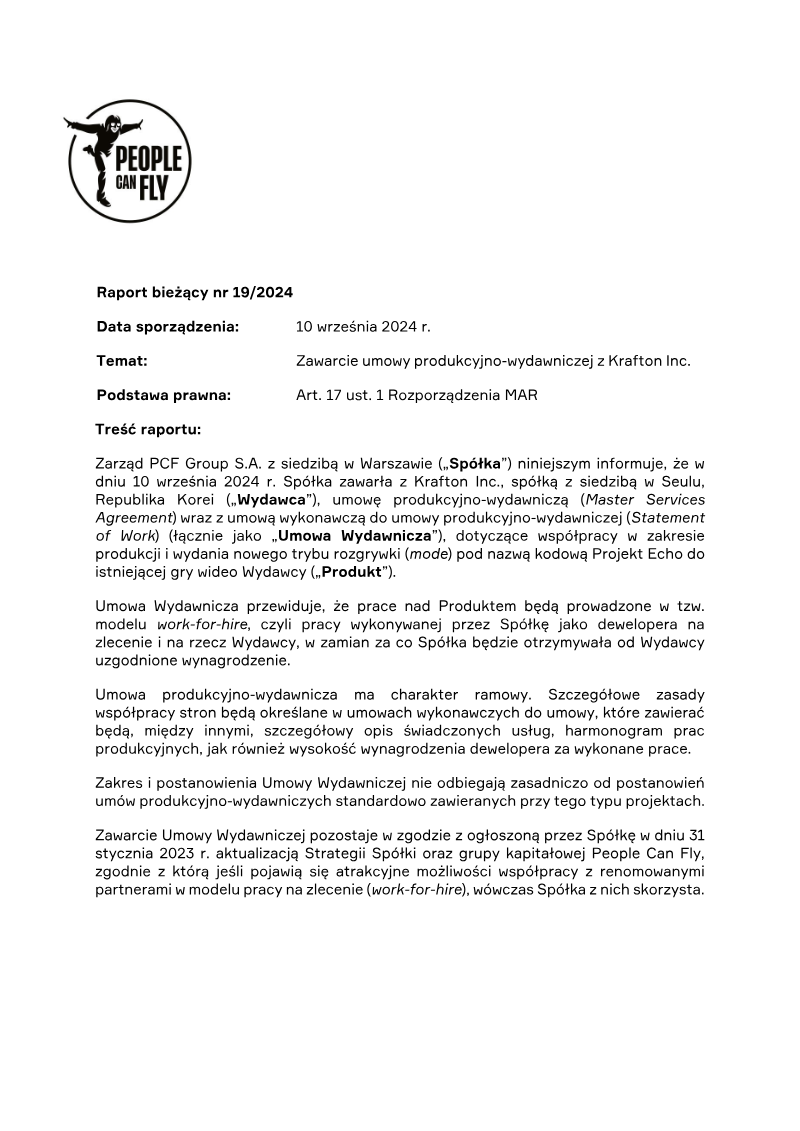
Raport Bieżący Nr 19/2024: Zawarcie Umowy Produkcyjno-Wydawniczej z Krafton Inc.
PCF Group S.A. has entered into a formal production and publishing agreement with the South Korean firm Krafton Inc. as of September 10, 2024. This partnership centers on the development of a new gameplay mode, currently identified by the codename Project Echo, intended for an existing video game title owned by Krafton. The collaboration is structured as a work-for-hire arrangement, wherein the developer provides services and production expertise in exchange for agreed-upon compensation from the publisher.
The agreement functions as a master services framework, establishing the foundational legal and operational terms for the partnership. Specific project parameters, including detailed service descriptions, production timelines, and precise financial remuneration, will be defined through subsequent individual statements of work. The terms governing this engagement align with standard industry practices for international production and publishing contracts, ensuring a conventional approach to project management and intellectual property rights.
This strategic move directly supports the long-term objectives outlined in the company’s updated corporate strategy from January 2023. By securing this contract, the developer continues to execute its stated goal of pursuing high-value collaborations with reputable global partners within the work-for-hire business model. This development reinforces the company’s commitment to diversifying its project portfolio while leveraging its technical capabilities to support established titles in the global gaming market.
- PCF Group S.A. signed a production and publishing agreement with Krafton Inc. on September 10, 2024.
- The partnership focuses on the development of a new gameplay mode codenamed 'Project Echo' for an existing Krafton-owned title.
- The collaboration is structured as a work-for-hire arrangement where PCF Group provides production services in exchange for financial compensation.
- The agreement serves as a master services framework, with specific project timelines and remuneration to be defined in subsequent statements of work.
- This contract aligns with PCF Group’s January 2023 corporate strategy to secure high-value collaborations with global partners.
+1
PCF Group
Report2 pages
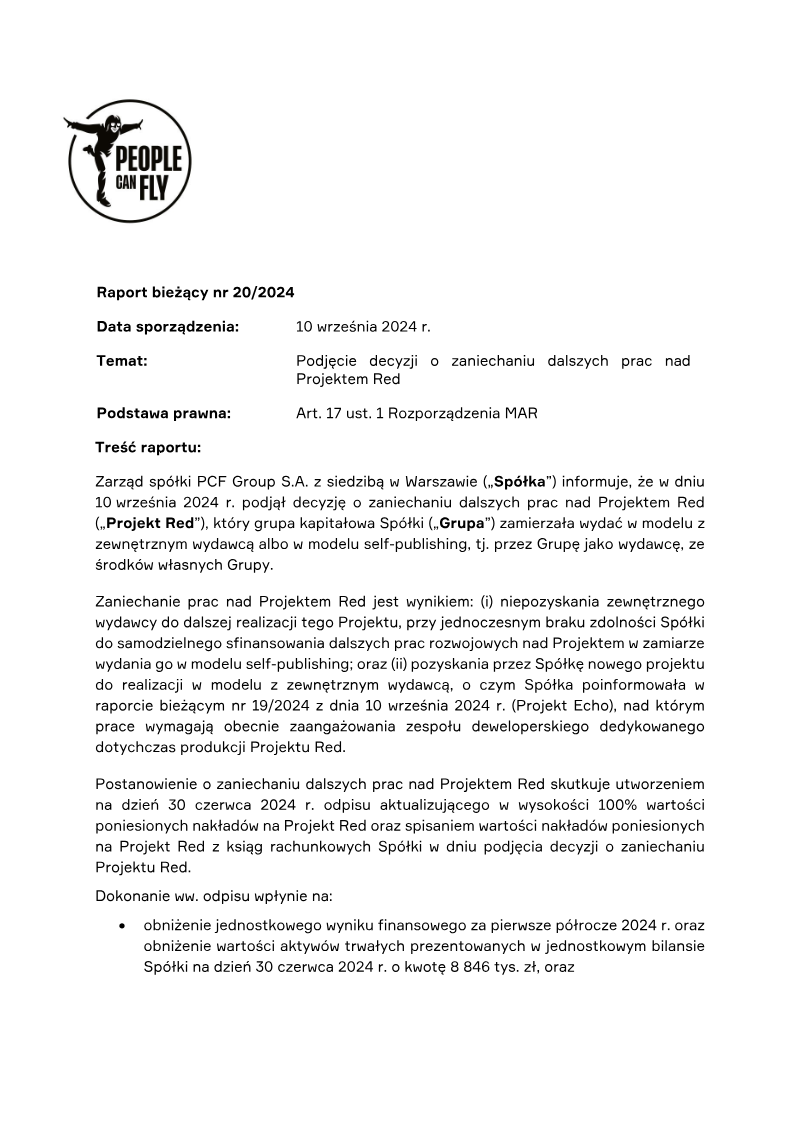
Current Report No. 20/2024: Decision to Discontinue Work on Project Red
PCF Group S.A. has officially terminated development of Project Red, a title previously intended for either external publishing or self-publishing. This strategic decision stems from the company’s inability to secure an external publishing partner and a lack of sufficient capital to sustain self-publishing efforts. Furthermore, the company has prioritized the allocation of its development resources toward a newly acquired project, designated as Project Echo, which necessitates the transfer of the team previously assigned to Project Red.
The cancellation of Project Red carries significant financial implications for the company’s 2024 fiscal reporting. As of June 30, 2024, the company will record a 100% impairment charge on all capitalized expenditures related to the project. This accounting action will result in an estimated reduction of 8.85 million PLN in the company’s standalone financial results and fixed assets, while the consolidated financial results and fixed assets for the group will decrease by approximately 7.72 million PLN.
These adjustments are classified as one-time, non-cash events and will not impact the company’s EBITDA. While these figures represent the current assessment of the financial impact, they remain subject to final auditor review and may be adjusted in the upcoming semi-annual financial statements. This shift in development focus reflects a broader realignment of the company’s portfolio, prioritizing projects with secured external funding over those requiring internal capital investment.
- PCF Group S.A. has officially terminated development of Project Red due to an inability to secure an external publishing partner and insufficient capital for self-publishing.
- The cancellation will result in a 100% impairment charge on all capitalized expenditures related to Project Red as of June 30, 2024.
- The impairment will reduce the company’s standalone financial results and fixed assets by approximately 8.85 million PLN.
- The consolidated financial results and fixed assets for the group will decrease by approximately 7.72 million PLN due to the project's termination.
- These financial adjustments are classified as one-time, non-cash events and will have no impact on the company’s EBITDA.
+2
PCF Group
Report7 pages
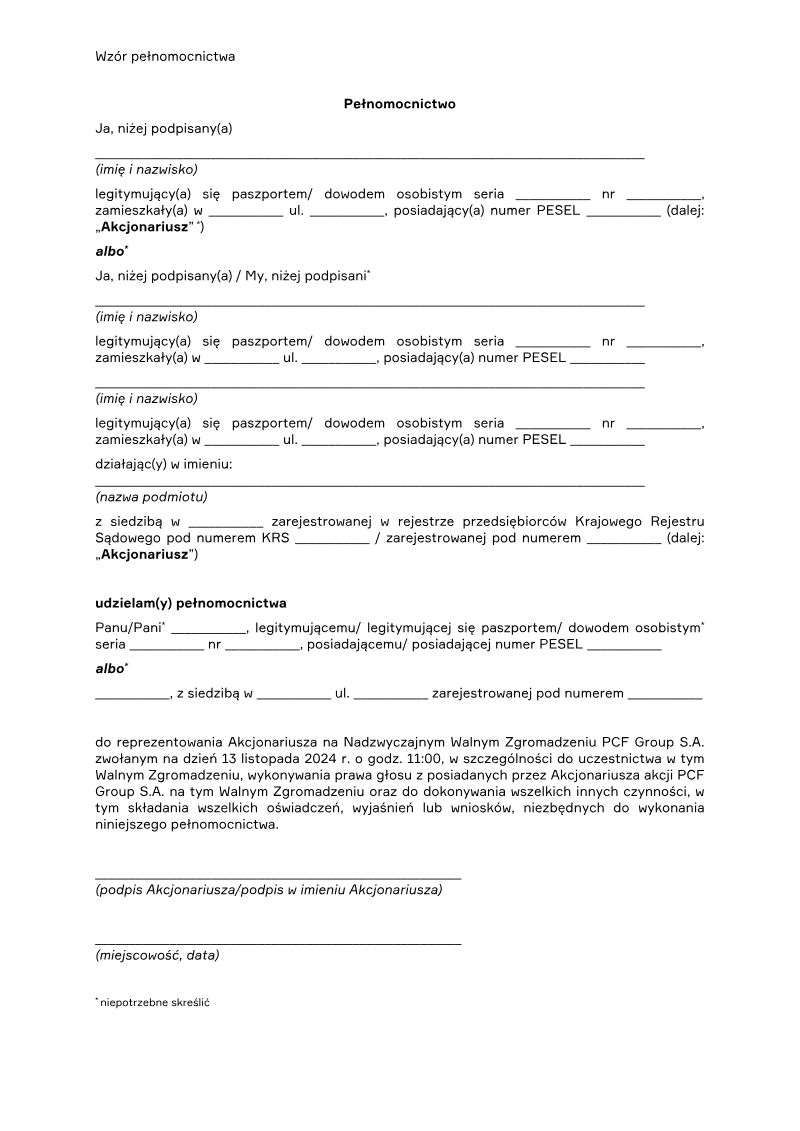
Załącznik do Raportu bieżącego nr 21/2024Wzór pełnomocnictwa na NWZ
The provided text serves as the official proxy voting template for the Extraordinary General Meeting of PCF Group S.A., scheduled for November 13, 2024. The primary purpose of this instrument is to establish a formal legal framework allowing shareholders to appoint a representative to exercise their voting rights and participate in corporate governance proceedings on their behalf. By standardizing the authorization process, the company ensures that all proxy representations comply with regulatory requirements for shareholder participation in high-level corporate decision-making.
The template facilitates both individual and institutional shareholder participation by providing distinct fields for personal identification, such as passport or national identity card details and PESEL numbers, as well as corporate registration data for legal entities. The scope of the authorization is comprehensive, granting the appointed proxy the authority to attend the meeting, cast votes associated with the shareholder’s equity stake, and perform all necessary ancillary actions, including the submission of statements, explanations, or formal motions required during the proceedings.
This administrative document functions as a procedural requirement for the upcoming meeting, ensuring that the company maintains a transparent and legally binding record of shareholder representation. By defining the specific date and time of the meeting, the template serves as a critical tool for maintaining quorum and facilitating the orderly execution of the Extraordinary General Meeting. It reflects standard corporate governance practices within the Polish capital market, providing a structured mechanism for shareholders to delegate their voting power while maintaining clear accountability and legal clarity.
- PCF Group S.A. has scheduled an Extraordinary General Meeting for November 13, 2024.
- The provided document is a standardized proxy voting template designed to formalize shareholder representation for this specific meeting.
- The proxy instrument grants appointed representatives full authority to attend the meeting, cast votes on equity stakes, and submit formal motions or statements.
- The template requires specific identification data, including passport or national identity card details and PESEL numbers for individuals, or corporate registration data for legal entities.
- This administrative tool is intended to ensure regulatory compliance, maintain a transparent record of representation, and assist in achieving the necessary quorum for corporate decision-making.
PCF Group
Report3 pages
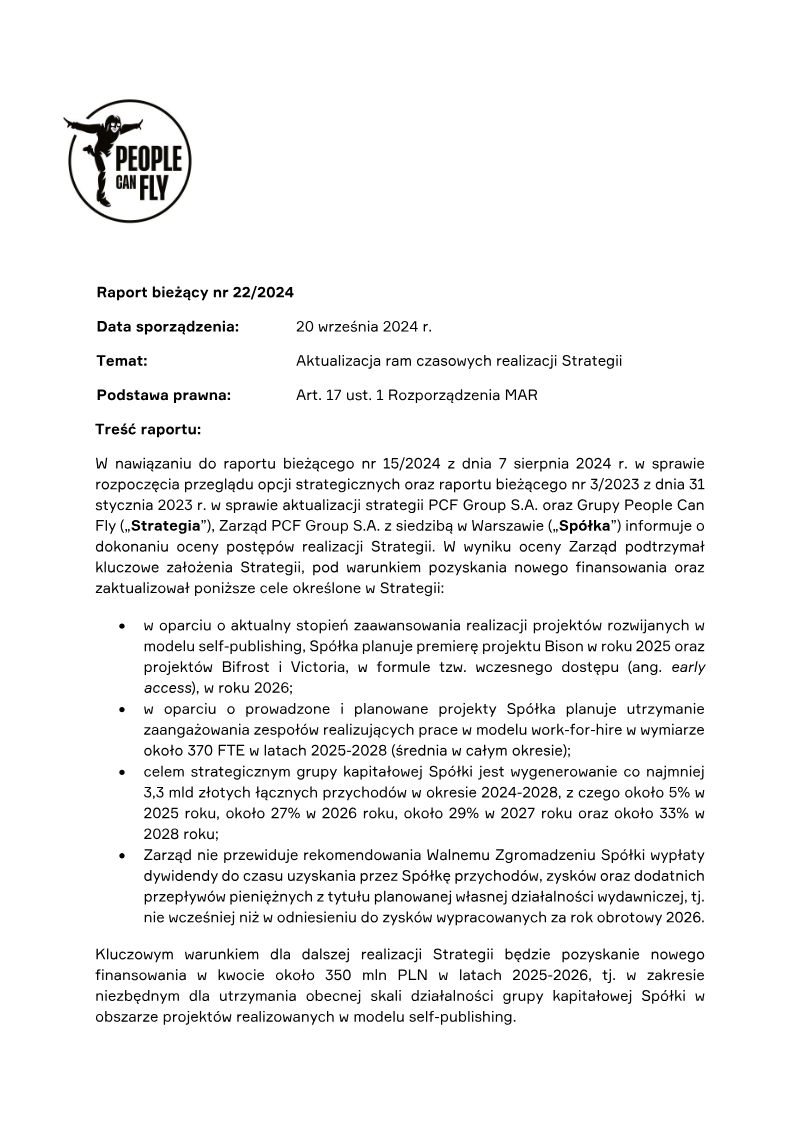
Aktualizacja ram czasowych realizacji Strategii
People Can Fly Group has updated its long-term strategic framework, maintaining core objectives while adjusting project timelines and financial targets for the 2024–2028 period. The company now plans to release its self-published project, Bison, in 2025, followed by early access launches for projects Bifrost and Victoria in 2026. To support these operations, the company aims to maintain a workforce of approximately 370 full-time equivalents for its work-for-hire segment through 2028.
The updated financial strategy targets at least 3.3 billion PLN in total revenue between 2024 and 2028, with a projected growth trajectory that scales from 5% of this total in 2025 to 33% by 2028. Management has suspended dividend recommendations until at least the 2026 fiscal year, contingent upon achieving positive financial results from self-publishing activities. Furthermore, the development of a previously proposed incentive program tied to 1.5 billion PLN in cumulative EBITDA has been paused pending the outcome of an ongoing strategic review.
Execution of these goals is strictly dependent on securing approximately 350 million PLN in new financing during 2025 and 2026. Should this funding not materialize, or if specific work-for-hire project conditions remain unmet, the company is evaluating alternative scenarios, including the potential transition of the Bifrost or Victoria projects into the work-for-hire model. These updates reflect a recalibration of the company’s operational roadmap as it navigates capital requirements and project development milestones.
- People Can Fly Group requires 350 million PLN in new financing during 2025–2026 to execute its updated strategic roadmap.
- The company targets at least 3.3 billion PLN in total revenue for the 2024–2028 period, with growth scaling from 5% in 2025 to 33% by 2028.
- The self-published project 'Bison' is scheduled for release in 2025, followed by early access launches for 'Bifrost' and 'Victoria' in 2026.
- Management has suspended dividend recommendations until at least the 2026 fiscal year, pending positive financial results from self-publishing activities.
- The company plans to maintain a workforce of approximately 370 full-time equivalents for its work-for-hire segment through 2028.
PCF Group