ArticleGame Maker's Toolkit
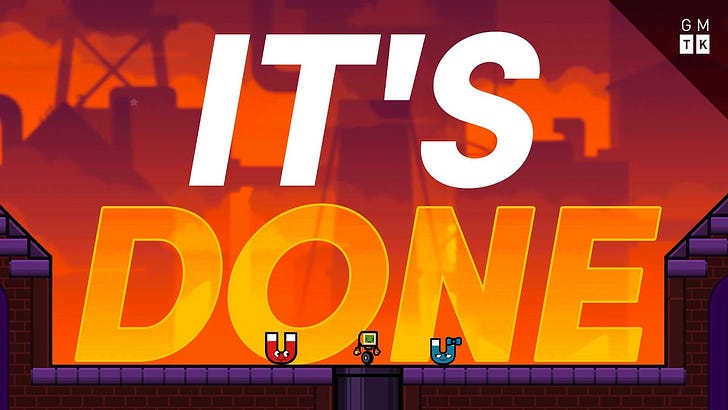
The Hardest Thing About Finishing a Game
2 Aug 20241 page~11 min full read
Key insights
6 slides
Core thesis
Game completion is defined by strategic abandonment.
Developers must aggressively cut mechanics, levels, and narrative elements to meet production deadlines. This reality is a universal challenge in the industry.
strategic abandonment
The defining characteristic of game completion
Historical examples
Major titles reached completion after significant content reductions.
The Wind Waker, Shadow of the Colossus, and Dark Souls all underwent significant content reductions to meet production constraints. These examples support the universal nature of the challenge.
Evidence. Major industry titles reached completion only after undergoing significant content reductions.
Process shift
Content lockdown allows developers to pivot toward polish.
Shifting from content creation to rigid content lockdown is essential.
Process. Transitioning from content creation to a rigid content lockdown is essential to pivot resources toward final polish and playtesting.
Deliberate decision
Completion is a deliberate decision to stop adding features.
There is no objective finish line in game design. Completion is a deliberate decision to stop adding features, preventing dilution with unfinished additions.
Final outcome
Refinement transforms disparate ideas into a cohesive product.
Prioritizing refinement over expansion transforms a collection of disparate ideas into a cohesive, functional product. This approach also boosts team morale during final stages.
Research basis
Insights derive from personal experience and professional discourse.
The analysis is derived from personal development experience on Mind Over Magnet. It is supplemented by professional discourse with peers at industry events such as the Develop Conference.
1 / 6
Ask AI about this report