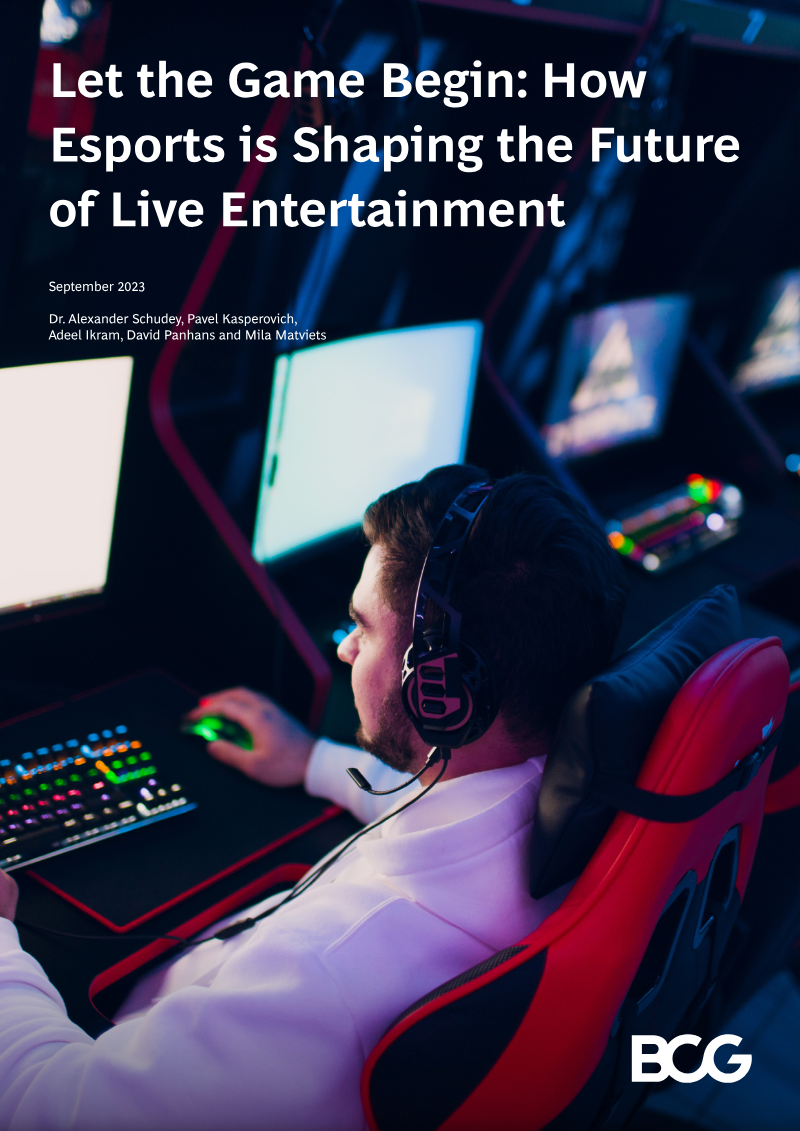
Report29 pages
Esports is Shaping the Future of Live Entertainment
Esports is rapidly evolving into a mainstream live‑entertainment sector, with viewership surpassing 100 million hours and prize pools doubling since 2018. The industry’s growth outpaces traditional sports, registering a 10 % year‑over‑year increase while leagues such as the NFL and NBA stagnate. Core titles—League of Legends, CS:GO, Mobile Legends: Bang Bang, Dota 2 and Valorant—concentrate 70 % of total viewing hours, yet an estimated $2.5 billion in untapped gamer audiences remains available, underscoring significant scalability potential.
Geographically, governments across France, Denmark, China and Japan are investing in infrastructure, tax incentives and athlete support, while the International Esports Federation seeks Olympic recognition. Sponsorship penetration has reached 45 % of non‑gaming brands, and universities now offer esports scholarships, indicating a blending of traditional sports support structures with the unique dynamics of game publishers. However, media‑rights monetisation remains constrained by fragmented licensing arrangements.
The absence of a unified regulatory body creates volatility for players; games and prize pools can collapse abruptly, as seen with Fortnite and Heroes of the Storm. Coordinated regulation, career pathways, post‑career support and state investment are identified as essential for legitimising esports as a sustainable profession. In sum, the sector demonstrates explosive growth and high engagement among younger, tech‑savvy audiences, but requires cohesive governance and media‑rights frameworks to unlock its full economic potential.
- Esports is outperforming traditional sports with a 10% year-over-year growth rate, while viewership has surpassed 100 million hours and prize pools have doubled since 2018.
- Five core titles—League of Legends, CS:GO, Mobile Legends: Bang Bang, Dota 2, and Valorant—account for 70% of total viewing hours, yet $2.5 billion in gamer audiences remains untapped.
- Non-gaming brand sponsorship has reached 45% penetration, supported by emerging institutional structures like university scholarships and government investments in infrastructure and tax incentives.
- The lack of a unified regulatory body and fragmented media-rights licensing remain the primary barriers to long-term economic stability and monetization.
- The industry faces significant volatility, as evidenced by the abrupt collapse of prize pools and professional ecosystems for titles like Fortnite and Heroes of the Storm.
+1
InvestGameDec 2025
Report52 pages
The Gaming and Interactive Media Opportunity in India
India’s gaming and interactive media sector is undergoing a rapid transformation, evolving from a $2.4 billion market into a projected $7.8 billion industry by fiscal year 2030. This growth is underpinned by a young, digitally native population, widespread smartphone penetration, and a robust digital payment infrastructure. While the industry is pivoting away from online money games due to regulatory shifts, the broader ecosystem is finding resilience through a transition toward core and mid-core digital gaming, esports, and emerging interactive media platforms.
The market is increasingly defined by a mobile-first approach that prioritizes culturally relevant, vernacular content to capture audiences in Tier 2 and Tier 3 cities. Domestic studios are scaling their capabilities to serve both local and global markets, leveraging generative AI and gamification to enhance user engagement. Monetization strategies are maturing alongside this expansion, moving toward in-app purchases, subscriptions, and nanotransactions facilitated by seamless payment systems like UPI AutoPay. These financial models are proving essential for the sustainability of diverse segments, including social discovery, audio streaming, and micro-dramas.
Niche sectors such as devotional tech and AI-driven companionship are also emerging as significant growth engines. By integrating localized storytelling and personalized digital services, these platforms address specific cultural needs and the rising demand for community-driven experiences. Although the industry faces ongoing challenges related to regulatory scrutiny, content authenticity, and the necessity of optimizing customer acquisition costs, the overall trajectory remains positive. The convergence of technological innovation and a deepening consumer appetite for interactive, short-form content positions India as a critical player in the global digital media landscape through the end of the decade.
- India’s gaming and interactive media market is projected to grow from $2.4 billion to $7.8 billion by fiscal year 2030.
- The industry is shifting its focus away from online money games toward core and mid-core digital gaming, esports, and interactive media platforms due to regulatory changes.
- Market expansion is driven by a mobile-first strategy that targets Tier 2 and Tier 3 cities through culturally relevant, vernacular content.
- Monetization is evolving toward sustainable models including in-app purchases, subscriptions, and nanotransactions, supported by digital infrastructure like UPI AutoPay.
- Domestic studios are increasingly utilizing generative AI and gamification to scale production and enhance user engagement for both local and global audiences.
+2
BITKRAFT VenturesJan 2025
Report6 pages
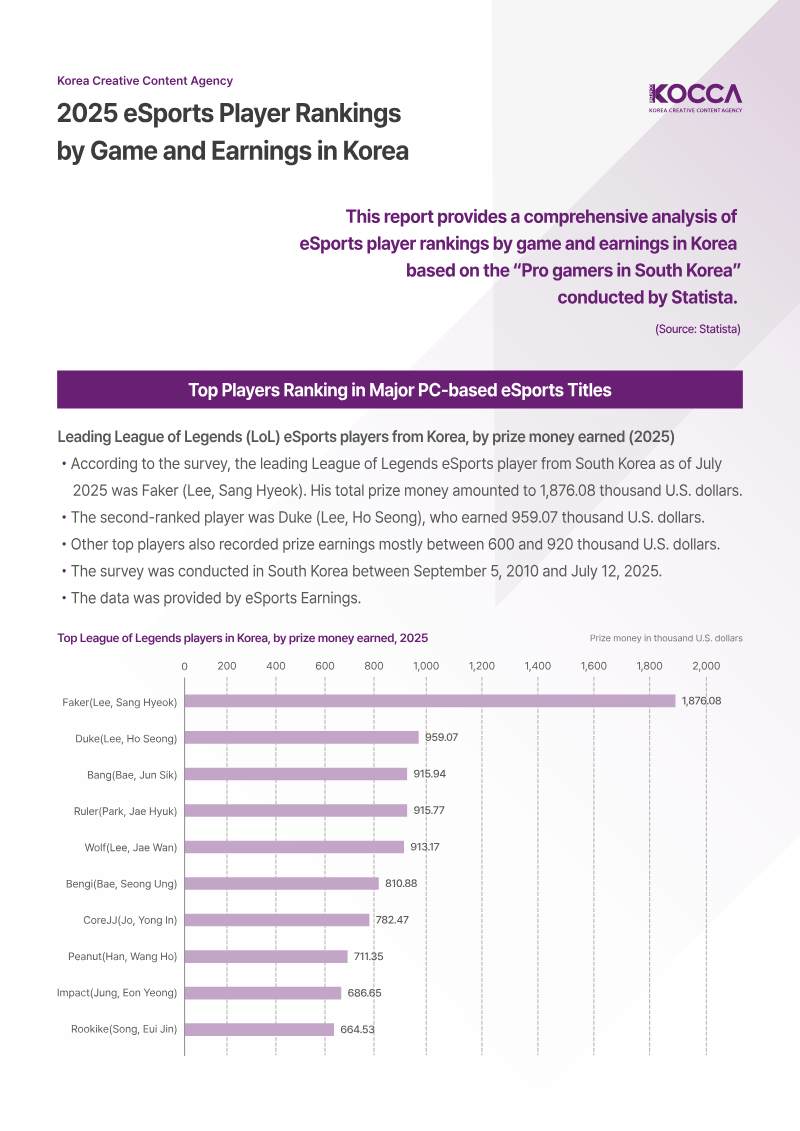
2025 eSports Player Rankings: By Game and Earnings in Korea
South Korea’s professional gaming landscape is characterized by a title-centered evaluation system where prize earnings are highly concentrated among elite players. Analysis of the country’s top eSports competitors across five major PC-based titles—League of Legends, StarCraft II, Valorant, Overwatch 2, and PlayerUnknown’s Battlegrounds (PUBG)—reveals significant disparities in cumulative wealth based on the longevity and global scale of each game’s competitive scene.
League of Legends remains a dominant sector, with Lee Sang-hyeok (Faker) leading all players with approximately $1.88 million in prize money as of July 2025. This exceeds the top earners in other disciplines, such as Cho Sung-choo (Maru) in StarCraft II, who earned $1.39 million, and Park Jung-young (Loki) in PUBG, who secured $1.25 million. In contrast, newer or more recently transitioned titles like Overwatch 2 and Valorant show lower cumulative earnings, with top players Choi Tae-min (MER1T) and Kim Jong-min (Lakia) earning $375,450 and $164,980 respectively.
The data, sourced from eSports Earnings and compiled by the Korea Creative Content Agency, utilizes a longitudinal methodology tracking performance from as early as 2010 through mid-2025. While the rankings for League of Legends, StarCraft II, and Valorant reflect 2025 figures, the data for Overwatch 2 and PUBG is current through late 2024. This segmentation highlights a fragmented domestic performance structure where success is measured by game-specific milestones rather than a unified national ranking. The findings underscore a mature market where established titles continue to provide the highest financial returns for top-tier professional talent.
- League of Legends remains the most lucrative eSports title in South Korea, with top earner Lee Sang-hyeok (Faker) accumulating $1.88 million in prize money as of July 2025.
- Established titles offer significantly higher financial returns than newer games, as evidenced by StarCraft II leader Cho Sung-choo earning $1.39 million and PUBG leader Park Jung-young earning $1.25 million.
- Newer competitive titles show a substantial earnings gap compared to legacy games, with top Overwatch 2 player Choi Tae-min earning $375,450 and Valorant leader Kim Jong-min earning $164,980.
- The South Korean professional gaming market lacks a unified national ranking system, relying instead on a fragmented structure where success is measured by game-specific milestones.
- Data compiled by the Korea Creative Content Agency indicates that cumulative wealth in the sector is heavily concentrated among elite players at the top of their respective disciplines.
+1
KOCCA – Korea Creative Content AgencyJan 2025
Report13 pages
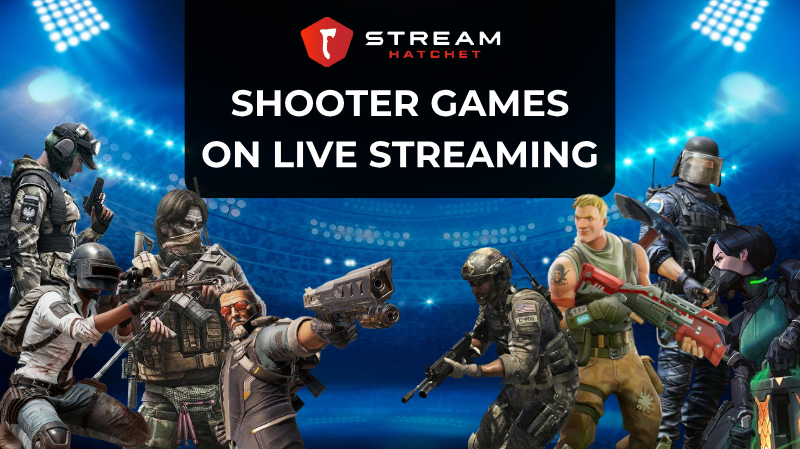
Shooter Games on Live Streaming Mini-Report
This analysis explores the landscape of shooter games on live streaming platforms from 2019 through 2025, tracking viewership trends, subgenre shifts, and the impact of esports. While shooters remain a cornerstone of the industry—consistently accounting for at least 20% of all gaming viewership—the genre has seen a 6% decline in market share since 2022. By 2024, shooters represented approximately one-in-five gaming hours watched, totaling 6.1 billion hours.
The data reveals a significant transition in subgenre dominance. Tactical shooters overtook battle royale games in 2023 to become the most-watched subgenre. This shift is largely driven by the sustained popularity of Valorant and Counter-Strike, which together claim 90% of tactical shooter viewership. Conversely, the battle royale subgenre has seen its viewership halve since its 2020 peak, despite the continued popularity of Fortnite. Other segments, such as extraction and arena shooters, have maintained stable but smaller market shares, with Escape From Tarkov accounting for nearly two-thirds of all extraction shooter hours.
Esports serves as a primary engine for the genre's visibility. By late 2025, nearly half of all Counter-Strike viewership was generated by esports events. Valorant maintains a balanced global presence, holding significant viewership shares across North America, Europe, Asia, and the Southern Hemisphere. In contrast, Counter-Strike remains heavily reliant on the European market, while PUBG Mobile dominates the mobile-centric Asian market.
The analysis also highlights the influence of individual creators and variety streamers. In 2024, Gaules emerged as the leading shooter streamer with 79.2 million hours watched. While Twitch remains the dominant platform for top creators, accounting for 73% of the top ten's viewership, the data shows high viewer overlap between franchises. For example, over 40% of Valorant viewers also engage with other tactical shooters, suggesting strong community fluidity across the genre. Methodology for these findings includes data aggregation from all major streaming platforms, excluding TikTok Live, with specific sentiment analysis conducted on Twitch chat data.
- Shooter games remain a pillar of live streaming, accounting for 6.1 billion hours watched in 2024, though their total market share has declined by 6% since 2022.
- Tactical shooters became the most-watched subgenre in 2023, with Valorant and Counter-Strike capturing 90% of that segment's viewership.
- Battle royale viewership has halved since its 2020 peak, despite the sustained popularity of Fortnite.
- Esports is a critical driver of engagement, accounting for nearly 50% of all Counter-Strike viewership by late 2025.
- Viewer demographics are geographically segmented, with Counter-Strike concentrated in Europe, PUBG Mobile dominating the Asian market, and Valorant maintaining a balanced global presence.
+2
Stream HatchetJan 2025
Report54 pages
Save Point 2024: Recapping the Year's Biggest Trends in Live Streaming
The live streaming industry in 2024 underwent a fundamental transformation characterized by decentralization and the diversification of content beyond traditional gaming. As platforms like Kick experienced explosive growth and new services emerged to fill regional voids left by Twitch’s departure from Korea, the ecosystem shifted toward a multi-platform approach. Creators increasingly utilized simulcasting to expand their reach, while high-production marathons and global IRL content became the primary drivers of audience engagement. This evolution reflects a broader move away from platform exclusivity toward a creator-led model where individual influence dictates viewership patterns.
Esports and competitive gaming remained central to the industry’s success, though the nature of consumption changed significantly. Co-streaming emerged as a dominant force, accounting for nearly 45 percent of all esports viewership, while mobile esports solidified its status as a global powerhouse, particularly during the Esports World Cup. Simultaneously, the industry benefited from a strong synergy between transmedia adaptations and gaming, as film and television projects like Fallout revitalized interest in specific titles. The rise of VTubers and the enduring popularity of RPGs and nostalgia-driven remakes further sustained high levels of viewer retention throughout the year.
Beyond gaming, the landscape expanded to include political commentary, music-focused programming, and massive independent events that rivaled traditional broadcast media. Large-scale spectacles, such as La Velada del Año 4, demonstrated the potential for creators to command millions of concurrent viewers outside of established gaming frameworks. Brands successfully capitalized on these shifts by integrating directly into the viewer experience through strategic initiatives like Twitch Drops. Ultimately, the industry in 2024 proved that long-term growth is now tethered to the ability to blend interactive community engagement with diverse, multi-genre content that transcends the traditional boundaries of the gaming sector.
- The live streaming industry shifted toward a creator-led, multi-platform model in 2024, characterized by widespread simulcasting and the rise of alternative platforms like Kick following Twitch’s withdrawal from the Korean market.
- Co-streaming has become a dominant force in competitive gaming, now accounting for nearly 45 percent of total esports viewership.
- Large-scale, non-gaming spectacles like La Velada del Año 4 demonstrated that independent creators can now command millions of concurrent viewers, rivaling traditional broadcast media.
- Mobile esports solidified its status as a global powerhouse in 2024, highlighted by the significant viewership performance of the Esports World Cup.
- Transmedia adaptations, such as the Fallout series, proved highly effective at revitalizing interest in specific gaming titles and driving viewer retention.
+1
Stream HatchetJan 2024
Report6 pages
2024 Professional Gamer Workforce and Career Structure in Korea
The analysis aims to map the composition, demographics, career trajectories, and income streams of South Korea’s professional e‑sports workforce, drawing on Statista surveys conducted between June and November 2024. It covers domestic players across major titles, Korean competitors active in overseas leagues, and the age, tenure, and earnings profiles of a sample of 138 active professionals, providing a snapshot of the industry’s structure during the current competitive season.
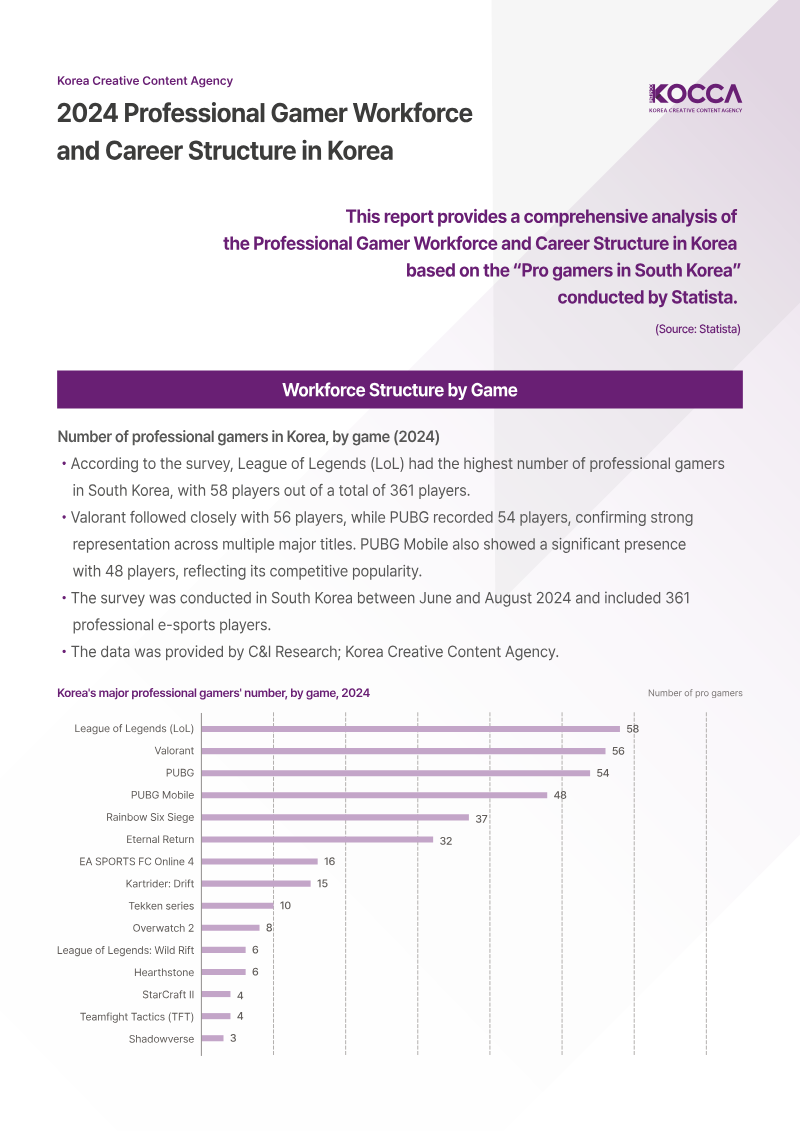
Domestic data identify 361 professional gamers, heavily clustered around four titles: League of Legends (58 players), Valorant (56), PUBG (54) and PUBG Mobile (48). Smaller but notable presences include Rainbow Six Siege (37) and Eternal Return (32). Internationally, 372 Korean e‑sports athletes were reported competing abroad, with League of Legends accounting for 169 participants and Overwatch 2 for 108, while StarCraft II, Valorant and other games each contributed fewer than 30 players.
Age distribution reveals a predominance of young adults, as 37.7 % fall within the 22‑24 year bracket, followed by 29.7 % aged 25 and older, 23.9 % aged 20‑21, and 8.7 % under 19. Career length shows a polarized pattern: 29.7 % have six or more years of experience, while the
- South Korea’s professional e-sports workforce consists of 361 domestic players and 372 athletes competing in overseas leagues.
- League of Legends is the dominant title for Korean professionals, accounting for 58 domestic players and 169 athletes competing internationally.
- The professional player base is heavily concentrated in four domestic titles: League of Legends (58), Valorant (56), PUBG (54), and PUBG Mobile (48).
- Overwatch 2 serves as the second-largest destination for Korean talent abroad, with 108 players currently competing in international leagues.
- The workforce is primarily composed of young adults, with 61.6% of professionals aged 20 to 24 and only 8.7% under the age of 19.
+2
KOCCA – Korea Creative Content AgencyJan 2024
Report5 pages
2024 Financial and Fan Support Structures in Korean eSports
The analysis examines the financial scale of Korean e‑sports organizations and the patterns of fan support, drawing on a longitudinal budget survey (2015‑2023) and two 2024 public opinion polls conducted across South Korea. It targets professional teams, the broader e‑sports audience aged ten and older, and the period from the mid‑2010s through mid‑2024, providing a comprehensive view of market growth and consumer behavior.
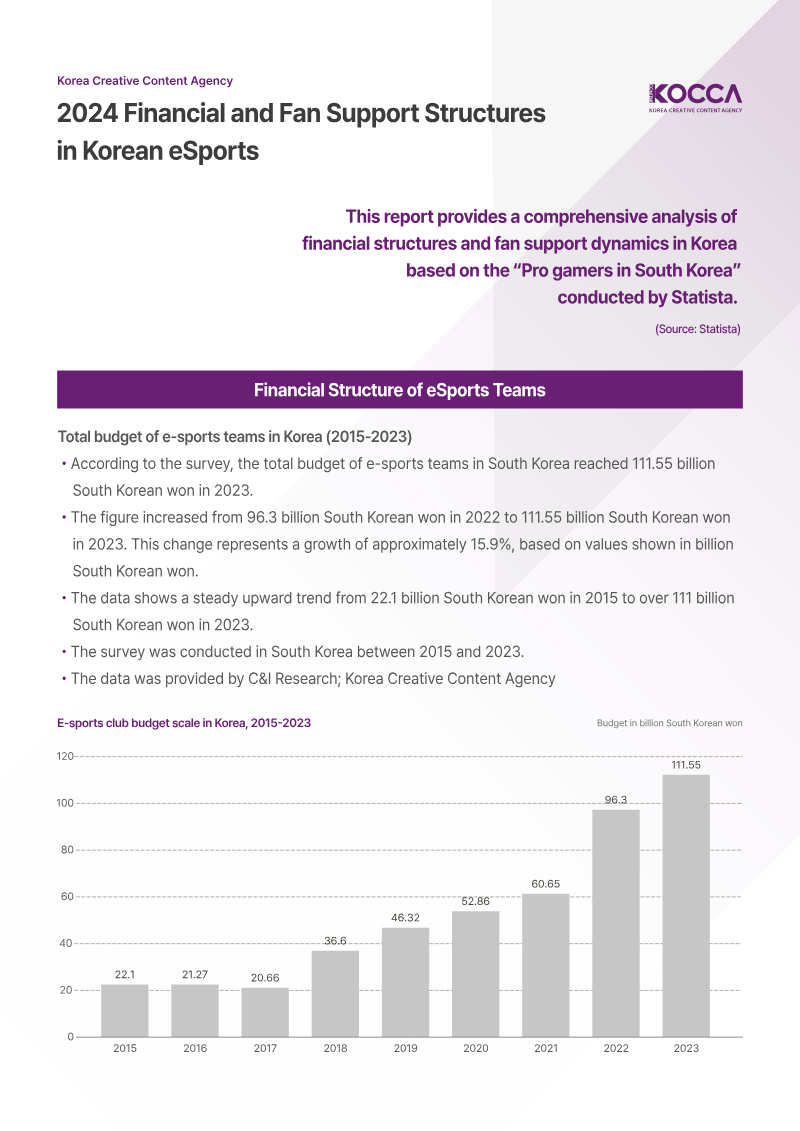
Budget data reveal a steady expansion, with total team expenditures rising from roughly 22.1 billion won in 2015 to 111.6 billion won in 2023—a near five‑fold increase over eight years. The most recent year alone saw a 15.9 % jump from 96.3 billion won in 2022, underscoring accelerating investment in the sector. These figures originate from C&I Research and are based on the Statista “Pro gamers in South Korea” survey.
Fan engagement remains modest: among 2,000 respondents surveyed between June and August 2024, only 35.3 % reported supporting a specific professional team, while 64.7 % did not align with any team. Of the 706 supporters who identified a favorite, T1 commanded an overwhelming 78.2 % share, with the runner‑up Gen.G attracting just 5.4 % and all other teams each receiving under 2 % of votes, indicating a highly concentrated fan base.
Motivational analysis shows that personal affinity for players drives support (48.6 %), followed by a positive perception of the team’s image (41.4 %). Interest in tactical or skill‑based aspects accounts for only 9.2 % of the rationale, highlighting the primacy of player appeal in shaping loyalty.
Overall, the sector demonstrates robust fiscal growth, yet the majority of the audience remains unaffiliated with specific teams, and fan allegiance is heavily skewed toward a single dominant organization. Player popularity emerges as the key lever for deepening fan commitment and expanding market participation.
- Korean e-sports team expenditures grew nearly five-fold between 2015 and 2023, rising from 22.1 billion won to 111.6 billion won.
- Market investment is accelerating, with total team spending increasing by 15.9% between 2022 and 2023 alone.
- Fan loyalty is highly concentrated, as T1 commands 78.2% of identified team supporters, while the runner-up Gen.G holds only 5.4%.
- The majority of the Korean e-sports audience remains unaligned, with 64.7% of 2024 survey respondents reporting no specific team affiliation.
- Player affinity is the primary driver of fan loyalty, accounting for 48.6% of support motivations, compared to just 9.2% for tactical or skill-based interest.
+1
KOCCA – Korea Creative Content AgencyJan 2024
Report7 pages
2024 E‑Sports Viewership and Engagement Trends in Korea
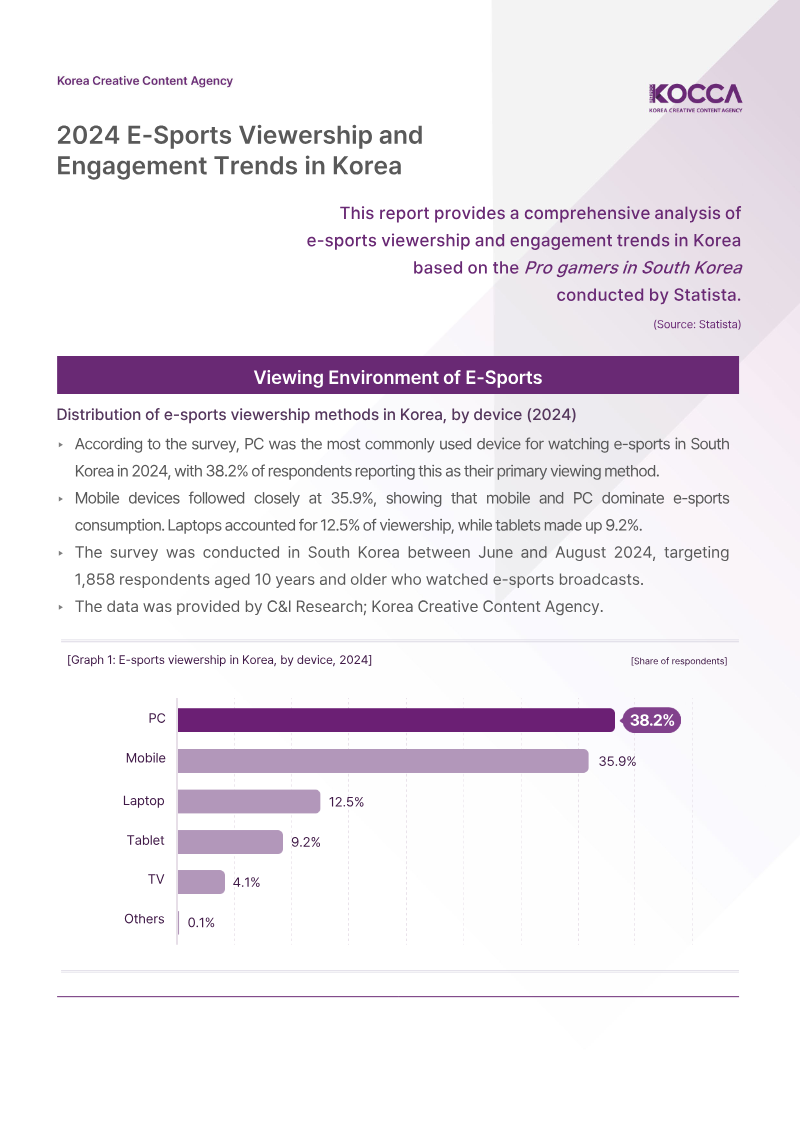
The analysis aims to map current e‑sports viewership and engagement patterns among South Korean audiences, highlighting how consumption devices, platforms, and motivations shape the market and indicating the potential for offline event conversion. Findings reveal a sharply concentrated viewing environment: personal computers account for 38.2 % of primary devices and mobile phones 35.9 %, together representing 74.1 % of usage, while laptops, tablets and televisions capture smaller shares. Platform preference is even more centralized, with YouTube commanding 78.5 % of respondents, far ahead of SOOP (14.1 %) and CHZZK (7.2 %).
Regularity of consumption is high; 38.5 % of participants watch e‑sports 1–2 times per week and 20.4 % watch 3–4 times weekly, meaning at least 58.9 % engage at least once a week. Weekday sessions cluster around one hour for the majority, whereas weekend viewing extends, with 22 % spending two hours on weekdays and 28.6 % doing so on weekends; longer sessions of five hours or more occur for 4.7 % of weekday viewers and 8.1 % of weekend viewers.
Motivational drivers are dominated by entertainment and self‑improvement: 62.1 % watch because the game is fun, 41.9 % seek to enhance their own gameplay, and 37.5 % cite stress relief. Additional reasons include boredom or free access (27.3 %), support for specific players (22.1 %), and social bonding with friends or coworkers (8.6 %).
The survey, conducted between June and August 2024, sampled 1,858 South Korean e‑sports viewers aged ten and older, with data supplied by C&I Research and the Korea Creative Content Agency. A clear majority—62.7 %—expressed willingness to attend live e‑sports events, while 26.9 % remain undecided and 10.4 %
- YouTube dominates the South Korean e-sports market with a 78.5% platform share, significantly outpacing competitors SOOP (14.1%) and CHZZK (7.2%).
- E-sports consumption is primarily mobile and desktop-driven, with PCs (38.2%) and mobile phones (35.9%) accounting for 74.1% of all viewing devices.
- Engagement is frequent and consistent, as 58.9% of viewers watch e-sports content at least once a week, with 20.4% watching 3–4 times weekly.
- Viewer motivation is driven primarily by entertainment (62.1%), gameplay improvement (41.9%), and stress relief (37.5%).
- There is strong potential for offline market growth, as 62.7% of the 1,858 surveyed viewers expressed a willingness to attend live e-sports events.
+1
KOCCA – Korea Creative Content AgencyJan 2024
Report33 pages
Italian Esports Report 2024: Market & Streaming Trends
The analysis evaluates Italy’s esports ecosystem in 2024, aiming to map its audience composition, revenue structure, and strategic priorities for industry participants. Findings reveal a core fan base of 7.3 million individuals, of whom 3.3 million regularly watch esports content. This audience skews younger, resides in urban centres, is predominantly male, and is more likely to hold full‑time employment than the broader gaming population, indicating a segment with disposable income and commercial appeal.
Revenue streams are heavily weighted toward advertising and sponsorship, with 80 % of organisations citing these as primary income sources and accounting for roughly one‑third of total market revenue. This concentration underscores the sector’s dependence on brand partnerships and suggests that monetisation beyond traditional media rights remains limited.
The study draws on a balanced consumer survey of approximately 1,000 Italian internet users aged 16‑65, conducted in September‑October 2024, and a complementary questionnaire administered to an equal number of esports‑industry stakeholders in partnership with IIDEA. All quantitative data are rounded, sourced from publicly available information, and have not undergone independent verification.
Overall, the Italian esports market emerges as a youthful, urban‑centric niche with significant advertising potential, yet its financial model remains narrowly focused. Stakeholders are likely to continue prioritising sponsorship acquisition and related promotional activities to capitalise on the identified demographic strengths.
- Italy’s esports ecosystem comprises 7.3 million fans, with 3.3 million identified as regular viewers of esports content.
- The Italian esports audience is characterized by a younger, urban-centric demographic that is predominantly male and more likely to be employed full-time than the general gaming population.
- Revenue generation is heavily concentrated, with 80% of organizations relying on advertising and sponsorship as their primary income source.
- Advertising and sponsorships account for approximately one-third of the total Italian esports market revenue.
- Monetization strategies in the Italian market remain limited, showing a significant reliance on brand partnerships rather than diversified income streams like media rights.
+1
IIDEA – Italian Interactive Digital Entertainment AssociationJan 2024
Report36 pages
Localization in the MENA Region
The Middle East and North Africa (MENA) gaming market, specifically within the Gulf Cooperation Council (GCC), represents a high-growth frontier projected to reach $3.24 billion in player spending and 38.9 million gamers by 2028. This expansion is fueled by 96% internet penetration, high per capita income, and substantial government investment. Despite Arabic being the fifth most spoken language globally, a significant supply gap persists, as only 3.5% of Steam titles are currently localized for the region. This disparity exists even though 41% of regional gamers prioritize localized titles and over 50% highly value content tailored to their linguistic and cultural background.
Successful market entry demands a sophisticated approach to localization that transcends literal translation. Technical execution must account for right-to-left user interface formatting and complex cursive script rendering to avoid the legibility errors that have plagued previous major releases. Strategically, developers should utilize Modern Standard Arabic for text while employing regional dialects for voice-overs to enhance immersion. Culturalization is equally critical, as 40% of players are more likely to recommend games that include accurate religious considerations and regional festivals. Conversely, 27% of players will abandon a title if it relies on inaccurate stereotypes or disrespectful portrayals, highlighting the reputational risks of superficial localization.
Case studies indicate that deep culturalization can lead to exponential growth, with some titles seeing their MENA-based revenue and daily active users jump from 3% to 80% of their global total within months. Achieving these results requires integrating regional voice talent, ensuring historical accuracy, and leveraging local influencers for community engagement. To navigate these sensitivities and technical requirements effectively, international developers benefit most from partnering with regional experts. Such collaborations ensure that games resonate authentically with Arabic-speaking audiences, transforming a title from a foreign product into a culturally relevant experience.
- The MENA gaming market is a high-growth frontier projected to reach $3.24 billion in player spending and 38.9 million gamers by 2028.
- There is a significant supply gap in the region, as only 3.5% of Steam titles are currently localized despite 41% of regional gamers prioritizing localized content.
- Deep culturalization can drive exponential growth, with some titles increasing their MENA-based revenue and daily active users from 3% to 80% of their global total.
- Technical localization must account for right-to-left UI formatting and complex cursive script rendering to avoid legibility errors.
- Developers should use Modern Standard Arabic for text while employing regional dialects for voice-overs to enhance immersion and authenticity.
+1
Saudi Esports FederationJan 2024
Report18 pages
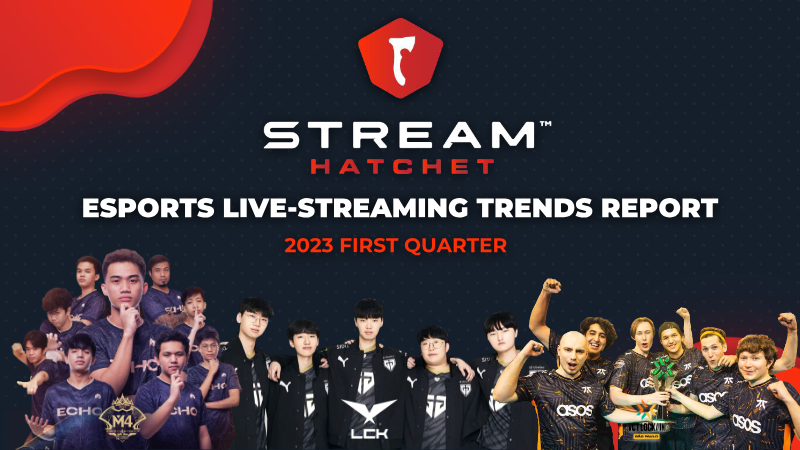
Esports Live-Streaming Trends Report: Q1 2023
The esports live-streaming market demonstrated significant resilience in the first quarter of 2023, with viewership growing 15% year-over-year to reach 651 million hours watched. This growth occurred despite a general decline in broader live-streaming viewership during the same period. The data, aggregated from major platforms including Twitch, YouTube, Facebook Gaming, and AfreecaTV, indicates that the top 30 tournaments alone account for 68% of total esports viewership, highlighting a heavy concentration of audience interest in premier events.
Twitch maintains its market leadership with a 62% share of esports hours watched, followed by YouTube at 30%. While Twitch dominates smaller events with an 81% market share, YouTube has successfully increased its presence in the large-scale event segment, capturing 34% of viewership for tournaments with an average minute audience exceeding 80,000. Multiplayer Online Battle Arena (MOBA) and First-Person Shooter (FPS) remain the most popular genres, though Action-Adventure saw the highest growth due to specialized events like Minecraft Extremo.
A critical trend identified is the rise of co-streaming, where independent creators broadcast official tournament footage to their own audiences. In the case of the Call of Duty League, co-streaming helped triple the league's hours watched compared to the previous year, with nearly 60% of the peak audience watching via creator channels rather than official streams. Top creators like Tarik and Ibai have become central to this ecosystem, often generating higher chat engagement rates than official broadcasts. Mobile esports also showed strength, particularly Mobile Legends: Bang Bang, which saw a 273% increase in esports viewership despite a general downturn in the mobile gaming sector.
- Esports live-streaming viewership grew 15% year-over-year in Q1 2023 to 651 million hours, bucking the broader industry trend of declining live-streaming viewership.
- Audience interest is highly concentrated, with the top 30 tournaments accounting for 68% of total esports hours watched.
- Twitch holds 62% of the total esports market share, while YouTube maintains 30% and has successfully captured 34% of viewership for large-scale events with an average minute audience over 80,000.
- Co-streaming has become a primary growth driver, exemplified by the Call of Duty League tripling its hours watched as 60% of its peak audience tuned in via creator channels rather than official streams.
- Mobile esports demonstrated significant momentum, with Mobile Legends: Bang Bang recording a 273% increase in viewership despite a general downturn in the mobile gaming sector.
+1
Stream HatchetMar 2023
Report15 pages
Japanese Esports on the Rise: Five Teams to Watch
Japan is rapidly evolving from a video game superpower into a significant esports market, overcoming historical regulatory and cultural hurdles. While the country previously lagged behind China and South Korea due to strict anti-gambling laws that capped prize pools and a lack of domestic titles in popular esports genres like MOBAs, recent policy shifts have transformed the landscape. Following the 2019 removal of most legal restrictions and the formation of the Japan Esports Union (JeSU), the market grew by 11% to reach $77 million in 2022.
The ecosystem is characterized by a unique "watching but not playing" culture, where livestreaming and content creation drive engagement among both gamers and non-gamers. This has led to the rise of prominent organizations such as Crazy Raccoon, DetonatioN FocusMe, FENNEL, SCARZ, and ZETA DIVISION. These teams increasingly operate as lifestyle brands, generating revenue through traditional sponsorships, merchandise, and specialized content partnerships. Notably, non-endemic brands like Nissin Foods have entered the space, with sponsorship fees reportedly increasing tenfold over the last five years.
Despite this momentum, the industry faces challenges, including a "Galapagos syndrome" where domestic game preferences differ from global trends, and a power imbalance where publishers maintain strict control over tournament formats. However, the outlook remains optimistic. Industry leaders anticipate further consolidation and professionalization, mirroring the evolution seen in Western markets a decade ago. As teams seek international expansion and venture capital, Japan is positioned to become a major hub for esports talent and tourism in Asia.
- Japan's esports market reached $77 million in 2022, marking an 11% growth following the 2019 removal of restrictive anti-gambling laws and the establishment of the Japan Esports Union (JeSU).
- Non-endemic brand involvement is surging, evidenced by companies like Nissin Foods entering the space and sponsorship fees increasing tenfold over the last five years.
- Leading organizations including Crazy Raccoon, DetonatioN FocusMe, FENNEL, SCARZ, and ZETA DIVISION are operating as lifestyle brands to monetize through merchandise, content partnerships, and sponsorships.
- The Japanese market is driven by a unique 'watching but not playing' culture, where high engagement in livestreaming and content creation attracts both gamers and non-gamers.
- The industry faces structural challenges including 'Galapagos syndrome,' where domestic game preferences diverge from global trends, and strict tournament control by game publishers.
+1
Niko PartnersFeb 2023
Report25 pages
The MENA Games Market: From Sand to Stardom
The Middle East and North Africa (MENA) gaming market is experiencing a period of rapid expansion, characterized by significant government investment, a growing base of digital natives, and an increasing emphasis on cultural localization. As of 2022, the MENA-3 region—comprising Saudi Arabia, the United Arab Emirates, and Egypt—generated $1.8 billion in revenue and supported 67.4 million gamers. This growth is underpinned by a strong mobile-first ecosystem and a burgeoning esports sector that benefits from high engagement rates and substantial public sector backing, most notably through Saudi Arabia’s National Gaming and Esports Strategy.
The industry’s trajectory is heavily influenced by the necessity of localized content. Data indicates that 86.6% of regional gamers prioritize language localization, and successful titles like PUBG Mobile have demonstrated that integrating regional celebrities, cultural themes, and Arabic-language support is essential for market penetration. Beyond content, the region is actively fostering a domestic development pipeline through workforce training, educational initiatives, and high-profile mergers and acquisitions, such as those led by the Savvy Games Group. These efforts aim to transition the region from a consumer market into a global hub for game development and esports.
Esports serves as a primary driver of engagement, with 73% of regional gamers participating in competitive gaming. The rise of local influencers and streamers, coupled with massive prize pools and the development of dedicated infrastructure like esports cities, has created a self-sustaining cycle of fan engagement and corporate sponsorship. Furthermore, the market is increasingly viewed as a strategic partner for international firms, particularly those from China, which have successfully utilized the region as a growth market. By leveraging social gaming trends—where voice chat and online socialization are central to the player experience—and prioritizing gender-inclusive gaming spaces, the MENA region is positioning itself as a significant, high-growth player in the global gaming landscape.
- The MENA-3 region (Saudi Arabia, UAE, and Egypt) generated $1.8 billion in revenue from 67.4 million gamers as of 2022, driven by a mobile-first ecosystem.
- Cultural localization is a critical success factor, with 86.6% of regional gamers prioritizing language support and successful titles integrating Arabic themes and local celebrities.
- Esports is a primary engagement driver, with 73% of regional gamers participating in competitive gaming supported by massive prize pools and dedicated infrastructure.
- The region is transitioning from a consumer market to a development hub through strategic initiatives like Saudi Arabia’s National Gaming and Esports Strategy and the Savvy Games Group’s M&A activity.
- International firms, particularly from China, are increasingly using the MENA region as a strategic growth market by capitalizing on high social gaming engagement and voice chat trends.
+3
Niko PartnersJan 2023

Report98 pages
Gametech Report Q1 2023: Global & MENAP Outlook
The report argues that the MENAP region is poised to become a major hub for gaming, driven by rapid mobile‑gaming adoption, esports growth and an expanding local startup ecosystem. It identifies talent development, IP creation and cross‑industry collaboration as key levers for sustained expansion, while noting challenges such as technical upskilling, content localisation and stakeholder coordination.
Globally, the gaming market is shifting toward cloud‑based development and AI‑powered tools, with 68 % of studios already using AWS for Games and a projected $7.1 bn market by 2032. Generative AI is expected to reach a $7.1 bn valuation in gaming by 2032, growing at 23.3% CAGR, and private deals now account for 68 % of total investment activity. In MENAP, the market is projected to hit $2.8 bn by 2026 at a 10% CAGR, underpinned by mobile adoption and esports expansion.
Mobile‑first development dominates, with 70 % of developers prioritising data analytics and 50 % investing in AI tools. In‑app purchases, advertising and subscriptions drive revenue, with IAP rising 28 % YoY to $374.1 million and ad revenue up 6.1%. Platform shifts such as iOS SKAN 4.0 and Android privacy changes are reshaping monetisation strategies, while cloud‑gaming infrastructure is projected to grow 250 % by 2030.
Investment flows reflect these trends: seed‑stage funding in MENAP has reached $15 million across 20+ startups, and international firms target the region for free‑to‑play and Web3 opportunities. Funds like SHFT’s $15 million Gametech Fund aim to provide capital, expertise and networking to help local studios compete globally. The overall outlook indicates a 6.1% YoY revenue growth for global and MENAP gaming, with a 15 % rise in mobile gaming and a 43 % share captured by platform‑based titles.
- The MENAP gaming market is projected to reach $2.8 billion by 2026, growing at a 10% CAGR driven by mobile adoption and esports.
- Generative AI in gaming is forecast to reach a $7.1 billion valuation by 2032, expanding at a 23.3% CAGR.
- Global cloud-gaming infrastructure is projected to grow 250% by 2030, supported by the fact that 68% of studios already utilize AWS for Games.
- Mobile-first development remains the industry standard, with 70% of developers prioritizing data analytics and 50% investing in AI tools.
- In-app purchase revenue grew 28% year-over-year to $374.1 million, while advertising revenue increased by 6.1%.
+1
Shorooq PartnersJan 2023
Report23 pages
Peak Play: Trends in East Asian Videogame Streaming H1 2023
The East Asian videogame livestreaming market is a mature and culturally distinct ecosystem where competitive esports serve as the primary engine for audience engagement. During the first half of 2023, MOBA and Battle Royale titles accounted for over half of the region's most-watched content. While established franchises like League of Legends maintain a dominant presence, the market is increasingly shaped by the influence of Key Opinion Leaders and VTubers. These creators contribute up to 15% of total viewership for major titles and have demonstrated the power to revitalize older games such as Minecraft and Escape from Tarkov.
Regional preferences reveal a bifurcated landscape where specific titles command massive scale. In China, Honor of Kings remains the undisputed leader with 5.67 billion views, while VALORANT and Apex Legends dominate the Japanese and Korean markets, each surpassing 100 million hours watched. The barrier to entry for new releases is high, as only high-profile 2023 titles like Diablo IV, Honkai: Star Rail, and Street Fighter 6 managed to break into regional top-ten rankings. The rapid ascent of Honkai: Star Rail in China notably came at the expense of Genshin Impact, which saw a 31% decline in viewership as audiences shifted toward the newer release.
The integration of granular streaming analytics and market intelligence is essential for navigating this complex environment. By tracking metrics across platforms such as Twitch, YouTube, and AfreecaTV, stakeholders can monitor audience retention and demographic shifts. This data-driven approach highlights the volatility of the market, evidenced by the 68.5% decline in Splatoon 3 viewership following its launch period. Understanding these dynamics—ranging from the professional esports circuit to the rising prominence of virtual avatars—is critical for identifying growth opportunities and executing successful market entry strategies across Asia.
- Competitive esports, specifically MOBA and Battle Royale titles, drive over 50% of total viewership in the East Asian streaming market.
- Honor of Kings remains the dominant force in China with 5.67 billion views, while VALORANT and Apex Legends lead in Japan and Korea with over 100 million hours watched each.
- Key Opinion Leaders and VTubers are significant market drivers, contributing up to 15% of total viewership for major titles and successfully revitalizing older games.
- New title launches face high barriers to entry, with only Diablo IV, Honkai: Star Rail, and Street Fighter 6 breaking into regional top-ten rankings during H1 2023.
- Audience cannibalization is a measurable risk, as evidenced by Honkai: Star Rail’s growth contributing to a 31% decline in Genshin Impact viewership.
+1
Niko PartnersJan 2023
Report14 pages
Video Game Streaming Trends: 2022 Third Quarter Report
The third quarter of 2022 reflects a period of stabilization for the live streaming industry as it transitions away from pandemic-era highs. While total hours watched and unique channels both decreased by 13% compared to the previous year, the market remains significantly larger than in 2019, with viewership levels nearly double those of the pre-pandemic era. Data indicates that while fewer creators are active, those remaining are broadcasting for longer durations, resulting in a 7.5% increase in total hours broadcast year-over-year.
Twitch maintains a dominant market share, accounting for 72% of total gaming hours watched, followed by YouTube at 15% and Facebook Gaming at 12%. Notably, YouTube was the only major platform to see growth in hours watched, rising 4% as high-profile creators migrated to the service. Conversely, Facebook Gaming experienced a sharp 70% decline in viewership, likely influenced by the discontinuation of its standalone app. In contrast to the broader market slowdown, the esports segment grew by 40% year-over-year, with Twitch capturing 66% of this specific market.
Content trends highlight the rising influence of VTubers and the strategic shift of esports organizations toward variety content. VTubers now represent 50% of the top ten female creators, with the top ten VTubers seeing an average viewership growth of 30% over the previous quarter. Additionally, eight of the top ten esports organizations now generate more than half of their total watch time through content creators rather than competitive matches. While established titles like Grand Theft Auto V and League of Legends continue to lead the charts, the quarter also saw a peak in gambling viewership on Twitch just prior to the implementation of new platform restrictions on unlicensed sites.
- Twitch maintains a dominant 72% market share of gaming hours watched, while YouTube grew its viewership by 4% and Facebook Gaming suffered a 70% decline following the discontinuation of its standalone app.
- The live streaming industry is stabilizing post-pandemic with total hours watched down 13% year-over-year, though current viewership remains nearly double 2019 levels.
- Esports viewership grew 40% year-over-year, with Twitch capturing 66% of this segment and eight of the top ten esports organizations now generating the majority of their watch time through non-competitive variety content.
- While the total number of active channels decreased by 13%, the remaining creators increased their output, leading to a 7.5% year-over-year rise in total hours broadcast.
- VTubers are a significant growth driver, now representing 50% of the top ten female creators and achieving an average viewership increase of 30% over the previous quarter.
+1
Stream HatchetSept 2022
Report23 pages
Video Game Streaming Trends Report: 2022 First Quarter
The primary aim of the analysis is to map the state of global video‑game streaming in the first quarter of 2022, linking audience behavior to platform performance, game releases, and advertising potential. While overall viewership growth has begun to temper—total hours watched fell 6 % from the previous quarter—it remains 66 % higher than the same period in 2020 and 140 % above Q1 2019, underscoring the sector’s continued expansion despite pandemic stabilization.
Twitch retains overwhelming dominance, delivering roughly three‑quarters of all streamed hours and accounting for 80 % of esports viewership, which itself showed only a 0.3 % dip year‑over‑year but rose 63 % since 2019. Emerging competitors such as AfreecaTV, Trovo and NaverTV posted double‑digit growth, yet YouTube and Facebook together contributed less than 10 % of total hours. Core viewers—just 7.8 % of the audience—generated two‑thirds of watch time, averaging 276 minutes per day and proving 24 times more receptive to repeated advertising than casual viewers, who average 12 minutes daily.
Game‑level insights reveal that legacy titles like Grand Theft Auto V and League of Legends remain top‑draws, while new releases such as Elden Ring and Lost Ark captured strong core‑viewer engagement, each accounting for over half of their streaming hours. Mobile game streaming is heavily core‑oriented, with 78 % of hours coming from core fans despite casual dominance in downloads. Content creators mirror these patterns: xQcOW led live streams with 62.8 million hours, while VOD‑first creators like Rubius generated twice as many video‑on‑demand views per concurrent viewer, highlighting divergent monetization pathways.
- Twitch maintains a dominant market position, accounting for approximately 75% of all streamed hours and 80% of esports viewership.
- Total hours watched in Q1 2022 declined 6% from the previous quarter, yet remains 66% higher than Q1 2020 and 140% above Q1 2019 levels.
- A small segment of core viewers, representing only 7.8% of the total audience, generates two-thirds of all watch time and is 24 times more receptive to repeated advertising than casual viewers.
- While YouTube and Facebook combined contribute less than 10% of total streaming hours, emerging platforms like AfreecaTV, Trovo, and NaverTV are experiencing double-digit growth.
- New releases such as Elden Ring and Lost Ark successfully captured core-viewer engagement, with both titles deriving over 50% of their streaming hours from this demographic.
+1
Stream HatchetMar 2022
Report51 pages
Global Esports & Live Streaming Market Report 2022
The global esports and live streaming industry is undergoing a period of robust expansion, with total esports revenue projected to reach $1.38 billion in 2022 and an audience base of 532 million people. This growth trajectory is expected to continue, with market valuations potentially hitting $1.86 billion by 2025. While sponsorship remains the dominant revenue stream, accounting for nearly 60 percent of total earnings, the industry is actively diversifying its financial models. Organizations are increasingly pivoting toward direct-to-fan strategies, including digital merchandise, loyalty programs, and educational initiatives, to mitigate risk and transition toward sustainable, lifestyle-oriented business models.
The live streaming sector serves as a critical pillar of this ecosystem, with its audience projected to grow to 1.41 billion by 2025. Market dominance is currently split between major platforms like Twitch, YouTube Gaming, and Facebook Gaming, each leveraging distinct regional strengths. Twitch maintains a stronghold in Western PC and console markets, whereas YouTube and Facebook are capitalizing on the rapid proliferation of mobile gaming in emerging economies. These platforms are further evolving by integrating non-gaming content and interactive features to enhance user retention and broaden monetization opportunities.
Despite the positive outlook, the industry must navigate potential volatility stemming from shifting media consumption habits, evolving publisher investment strategies, and the lingering economic effects of the pandemic. Nevertheless, the sector remains highly attractive to stakeholders due to its core demographic of young, high-income professionals. As the market matures, the integration of co-streaming and the expansion into emerging regions—supported by localized platforms—will be essential for maintaining long-term growth and fostering deeper engagement with a global, digitally native audience.
- Global esports revenue is projected to reach $1.38 billion in 2022, with a total audience of 532 million, and is expected to grow to $1.86 billion by 2025.
- Sponsorship currently accounts for nearly 60% of total esports revenue, though organizations are shifting toward direct-to-fan models like digital merchandise and loyalty programs to improve financial sustainability.
- The live streaming audience is forecast to reach 1.41 billion by 2025, driven by the integration of non-gaming content and interactive features to boost user retention.
- Market dominance in live streaming is split between Twitch, which leads in Western PC and console markets, and YouTube Gaming and Facebook Gaming, which are capturing growth in mobile-first emerging economies.
- The industry remains highly attractive to stakeholders due to its core demographic of young, high-income professionals.
+3
NewzooJan 2022
Report30 pages
Games, Esports, Live Streaming, Cloud and the Metaverse: 2022 Trends to Watch
The global gaming industry is currently undergoing a structural transformation characterized by the integration of emerging technologies and a pivot toward cross-platform accessibility. Central to this evolution is the expansion of cloud gaming, which serves as a critical bridge to overcome hardware constraints, allowing publishers to reach broader audiences on mobile devices and legacy consoles. Simultaneously, the metaverse is maturing into a robust commercial ecosystem, fueled by significant venture capital investment, the proliferation of virtual real estate, and the integration of digital fashion. These developments signal a broader industry shift toward enhanced creator-viewer interactivity and the adoption of Web3.0 business models.
Monetization strategies are diversifying as companies experiment with blockchain-based player trading and fan engagement tools, despite notable consumer resistance toward non-fungible tokens. This period is also defined by a surge in high-quality cross-media intellectual property adaptations and a crowded release calendar, which intensifies competition for consumer attention. Furthermore, regulatory and consumer pressures are forcing a transition toward more open app store ecosystems, challenging traditional distribution gatekeepers.
Within the esports sector, organizations are actively diversifying revenue streams by prioritizing mobile-first titles and leveraging co-streaming to maximize viewership reach. These trends, observed throughout 2022, reflect a strategic effort to sustain growth across global markets. By synthesizing market intelligence and tracking key performance metrics, the industry continues to navigate the complexities of digital transformation, balancing the pursuit of innovative monetization with the necessity of maintaining user trust in an increasingly interconnected virtual landscape.
- Cloud gaming is driving industry growth by bypassing hardware limitations, enabling publishers to deliver high-end experiences to mobile devices and legacy consoles.
- The metaverse is evolving into a commercial ecosystem supported by significant venture capital, virtual real estate markets, and digital fashion integration.
- Monetization models are shifting toward Web3.0 and blockchain-based player trading, despite ongoing consumer resistance to non-fungible tokens.
- Regulatory and consumer pressure is forcing a transition away from traditional app store gatekeepers toward more open distribution ecosystems.
- Esports organizations are prioritizing mobile-first titles and utilizing co-streaming strategies to diversify revenue and expand global viewership.
+5
NewzooJan 2022
Report30 pages
Games, Esports, Live Streaming, Cloud and the Metaverse: 2022
The global gaming industry is undergoing a fundamental transformation characterized by the convergence of traditional media, high-fidelity content, and emerging Web3 technologies. The primary thesis posits that the sector is shifting toward an interconnected, cross-platform ecosystem where revenue diversification and creator-driven engagement models are essential for growth. While consumer skepticism persists regarding blockchain-based assets and NFTs, publishers are successfully navigating this transition by prioritizing mobile esports, co-streaming strategies, and efforts to circumvent restrictive app store ecosystems to foster deeper fan loyalty.
Technological infrastructure is evolving to support this expansion, with cloud-based solutions and Platform-as-a-Service models playing a critical role in mitigating hardware limitations. By integrating gaming experiences into smart TVs and leveraging cloud technology, companies are effectively broadening their reach to new demographics. Simultaneously, the metaverse has emerged as a significant focal point for venture capital and brand investment, as corporations increasingly utilize digital fashion and virtual real estate to capture the attention of younger, digitally native audiences.
Geographically, the market remains dominated by the Asia-Pacific region, which generates $88.2 billion in annual revenue, representing over half of the global total. North America follows with $42.6 billion, maintaining a strong position in the industry landscape. However, the long-term trajectory of the market is increasingly influenced by emerging territories in Latin America, the Middle East, and Africa. These regions are currently expanding at rates exceeding the global average, signaling a gradual decentralization of revenue and a more diverse, globalized future for the interactive entertainment sector.
- The Asia-Pacific region dominates the global gaming market with $88.2 billion in annual revenue, accounting for more than 50% of the total global share.
- North America remains a primary industry pillar, generating $42.6 billion in annual revenue.
- Emerging markets in Latin America, the Middle East, and Africa are currently experiencing growth rates that exceed the global average, signaling a shift toward market decentralization.
- Publishers are prioritizing mobile esports, co-streaming, and direct-to-consumer strategies to bypass restrictive app store ecosystems and increase fan loyalty.
- Cloud-based infrastructure and Platform-as-a-Service models are being used to overcome hardware limitations and expand reach through smart TV integration.
+5
NewzooJan 2022