Report29 pages
Interim Financial Report: Nine Months Ended September 30th 2019
These interim condensed financial statements have been prepared on a historical cost basis. They do not include all information and disclosures required in full-year financial statements and should be read in conjunction with the Company's full-year financial statements for 2018, including notes, for the period of 12 months ended December 31st 2018, prepared in accordance with the IFRS as endorsed by the EU.
- 11 bit studios S.A. reported revenue of PLN 49,430,023 for the first nine months of 2019, a 17.09% decrease year-on-year.
- Basic earnings per share significantly dropped from PLN 12.47 in the nine months ended September 30, 2018, to PLN 4.38 in the same period of 2019.
- The company is actively developing "Projekt 10" and aims to release one proprietary game annually, while its publishing division plans for three to four external game debuts each year.
- Moonlighter and Children of Morta (PC version) were financial successes, boosting the company's position as a global game publisher; Moonlighter sales were particularly strong on Nintendo Switch, especially in Japan.
- 11 bit studios S.A. is expanding its workforce, projecting approximately 140 employees by the end of 2019 and potentially 180-200 in 2020, coinciding with a move to new offices in Warsaw with space for up to 300 employees.
+2
11 bit studios
Report2 pages
11 bit studios — Quarterly Report Q1 2020: Letter from the CEO
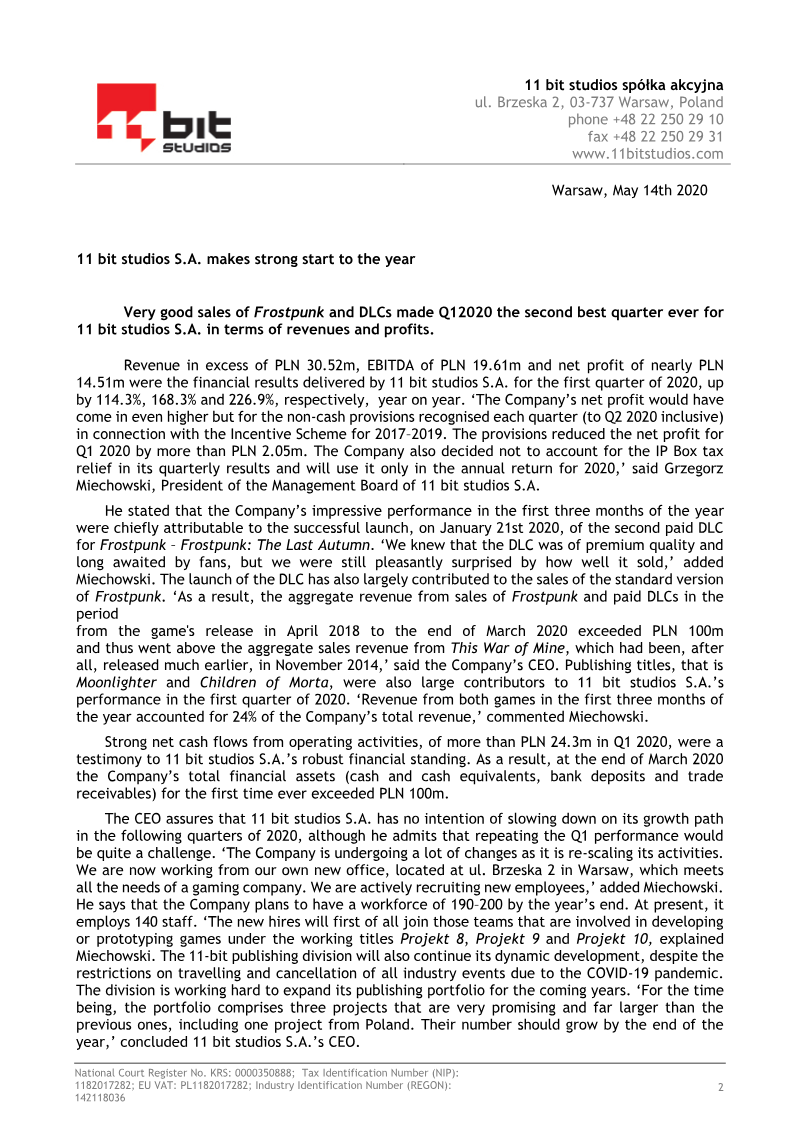
11 bit studios S.A. reported a record‑breaking first quarter of 2020, with revenue surpassing PLN 30.52 million and EBITDA reaching PLN 19.61 million, both up 114.3% and 168.3% year‑on‑year respectively. Net profit climbed nearly PLN 14.51 million, a 226.9% increase, though non‑cash provisions related to the 2017–2019 Incentive Scheme reduced the figure by more than PLN 2.05 million; the company elected to defer IP Box tax relief until the annual return. The surge was driven largely by the launch of Frostpunk’s second paid DLC, “The Last Autumn,” on 21 January 2020, which not only boosted DLC sales but also lifted demand for the base game. Combined revenue from Frostpunk and its DLCs exceeded PLN 100 million between April 2018 and March 2020, surpassing the cumulative sales of This War of Mine. Publishing titles Moonlighter and Children of Morta contributed 24% of total revenue in the quarter.
Operating cash flow exceeded PLN 24.3 million, allowing total financial assets to cross the PLN 100 million threshold for the first time. The company plans to expand its workforce from 140 to 190–200 employees by year‑end, focusing on new projects under development (Projekt 8, 9, and 10) and a growing publishing portfolio that now includes three promising titles. Operations continue amid COVID‑19 restrictions, with the company relocating to a new Warsaw office that supports its scaling ambitions. The report covers Poland‑based activities for Q1 2020, highlighting strong performance across development and publishing segments.
- 11 bit studios achieved record Q1 2020 financial results, with revenue reaching PLN 30.52 million (up 114.3% YoY) and net profit rising 226.9% to PLN 14.51 million.
- The launch of the 'The Last Autumn' DLC for Frostpunk on 21 January 2020 served as the primary growth driver, boosting both DLC and base game sales.
- Frostpunk and its associated DLCs generated over PLN 100 million in revenue between April 2018 and March 2020, officially surpassing the cumulative lifetime sales of This War of Mine.
- Total financial assets exceeded the PLN 100 million threshold for the first time, supported by an operating cash flow of over PLN 24.3 million.
- The company is scaling its workforce from 140 to 190–200 employees by the end of 2020 to support three new internal projects (Projekt 8, 9, and 10) and an expanding publishing portfolio.
+4
11 bit studios
Report85 pages
Half-Year Report of 11 Bit Studios S.A.: First Half of 2020
HALF-YEAR REPORT OF 11 BIT STUDIOS S.A. FOR THE FIRST HALF OF 2020 Dear Shareholders and Investors, Please be invited to read 11 bit studios S.A.’s report for the first half of 2020. We, as the Management Board, are extremely satisfied with the Company’s financial performance in the In the first six months of 2020, 11 bit studios S.A. reported revenue of nearly PLN 50.2m, up 63.2% year on year, and delivered a net profit of more than PLN 25.0m, up 237%.
- 11 Bit Studios S.A. achieved significant financial growth in H1 2020, with revenue increasing by 63.2%, operating profit by 172.25% to PLN 26,376,046, and net profit by 241.31% to PLN 25,330,511, marking its second-highest half-year net profit in company history.
- The strong financial performance was driven by excellent sales of games released in previous periods, including Frostpunk and Moonlighter (Q2 2018), Children of Morta (Autumn 2019), and continued strong sales of This War of Mine (November 2014).
- Operating expenses increased at a slower rate (12.92%) than revenue, partly due to a change in accounting for the 2017–2019 Incentive Scheme costs, which were fully recognized by the end of 2019 instead of Q2 2020.
- The company's headcount as of the report's issue date was 148 employees, working under employment contracts or civil law contracts.
- The COVID-19 pandemic had no adverse effect on the company's revenue from game sales and is not expected to threaten liquidity in the next 12 months, with the company successfully transitioning to remote work and offering a safe return-to-office option.
+1
11 bit studios
Report54 pages
Quarterly Report for Nine Months Ended September 30th 2020
STUDIOS S.A.<sub>FOR </sub>NINE QUARTERLY REPORT OF 11 BITSTUDIOS S.A. FOR NINE MONTHS ENDED Dear Shareholders and Investors, It is our pleasure to present to you the report of 11 bit studios S.A. for the nine months ended September 30th 2020. The results for this period, which proved better than we assumed in the budget, clearly demonstrate that the consistent implementation of the Company's growth strategy is bringing measurable financial results.
- 11 bit studios S.A. generated PLN 68,159,127 in revenue from sales of computer games in the nine months ended September 30th, 2020, a significant increase from PLN 49,430,023 in the same period of 2019.
- The launch of Frostpunk: The Last Autumn on January 21st, 2020, was highly successful, driving sales of both the add-on and the base game, including the Frostpunk: Game of The Year edition.
- Revenue from third-party developed games, primarily Moonlighter and Children of Morta, accounted for approximately 28% of the Company's total revenue in the nine months ended September 30th, 2020.
- The US was the largest market for 11 bit studios S.A., contributing PLN 52,087,826 in revenue in the nine months ended September 30th, 2020, followed by Japan with PLN 10,072,823.
- 11 bit studios S.A. is developing a mobile version of Frostpunk in a free-to-play model with Chinese gaming giant NetEase, and a Frostpunk board game which successfully raised EUR 2,496,308 on Kickstarter.
+2
11 bit studios
Report75 pages
Half-Year Report of 11 Bit Studios S.A.: First Half of 2021
HALF-YEAR REPORT OF 11 BIT STUDIOS S.A. FOR THEFIRST HALF OF 2021 Dear Shareholders and Investors, Please be invited to read 11 bit studios S.A.’s report for the first half of 2021. We, as the Management Board, are clearly satisfied with the Company’s financial performance, which was far better than assumed in the budget for the period. In the first six months of this year, our Company posted revenue of nearly PLN 35.78m.
- 11 Bit Studios S.A. experienced a significant decrease in operating profit in H1 2021, falling 45.04% to PLN 14,495,759 from PLN 23,943,648 in H1 2020, with the operating profit margin dropping from 52.57% to 40.51%.
- EBITDA also declined in H1 2021 to PLN 19,760,614, down from PLN 31,220,900 in H1 2020, resulting in an EBITDA margin decrease from 62.23% to 55.23%.
- Cash flows from operating activities in H1 2021 were PLN 22,490,664, a 26.92% decrease compared to PLN 30,775,715 in H1 2020, despite the absence of new game releases.
- Total assets increased to PLN 201,184,432 (EUR 44,501,954) as of June 30, 2021, up from PLN 186,339,222 (EUR 40,378,613) on December 31, 2020.
- The company's share capital as of August 11, 2021, was PLN 236,542.1, comprising 2,365,421 shares, with 1,710 Series G shares subscribed and paid for on that date for PLN 176,779.80.
+2
11 bit studios
Report51 pages
Quarterly Report for 11 bit studios S.A.: Nine Months Ended September 30th 2021
QUARTERLY REPORT OF 11 BIT STUDIOS S.A. FOR NINE MONTHS ENDED Dear Shareholders and Investors, It is our pleasure to present to you the report of 11 bit studios S.A. for the nine months ended September 30th 2021. The results for that period, which proved much better than we assumed in our budget both in terms of revenue and profits, clearly demonstrate that the consistent implementation of the Company's growth strategy is bringing tangible financial results.
- 11 bit studios S.A.'s revenue for the nine months ended September 30th, 2021, was PLN 49,196,100, a 27.82% decrease year-on-year, primarily due to a high comparative base from the successful 2020 release of Frostpunk: The Last Autumn DLC.
- The company's total equity increased to PLN 185,464,601 as of September 30th, 2021, up from PLN 164,648,124 at December 31st, 2020.
- Salaries, wages, and employee benefits significantly increased by 74.63% to PLN 8,938,472 for the nine months ended September 30th, 2021, largely due to workforce growth and PLN 2,916,714 in non-cash provisions from the 2021–2025 Incentive Scheme.
- Basic earnings per share decreased to PLN 7.36 for the nine months ended September 30th, 2021, from PLN 13.90 in the corresponding period of 2020.
- The company is developing new games, including a new IP and a Frostpunk universe project, and has three third-party developed games in its publishing pipeline, all utilizing Unreal Engine instead of their previous Liquid Engine.
+2
11 bit studios
Report76 pages
Half-Year Report: 11 bit studios (H1 2022)
HALF-YEAR REPORT OF 11 BIT STUDIOS S.A. FOR THE SIX MONTHSENDED Dear Shareholders and Investors, Please be invited to read 11 bit studios’ report for the six months ended June 30th 2022. It was a time of hard work for us. Despite the unfavourable macroeconomic headwinds, the Company’s financial performance in that period was much stronger than in the previous year and far better than we assumed in our budget.
- 11 bit studios S.A. reported a profit of PLN 15,083,775 for the period ended June 30, 2022, an increase from PLN 13,308,096 in the same period of 2021.
- The company's total assets increased by 10.48% to PLN 242,514,237 as of June 30, 2022, up from PLN 219,512,964 at December 31, 2021.
- Cash provided by operating activities rose to PLN 28,377,470 in H1 2022 from PLN 22,490,664 in H1 2021, with net cash from operating activities at PLN 24,080,772.
- Depreciation and amortisation expenses decreased by 41.63% year-on-year to PLN 3,072,760 in H1 2022, mainly due to lower amortisation of intangible assets as certain products completed amortisation.
- 11 bit studios acquired a 40% interest in Fool’s Theory Sp. z o.o. for an initial payment of PLN 2,619,215.50 in March 2022, with a second payment contingent on the sales and user ratings of their game, Vitriol.
+2
11 bit studios
Report55 pages
Quarterly Report: 11 bit studios Q1-Q3 2024
QUARTERLY REPORT OF 11 BIT STUDIOS FOR NINE MONTHS ENDED 30 SEPTEMBER 2024 DEAR SHAREHOLDERS AND INVESTORS, It is with great pleasure that we present the quarterly report of 11 bit studios S.A. for the nine months ended 30 September 2024.
- 11 bit studios' net profit for the nine months ended September 30, 2024, was PLN 47,547,111, a significant increase from PLN 1,350,738 in the same period of 2023.
- Total comprehensive income for the nine months ended September 30, 2024, reached PLN 274,612,144, up from PLN 231,721,429 in the prior year.
- The company's cost of services increased to PLN 28,565,995 in Q1-Q3 2024, from PLN 20,038,142 in Q1-Q3 2023, driven by higher royalties (PLN 11,766,222) and marketing expenses (PLN 5,194,744).
- Salaries and wages rose to PLN 15,451,599 in Q1-Q3 2024 (from PLN 9,588,136 in 2023), including a non-cash provision of PLN 2,882,089 for the 2021–2025 Incentive Scheme.
- Finance costs significantly increased to PLN 2,781,184 in Q1-Q3 2024 from PLN 932,271 in Q1-Q3 2023, largely due to exchange differences (PLN 1,889,374) and measurement of financial instruments (Starward Industries S.A.) (PLN 440,287).
+4
11 bit studios
Report77 pages
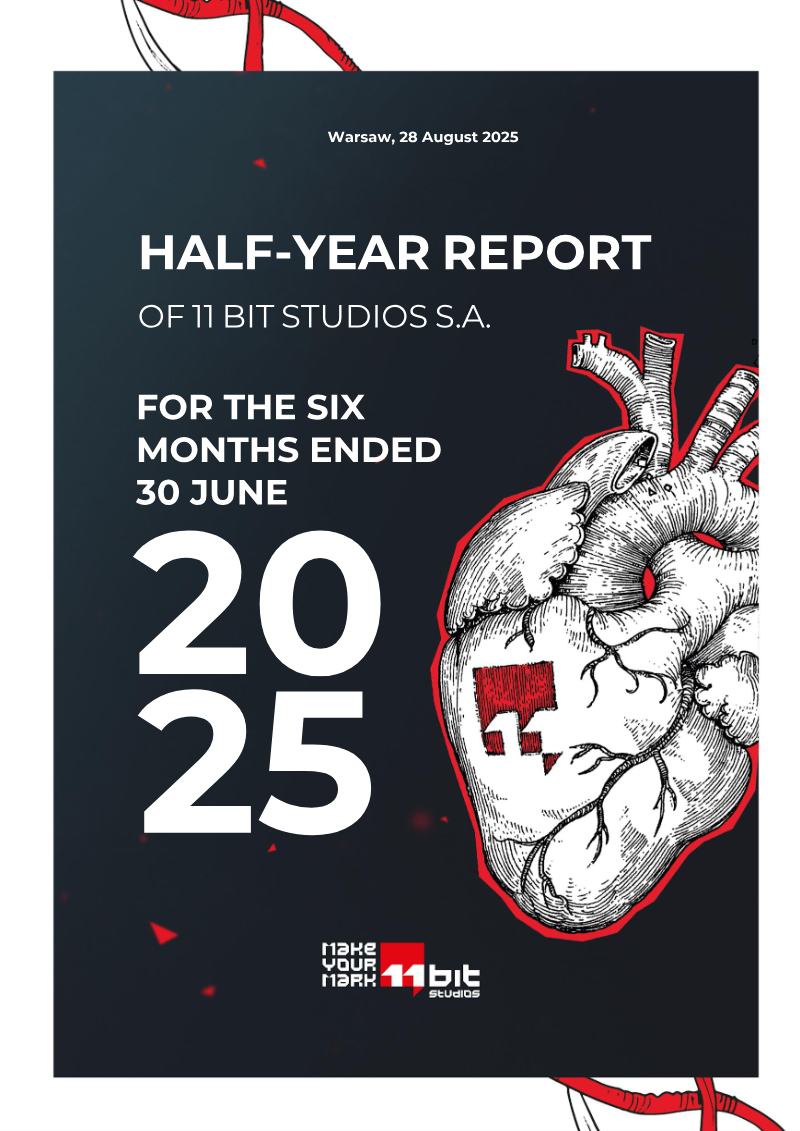
Half-Year Report of 11 bit studios S.A.: H1 2025
HALF-YEAR REPORT OF 11 BIT STUDIOS S.A. FOR THE SIX MONTHS ENDED 30 JUNE DEAR SHAREHOLDERS AND INVESTORS, It is our pleasure to present to you the half-year report of 11 bit studios S.A. for the six months ended 30 June 2025. During the period, we earned PLN 57.24 million in revenue, a year-on-year increase of 86.09%.
- 11 bit studios S.A. reported a net profit of PLN 8,482,905 for H1 2025, a significant turnaround from a net loss of PLN 477,805 in H1 2024.
- Revenue for H1 2025 increased by 86.09% year-over-year to PLN 57,241,575, driven primarily by new titles 'The Alters' (PLN 20,415,393) and 'Frostpunk 2' (PLN 13,173,906).
- Operating profit saw a substantial improvement, reaching PLN 18,068,721 in H1 2025 compared to an operating loss of PLN 5,352,141 in H1 2024.
- Salaries, wages, and employee benefits decreased by 42.09% to PLN 7,711,456 in H1 2025, while depreciation and amortization increased by 275.18% to PLN 10,946,880.
- The company's liabilities decreased by 14.64% to PLN 27,644,524 as of June 30, 2025, mainly due to lower royalties payable to third-party developers.
+3
11 bit studios
Report1 pages
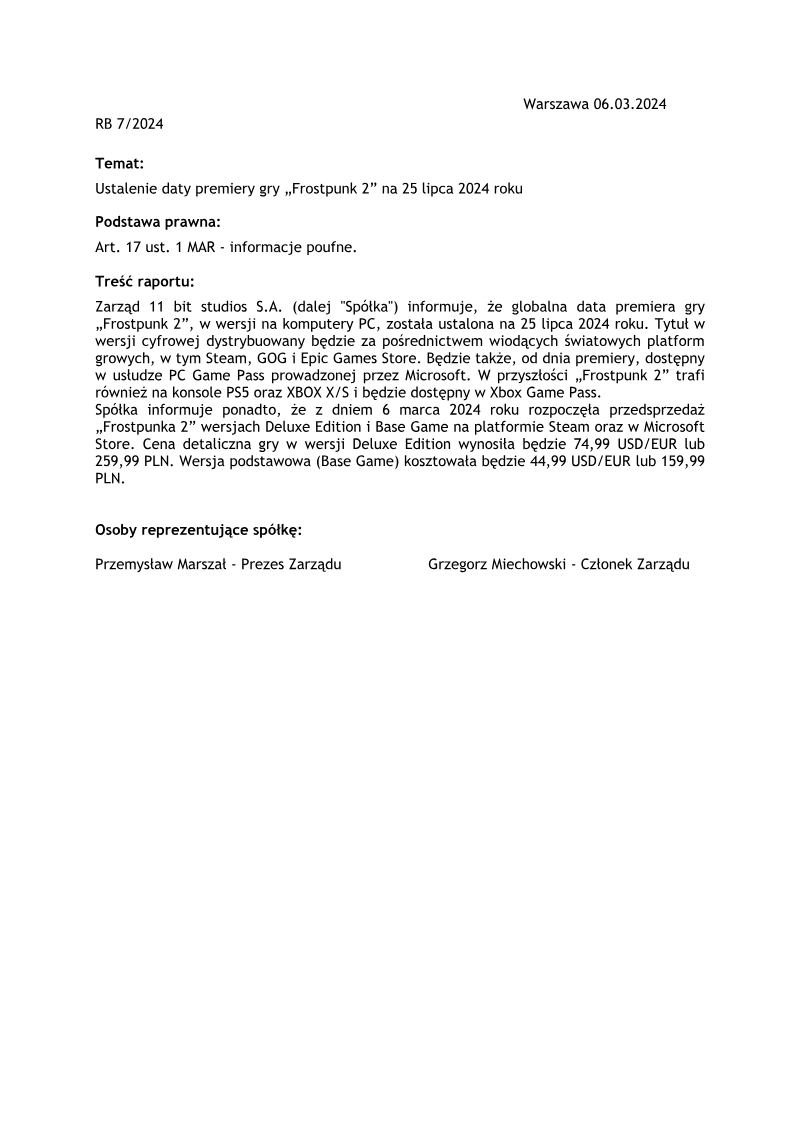
Establishment of the Release Date for the Game Frostpunk 2
The release schedule for the sequel to the critically acclaimed survival‑simulation title has been finalized, with a global launch set for July 25 2024. The announcement confirms that the PC version will debut on major digital storefronts—Steam, GOG, and Epic Games Store—and will be immediately available through Microsoft’s PC Game Pass. Future console releases are planned for PlayStation 5 and Xbox Series X/S, with the game slated to join the Xbox Game Pass library thereafter.
Pre‑sales commenced on March 6 2024, offering both a Deluxe Edition and a Base Game through Steam and the Microsoft Store. Pricing for the premium package is set at $74.99 / €74.99 (259.99 PLN), while the standard edition is priced at $44.99 / €44.99 (159.99 PLN). These figures reflect the company’s strategy to capture early adopters and maximize revenue across multiple platforms.
The communication originates from the board of 11 bit studios S.A., with Przemysław Marszał as President and Grzegorz Miechowski as board member. The release date decision aligns with the studio’s broader rollout plan, ensuring a coordinated launch across digital and subscription services. The information is disclosed under Article 17(1) of the MAR, indicating its confidential nature within corporate governance.
- Frostpunk 2 will launch globally on July 25, 2024, for PC via Steam, GOG, Epic Games Store, and Microsoft PC Game Pass.
- The standard edition is priced at $44.99/€44.99, while the Deluxe Edition is priced at $74.99/€74.99.
- Pre-sales for the game began on March 6, 2024, across Steam and the Microsoft Store.
- Future console releases are confirmed for PlayStation 5 and Xbox Series X/S, with the title scheduled to join the Xbox Game Pass library after the initial launch.
- The release strategy is managed by 11 bit studios S.A. and is being disclosed as a regulatory requirement under Article 17(1) of the MAR.
+2
11 bit studios
Report1 pages
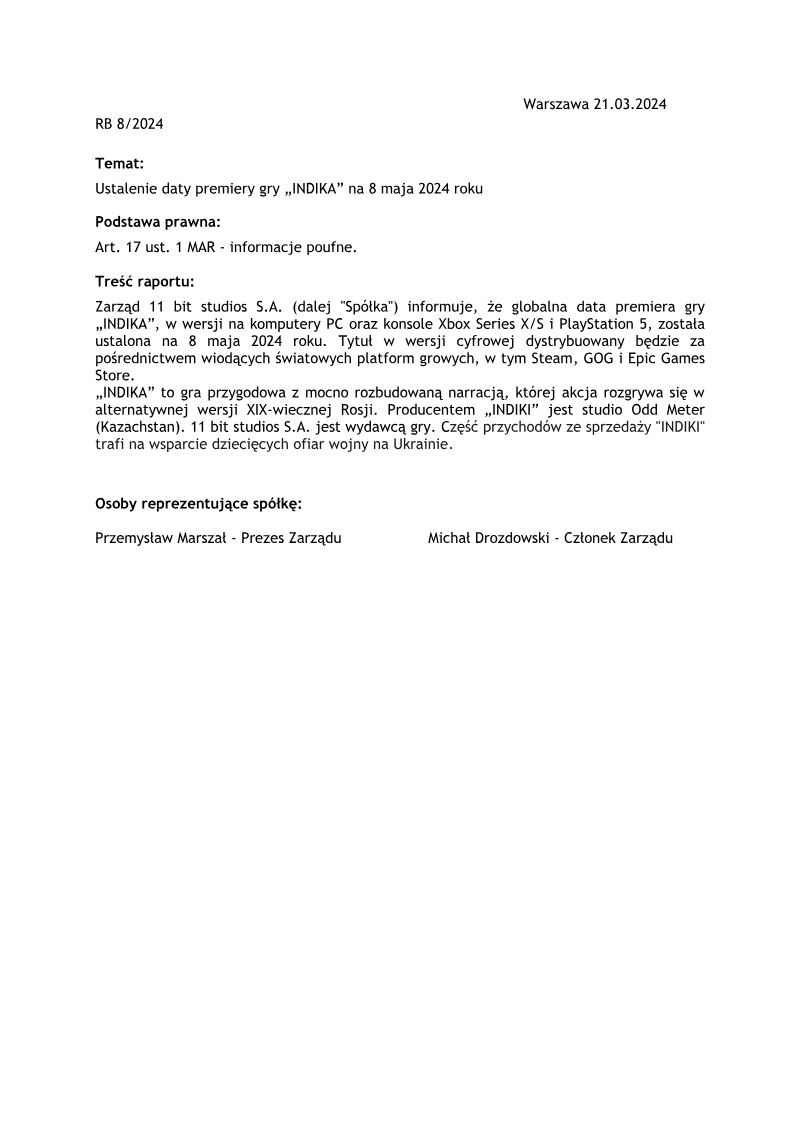
Ustalenie daty premiery gry „INDIKA”
The release date for the adventure title “INDIKA” has been officially set for 8 May 2024. The game will launch worldwide on PC and next‑generation consoles, including Xbox Series X/S and PlayStation 5. Digital distribution will be handled through major global platforms such as Steam, GOG and the Epic Games Store. “INDIKA” is a narrative‑rich adventure set in an alternate 19th‑century Russian backdrop, developed by the Kazakh studio Odd Meter and published by 11 bit Studios S.A. The publisher has pledged a portion of sales proceeds to support children affected by the war in Ukraine, underscoring a charitable component tied to the title. The announcement originates from 11 bit Studios’ board, with Przemysław Marszał serving as Chairman and Michał Drozdowski as a board member. The communication references Article 17(1) of the MAR for confidentiality purposes, indicating that the information is protected under relevant legal provisions. The release strategy focuses on digital channels and aligns with contemporary distribution trends in the gaming industry, targeting a global audience across multiple high‑profile platforms. The statement serves to inform stakeholders and the public of the finalized launch schedule, distribution partners, and social responsibility initiative associated with “INDIKA.”
- The adventure game 'INDIKA' is scheduled for a worldwide release on May 8, 2024.
- The title will launch on PC via Steam, GOG, and the Epic Games Store, as well as on PlayStation 5 and Xbox Series X/S consoles.
- The game is developed by the Kazakh studio Odd Meter and published by 11 bit studios S.A.
- 11 bit studios S.A. has committed to donating a portion of the game's sales proceeds to support children affected by the war in Ukraine.
- The narrative-driven game is set in an alternate version of 19th-century Russia.
+3
11 bit studios
Report1 pages
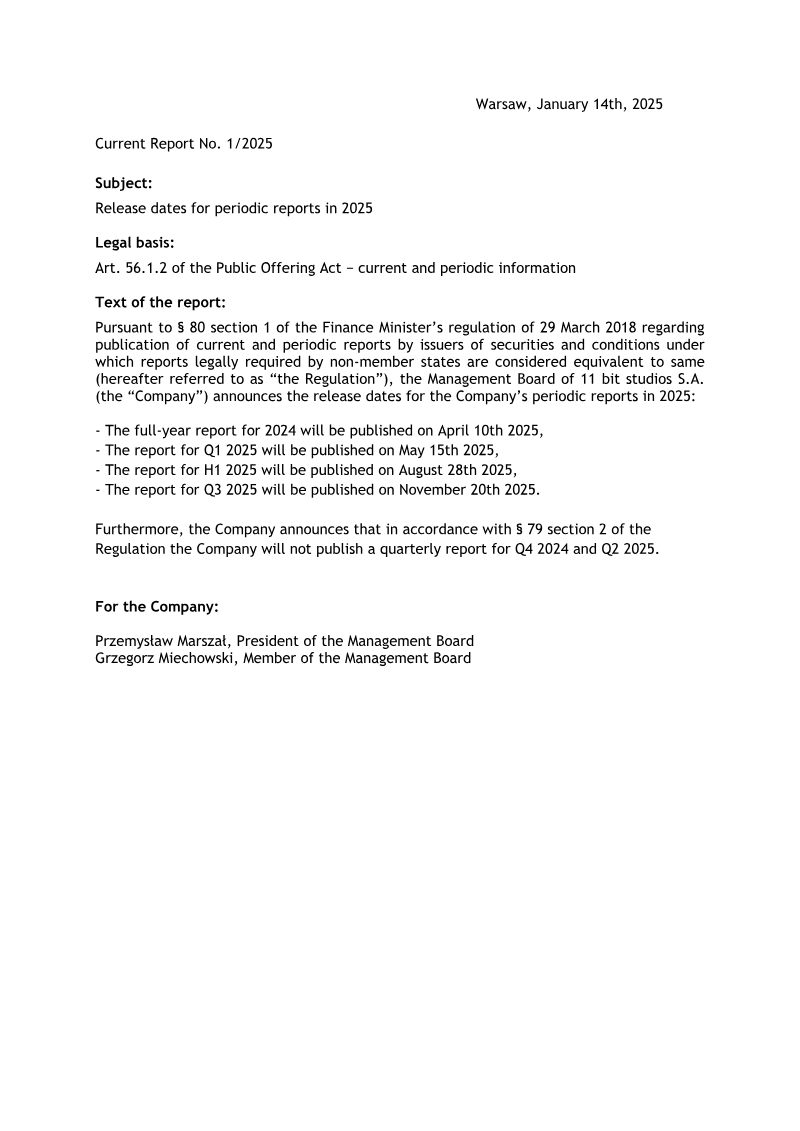
Release Dates for Periodic Reports: 2025
The announcement from Warsaw, dated January 14 2025, outlines the 11 bit studios S.A. schedule for releasing its periodic financial reports in 2025, pursuant to the Finance Minister’s regulation of March 2018 and Article 56.1.2 of the Public Offering Act. The company will publish its full‑year report for 2024 on April 10 2025, followed by quarterly and semiannual reports: Q1 2025 on May 15 2025, H1 2025 on August 28 2025, and Q3 2025 on November 20 2025. In line with § 79(2) of the Regulation, no reports will be issued for Q4 2024 or Q2 2025. The release dates are set by the Management Board, chaired by President Przemysław Marszał and Member Grzegorz Miechowski. The communication serves to inform shareholders, regulators, and market participants of the company’s compliance timetable for statutory disclosures within Poland’s public offering framework. No additional data, statistics, or methodological details are provided beyond the scheduled dates and regulatory references.
- 11 bit studios S.A. will release its 2024 full-year financial report on April 10, 2025.
- The 2025 quarterly and semiannual reporting schedule is set for May 15 (Q1), August 28 (H1), and November 20 (Q3).
- In accordance with regulatory requirements, the company will not issue separate reports for Q4 2024 or Q2 2025.
- The disclosure schedule is mandated by the Polish Finance Minister’s regulation of March 2018 and Article 56.1.2 of the Public Offering Act.
- The reporting calendar was formally established by the company's Management Board, led by President Przemysław Marszał and Member Grzegorz Miechowski.
+1
11 bit studios
Report1 pages
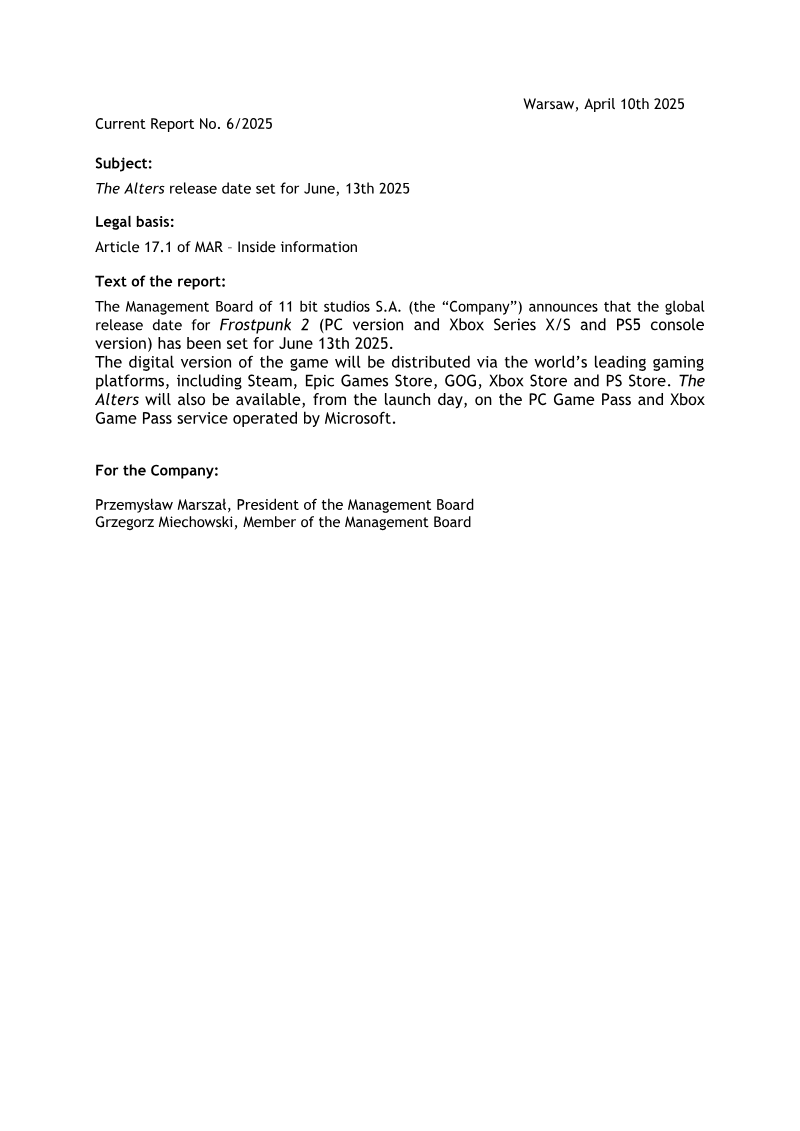
Current Report No. 6/2025: The Alters Release Date
The release of Frostpunk 2, the highly anticipated sequel to the critically acclaimed survival‑city builder, has been officially scheduled for June 13 2025. The announcement comes from the Management Board of 11 bit studios S.A., a Warsaw‑based developer known for its narrative‑driven titles. The global launch will encompass the PC edition and next‑generation console versions for Xbox Series X/S and PlayStation 5, ensuring simultaneous availability across major platforms.
Digital distribution will be handled by the industry’s leading storefronts: Steam, Epic Games Store, GOG, Xbox Store and PlayStation Store. In addition, the game will be added to Microsoft’s subscription services—PC Game Pass and Xbox Game Pass—from day one, broadening accessibility for subscribers. The release date was disclosed under Article 17.1 of the Market Abuse Regulation, classifying it as inside information that must be communicated promptly to avoid market manipulation.
The announcement is concise, focusing solely on the release logistics and distribution channels. No sales projections, marketing strategies, or financial implications are provided in this communication. The scope is strictly global, covering all major digital marketplaces and subscription services at launch. Methodologically, the information originates from an official board statement, with no external data or survey references included.
- 11 bit studios has scheduled the global release of Frostpunk 2 for June 13, 2025.
- The game will launch simultaneously on PC, Xbox Series X/S, and PlayStation 5.
- Frostpunk 2 will be available on day one through PC Game Pass and Xbox Game Pass subscription services.
- Digital distribution will be supported across Steam, Epic Games Store, GOG, the Xbox Store, and the PlayStation Store.
- The release date announcement was issued by the 11 bit studios Management Board as regulated inside information.
+2
11 bit studios
Report1 pages
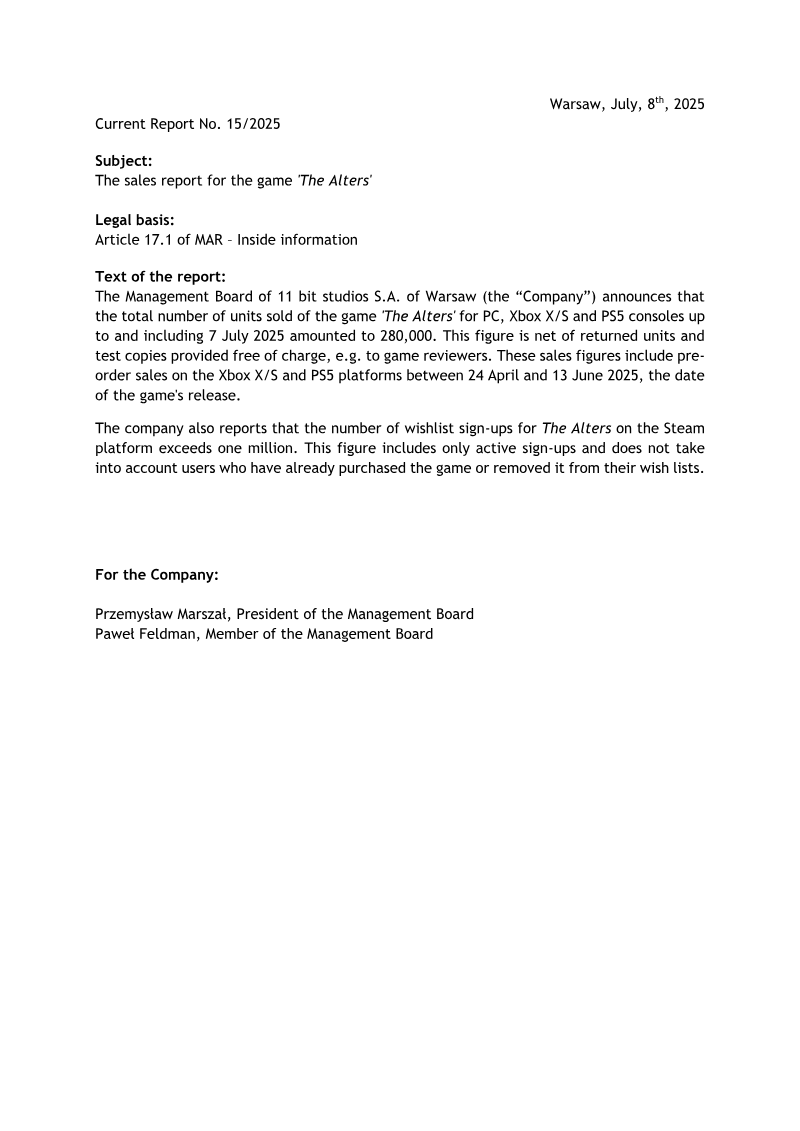
Sales Report: The Alters
The report announces that the title “The Alters” has sold 280,000 units across PC, Xbox X/S and PS5 platforms through 7 July 2025, after deducting returns and complimentary copies. Pre‑order sales on Xbox X/S and PS5, recorded between 24 April and 13 June 2025, are included in this total. The company also highlights that more than one million users have added the game to their wish lists on Steam, a metric that excludes prior purchasers or those who later removed the title. The data covers sales up to mid‑July 2025 and focuses on three major platforms: PC, Xbox X/S, and PS5. No additional market segments or geographic breakdowns are provided beyond the platform‑level aggregation. The methodology is implicit: sales figures are reported by the company’s Management Board, presumably sourced from internal distribution and retail tracking systems. The report serves to inform stakeholders of the game’s commercial performance, emphasizing both actual sales and pre‑launch interest as measured by wish list activity. The information is presented under Article 17.1 of MAR, indicating it constitutes inside information for regulatory purposes.
- The Alters achieved 280,000 net unit sales across PC, Xbox Series X/S, and PS5 platforms as of 7 July 2025.
- Steam wish list activity for the title has surpassed one million users, excluding those who have already purchased or removed the game.
- The reported sales figures include pre-order data collected for Xbox Series X/S and PS5 between 24 April and 13 June 2025.
- The sales data reflects net performance after accounting for all returns and complimentary copies.
- This commercial performance data is classified as inside information under Article 17.1 of the Market Abuse Regulation (MAR).
+3
11 bit studios
Report1 pages
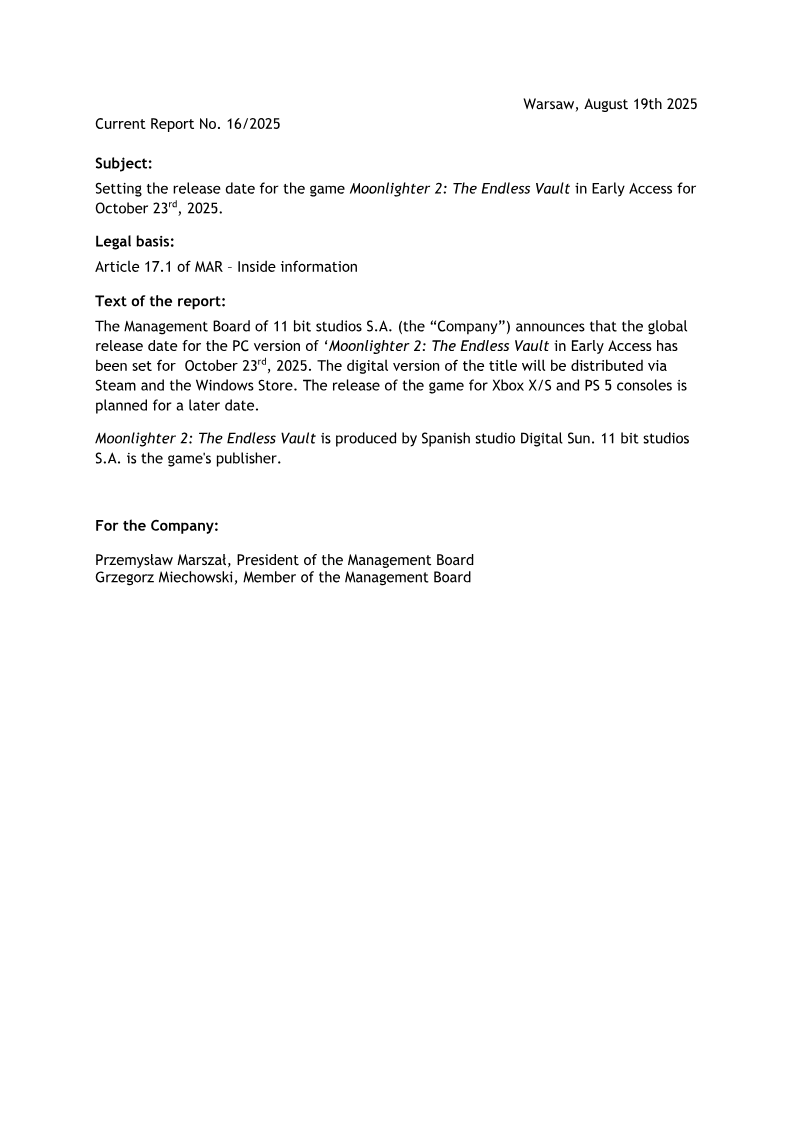
Current Report No. 16: Setting Release Date for Moonlighter 2: The Endless Vault
The announcement establishes the global early‑access release date for Moonlighter 2: The Endless Vault on PC as October 23, 2025. Distribution will occur through Steam and the Windows Store, while console releases for Xbox X/S and PlayStation 5 are deferred to a later date. The title is developed by Spanish studio Digital Sun, with 11 bit Studios S.A. acting as publisher.
The release schedule reflects a strategic focus on the PC market, leveraging major digital storefronts to maximize initial reach. By postponing console launches, the publisher can concentrate resources on polishing the PC experience and gathering player feedback during early access. The decision aligns with industry trends where developers use early‑access periods to iterate on gameplay, balance mechanics, and build community engagement before broader platform releases.
The communication is issued by the Management Board of 11 bit Studios, underscoring corporate governance and regulatory compliance. The statement cites Article 17.1 of MAR – Inside information as the legal basis, indicating that the release date is considered material information for investors. The brief does not provide additional data on sales projections, market analysis, or development milestones, focusing solely on the release timeline and distribution channels.
- Moonlighter 2: The Endless Vault will launch in early access on PC via Steam and the Windows Store on October 23, 2025.
- Console versions for PlayStation 5 and Xbox Series X/S are deferred to a later date to allow for a focused PC-first release strategy.
- The development is led by the Spanish studio Digital Sun, with 11 bit Studios S.A. serving as the publisher.
- The early-access period is intended to facilitate gameplay iteration, mechanical balancing, and community engagement prior to a wider platform rollout.
- 11 bit Studios issued this announcement as material information under Article 17.1 of the Market Abuse Regulation (MAR) to ensure regulatory compliance.
+2
11 bit studios
Report1 pages
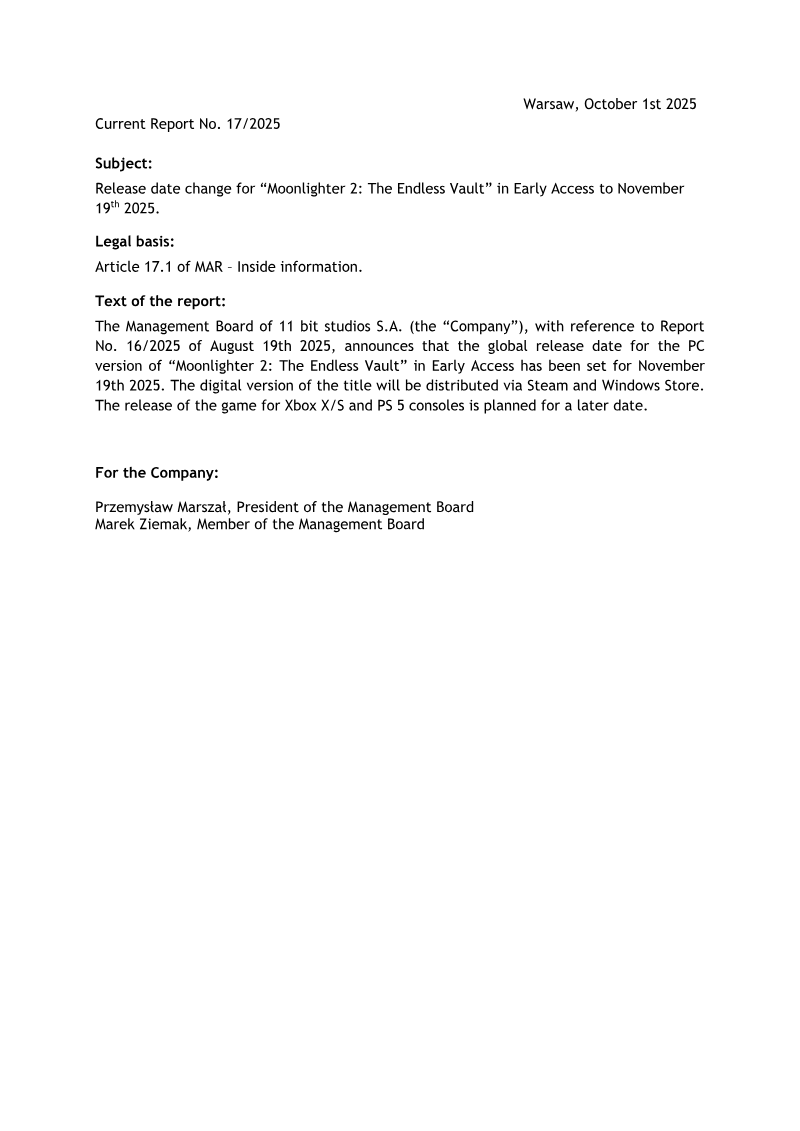
Current Report No. 17/2025: Release Date Change for Moonlighter 2
The release schedule for “Moonlighter 2: The Endless Vault” has been updated. 11 bit studios S.A. announced that the PC version will enter Early Access on November 19, 2025, with distribution through Steam and the Windows Store. The company indicated that console releases for Xbox X/S and PlayStation 5 will occur at a later, unspecified date. This change follows the earlier announcement in Report No. 16/2025 dated August 19, 2025, which set the initial release framework. The update is issued under Article 17.1 of MAR, classifying it as inside information that must be disclosed to the market. The announcement is signed by Przemysław Marszał, President of the Management Board, and Marek Ziemak, a board member. No additional data on sales projections, market impact, or development milestones are provided in the brief communication. The scope is limited to the PC Early Access launch, with no geographic restrictions noted beyond the global availability of digital distribution platforms. The report serves to inform investors and stakeholders of the revised launch timeline, ensuring compliance with regulatory disclosure requirements.
- 11 bit studios S.A. has scheduled the PC Early Access release of 'Moonlighter 2: The Endless Vault' for November 19, 2025.
- The PC version will be distributed globally via Steam and the Windows Store.
- Console releases for Xbox Series X/S and PlayStation 5 have been delayed to an unspecified date following the initial framework established in August 2025.
- This update constitutes regulated inside information under Article 17.1 of MAR, requiring formal disclosure to investors and stakeholders.
- The announcement was officially authorized by 11 bit studios board members Przemysław Marszał and Marek Ziemak.
+2
11 bit studios
Report1 pages
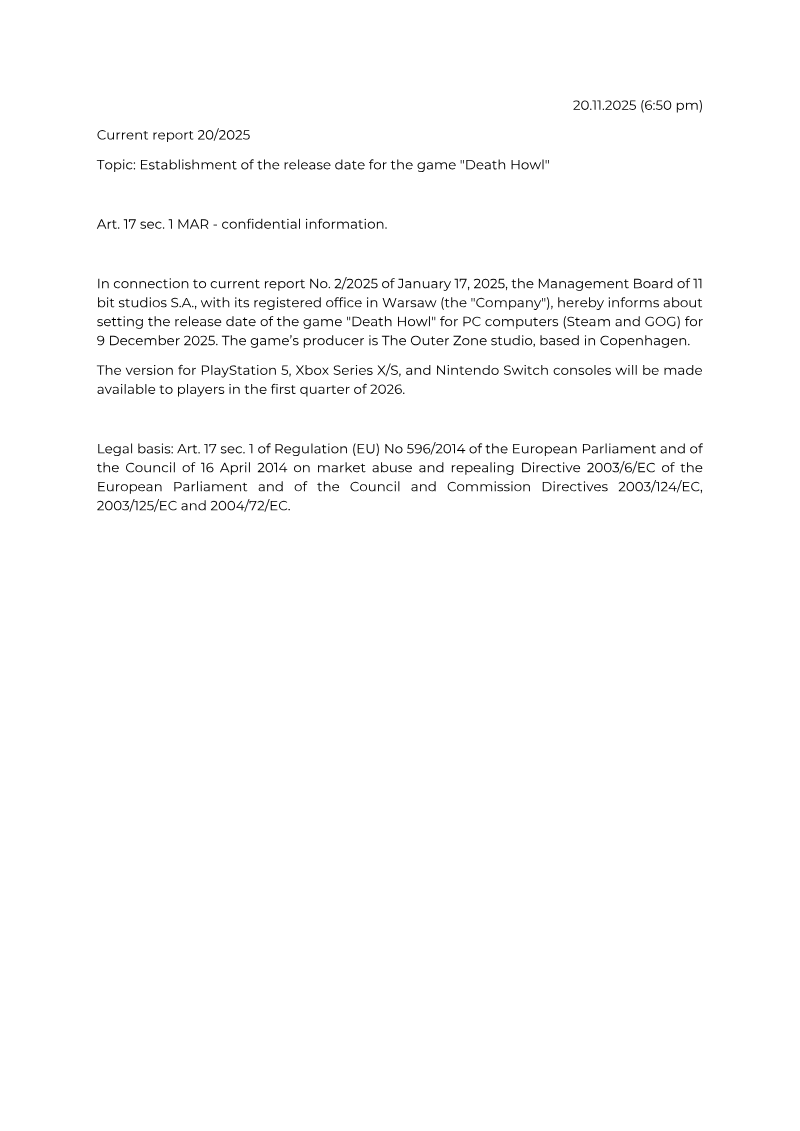
Establishment of the Release Date for the Game Death Howl
The release schedule for the upcoming title “Death Howl” has been formally announced by 11 bit studios S.A. The company, headquartered in Warsaw, confirmed that the PC version—available through Steam and GOG—will launch on 9 December 2025. Production is handled by The Outer Zone studio in Copenhagen, and the announcement follows a prior disclosure issued on 17 January 2025. Console editions for PlayStation 5, Xbox Series X/S, and Nintendo Switch are slated for release in the first quarter of 2026. The announcement is made under Article 17, Section 1 of the Market Abuse Regulation (EU) No 596/2014, ensuring compliance with EU market‑abuse legislation. The communication provides a clear timeline for both digital and console platforms, indicating that the PC release precedes console availability by several months. No additional data on sales projections or market analysis is included, and the scope remains limited to the release dates for the specified platforms without geographic expansion beyond the European market. The statement serves primarily as a regulatory disclosure rather than an analytical report, fulfilling legal obligations for public companies to inform shareholders of material events.
- 11 bit studios S.A. will release the PC version of 'Death Howl' on Steam and GOG on 9 December 2025.
- Console versions for PlayStation 5, Xbox Series X/S, and Nintendo Switch are scheduled for release in Q1 2026.
- Development of the title is being handled by The Outer Zone studio based in Copenhagen.
- The PC launch precedes the console release by a margin of several months.
- This announcement serves as a formal regulatory disclosure under Article 17, Section 1 of the EU Market Abuse Regulation (EU) No 596/2014.
+2
11 bit studios
Report1 pages
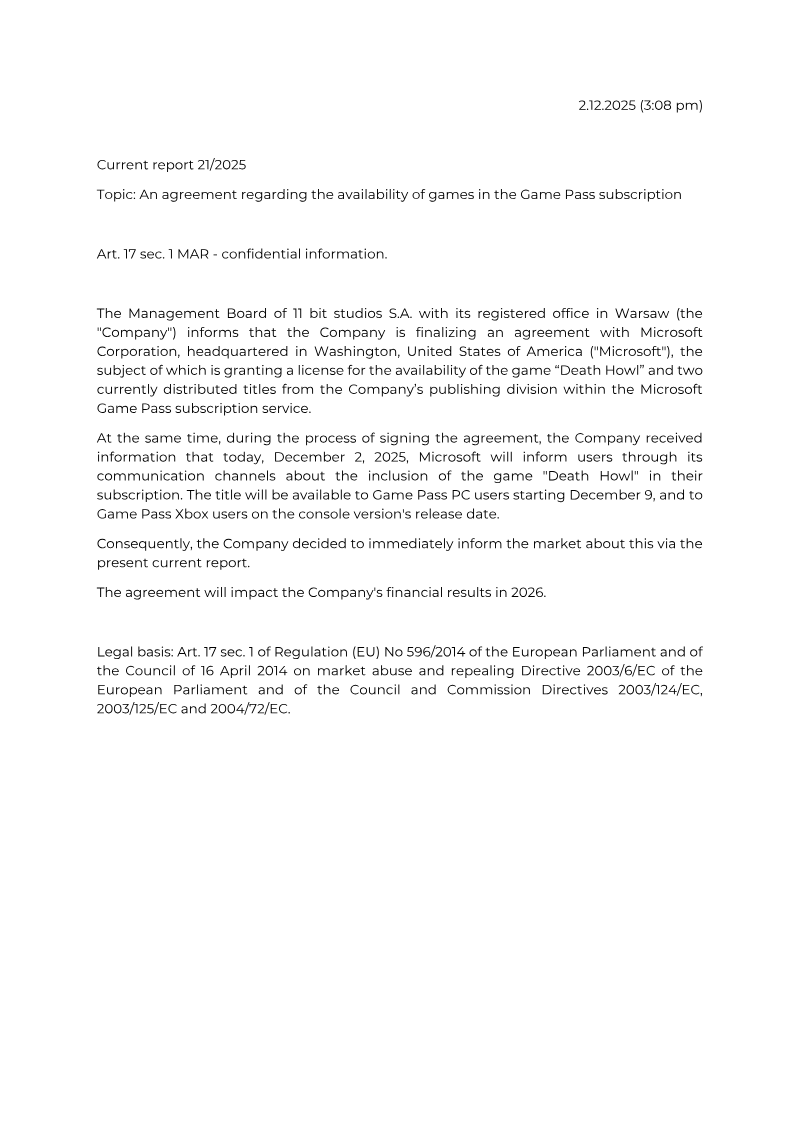
An Agreement Regarding the Availability of Games in the Game Pass Subscription
The announcement informs shareholders that 11 bit studios S.A. is finalizing a licensing agreement with Microsoft Corporation to make the game “Death Howl” and two other titles from its publishing division available on Microsoft Game Pass. The deal, governed by Article 17(1) of the EU Market Abuse Regulation, will become effective in 2026 and is expected to influence the company’s financial performance for that year. Microsoft has already communicated to users that “Death Howl” will join Game Pass for PC on December 9, 2025, with the Xbox version following upon its console release. The agreement covers both PC and Xbox platforms, expanding 11 bit’s distribution reach within the subscription service. The company’s management board deemed it necessary to disclose this development promptly, citing regulatory obligations and the potential impact on investor expectations. No specific financial figures or detailed terms of the license are disclosed, but the timing and platform scope suggest a strategic partnership aimed at increasing revenue streams through subscription-based access. The report is limited to the Polish market, with implications for European investors, and covers the period up to the end of 2025, outlining anticipated effects in the 2026 fiscal year.
- 11 bit studios S.A. has finalized a licensing agreement with Microsoft to bring 'Death Howl' and two additional publishing titles to the Game Pass subscription service.
- The 'Death Howl' PC version is scheduled to launch on Game Pass on December 9, 2025, with the Xbox console version to follow upon its release.
- The agreement covers both PC and Xbox platforms and is expected to materially influence 11 bit studios' financial performance in the 2026 fiscal year.
- The deal is officially governed by Article 17(1) of the EU Market Abuse Regulation, necessitating prompt disclosure to shareholders due to its potential impact on investor expectations.
- While specific financial terms remain undisclosed, the partnership represents a strategic move by 11 bit studios to diversify revenue streams through subscription-based distribution.
+2
11 bit studios
Report1 pages
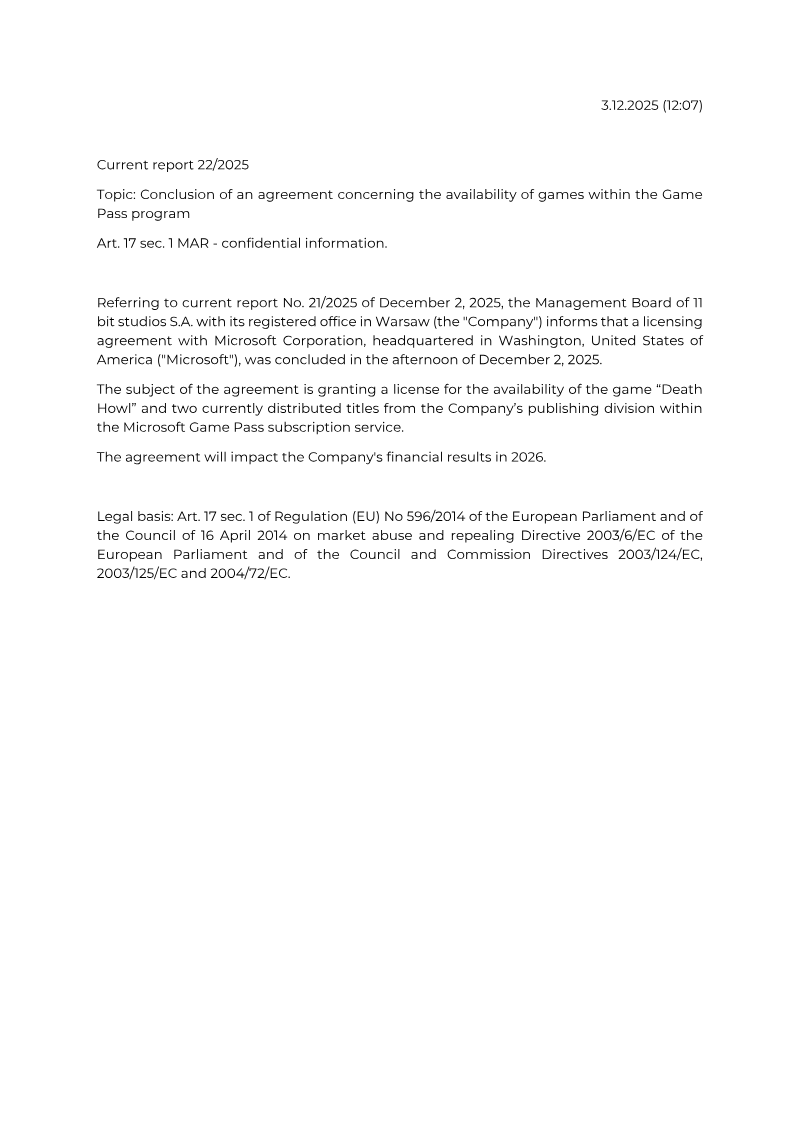
Conclusion of an Agreement Concerning the Availability of Games within the Game Pass Program
The agreement, finalized on December 2 2025 between 11 bit studios S.A. and Microsoft Corporation, grants Microsoft the right to host the game “Death Howl” and two additional titles from 11 bit’s publishing division on its Game Pass subscription platform. The licensing deal is expected to influence the company’s financial performance in 2026, as noted by the Management Board. The announcement follows a prior report issued on December 2 2025, and it is disclosed under Article 17(1) of Regulation (EU) No 596/2014, which governs market‑abuse disclosures. The agreement’s scope is limited to the specified titles and their availability on Microsoft’s Game Pass service, with no broader geographic or product implications indicated. No further details regarding revenue projections, user reach, or contractual terms are provided in the brief disclosure. The communication is directed at shareholders and market participants to ensure compliance with EU transparency requirements, emphasizing that the licensing arrangement will be reflected in the company’s 2026 financial statements.
- 11 bit studios S.A. signed an agreement with Microsoft Corporation on December 2, 2025, to include the game 'Death Howl' and two additional publishing titles in the Game Pass subscription service.
- The licensing deal is expected to impact 11 bit studios' financial performance during the 2026 fiscal year.
- The agreement is limited strictly to the three specified titles and their availability on the Game Pass platform, with no broader product or geographic scope.
- The disclosure was issued to comply with Article 17(1) of EU Regulation No 596/2014 regarding market-abuse transparency requirements.
- No specific financial terms, revenue projections, or user reach metrics were disclosed regarding the licensing arrangement.
+3
11 bit studios

Report21 pages
Results Briefing Materials: Fiscal Year Ending March 2026, First Half
The briefing presents the first‑half financial performance of Marvelous Inc. for the fiscal year ending March 2026, covering April–September 2025. Net sales surged 157.5 % to ¥20,281 million, driven by the launch of three core video‑game titles—“Rune Factory: Guardians of Azuma,” “STORY OF SEASONS: Grand Bazaar,” and “DAEMON X MACHINA TITANIC SCION”—and robust sales of Pokémon‑branded amusement machines. Segment analysis shows Digital Contents Business revenue rising 198.7 % to ¥12,414 million, while Amusement Business increased 136.3 % to ¥5,982 million; Audio & Visual Business declined 84.0 %. Operating profit fell 38.2 % to ¥226 million due to elevated development costs, yet ordinary and net income rose 102.0 % and 234.7 %, respectively, largely from a shift to foreign‑exchange gains.
The company forecasts full‑year net sales of ¥35,000 million (125.2 % of FY2025), operating profit of ¥2,000 million (110.0 % increase), and a dividend uplift to ¥12 million per share, maintaining the initial earnings outlook. Cash flow improved markedly: operating cash inflows rose from a negative ¥786 million to ¥5,822 million, and net cash increased by ¥5,274 million to ¥12,386 million. Asset growth was modest, with total assets rising by ¥1,424 million and net assets slightly declining due to higher liabilities.
Methodologically, figures derive from consolidated financial statements for the semi‑annual period; no survey data are cited. The report covers Japan, North America, Europe, and Asia for game sales, and includes detailed segment‑level performance. The outlook remains unchanged, with emphasis on sustaining momentum from the newly released titles and existing online properties.
- Marvelous Inc. reported a 157.5% surge in net sales to ¥20,281 million for the first half of fiscal year 2026, driven by the release of three major titles and strong Pokémon-branded amusement machine sales.
- Operating profit declined 38.2% to ¥226 million due to increased development costs, though net income rose 234.7% primarily due to foreign-exchange gains.
- The Digital Contents Business segment saw revenue grow 198.7% to ¥12,414 million, while the Amusement Business grew 136.3% to ¥5,982 million, offsetting an 84.0% decline in the Audio & Visual Business.
- Cash flow improved significantly, with operating cash flow shifting from a negative ¥786 million in the prior period to a positive ¥5,822 million.
- The company maintained its full-year forecast of ¥35,000 million in net sales and a 110% increase in operating profit to ¥2,000 million.
+2
Marvelous