Key insights
7 slides
Strategic shift
PCF transitions to a self-publishing model while keeping its shooter expertise.
The updated strategy moves PCF from a single-project focus to a multi-project production model. It leverages internal intellectual property and proprietary technology to capture a larger share of revenue.
Self-publishing. PCF transitions to a self-publishing model while maintaining its core expertise in developing high-end shooter games.
Operational scale
Operations have scaled to over 600 employees across seven global studios.
The company has implemented agile methodologies and Centers of Excellence to improve efficiency and risk management. This supports the new multi-project production model.
Revenue goal
PCF aims to generate 3.0 billion PLN in total revenue between 2023 and 2027.
The company plans to release six games over the next four years. It prioritizes the Games-as-a-Service model to secure recurring revenue and long-term player engagement.
Capital raise
PCF intends to raise between 205 million and 295 million PLN through a new share issuance.
This capital will be directed toward scaling development teams and supporting the production of its self-published portfolio. No dividend payments are expected before 2025.
Current projects
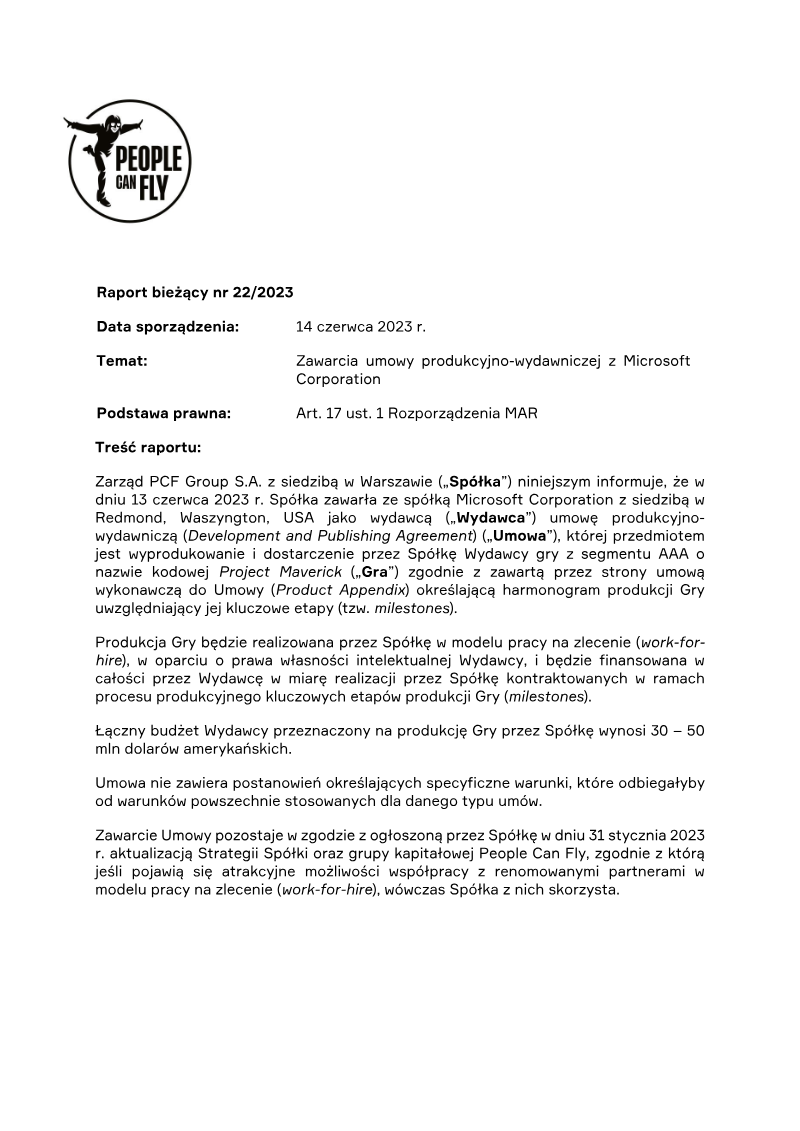
Five current projects utilize proprietary technology and Unreal Engine 5.
Projects currently in development include Gemini, Dagger, Bifrost, Victoria, and Thunder. The mix includes work-for-hire and self-published titles.
Dividend policy
The company has suspended dividend payments until at least 2025.
Capital allocation is prioritized toward the ambitious production pipeline. This supports the scaling of development teams and the self-published portfolio.
Post-IPO progress
PCF has successfully completed its post-IPO objectives.
These include the expansion of production capacity and the establishment of multiple creative studios across Europe and North America. The company now aims to scale operations to support simultaneous development.
1 / 7
Ask AI about this report