World of Tanks
GameBy Wargaming Group Limited
Documents about World of Tanks
Russia’s Video Game Strategy
The Russian Video Game Trade Association (VIDO) has unveiled a formal strategy aimed at revitalizing the nation’s interactive entertainment sector following years of industry isolation.
- The Russian Video Game Industry Development Organization (VIDO) has published a formal national strategy aiming to increase the gaming sector's contribution to Russia's GDP to 0.4%-0.5%.
- The strategy proposes state-backed funding for startups, tax incentives for investors, and mandatory representation for the gaming industry in Duma policy discussions.
- Russian gaming policy is increasingly intertwined with state objectives, including the potential resurrection of a China-style approval system and the use of state-backed ID systems for player logins.
UK and China's Shifting AI Mandates
Generative artificial intelligence has become the foundational pillar of modern game development, with full adoption now standard among major studios.
- The UK government has undergone a cabinet reshuffle, abolishing the Department for Science, Innovation and Technology and creating the Department of Business, Innovation, Science and Trade (DBIST). Kanishka Narayan has been appointed as the UK's first Minister for AI within DBIST, and Lord Vallance now chairs a dedicated AI taskforce.
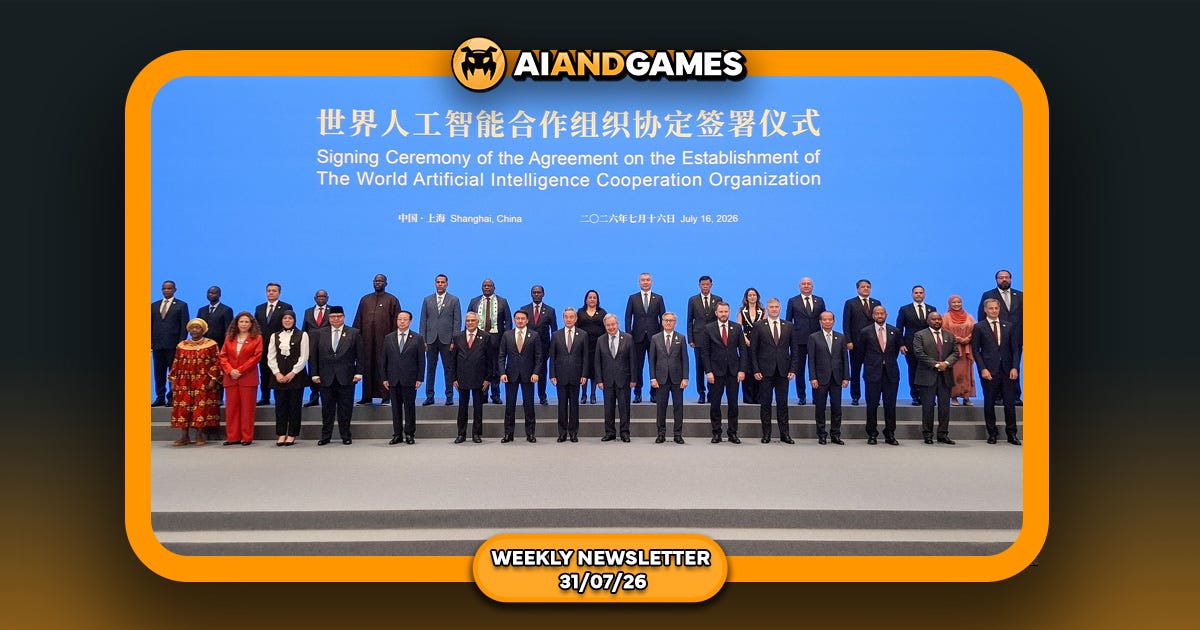
- China is actively building a broader AI ecosystem reliant on Chinese open-source models and has established WAICO, a competing international AI governance body focused on the 'global south' (Africa, South America, South Asian countries, and Russia), in contrast to the US-dominated Pax Silica.
- A 2026 survey by Japan’s Online Game Association (JOGA) found that 100% of polled Japanese online game studios are utilizing Generative AI, with Google Gemini, Anthropic's Claude, and Microsoft's GitHub CoPilot being the top three tools.
What's the Career Path of a Celebrity Gamer?
This analysis examines the shifting landscape of the global video game industry during early 2020, focusing on the professionalization of gaming personalities, the entry of big tech into cloud services, and the evolving platform dynamics of streaming and digital distribution.
- Asian markets are aggressively pursuing vertical integration, exemplified by Tencent’s majority acquisition of Huya to directly link game marketing with content consumption.
- Celebrity gamers face significant long-term career instability due to a lack of post-retirement infrastructure comparable to traditional sports, despite high-value exclusivity deals.
- The operational costs of maintaining social gaming platforms are rising due to systemic issues like cheating, specifically noted in Call of Duty: Warzone.
Revisiting the Strategy Genre Map: Age, Audience Homogeneity, and the Lasso Effect
This analysis updates the strategy genre map by integrating demographic and motivational data from over 220,000 global gamers.
- Games with high strategic complexity attract more homogenous audiences with similar motivation profiles, whereas high-excitement games do not exhibit this restrictive 'lasso' effect.
- There is a clear correlation between gameplay pace and player age: fast-paced competitive titles like League of Legends, DotA, and Counter-Strike attract the youngest audiences, while turn-based or pause-able games like Civilization and SimCity attract the oldest.
- World of Tanks is a significant outlier in the strategy genre, demonstrating the broadest age appeal among all analyzed titles with a standard deviation of 10.3.