The Sims Online
Game
5 documents in the library are about The Sims Online, from writers such as DiGRA and G|A|M|E – The Italian Journal of Game Studies. Each has a summary and key insights with the page they come from.
Connections
Each row is a game or company named alongside The Sims Online, each column a document, oldest first. A mark means that document names it. Select a row to see those documents.
Documents about The Sims Online
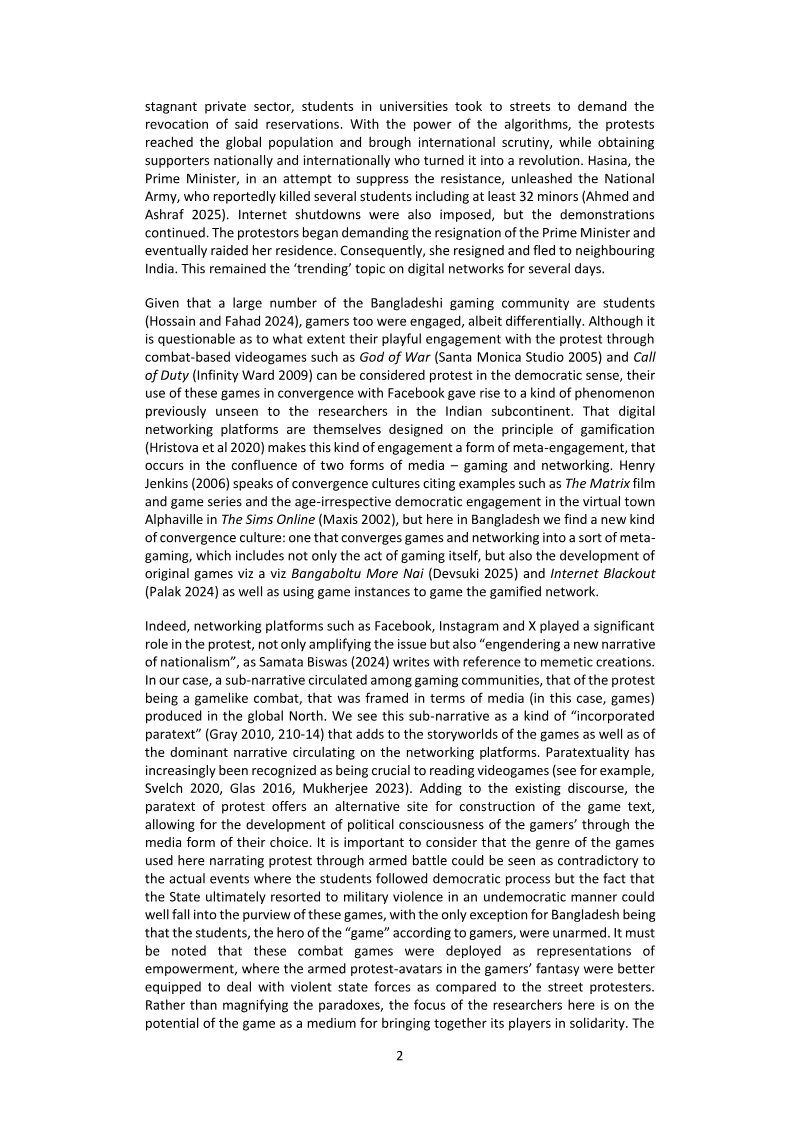
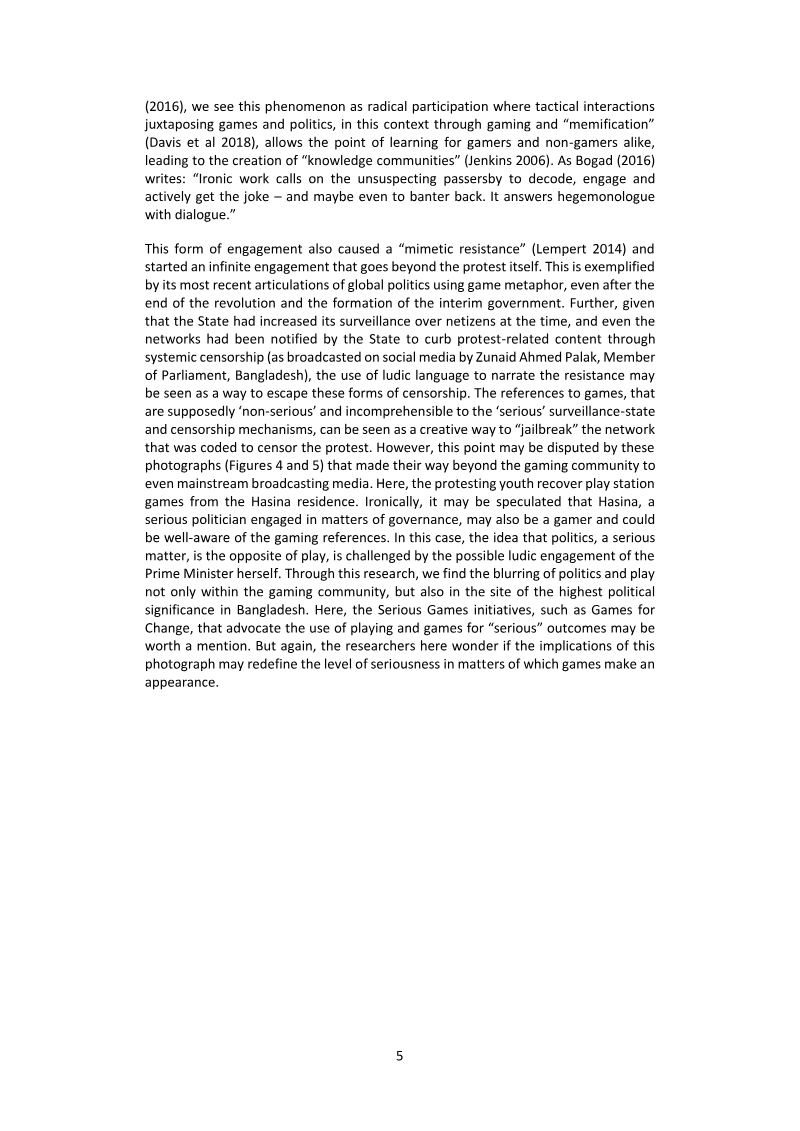
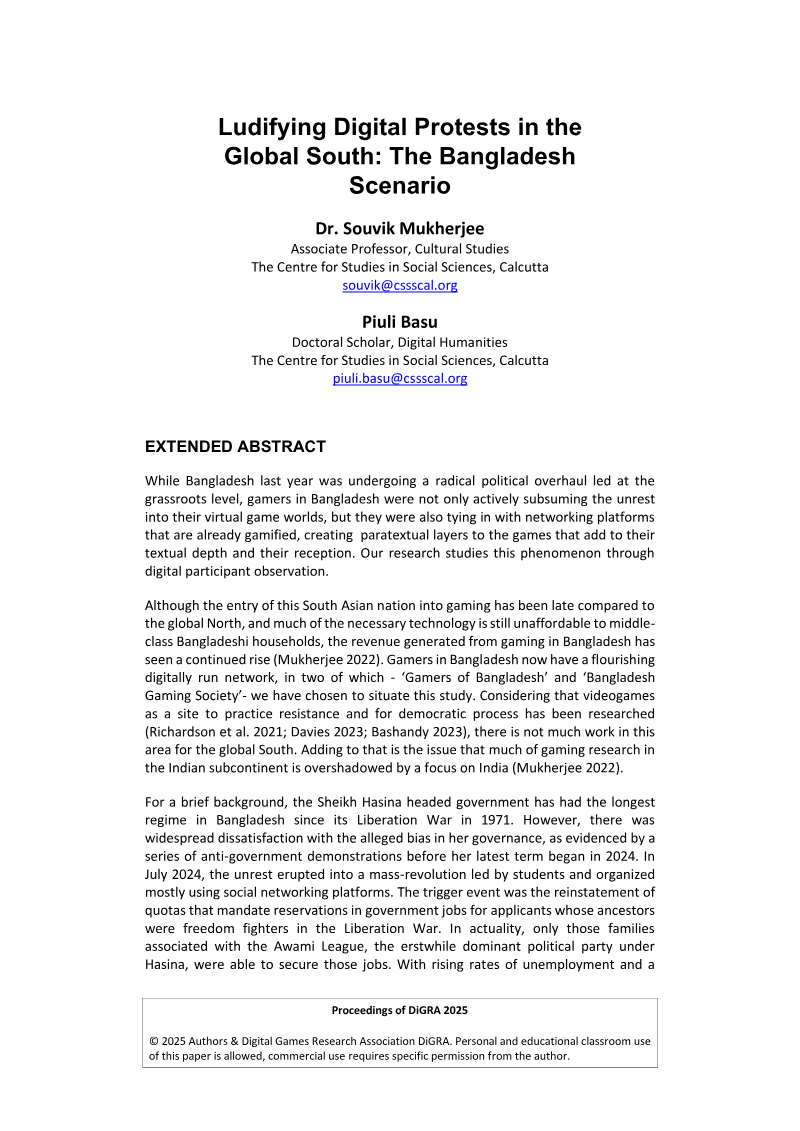
Ludifying Digital Protests in the Global South: The Bangladesh Scenario
This study examines how gamers in Bangladesh responded to the July 2024 mass protests that toppled Prime Minister Sheikh Hasina, focusing on two digital gaming networks, "Gamers of Bangladesh" and "Bangladesh Gaming Society."
- The July 2024 mass protests that toppled Prime Minister Sheikh Hasina were triggered by the reinstatement of government job quotas for descendants of Liberation War fighters and were largely driven by students mobilizing through social networks.
- The study examines two Bangladeshi gaming communities, "Gamers of Bangladesh" and "Bangladesh Gaming Society," showing how gamers folded the unrest into a layered "meta-gaming" practice blending combat games such as God of War and Red Dead Redemption 2 with gamified platforms like Facebook.
- Protest was rendered as a playful paratext: gamers paired protesters with Kratos and Sheikh Hasina with a Red Dead Redemption 2 character, placing local political figures inside Global North game narratives.
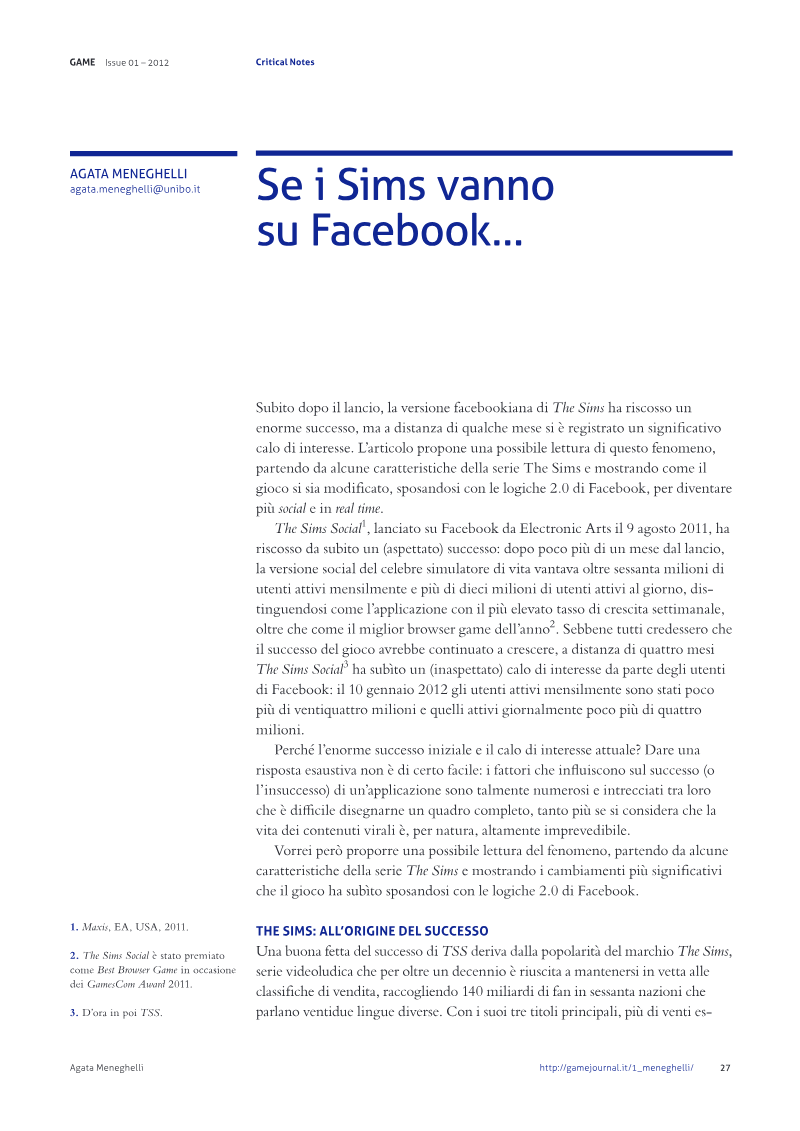
Se i Sims vanno su Facebook
Agata Meneghelli's essay, published in the 2012 inaugural issue of the Italian journal Critical Notes, examines why The Sims Social, launched by Electronic Arts on Facebook in August 2011, achieved rapid success and then lost a substantial share of its audience within months.
- The Sims Social, launched by Electronic Arts on Facebook in August 2011, reached more than 60 million monthly active users and over 10 million daily active users within about a month of launch.
- The game's audience collapsed quickly: by January 2012 it had fallen to roughly 24 million monthly and 4 million daily active users, a loss of more than half its monthly and over 60% of its daily players.
- Meneghelli argues that the success and decline stem from how the franchise's core qualities of interactivity, personalization, and creativity were adapted to Facebook's social, real-time logic, rather than from a statistical measure of player behaviour, since the essay is a qualitative, theory-informed reading.
MMOGs and the Future of Literature
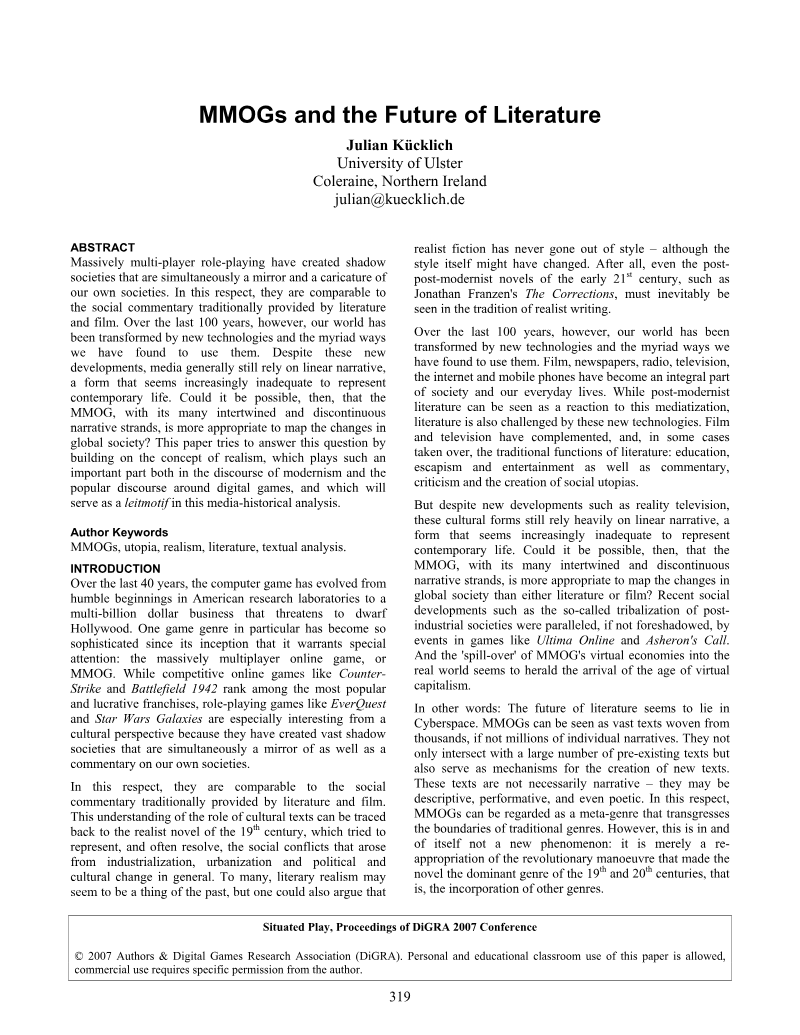
Massively multiplayer online games (MMOGs) such as EverQuest and Star Wars Galaxies are presented as textual works that can be read as a modern extension of the realist novel.
- The report argues that MMOGs such as EverQuest and Star Wars Galaxies can be read as a modern extension of the realist novel, with meaning emerging from the collective actions of thousands of players.
- The central conclusion is that MMOGs have dialogic potential for multiple voices and shared meaning, but publisher control over intellectual property and player "citizenship" suppresses that potential, leaving their realism and social possibilities largely unrealized.
- Virtual worlds are presented as resembling the real one because both lack a fixed plot and are shaped by complex social dynamics, allowing them to function as social critique and models for society.
Framing Virtual Law
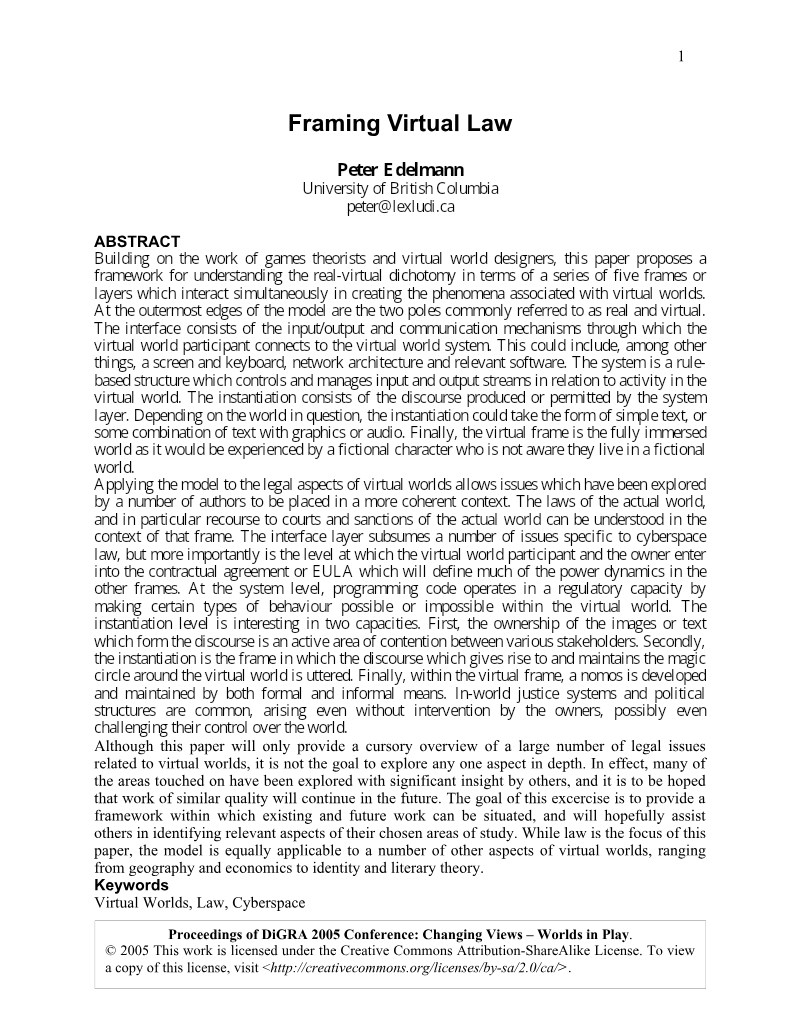
"Framing Virtual Law," presented at DiGRA 2005, argues that the conventional real-versus-virtual dichotomy obscures how legal order actually operates in online game worlds.
- The paper replaces the real-versus-virtual dichotomy with a five-layer model (actual, interface, system, instantiation, virtual) and argues that control over virtual worlds is distributed across these layers rather than held by a single authority.
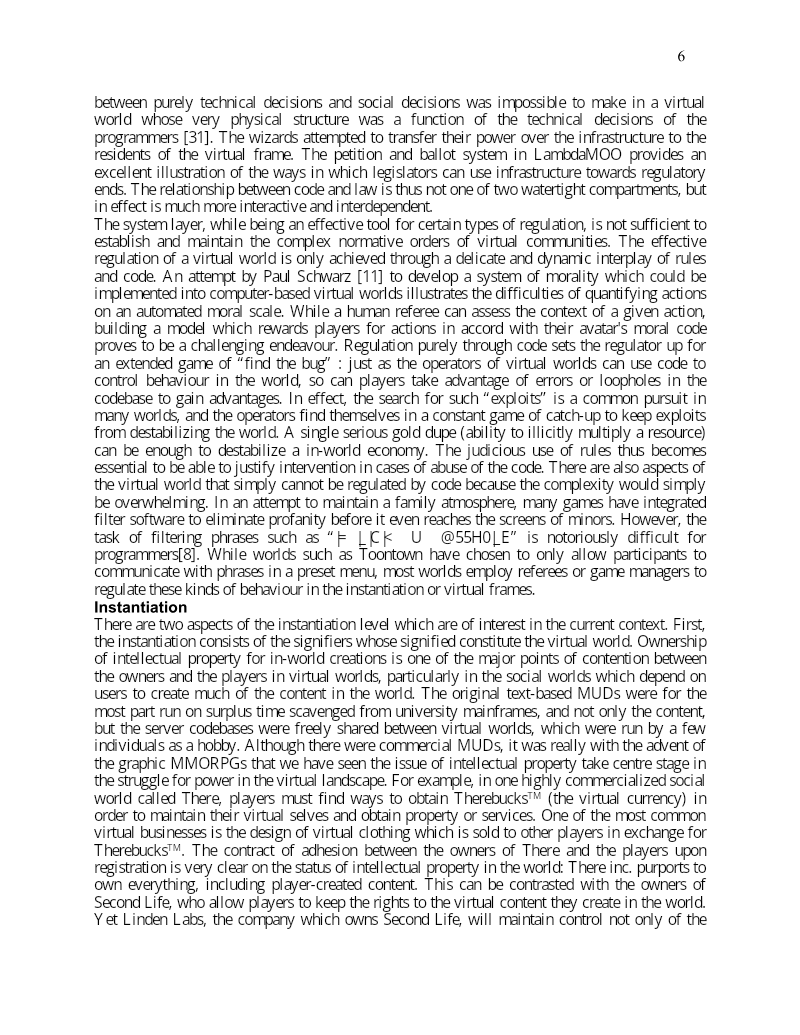
- Actual-world law operates mainly at the outermost layer through courts and sanctions, while end-user license agreements at the interface layer often waive participants' access to courts, leaving owners largely shielded from legal challenge.
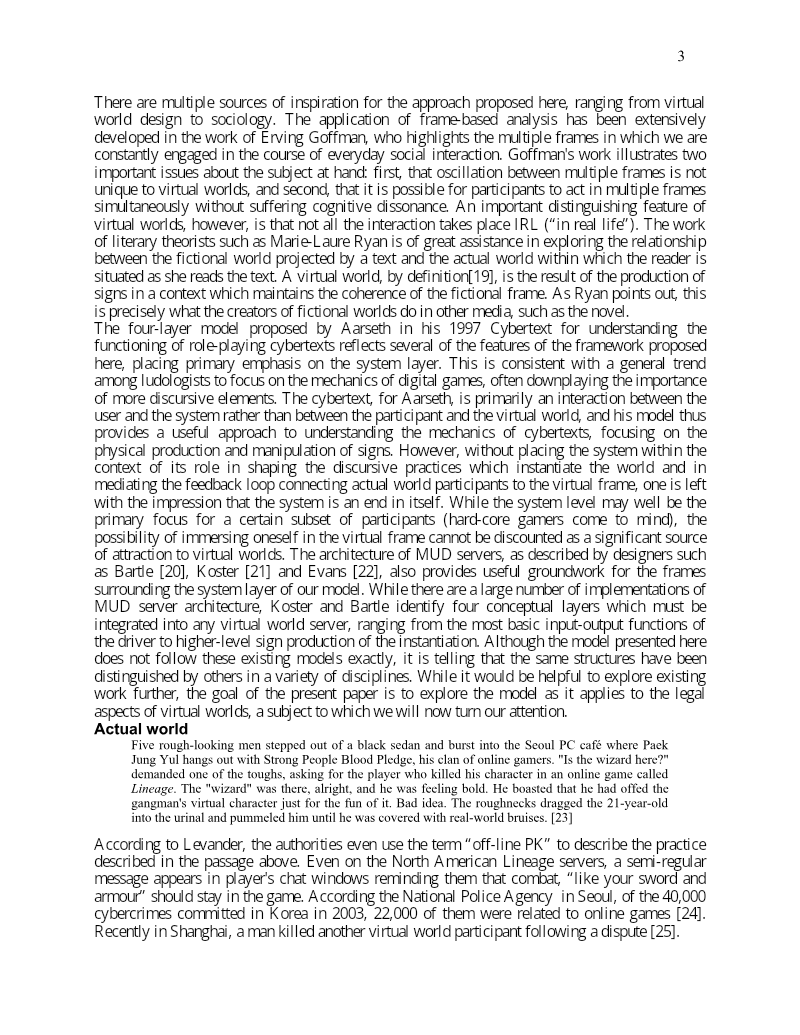
- Illustrative cases such as the Korean Lineage "off-line PK" assault and the banishment of Peter Ludlow from The Sims Online show owners excluding participants with little practical recourse.
Encounters With Consumption During Computer-Mediated Play: The Development of Digital Games as Marketing Communication Media
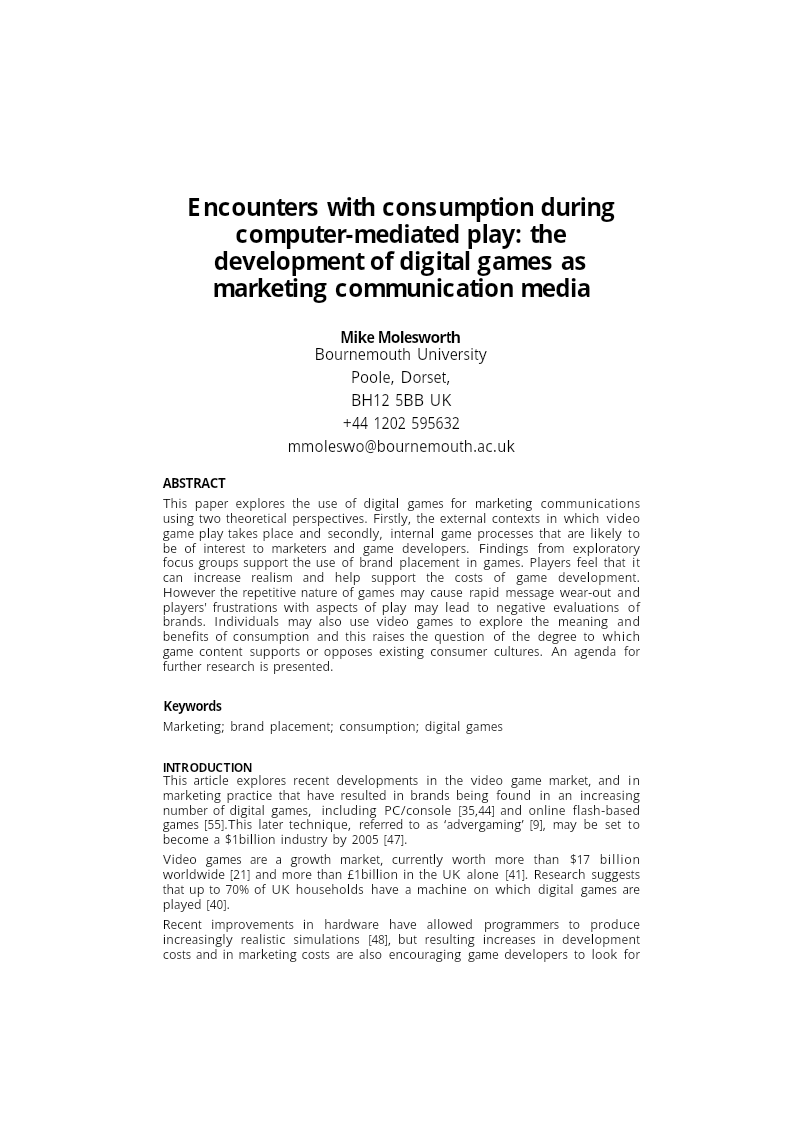
This paper examines digital games as marketing media by considering both the consumer-culture context of play and the psychological processes that shape how players respond to in-game brands.
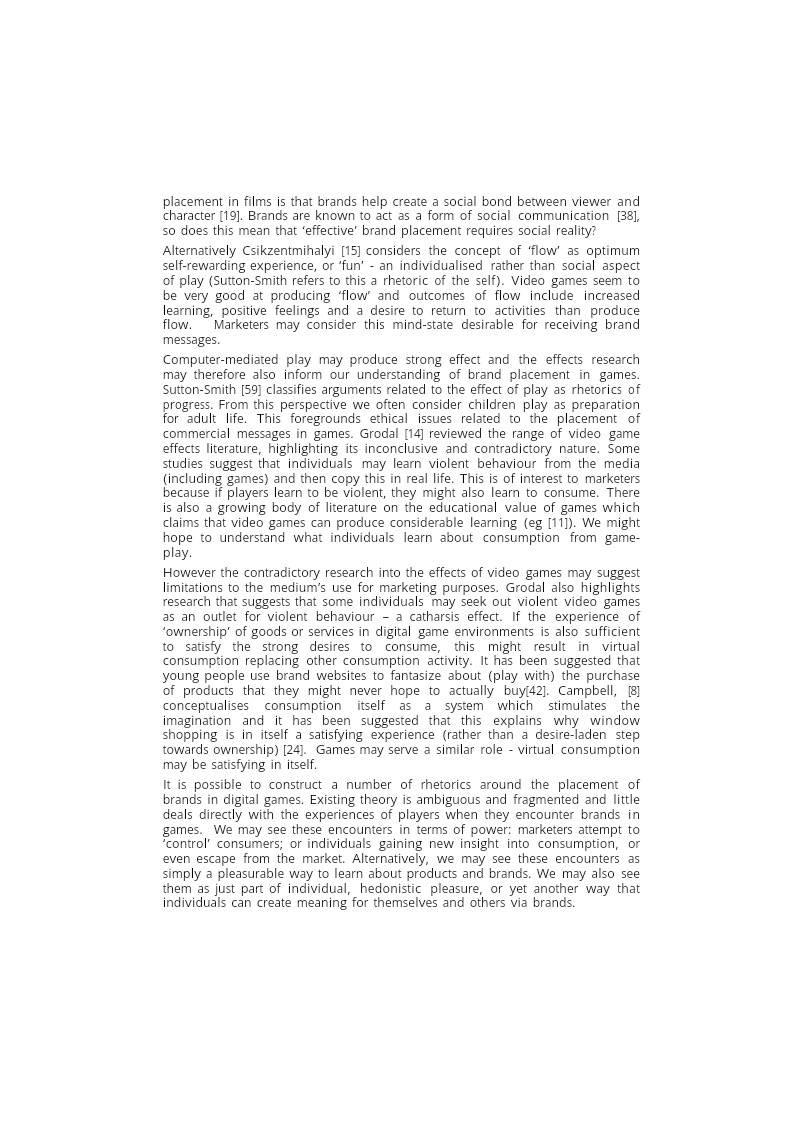
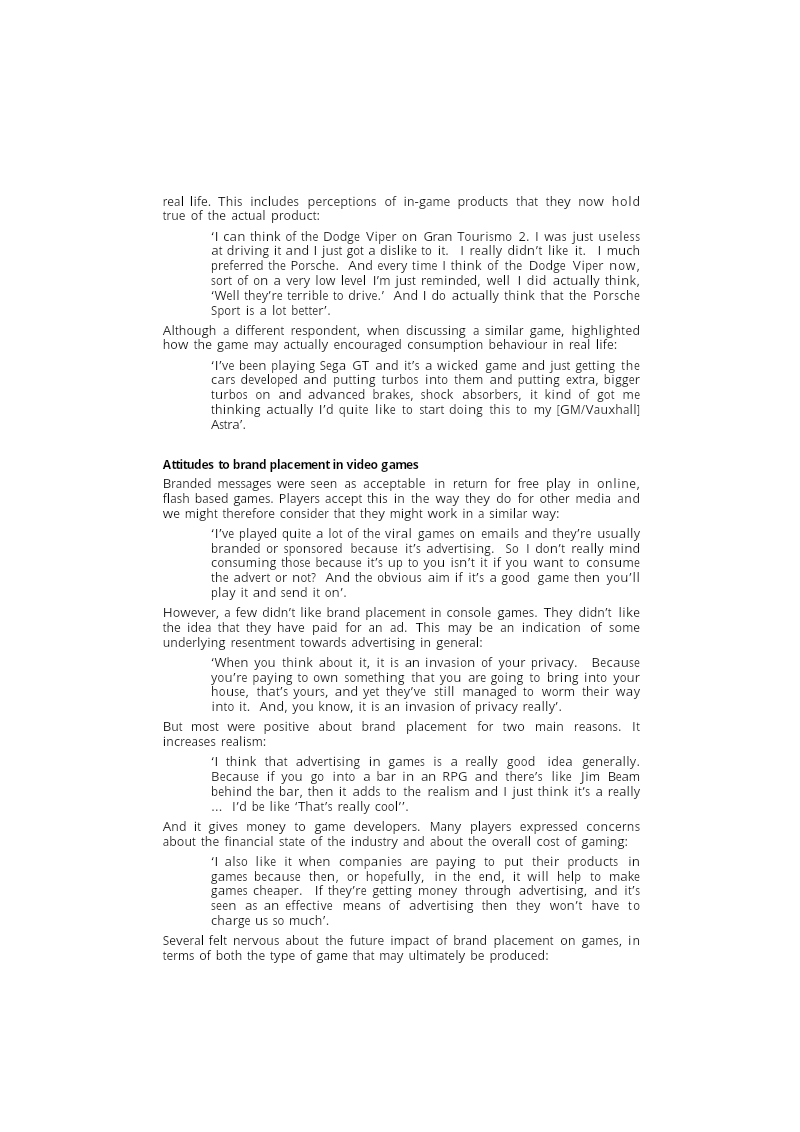
- Exploratory focus groups with 24 experienced video game players across four sessions found that players generally view in-game brand placement as a source of realism and as a way to fund lower-priced games.
- Players also voiced concern that brand placement can be invasive and that advertising revenue could distort game design.
- Brand placement is presented as potentially effective: it can strengthen brand recall, and players may show shifts in attitude or purchase intention.