Tetris
Documents about Tetris

Form 10-Q: Playstudios Q2 2023
Playstudios demonstrates a strategic pivot toward an advertising-heavy business model during the first half of 2023, characterized by revenue growth and operational restructuring.
- Playstudios reported $157.9 million in net revenue for the first half of 2023, a 13.8% increase driven by the integration of the Brainium portfolio and Tetris.
- The company recorded a $0.8 million net loss in Q2 2023, primarily due to costs associated with a 14% global workforce reduction aimed at long-term operational efficiency.
- Despite revenue growth, the firm faces significant platform concentration risk, with Apple and Google accounting for 66.3% of its platform-related revenue.
Form 10-Q: Playstudios Q1 2023
PLAYSTUDIOS demonstrated improved financial performance during the first quarter of 2023, characterized by a 13.7% year-over-year increase in net revenue to $80.1 million.
- Playstudios reported net revenue of $80.1 million for the first quarter of 2023, representing a 13.7% increase compared to the $70.5 million recorded in the same period of 2022.
- Revenue growth was primarily driven by the United States market, which grew 12% to $69.6 million, and North America (excluding the U.S.), which saw a 186.3% increase to $10.6 million.
- The company's cash and cash equivalents decreased from $134.0 million at the beginning of the quarter to $127.5 million as of March 31, 2023.

Playstudios Annual Report: Form 10-K 2022
Playstudios, a developer of free-to-play mobile games, utilizes its proprietary playAWARDS loyalty program to differentiate its offerings by allowing players to exchange in-game currency for real-world rewards.
- Playstudios reported 2022 revenue of $290.3 million, a 1% increase, but incurred a net loss of $17.8 million and an operating loss of $28.1 million.
- The company is aggressively pivoting toward advertising revenue, which surged 213.6% in 2022, helping to offset a 6.6% decline in virtual currency sales.
- The playAWARDS loyalty program remains a core differentiator, having facilitated over 15 million redemptions with a retail value exceeding $725 million through 96 partners.

Essential Facts About the U.S. Video Game Industry: Power of Play 2023
The global video game industry, represented by various national trade associations, highlights the multifaceted benefits of gaming beyond mere entertainment.
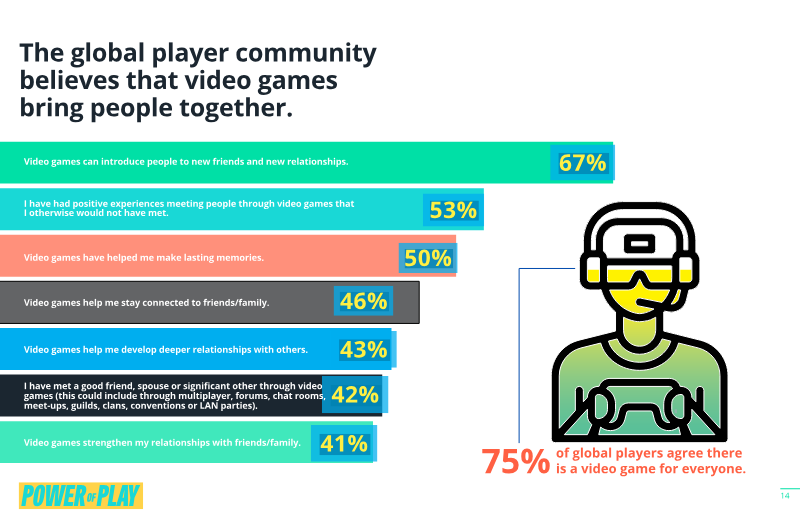
- 71% of global players use video games to relieve stress, while 62% utilize them as a tool to reduce anxiety.
- 67% of gamers believe that video games foster social connection, with nearly 50% of players having met a close friend or significant other through gaming platforms.
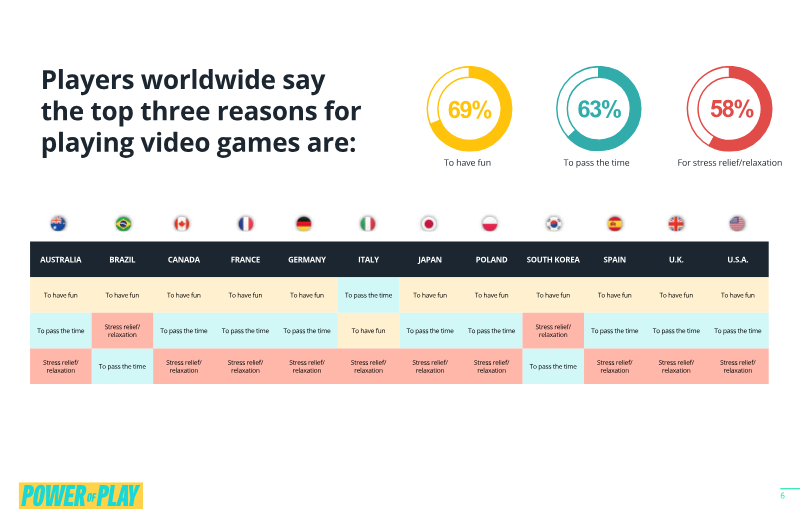
- The 2023 survey of nearly 13,000 players across 12 countries confirms that fun remains the primary motivator for gaming, followed by significant mental health and social benefits.

Can Tetris Treat Trauma?
Research into the use of the video game Tetris as a preventative and therapeutic tool for trauma focuses on disrupting memory consolidation, the process by which the brain solidifies experiences into long-term memory.
- Playing Tetris shortly after a traumatic event may disrupt memory consolidation, preventing the brain from deeply encoding intrusive memories or flashbacks.
- A study of 20 patients with long-standing trauma showed that playing Tetris for 25 minutes after recalling a traumatic memory resulted in a 64% reduction in related flashbacks.
- Research involving 71 car crash victims found that playing Tetris within six hours of an accident led to fewer and less persistent intrusive memories compared to a control group.

Form 10-Q: Q2 2022
PLAYSTUDIOS, Inc.’s Form 10-Q for the period ending June 30, 2022, provides a comprehensive overview of the company’s financial standing and operational risk profile as a publicly traded entity in the free-to-play social gaming sector.
- PLAYSTUDIOS reported a net loss of $19.7 million on $138.8 million in revenue for the first half of 2022, reflecting a year-over-year decline.
- The company maintains a strong liquidity position with $220.6 million in cash and an undrawn $81 million revolving credit facility.
- Distribution and payment processing are highly concentrated, with Apple and Google accounting for 75% of the company's trade receivables.
One Frame in 'Halo Infinite'
The transition from the rigid, fixed-interval architecture of the Halo 5 engine to the flexible, job-based system in Halo Infinite represents a fundamental shift toward multi-platform scalability.
- 343 Industries transitioned from Halo 5's specialized thread architecture to a generic 'real-time worker thread' pool in Halo Infinite, allowing for more flexible execution across available CPU cores.
- To handle variable frame rates while maintaining physical simulation accuracy, the engine uses a 'twinning' interpolation system that projects character poses between the two most recent fixed-update game ticks.
- The engine employs a job-based graph system that dynamically constructs and submits fixed-update job graphs based on the current frame rate, allowing the game to perform multiple ticks per frame when necessary.
Form 10-Q: Playstudios Q1 2022
Playstudios experienced a challenging first quarter in 2022, characterized by a transition from profitability to a net loss of $25.2 million.
- As of March 31, 2022, Playstudios had approximately 7.2 million Public Warrants and 3.8 million Private Warrants outstanding.
- On April 1, 2022, the company initiated a tender offer to purchase outstanding warrants for $1.00 in cash or, via a consent solicitation, to amend the warrant agreement to allow for a $0.90 cash redemption.
- During Q1 2022, the company approved the issuance of 7.9 million Restricted Stock Units (RSUs) and accelerated the first-year vesting for several employees, resulting in 0.2 million RSUs vesting during the period.

Making 'Tetris Effect'-ive
Tetris Effect reimagines the classic puzzle formula by transforming it into an immersive, sensory-driven experience that prioritizes emotional resonance over traditional competitive mechanics.
- To modernize a classic IP like Tetris, the development team focused on creating a 'synesthesia' experience by integrating a custom engine that links music, visual particles, and 3D movement to gameplay.
- The team addressed the challenge of balancing immersive VR presentation with functional gameplay by placing visual elements close to the play area, allowing players to process environmental effects without losing focus on the tetraminos.
- The 'synesthesia' engine was expanded with physics and morphing functions to provide a sense of weight and tempo to particle movements, enhancing the player's emotional connection to the game's atmosphere.

History of Mobile Gaming Quiz PG Connects Digital #2
The mobile gaming industry has experienced rapid evolution since its inception, a trajectory highlighted through a ten-question historical quiz presented at the Pocket Gamer Connects Digital #2 event in June 2020.
- The mobile gaming industry has evolved from the 1997 debut of Snake on the Nokia 6110 to a multi-billion dollar global economic force.
- Modern mobile gaming scale is exemplified by titles like Candy Crush, which contains over 7,100 levels, and the 2019 Fortnite World Cup, which awarded a $3 million first-place prize.
- The industry demonstrates massive financial impact, such as the 2016 launch of Pokémon Go increasing Nintendo’s market value by $7 billion in one day and Monster Strike generating over $8 billion for Mixi.

PGC 2020 Sessions @ PGC LONDON - Oscar Clark
The evolution of the video game industry is framed through the metaphorical lens of cake, representing the addictive and pervasive nature of interactive entertainment.
- The gaming industry has evolved from a niche hobby into a multi-billion dollar global sector that now competes directly with traditional media industries like film and music.
- Technological milestones, specifically the introduction of Java-based mobile gaming and the 2008 launch of smartphone-based distribution, were the primary catalysts for democratizing access to digital entertainment.
- The industry’s growth model has shifted toward a cycle of consumption driven by social gaming, microtransactions, and deep brand integration.
Gamer Mom: Cross-Stitching Meets 8-Bit Graphics
This analysis explores the evolving intersection of gaming culture, industry regulation, and market shifts during early 2020.
- The gaming industry is undergoing a shift toward consolidation and mainstream integration, exemplified by aggressive acquisition strategies from conglomerates like Tencent.
- Cloud gaming success is currently tethered to 5G infrastructure and strategic partnerships, such as those between Verizon and Google or Microsoft and SK Telecom, rather than hardware capabilities alone.
- The esports sector is experiencing market volatility and declining share prices, calling into question the validity of aggressive multi-billion dollar revenue forecasts.