Tetris
Documents about Tetris
Tetris World Championship: Building Explosive Esports on 8-bit Nintendo
The Classic Tetris World Championship has successfully transformed the 1989 Nintendo Entertainment System version of Tetris into a premier, high-stakes esport.
- The Classic Tetris World Championship successfully transformed the 1989 Nintendo Entertainment System version of Tetris into a professional esport by creating a standardized ruleset for original hardware and CRT monitors.
- The competitive ecosystem relies on modern broadcast technology, including real-time statistical overlays and multi-angle camera feeds, to turn a game without native competitive modes into a high-stakes spectator experience.
- Strategic partnerships with established entities like the Portland Retro Gaming Expo provided the logistical stability required to scale the event from a niche gathering to a global phenomenon.

Controls You Can Feel: Putting Tactility Back Into Touch Controls
Successful game design on touch-based platforms requires prioritizing tactility and physical interaction, moving beyond the traditional reliance on visual feedback.
- Prioritize proprioception and muscle memory over visual feedback to make the interface feel invisible and allow players to focus on the game world.
- Avoid virtual joysticks and other legacy controller paradigms that lack physical affordances, as these force players to rely on slower visual processing.
- Design for primary feedback where players intuitively know the outcome of an input before it is confirmed visually.

Size DOS Matter: Mattis Delerud of Team DOS talks to Biz during Dare to be Digital
Size Does Matter is a rhythm-action game developed by Team DOS that blends mechanics from titles like Tetris, Super Hexagon, and Guitar Hero.
- Size Does Matter is a rhythm-action game developed in Unity that combines mechanics from Tetris, Super Hexagon, and Guitar Hero for touchscreen devices.
- To circumvent the high costs of licensing mainstream music, the developers source royalty-free soundtracks from emerging electronic artists on platforms like Newgrounds.
- The game utilizes a free-to-play model that includes a base package of eight to ten songs, with additional revenue generated through the sale of artist-specific song packs.
Creator-Intensive Content
The fundamental challenge in game development lies in the distinction between system-driven gameplay and designer-intensive content.
- Game design complexity exists on a spectrum ranging from self-perpetuating systems like Minecraft to designer-intensive, puzzle-heavy experiences like Monkey Island.
- Puzzle-based games are inherently more difficult to develop because designers cannot objectively test their own puzzles, as they already know the solutions.
- Designer-intensive content requires constant, high-level attention to detail, as a single poorly designed puzzle can diminish the quality of the entire experience.


PLAYSTUDIOS, Inc. Second Quarter Results: 2026
PLAYSTUDIOS, Inc. reported financial results for the second quarter of 2026, highlighting a strategic pivot toward operational simplification and cost discipline amidst persistent secular headwinds in its legacy social casino portfolio.
- PLAYSTUDIOS is implementing a restructuring program called 'Renewal' to cut costs by $33 million to $39 million annually by closing four of nine studios and eliminating 177 positions.
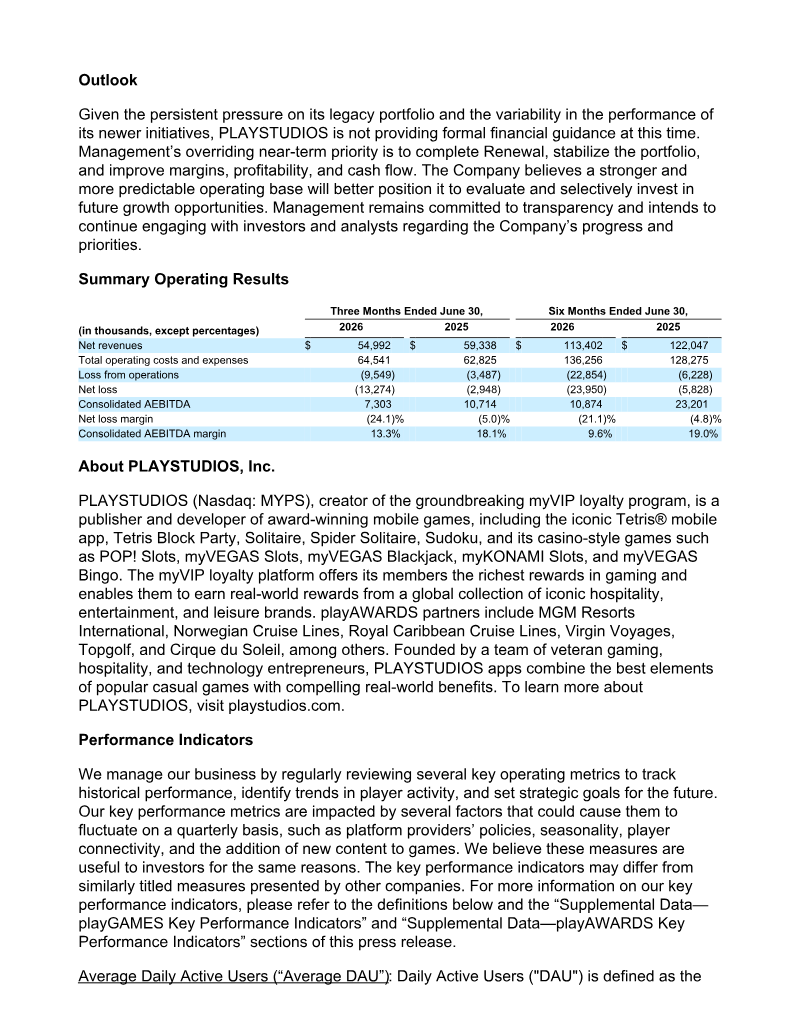
- Q2 2026 revenue fell to $55.0 million from $59.3 million in Q2 2025, with net losses widening to $13.3 million compared to a $2.9 million loss in the prior-year period.
- Direct-to-consumer revenue grew 120% year-over-year to $14.7 million, serving as a bright spot despite a decline in consolidated AEBITDA to $7.3 million.