Playstudios
Technology17 documents
Mobile F2P game developer. myVEGAS, POP! Slots, Kingdom Boss. Loyalty rewards platform.
Documents
Financial13 pages
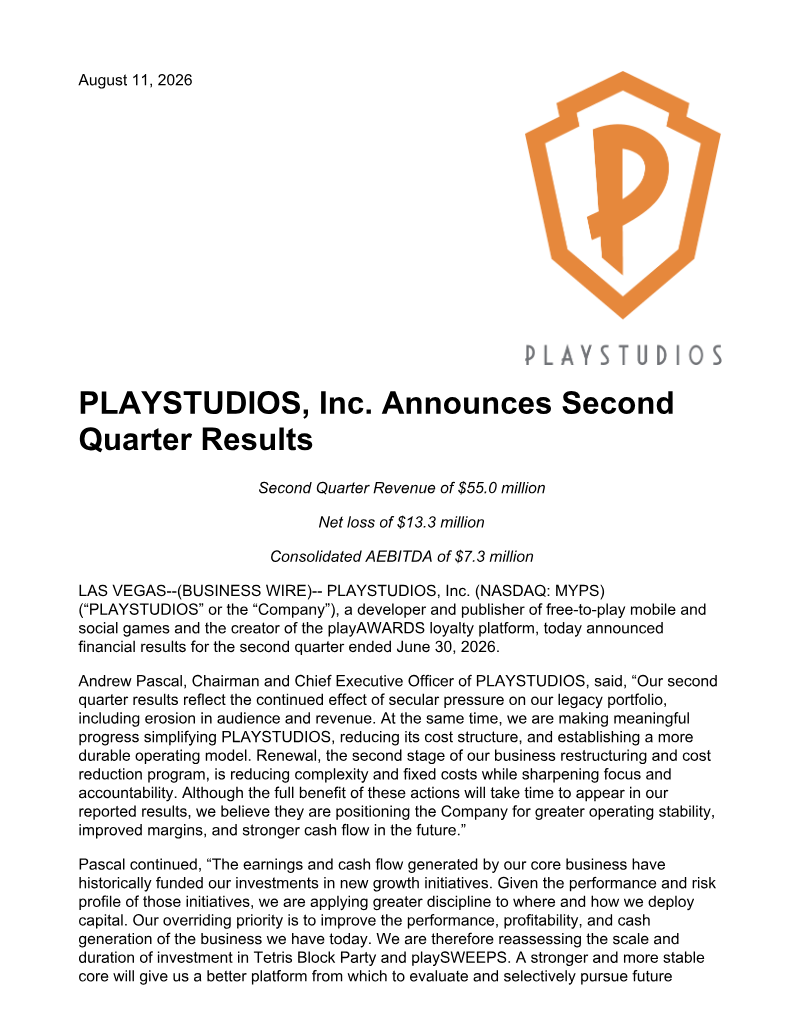
PLAYSTUDIOS, Inc. Second Quarter Results: 2026
PLAYSTUDIOS, Inc. reported financial results for the second quarter of 2026, highlighting a strategic pivot toward operational simplification and cost discipline amidst persistent secular headwinds in its legacy social casino portfolio. The company’s primary objective is to stabilize its core business, improve margins, and generate consistent cash flow, leading to a more selective approach to capital deployment for new growth initiatives.
Financial performance for the quarter ending June 30, 2026, showed revenue of $55.0 million, a decrease from $59.3 million in the same period of 2025. The company recorded a net loss of $13.3 million, compared to a $2.9 million loss in the prior-year quarter, and reported a consolidated AEBITDA of $7.3 million, down from $10.7 million. Despite these pressures, direct-to-consumer revenue grew by 120% year-over-year, reaching $14.7 million. As of June 30, 2026, the company maintained a cash and cash equivalents balance of $102.7 million.
The company is currently executing a restructuring program titled "Renewal," which follows an earlier initiative that yielded $29.0 million in annualized savings. Renewal aims to further reduce complexity and fixed costs by closing four of nine studios and eliminating 177 positions, with an expected additional $33.0 million to $39.0 million in annualized savings. Consequently, management is reassessing its investment in growth products like Tetris Block Party and the playSWEEPS initiative, which have underperformed internal expectations.
Operational metrics reflected a decline in audience engagement, with average daily active users (DAU) falling to 1.9 million and average monthly active users (MAU) to 7.8 million. However, the company noted an improvement in average daily payer conversion to 1.0% and an increase in average daily revenue per DAU (ARPDAU) to $0.32. Given the current market volatility and portfolio transition, the company has opted not to provide formal financial guidance for the remainder of the year.
- PLAYSTUDIOS is implementing a restructuring program called 'Renewal' to cut costs by $33 million to $39 million annually by closing four of nine studios and eliminating 177 positions.
- Q2 2026 revenue fell to $55.0 million from $59.3 million in Q2 2025, with net losses widening to $13.3 million compared to a $2.9 million loss in the prior-year period.
- Direct-to-consumer revenue grew 120% year-over-year to $14.7 million, serving as a bright spot despite a decline in consolidated AEBITDA to $7.3 million.
- Management is reassessing investments in growth products like Tetris Block Party and playSWEEPS due to underperformance relative to internal expectations.
- Audience engagement metrics declined to 1.9 million daily active users and 7.8 million monthly active users, though daily payer conversion improved to 1.0% and ARPDAU rose to $0.32.
+2
Playstudios
Article
Form 10-Q: Playstudios (Q2 2026)
Playstudios’ financial results for the second quarter of 2026 reveal a period of significant contraction and structural transition. The company reported a net loss of $13.3 million on $55.0 million in revenue, a decline from the $59.3 million in revenue generated during the same period in 2025. For the first half of 2026, the cumulative net loss reached $23.95 million, compared to a $5.83 million loss in the first half of 2025. This downturn is largely attributed to a decrease in virtual currency revenue within the playGAMES segment, rising user acquisition costs, and substantial restructuring expenses, including a 27% workforce reduction initiated in March 2026.
The company faces a complex risk profile characterized by both operational and external pressures. Market shifts toward sweepstakes-based gaming, combined with intense competition and a reliance on third-party platforms like Apple and Google, have created significant headwinds for the company’s traditional social casino portfolio. Furthermore, Playstudios is navigating ongoing legal challenges, including class action litigation regarding its monetization practices, and must address technical and geopolitical vulnerabilities, such as the potential for operational disruptions at its primary development studio in Israel. Financial stability is also a focus, as the company manages the expiration of its revolving credit facility and works to regain compliance with Nasdaq’s minimum bid price requirements by November 2026.
Despite these challenges, the company maintains that its current cash position and operational cash flow are sufficient to support business requirements for the next twelve months. Strategic efforts to stabilize the organization include a reorganization plan that involved vacating leased facilities and the extinguishment of 15 million "Earnout Shares" following the failure to meet performance-based stock price targets. While the company continues to utilize a stock repurchase program to manage its capital structure, it remains heavily dependent on its loyalty partnership with MGM and the stability of its third-party infrastructure to sustain its long-term growth strategy.
- Total net revenue for the six months ended June 30, 2026, declined to $113.4 million from $122.0 million in the same period of 2025, driven primarily by a decrease in Daily Paying Users (DPU).
- The playGAMES segment saw its AEBITDA drop significantly to $20.1 million for the first half of 2026, down from $34.8 million in the first half of 2025, due to lower virtual currency revenue and increased user acquisition costs.
- The playAWARDS segment showed improved performance, with AEBITDA losses narrowing to $(0.9) million for Q2 2026 compared to $(2.4) million in Q2 2025, driven by revenue growth and reduced operating costs.
- The company's effective tax rate for the three months ended June 30, 2026, was (12.6)%, compared to (7.6)% for the same period in 2025, with tax expenses rising to $1.5 million for the quarter.
- Platform providers such as Apple, Google, Amazon, and Facebook continue to charge transaction fees typically set at 30% of in-game purchases, representing a significant ongoing cost and operational dependency.
+2
PlaystudiosAug 2026
Financial10 pages
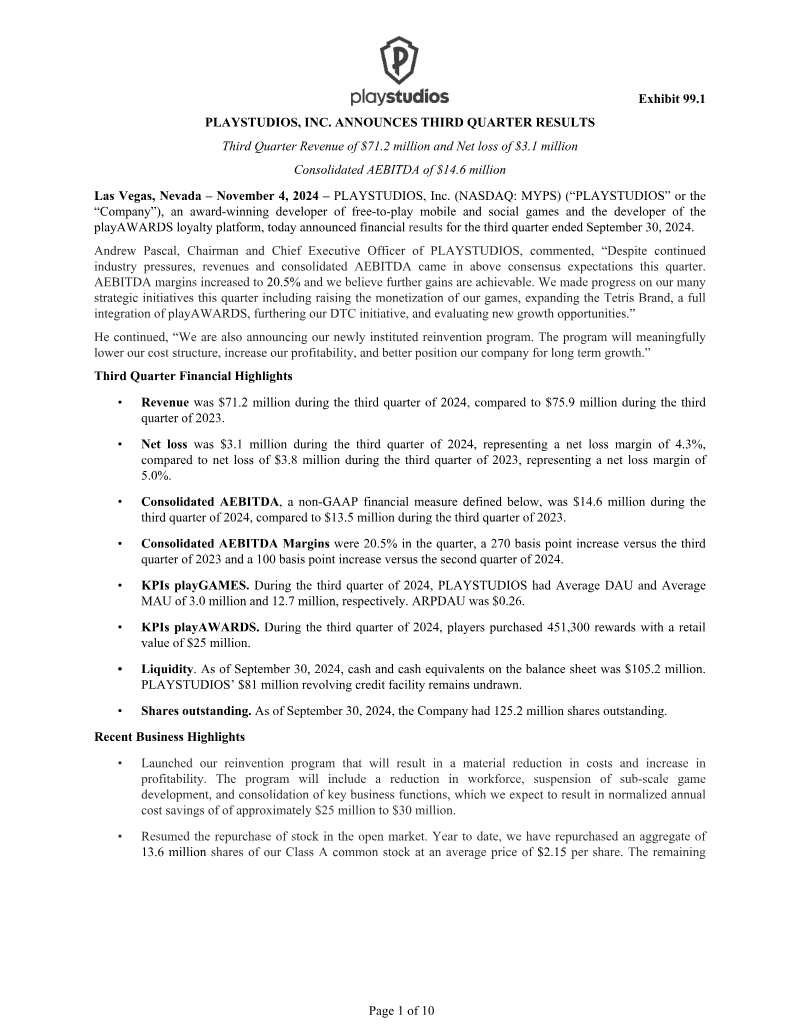
Playstudios, Inc. Third Quarter Results 2024
PlayStudios reported third‑quarter 2024 results that exceeded consensus expectations, driven by stronger monetization and a successful reinvention program. Net revenue fell 5.9% to $71.2 million from $75.9 million a year earlier, while net loss narrowed to $3.1 million (loss margin 4.3%) from a $3.8 million loss (5.0% margin) in Q3 2023. Consolidated adjusted EBITDA rose to $14.6 million, a 20.5% margin that represents a 270‑basis‑point improvement over Q3 2023 and a 100‑basis‑point gain versus Q2 2024. The playGAMES segment generated $71.2 million in revenue and $23.2 million in EBITDA, with an EBITDA margin of 32.6%, while playAWARDS posted a $3 million loss and negative EBITDA, reflecting ongoing investment in the loyalty platform.
Key operating metrics showed a decline in average daily active users to 2.96 million (−15.9%) and a modest drop in average daily paying users to 23 (−11.5%). However, average revenue per DAU increased by 13% to $0.26, and playAWARDS purchases grew 4.2%, with retail value rising 3.4% to $24.98 million. Cash and cash equivalents stood at $105.2 million, with an undrawn $81 million revolving credit facility.
The company reiterated full‑year 2024 guidance of net revenue $285–295 million and consolidated EBITDA $55–60 million, noting that certain non‑GAAP items are difficult to estimate. The reinvention program targets $25–30 million in annual cost savings through workforce reductions, project scaling, and function consolidation. Overall, PlayStudios demonstrated improved profitability margins amid a challenging mobile gaming environment while maintaining liquidity and pursuing strategic growth initiatives.
- PlayStudios improved profitability in Q3 2024, with consolidated adjusted EBITDA rising to $14.6 million (a 20.5% margin) despite a 5.9% year-over-year decline in net revenue to $71.2 million.
- The company is executing a reinvention program targeting $25–30 million in annual cost savings through workforce reductions, project scaling, and function consolidation.
- While average daily active users (DAU) dropped 15.9% to 2.96 million, average revenue per DAU increased by 13% to $0.26, indicating stronger monetization per user.
- The playGAMES segment remains the primary profit driver, generating $71.2 million in revenue and $23.2 million in EBITDA, while the playAWARDS loyalty platform continues to operate at a $3 million loss.
- PlayStudios maintains a stable liquidity position with $105.2 million in cash and cash equivalents, supplemented by an undrawn $81 million revolving credit facility.
+2
Playstudios
Financial12 pages
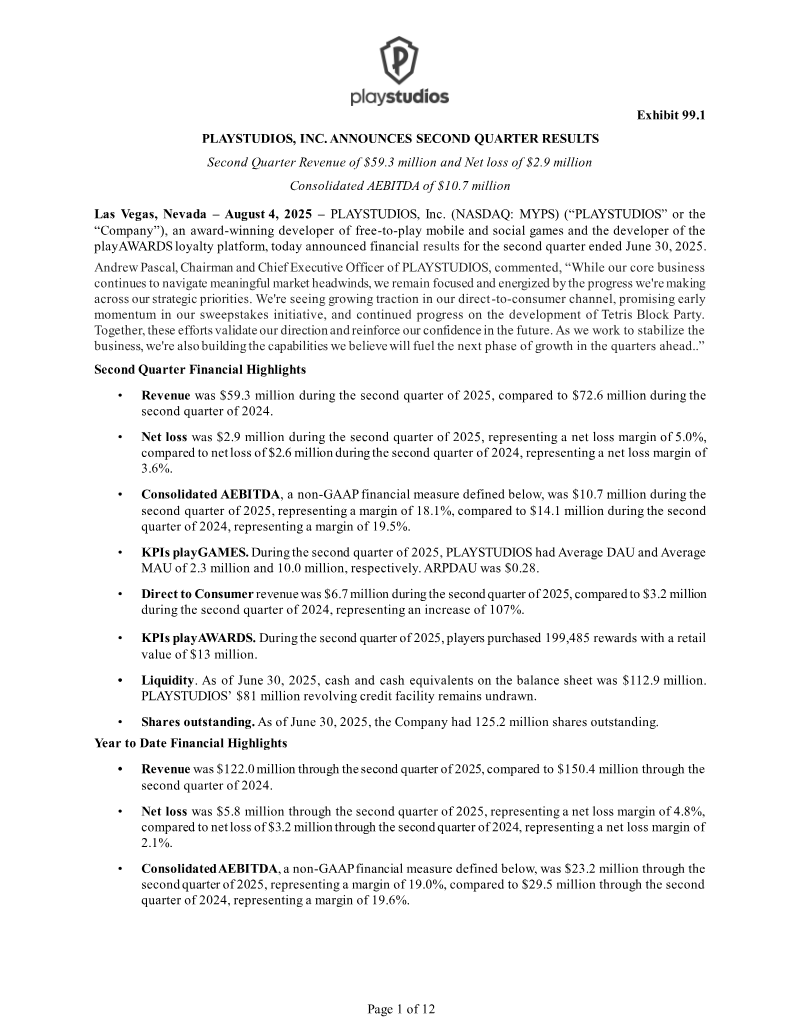
PLAYSTUDIOS, Inc. Second Quarter 2025 Financial Results
PLAYSTUDIOS reported second‑quarter 2025 results with net revenue of $59.3 million, down 18.4 % from the same period in 2024, and a net loss of $2.9 million, reflecting a loss margin of 5.0 %. Consolidated AEBITDA reached $10.7 million, an 18.1 % margin, lower than the 19.5 % margin recorded in Q2 2024. Year‑to‑date revenue totaled $122.0 million, a 18.9 % decline from the prior year, while net loss widened to $5.8 million with a 4.8 % margin. Direct‑to‑consumer (DTC) revenue surged 107 % to $6.7 million in Q2, driven by a 106.8 % increase in DTC virtual‑currency sales; however, overall virtual‑currency revenue fell 14.6 % to $48.2 million due to declines in third‑party platform sales.
Key performance indicators for playGAMES showed average daily active users at 2.3 million and average monthly active users at 10.0 million, both down 27–26 % from Q2 2024, while average daily revenue per user rose 12.0 % to $0.28. playAWARDS metrics revealed a 41 % drop in available rewards and a 61.6 % decline in reward purchases, with retail value of purchases falling 59.7 % to $12.7 million.
Liquidity remained robust, with cash and equivalents of $112.9 million and an undrawn $81 million revolving credit facility. The company maintains full‑year 2025 guidance of net revenue $250–270 million and consolidated AEBITDA $45–55 million, acknowledging that current results do not yet align with guidance. The report covers the United States market, focusing on mobile and social gaming segments, and relies on unaudited financial statements and non‑GAAP reconciliations to present operational performance.
- PLAYSTUDIOS reported a significant Q2 2025 revenue decline of 18.4% to $59.3 million, resulting in a net loss of $2.9 million.
- Year-to-date revenue reached $122.0 million, representing an 18.9% decrease compared to the same period in 2024.
- Direct-to-consumer (DTC) revenue grew 107% to $6.7 million, though this was offset by a 14.6% decline in overall virtual-currency revenue due to poor performance on third-party platforms.
- User engagement metrics for playGAMES dropped sharply, with daily active users falling 27% and monthly active users down 26% year-over-year, despite a 12% increase in average daily revenue per user to $0.28.
- The playAWARDS segment experienced a substantial contraction, with reward purchases declining 61.6% and the retail value of those purchases falling 59.7% to $12.7 million.
+2
Playstudios
Article
Form 10-Q: Q1 2026
PLAYSTUDIOS faced a challenging financial landscape in the first quarter of 2026, characterized by a 6.9% year-over-year decline in net revenue to $58.4 million. This downturn, primarily attributed to reduced virtual currency sales within the playGAMES segment, contributed to a widened net loss of $10.7 million. Despite these headwinds, the company achieved an increase in average revenue per daily active user to $0.31, signaling continued engagement through its proprietary loyalty programs. To address operational inefficiencies, management initiated a 2026 Reorganization Plan, which included a 27% workforce reduction and the consolidation of leased facilities, resulting in $2.9 million in restructuring charges during the period.
The company’s liquidity position remains stable, with $103.7 million in cash and cash equivalents as of March 31, 2026. While the firm maintains an $81.0 million revolving credit facility, it currently carries no outstanding debt and remains in full compliance with all financial covenants. Operating cash flow improved slightly to $3.7 million, providing a buffer against the $4.1 million utilized for internal software development and ongoing legal obligations. These legal matters include a $3.2 million accrual for a multi-state class action settlement and various pending claims regarding gambling statutes, which management currently contests as meritless.
Looking ahead, the company’s business model continues to rely heavily on third-party platforms such as Apple, Google, Xsolla, and AppLovin for distribution and revenue collection. While Consolidated AEBITDA fell to $3.6 million due to elevated marketing and restructuring expenses, management asserts that existing cash reserves are sufficient to sustain operations and growth initiatives for at least the next twelve months. Future performance remains contingent on the success of ongoing game development efforts and the ability to mitigate risks associated with platform fees and evolving regulatory environments.
- PLAYSTUDIOS reported a decline in total net revenue to $58.4 million for Q1 2026, down from $62.7 million in Q1 2025, driven by a decrease in virtual currency sales from $50.7 million to $44.7 million.
- Reportable segment AEBITDA dropped significantly to $7.2 million in Q1 2026 compared to $16.0 million in the same period last year, primarily due to increased user acquisition costs and lower revenue.
- User acquisition expenses rose sharply to $16.7 million in Q1 2026, up from $10.2 million in Q1 2025, representing a substantial increase in marketing investment despite the revenue contraction.
- The company faces ongoing legal risks regarding the legality of its games, including a civil lawsuit in Kentucky and multiple arbitration demands alleging that its social gaming applications constitute illegal gambling.
- As of March 31, 2026, the company held $103.7 million in cash and cash equivalents, maintaining a relatively stable liquidity position compared to the $104.9 million reported at the end of 2025.
+2
PlaystudiosMay 2026

Financial1 pages
Annual Report on Form 10-K: 2025
SEC 10-K filing for Playstudios, filed 2026-03-16.
- PLAYSTUDIOS, Inc. (formerly Acies Acquisition Corp.) completed a business combination on June 21, 2021, merging with Old PLAYSTUDIOS and subsequently changing its name.
- The company primarily generates revenue from the sale of in-game virtual currencies in its free-to-play mobile and web games, with revenue largely concentrated in North America.
- PLAYSTUDIOS faces significant competition from various mobile and web game developers in the social casino gaming category, including Product Madness, DoubleU, Huuuge Games, Playtika, SciPlay, Scopely, and Zynga.
- The company is facing legal and regulatory challenges related to social casino games, including a monetary award in 2025 due to a lawsuit alleging illegal gambling under Washington law, and a lawsuit filed in February 2026 by the Washington State Attorney General against social casino operators.
- PLAYSTUDIOS' Class A common stock was non-compliant with Nasdaq's minimum bid price requirement as of November 5, 2025, with a deadline of May 4, 2026, to regain compliance.
+4
PlaystudiosMar 2026

Financial1 pages
Form 10-Q: Playstudios Q2 2025
SEC 10-Q filing for Playstudios, filed 2025-08-08.
- Playstudios' total net revenue for Q2 2025 was $59,338, a decrease from $72,590 in Q2 2024. For the six months ended June 30, 2025, total net revenue was $122,047, down from $150,418 in the same period of 2024.
- Virtual currency revenue, recognized over time, decreased to $48,208 in Q2 2025 from $56,477 in Q2 2024, and to $99,049 for the first six months of 2025 from $116,724 in the prior year.
- Advertising revenue, recognized at a point in time, also saw a significant drop, from $16,006 in Q2 2024 to $11,128 in Q2 2025, and from $33,448 to $22,991 for the six-month period.
- The company experienced a net loss of $2,948 in Q2 2025 and a net loss of $5,828 for the six months ended June 30, 2025.
- Playstudios made charitable contributions of $0.3 million to the PLAYSTUDIOS Impact Fund during the first six months of 2025, with an additional $1.25 million contributed after June 30, 2025.
+2
PlaystudiosAug 2025

Financial1 pages
Form 10-K: 2024 Annual Report
PLAYSTUDIOS, Inc., a Las Vegas-based mobile gaming company, operates a portfolio of free-to-play social casino and casual games integrated with its proprietary playAWARDS loyalty program. The company’s primary business model relies on monetizing 13.1 million monthly active users through in-game virtual currency purchases and advertising. By connecting players to real-world rewards from over 200 global brands, the firm seeks to differentiate itself in a highly saturated market. However, the company faces significant operational challenges, including a heavy reliance on third-party platforms like Apple and Google, intense industry competition, and a concentrated dependence on MGM Resorts International for key rewards and intellectual property.
Financial performance in 2024 reflected a challenging environment, with net revenue declining 6.9% to $289.4 million and the net loss widening to $28.7 million, compared to $19.4 million in 2023. Consolidated Adjusted EBITDA also fell to $56.5 million. In response to these pressures, the company executed a 30% workforce reduction, incurring $16.2 million in restructuring charges, and pursued strategic growth through the $6.8 million acquisition of Pixode Games Limited. Despite these losses, the company maintains a stable liquidity position with $109.2 million in cash and equivalents, which management expects will sustain operations through 2025.
The company’s risk profile is dominated by legal and regulatory uncertainties, including ongoing class-action lawsuits and arbitration demands alleging that its social casino titles violate state gambling laws. To address these, the firm accrued $9.8 million in settlement expenses. Furthermore, the business must navigate an increasingly complex global landscape of data privacy regulations, such as GDPR and CCPA, which threaten to increase compliance costs and limit marketing effectiveness. With a dual-class stock structure concentrating voting power in the Founder Group and significant exposure to macroeconomic and geopolitical instability, the company remains focused on balancing its long-term growth strategy against these substantial operational and financial headwinds.
- PLAYSTUDIOS reported a 6.9% decline in net revenue to $289.4 million and a widened net loss of $28.7 million for 2024.
- The company faces significant legal risk from ongoing class-action lawsuits alleging that its social casino games violate state gambling laws, resulting in $9.8 million in accrued settlement expenses.
- To combat financial headwinds, the firm executed a 30% workforce reduction incurring $16.2 million in restructuring charges and acquired Pixode Games Limited for $6.8 million.
- Despite operational losses, the company maintains $109.2 million in cash and equivalents, which management projects will sustain operations through 2025.
- The business model is highly concentrated, relying on 13.1 million monthly active users and a critical dependency on MGM Resorts International for key rewards and intellectual property.
+1
PlaystudiosMar 2025

Financial1 pages
Form 10-Q: Quarterly Report Q2 2024
PLAYSTUDIOS, Inc. maintains a focus on its dual-segment business model, comprising the playGAMES and playAWARDS divisions, while navigating a challenging financial landscape characterized by year-over-year revenue contraction. For the second quarter of 2024, the company reported $72.6 million in revenue, a 6.7% decline compared to the same period in 2023. This downturn was primarily attributed to reduced virtual currency sales and the non-renewal of a key licensing agreement. Despite these headwinds, the company achieved a 3.9% reduction in operating expenses through disciplined spending in user acquisition and research and development, though it remained in an operating loss position with a net loss of $2.6 million for the quarter.
The company’s liquidity remains stable, with $106.3 million in cash and cash equivalents as of June 30, 2024, and no outstanding balances on its $75 million revolving credit facility. Management has prioritized capital allocation toward shareholder returns, executing $48.7 million in treasury stock repurchases through the first half of the year, including a significant $24.6 million transaction with Microsoft. Strategic growth efforts continue alongside these financial maneuvers, highlighted by the July 2024 acquisition of Pixode Games, which aims to bolster the company’s casual gaming portfolio.
Operational risks remain a significant focal point, particularly regarding legal challenges and platform dependencies. PLAYSTUDIOS is currently defending against multiple arbitration notices and class action lawsuits alleging that its gaming products violate state gambling statutes. While the company maintains that these claims are without merit and has made no financial accruals, these proceedings represent a notable area of uncertainty. Furthermore, the company faces ongoing exposure to third-party platform fees from Apple and Google, as well as foreign currency fluctuations related to its Israeli operations, which it manages through active hedging strategies.
- PLAYSTUDIOS reported Q2 2024 revenue of $72.6 million, a 6.7% year-over-year decline driven by lower virtual currency sales and the loss of a key licensing agreement.
- The company recorded a net loss of $2.6 million for the quarter, despite achieving a 3.9% reduction in operating expenses through cuts to user acquisition and R&D spending.
- Management prioritized shareholder returns by executing $48.7 million in treasury stock repurchases during the first half of 2024, including a $24.6 million transaction with Microsoft.
- As of June 30, 2024, the company maintains a stable liquidity position with $106.3 million in cash and no outstanding debt on its $75 million revolving credit facility.
- The company is currently defending against multiple class action lawsuits and arbitration notices alleging that its gaming products violate state gambling statutes.
+1
PlaystudiosAug 2024

Financial1 pages
Form 10-Q Quarterly Report: Q3 2023
The third quarter of 2023 reflects a period of strategic consolidation and operational adjustment for the company, characterized by a focus on stabilizing revenue streams amidst shifting macroeconomic conditions. The primary objective of this financial disclosure is to provide transparency regarding liquidity, capital resources, and the ongoing integration of digital service offerings. The core thesis centers on the necessity of balancing aggressive investment in platform infrastructure with the need to maintain healthy cash reserves to navigate potential market volatility in the coming fiscal year.
Financial performance during this period indicates a measured approach to expenditure, with a notable emphasis on optimizing research and development costs. While top-line growth remained consistent with historical trends, the company experienced increased pressure on operating margins due to rising costs associated with cloud infrastructure and talent acquisition. Key data points reveal that while user engagement metrics remained stable across primary geographic markets, the conversion rate for premium subscription tiers saw a slight deceleration compared to the previous quarter. These findings underscore a broader industry trend where consumer spending on digital entertainment is becoming increasingly selective.
The scope of this analysis encompasses global operations, with a specific focus on North American and European market segments. The methodology relies on a rigorous review of internal financial statements, consolidated balance sheets, and cash flow assessments prepared in accordance with generally accepted accounting principles. By evaluating these metrics, the company concludes that its current capital structure is sufficient to support planned initiatives through the end of the fiscal year. Future growth strategies remain contingent upon the successful deployment of upcoming software updates and the ability to mitigate inflationary impacts on operational overhead.
- The company is prioritizing cash preservation and liquidity to hedge against potential market volatility heading into the next fiscal year.
- Operating margins faced downward pressure during Q3 2023 due to rising expenditures in cloud infrastructure and talent acquisition.
- Premium subscription conversion rates decelerated in Q3 2023, reflecting a broader industry trend of increasingly selective consumer spending on digital entertainment.
- Top-line revenue growth remained consistent with historical trends despite the challenging macroeconomic environment.
- User engagement metrics remained stable across the company's primary North American and European geographic markets.
+2
PlaystudiosNov 2023

Financial1 pages
Form 10-Q: Playstudios Q2 2023
Playstudios demonstrates a strategic pivot toward an advertising-heavy business model during the first half of 2023, characterized by revenue growth and operational restructuring. For the period ending June 30, 2023, the company reported net revenue of $157.9 million for the first six months, representing a 13.8% increase over the prior year. This growth was largely fueled by the integration of the Brainium portfolio and the addition of Tetris, which offset declines in virtual currency sales and Average Daily Payer Conversion. Despite this top-line expansion, the firm recorded a net loss of $0.8 million for the second quarter, reflecting the costs associated with a 14% global headcount reduction intended to improve long-term operational efficiency.
The company maintains a stable balance sheet with $345.5 million in total assets and $127.7 million in cash and cash equivalents. Financial management remains focused on the playAWARDS and myVIP loyalty programs, which serve as the primary drivers for player engagement and retention. While the firm successfully generated $23.9 million in net cash from operating activities, it also utilized $15.5 million for share repurchases, signaling a commitment to returning value to shareholders despite ongoing legal challenges, including class action securities litigation and disputes regarding gambling statutes.
Operating within the global mobile gaming sector, Playstudios faces significant concentration risk, with Apple and Google accounting for 66.3% of its platform-related revenue. The company continues to navigate this landscape as an emerging growth company, balancing the integration of recent acquisitions like WonderBlocks and Brainium with the management of an $81 million revolving credit facility. By achieving an Adjusted EBITDA margin of 21.6% for the first half of the year, the firm demonstrates a focus on balancing aggressive portfolio expansion with the disciplined management of in-game economies and platform-imposed fees.
- Playstudios reported $157.9 million in net revenue for the first half of 2023, a 13.8% increase driven by the integration of the Brainium portfolio and Tetris.
- The company recorded a $0.8 million net loss in Q2 2023, primarily due to costs associated with a 14% global workforce reduction aimed at long-term operational efficiency.
- Despite revenue growth, the firm faces significant platform concentration risk, with Apple and Google accounting for 66.3% of its platform-related revenue.
- Playstudios achieved an Adjusted EBITDA margin of 21.6% for the first half of 2023 while managing $127.7 million in cash and cash equivalents.
- The company utilized $15.5 million for share repurchases during the period, signaling a commitment to shareholder value despite ongoing class action litigation and legal disputes.
+2
PlaystudiosAug 2023

Financial1 pages
Playstudios Annual Report: Form 10-K 2022
Playstudios, a developer of free-to-play mobile games, utilizes its proprietary playAWARDS loyalty program to differentiate its offerings by allowing players to exchange in-game currency for real-world rewards. The company’s primary thesis centers on leveraging this loyalty ecosystem to drive player retention and monetization, while simultaneously diversifying revenue through strategic acquisitions and an increasing reliance on advertising. As of the end of 2022, the company maintained a network of 96 partners, having facilitated over 15 million reward redemptions with a retail value exceeding $725 million.
Financially, 2022 represented a period of transition and operational challenge. While total revenue remained relatively stable at $290.3 million—a 1% increase over the prior year—the company shifted its business mix, as a 213.6% surge in advertising revenue offset a 6.6% decline in virtual currency sales. This pivot, influenced by the acquisition of ad-heavy titles like the Brainium portfolio and Tetris-branded games, contributed to an operating loss of $28.1 million and a net loss of $17.8 million. Despite these pressures, the company maintained a stable cash position of $134 million and reported no outstanding debt under its credit facilities.
The company faces a complex risk profile characterized by intense competition, heavy reliance on third-party platforms like Apple and Google, and a demanding global regulatory environment regarding data privacy and social casino gaming. Operational risks are further compounded by ongoing legal proceedings, including a class-action securities lawsuit, and the integration challenges associated with recent acquisitions. To mitigate these pressures, management has initiated efficiency measures, including a 14% workforce reduction and a $50 million stock repurchase program, while continuing to navigate the complexities of its dual-class share structure and public company compliance requirements.
- Playstudios reported 2022 revenue of $290.3 million, a 1% increase, but incurred a net loss of $17.8 million and an operating loss of $28.1 million.
- The company is aggressively pivoting toward advertising revenue, which surged 213.6% in 2022, helping to offset a 6.6% decline in virtual currency sales.
- The playAWARDS loyalty program remains a core differentiator, having facilitated over 15 million redemptions with a retail value exceeding $725 million through 96 partners.
- To address operational challenges and financial losses, the company implemented a 14% workforce reduction and authorized a $50 million stock repurchase program.
- The company maintains a stable financial cushion with $134 million in cash and no outstanding debt under its credit facilities.
+1
PlaystudiosMar 2023