VideoThe Game Business
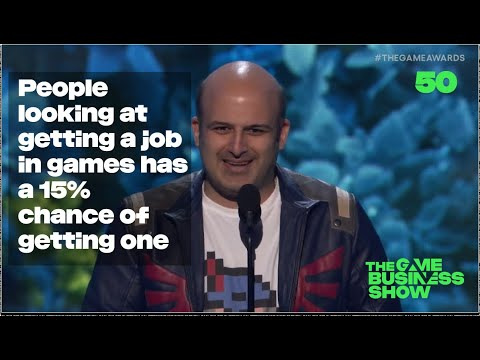
Over 50% of the job cuts in video games are in California
4 Sept 202538 min video
Transcript
Here's another stat for you. Over 50% of the cuts globally have been in California. And so California AAA is like the epicenter of the difficulty. It may be that if you want to stay in the industry, being open to going to some of these other places like China, like Japan, not forever, but for some amount of time, that's going to become a larger and larger part of the equation.
And now for a sponsored message from Keyword Studios. Passionate fandoms are the bedrock of a successful video game franchise, and our friends at Keyword Studios have a mission to cultivate that fandom. Keyword Studios' marketing services bring together expertise in research, strategy, creative production, social media, PR, and community management to help you build your audience and connect with your fans. These marketing services bring together award-winning marketing agencies including trailer production studios, PR specialists, and social media and community experts. With teams in North America, Europe, and Asia,
Keywords supports video game marketers across the globe to produce campaigns for gaming's biggest titles. They may be marketers, but they're gamers first. And for nearly two decades, they've been putting their love of video games into everything they do, helping marketers connect with their fans. From indie to AAA and from mobile to PC to console, Keyword supports studios with marketing services across the entire life cycle of their game. To learn more, visit www.keywordstudios.com. Now, back to the show. Hello and welcome to the game business show. The dominant story in the video game business over the past 3 years has surrounded the games industry sudden and violent retraction, resulting in tens of thousands of job losses across the business. We've covered many of the reasons as to why this has happened on the game business, but we've not really delved into the human cost on those who are working within the business. So, I'm delighted to be speaking to someone who has won awards for his selfless efforts into supporting people in the video games industry who are struggling to find work and looking for work in this industry. And Mia Sabat is the business development director at Tencent, but
he's best known for the Mia Sabat games community, which is the biggest dedicated games, resources, and communities out there. And it's entirely free. He picked up the inaugural game change award at the game awards last year and he's with us right now. Hello air. Welcome to the show.
Thank you so much Chris. Thank you for the warm introduction and uh and and I really appreciate this is a topic as with so many important topics you're giving a spotlight to. This will be fun and important.
Fun is an interesting we we'll see. But
well the the the the lighter parts at the end of course.
Yeah. Yeah. Hopefully there's some light in this.
Yeah.
There's probably some people listening to this that don't know your story. uh don't know what this is all about. So, I mean, I could recap it a little bit. I mentioned it a little bit in the intro, but why don't you tell us, you know, what your role has been in sort of helping people find jobs in the industry over the last over the last what, three years? Nearly three years.
Yeah, that's right. It'll be three years in November. I mean, you know, in in very brief, it's a very interesting and unconventional story. So, for those who don't know me, I didn't get my start in
the games business until I was 38 years old, almost entirely because of location. I come from a very tight-knit Persian family that lives on the east side of the United States. And so I didn't want to move for roles. And so because of that, it didn't happen until I could find a remote role in the industry, which was with Amazon games, you know, in my late 30s. The reason that's relevant is in addition to just caring about other people and kind of the skills I brought to the table, I know what it was like going through multiple decades of feeling like or literally not knowing anybody in the industry, not having support, trying to figure out how to put those beats together on my own. And I feel like all of that culminated when these heavy layoffs started in 2022 of saying, well, I have a set of skills I think I can use in practical ways to help people. And that's basically what happened. And and to point in the intro when we said about the fun part, this is all obviously a very very serious business. But one of the things that I think I'm most prouder
of for the community and the nearly 4,000 people who we've helped find work is that many of them tell me beyond any of the resources which we might talk about a little bit later. It's about kind of the environment, the content which I post. I also post a three to five times a day sometimes. But it's about a fun environment, a supportive environment, at times very serious, but at times more light-hearted. And so I try to meet our community where they are.
Talk about the community itself. So you do have these resources. You do have these various things that help people. What out of those what have been the most useful?
Yeah. So it's interesting. It all has been we ask the community for what they're looking for and we respond to it. So when I first started I was like there are obviously many many places where one can look for games jobs. But where we started was given I had a lot of experience in data science, Excel and so forth. I was like all I want is a top- down view where in a single pane of
glass I can see every company and then every functional category but in an applesto apples way. So if I'm looking at whatever 3,000 4,000 studios I can see it all in one view. And so our big big breakthrough that put us on the map was my working that out and figuring out how to present that to people for listings. quickly from that that's obviously been very important. I think the second is the community coaching. So we've now built up a network of nearly 2500 people who entirely for free do mentoring, CV and LinkedIn reviews, mock interviews, and portfolio reviews. We've done over 75,000 free conversations for members of the community.
Wow.
We also do things like tickets. We're an official partner for GDC. We gave over 500 tickets away last year to the community. One out of every 60 people at GDC was from our community. We're an official partner for Gamescom and Truth, we've given away over 2,000 free passes to events at over 20 events. And so I
think that over time as people have known the brand, we can do even more interesting things like and I'll give one more example. We've done 125 of what I call games or support posts. So there have been over 500 layoff situations since 2022. In more than one out of every four of them, the hiring manager recruiter now just knows to reach out to me directly. And so I will literally do a session with the team where I sit down with them and tell them about all our resources and what to do. But I also get a list of everybody who was affected so I can post them out. And in truth, while the resources were where we started, the Discord, the LinkedIn, and my website, now we arguably have richer data on the game's labor environment, both because of what I've collected and what people entrust me with non-publicly than anybody in the world. So, with time, that's now led to more analytics and insights as well. It's interesting. I've done a few projects, nothing of this scale. The games in the shop is used to
run a career fair in London with this is mostly aimed at students and young people and it was you know three days of talks and panels and portfolio reviews and things like that and then we did best places to work awards which was more on the employer side but it was all but the amount of data that we got about admittedly a self- selected group of games companies was was utterly fascinating. Out of some of the statistics you've got what what might some people be surprised to learn about what's happening in in games? Well, again to put context on it, right, we track tens of thousands of applicants because I see everybody who comes in, everybody who goes out and so forth and also get info from schools and employers. I say this just to say that this comes with a lot of breath and confidence and I don't say anything unless I'm very sure. I think what really surprised a lot of people is when I started sharing some of the data on what the odds were of getting a job in games. For example, I can now tell people that over 12 months, someone who has three or less years of work
experience and has never worked in games only has a 5 to 7% chance of finding a job in games. For everybody, that number is about 15%. And for veterans, it's like 30 to 35%. The other thing is I'm very passionate about the topic of agism. And what I found is those 5 to 7% odds that I quoted you for early career, it actually goes back to that when you get to 50. And so it actually is really hard at the other end of the spectrum too. I think one other thing that I shared with people is success varies highly by function. So, for example, the easiest job of the 20 functional categories that I track to get a job in in games is in engineering and programming. If you're someone who's in game design, your odds are about nine times tougher. If you're someone who's in writing or narrative, your odds are 22 times tougher. And I guess just one more is I recently spend a lot of time looking at location both
in terms of where jobs are open and where layoffs are. So another interesting stat is over 70% in some years 75% of the layoffs have been in North America. North America used to have 30 35 40% of the open roles. That number is now down to 25. And so really overall employment in the industry has actually increased since precoid. But if you're in North America in a AAA studio, you're like what are you talking about? Like the workforce is cut by 15 to 20%. versus if you're in Asia in a studio or in a code ever extever in a general studio you're like what are they talking about you've seen an increase in jobs
that's interesting I I did actually wonder we were talking before if the net gain in jobs was up or down you know we had that splurge of everyone hiring loads of people around the with all that COVID money and then it's gone the other way and and you're saying there is but in different markets it's it's a different story it's highly uneven it's
uneven by geography it's uneven by function It's uneven by studio size and so forth. But yes, the CO pickup was very large and so we are above it. But my estimate is that in the hardest hit area which is North America and here's another stat for you. Over 50% of the cuts globally have been in California. And so California AAA is like the epicenter of the difficulty. We had Ruiseria who used to run Ready at Dawn. Ready at Dawn was a Californian studio closed down by Meta. He's now opened a new studio in the south of France. And I asked, you know, or a question I asked him was, was the South of France appealing because it wasn't California. And he went yes, right? You know, it was just very honest about it. It was it's it's very expensive to make games in California. And interestingly, RU is a great example of this because the studio he's forming is he's already planning for it to be smaller than the previous studios. And in fact, a lot of the a lot of the new studios that are emerging are all looking at becoming smaller outfits than perhaps where those people who are
forming it were previously. So therefore, I mean, I'm just seeing that there's clearly not enough jobs for everybody and that isn't likely to change in the near future. So what do you say to people? What advice do you give to people when they're vising in a smaller pool of of roles? You know, it's very hard, right? It's easy for me to say to someone, listen, I'm as passionate about games as you are. But I also am a person with a heart and a head. And I know that it is different for me to say that to someone else as someone who's worked in for me banking, tech, healthcare has moved around a bit. Although all in strategy versus talking to someone who's like a 20 year lifer of the industry and has never known anything else. But what I tell people is I tell people two or three things. The first thing is that there is opportunity, but it's all going to increasingly become about flexibility. As we mentioned, we know 75% of the roles are not in North America. And so if you're not in North America, Western Europe, which is another big hiring
concentration area, it may be that if you want to stay in the industry, being open to going to some of these other places like China, like Japan, not forever, but for some amount of time, that's going to become a larger and larger part of the equation. We know remote employment has fallen from 25 30% to like 12 to 15%. So increasingly another location factor. A second thing is I've been pushing a lot with the schools and also with our community. I called it project reality which is getting games people to focus on looking for non-games roles. So I can tell you for the placements for our community. I actually think about people a kind of like concentric circles. Are they one circle away from games or like two circle or even three circles away? So one circle away would be well you were at Amazon in the studio now you're at like Prime Video. True circles would be you walk even further away from that. We now had more placements for our
community in non-game than in games. And we even now have an appreciable number of people who are even going to concentric circles outside. And what I tell people is look at any organization, people who are talking about games and helping people in games, they put 95% of the effort or more into helping gamers find games jobs. But as I just told you, we know 85% of those people are going to have to find non-games jobs. So it's been a slow empathetic process of trying to get people to understand that they simply have to look at other stuff. It's just mathematically not possible otherwise. Not forever but for some amount of time.
Yeah. Here's a question that a lot of people in the industry talk about this. I've not seen any actual data evidence of this happening of the industry moving to a freelance model looking at the movie industry where everyone's hired in on contractors and and that kind of stuff. Do you have any evidence of there being a growth in that area? I did a
very detailed analysis of freelance and contract work because it was of interest for our community. It might surprise you to learn that the percentage of roles that are open roles that are freelance and contract has actually gone down since 2022. Now I don't know if necessarily there's things that I can't see or I can't observe but I can tell you for open roles that is not a phenomenon. What I have noted is a lot of the full-time roles are now requiring wider span. So you have a lot more you see a lot more of these fractional CFOs, CMOs, etc. at more senior levels. At more junior levels, there's more of a phenomenon of asking people to do more. So you might be like in part of the game design, but you're also helping with part of the writing and narrative. So I think the full-time breakdown of work seems to be remaining similar, but I think we are asking candidates to do more.
That's interesting. But you did comment on when you talked about China earlier. a lot of these work for higher studios,
co-development studios, development services outfits and know I say this I sort of there've been cuts at Sumo, there's been cuts to the day at Vertus. So, but is that a space that's proving to be more popular because obviously as companies are sort of contracted and they start using outsource groups?
Yes. So, I would say definitely those types of codev exten growth. I think they're attractive for a variety of reasons and have become a larger percentage of the headcount on average on teams. I would say in terms of kind of the playbook of what companies are doing to what you were saying earlier, I think one of them is geographic shifting because a big cost difference is in some case 4x or bigger differences between LA and places like China, Eastern Europe. I think the second one is these codev and xdev places. The third which is of course a big question mark as you and I know is AI. And then I think a fourth one is just contemplating just different game types entirely in terms of shorter or less expensive development.
Let's talk about AI then.
Is it is it a threat?
I think it is. I don't know to what extent. It's very hard to know. I'm not a technical expert on AI. I try to be a thoughtful person and to see what I'm seeing in the maybe the unique way I can with the community of like what is the growth of it in terms of roles. If you look at roles that actually have like AI in the title like this is like an AI engineering or AI art role or something or it appears heavily in the job description. I think I looked at that and I found that it had grown but it had grown like modestly from like 3 to 6% of roles. But of course it is reasonable to believe that for many more roles than that people are being asked based upon what I'm hearing anecdotally I don't have stronger data to say anything more than this for now that like oh yeah like the expectation that you're going to experiment with this and it's going to be part of the skill set we expect that is becoming more and more and more common and opportunities that I'm
hearing about. What worried me initially about AI is that the talk initially was about how it was make those smaller jobs, those sort of more laborious jobs. AI can speed those up or even eliminate them. That used to worry me cuz when I Okay, we're going back a bit now. When I started in games journalism, my job was to do the release schedule. My job was to write up a little blurb on um an accessory that was coming out into the market. Right? This is this is how I learned this is how I learned the industry. It's how I learned how to string a sentence together. This is how I learned made contact. I didn't come out of university with all the skills I needed. I started on a bottom rung. And my worry about AI initially was the elimination of the bottom rung. That was my that was my concern because if you're going to get rid of the jobs that are a little bit more manual and and those are the just often, you know, games testing, right? It's a big one. You can see King and stuff moving away from well, I'm not saying they don't use game testers, but they they're using AI to help test their their new levels. This isn't a question. And this is just me musing on the impact
AI might have on on perhaps the lower end of the industry.
No, no, I appreciate the musing. Like I worry about early career a great deal. Like I think about the pathways you said too like QA. I even think about how people used to work in like retail.
Retail is a big one.
Some people as you know worked in journalism and use that to carry through even to studio roles. But you're so right that even though the total number of early career roles has actually stayed reasonably flat or gone slightly up, the challenge is there's more and more and more people coming through the pipeline. So like two things that I've noticed is there's just more and more people coming from these game degree programs and more often than not I observe that they're often in the majors per those relative functional stats I quoted you earlier that have the harder odds. an awful lot of them are majoring in game design which we know again is nine ten times harder to crack and so I worry about the demand side of it. It's
also interesting that postco you would think that based upon the data and all this stuff that's going on people both early career and further on in career would be like well if I'm a career switcher and I've never worked in games before maybe now's not the time. I actually interestingly found that that's gone in the other direction. People have kind of had this awakening where it's like, oh, I was working in X job, but I really want to be in games. And so it's just like all of these people being added to the funnel while the layoffs are happening are tough. And I guess one last thing is um it is definitely very real that there are more and more situations where I hear from studios that they're either cutting back on early career or just don't have entrylevel roles at all. The overall numbers are looking okay because I think the bigger places are still putting up reasonable numbers. But like in particular for places that do things like consulting, advisory, finance, stuff
like that related to games, I've already been observing a number of them saying there's just no entry level anymore. That definitely happens. Well, to be fair, it's always the industry's always struggled with this even before the current, you know, the current crisis. My brother works at Playground Games. He works on the new Fable. He's been in the industry a while now, but when he first was at university and I've been in the industry at that point, I say five, six years, I thought, oh, I'm I got contact because I was I'm sure I can help him get an internship or some work experience. And I went to some of the biggest studios in the UK at the time that was like Frontier and Rebellion and and they were just they just went, "We don't do internships. We don't do work experience." And I was sort of shocked that I think that that that's not the case anymore. He ended up getting on the Microsoft program entirely by himself and ended up at Lion Head and then got picked up by Sumo and now he's playground game. So he sort of done the circle. So he got in himself. I had no help at all in any of that. But I just remember back then I was quite surprised at how bad we were as an industry at at
bringing through entry- level people. Now the problem's different. It's different than it was back then. But I always think it's a challenge this industry's had. It has. And the truth is that fulltime is still again hanging in there. but just the demand is just impossible. But for the internships, that's an awfully small number. Like I often wonder, well, how many internships are there in games? There's only about 350 to 450. That's it. That's like globally for like everybody. And so there's just that's still a good number of internships, but there's a huge number of people competing for that.
The problem is we always talk about the diversity problem in video games. I take quite a pragmatic view on this in that the only way that's really going to be solved is through education. It's through going to young people making it seem like an industry that isn't just yeah just trying to develop the people that way. And if we're not having the entry- level jobs, I worry what that's going to do to that ongoing objective of trying to broaden out not just you know our workforce but in in by doing that
broadening out our games and broadening out the industry. And it's not really a question either. Hey, you're you're hitting all the notes that that resonate with me, Chris. Like all of these things are top of- mind concerns for me all the time. Diversity, agism, um even like giving people who aren't lifers a chance like me, right? Like I don't have to tell you how hard it was to break in at 38 with like no prior experience.
Yeah, I
I feel like we could take our pick and it's like just the harder things get and the more people there are in the funnel, each of these things becomes harder to manage. Absolutely. Is there anything positive happening?
Yeah. So, you know, the other day I actually made a post talking about for all the really tough things that we talk about all the time, what the encouraging notes are. And I said, one, the games market is absolutely growing and has a lot of room to grow. I really think it's going to be the dominant interactive and entertainment medium of the next century. I have no doubts about that unless something significant changes. It's very encouraging that
indies, which used to be only 10 to 20% of the top 25 Metacritic games 20 or 30 years ago, are now perennially 50 to 70% of the top Metacritic games. I feel like it is easier than ever to self-start, to self-publish, to make your own game, to make your own mods, to learn what to do. And so, we could pick a whole bunch of different things. I just I feel like everything is more everything is growing. everything is more open and people still love games, but I think it just takes a very different entrepreneurial skill set to take that on. I feel like if what you're looking for is the 20-year AAA standard functional gig in one location, that's going to be an expectation set that's hard to meet increasingly and may disappoint. But I feel like if you kind of go into it open, it's still very, very tough. But there are opportunities that didn't exist before.
It's interesting about the AI thing. My
wife's cousin, I saw him at Christmas. He's a he's a 12-year-old. He showed me a game that he' made and I was really impressed with it. He's a programmer and I and don't get me wrong, it was clearly a 12-year-old, you know, was not going to win any awards or make any money, but I thought was impressed. Oh, I could never have done that when I was 12 years old. But what was impressed me was it had artwork in it and it had all the sort of things. So, I asked if he had a team of people doing it, but that was all AI cuz he obviously he he could do the programming bit, but he obviously not an artist. So he used AI to sort of just plug those things. And as much as we can fear AI, I do think perhaps that's where when people are trying to learn the skills and develop their own, you know, you know, entrepreneurial, it's that that the ability to be able to, you know, realize what you're doing. Maybe maybe I don't know, but I was I wasn't quite sure whether to be impressed or terrified by that. It's a little bit of both. And look, like it's tough for me because both because of my personal beliefs, but also like both our games community with a big C and our community with a little C. I'm very
protective of things like generative AI and people within our space and all of that type of stuff. where I've kind of landed, which is what I sincerely believe is I am not like a pro- AAI person, but out of pragmatism, this old thing that I'm sure you've heard many people say that it's like, well, one of the things you shouldn't be afraid of is AI taking your job, but someone else using AI taking your job over you. I've been trying to encourage the community to at least understand what these things are to be prepared, but I also am empathetic that for some in the community, this is like so abhorent that even talking about it or engaging with it as a non-starter. I don't quite share that view because from my perspective, the most important thing to me is keeping our community employed, which is why I think they should at least know what the tools are. But I can understand that some would criticize me for saying, "Oh, Amir, even that's the wrong view."
Like it should just be opposition the whole way. You know, the amount of journalists that use AI transcription tools, these things aren't as good as doing it by hand, but it enables these people to move faster, write more, and that's where I think they'll end up getting an edge over other people. Not because they're better. Um, they might be just as good, but they're able to move a little faster because they've got some tools. I think um I think I might agree with you. Is there anything more that games companies could be doing or should be doing to sort of support your community and just the games community small generally? You know, as silly as it sounds, it's certainly not silly to me. I just think quite simply just being engaged is really important. But I want to be very specific about what I mean by that. One of the things that's super interesting is I looked at our community in terms of, you know, we get 500,000 unique monthly users roughly. Wow. We've had 5 million plus unique users lifetime. And I looked at I look at that data all the time for like who are these
people? We cover probably a gamut over the course of a year of to the best of my estimate 70 to 80% of the industry. And our two biggest experience demographics are entry-level people and executive level people. And of course, we cover everybody in between. But what's interesting is the entry level people and certainly the people at any level who are looking for work are very visible. I see them at events, they engage with content, they talk to me and so forth. The executive people are much less visible with notable exceptions. And so what I tell people is it is really important to me that leadership level people, Seale people, even one level below that VP plus level people, they engage with our community too. And in the worst case scenario that they engage at all and I tell senior people respectfully, I think it's a fail if your organization has a layoff. I know
your talent team. I know all the game directors. I know everybody on your staff. Everybody knows me. And then I run into the SVP and they're like, "Who are you?" Like, that should not be happening. Like, if you care about your staff, you need to care about their whole journey from you. Hire them. They're laid off. What support are they getting? What happened? So, I would say my biggest ask of everybody is just engage with us and know who in the world I and our community even are. That's like step one before we talk about anything else. Like we even have a page on our site which is like how you can help where we outline 161 17 self-service ways but like that first step is the most important part to me. One of the positives of the gold rush everyone's rushing and everyone's launching new teams and opening new studios and expanding their existing teams is that everyone was fighting for staff. We saw a real increase in benefits, in pay, in extra time off and days off and duvet days and all these in these things that were really really good and all these companies were competing with each other
and raising the bar. Are you seeing companies put rein a bit of that back in as a result of the current situation where there's where the demand for jobs is higher than the availability?
Yes. So I heard two different points in there. One is about pay and the other is about remote. For remote as mentioned that absolutely is being reigned in. So I started tracking these stats in mid 2022. Back then it was like yeah remote was 25 30% of total open jobs. That number regularly now is between 10 to 13%. So it's fallen significantly.
Mhm.
In terms of pay is actually not appreciably down. I would say it is basically flat. It's um it's slightly up but if I do it on a US basis it is below inflation by about 1%. So some of these nightmares again that I hear maybe like the point you were asking about freelance and contract a lot of people are like oh amir I perceive wages are down by whatever 20
or 30%. That is not true role to roll by geography. Now what is true is I do observe two phenomenons. One is people are certainly and is a very very real phenomenon are geographically shifting from more expensive areas to less expensive areas but then you have to adjust for cost of living. You do observe that sometimes people eliminate a role and then they reopen the role. I don't have enough data to say this statistically, but anecdotally I have observed that sometimes a role reopens and magically the new role is at a lower pay level than the one that existed before.
Well, is there any impact of the sort of rise of unionization in in video game particularly in the US anyway?
I don't have enough of an observation or size to comment on the impact that that is happening. I will say again anecdotally I have observed that in situations where people have unions they tend to shake out with better outcomes
than those that don't. I am personally my personal opinion I personally am in support of unions and generally believe that in the right context they can be very beneficial but I am always cautious as advertising is as advertising them as a panacea only because as someone who studied public policy in graduate school amongst other things I know of too many situations where in environments that are non-union supportive particularly in situations where people are geographically shifting labor even having unions in place sometimes doesn't protect staff. I certainly think that's a very good idea for each person to explore on their own time, but not a panacea.
You talked a little bit a few questions ago and I was going to ask this as the final question. So, in a way, um you might just end up repeating yourself. Um but where do you see things heading? What what's your I guess your hope or maybe even belief of where things are going? My hope is is that we will resize
oursself to an industry that has more cost and size discipline and that we can have some level of stabilization of studios and making games the way we do. but what will be a smaller sliver of kind of the biggest marquee titles or live live service titles and so forth and in between a lot more small to medium things that people can kind of play through get through and more affordable price points we could go really deep in many directions sideways and upways and downwards but like an industry where more of that middle is a sustainable indie base I think that's like one big piece that I hope for that would make me happy that sounds Um, uh, before I wrap things up, I mean, is there anything else that I've not touched upon actually that you think is important to bring up?
No, just, you know, to anyone listening this, this is a really great opportunity to talk about these topics and share them. And as you say, I'm very very
passionate about all of this and and uh I one appreciate anybody like you who gives an opportunity for us to discuss this, whether it's you or people I really respect and admire like Jeff. I am grateful not for me or for our community or anything like that but that in general we are putting these topics on the same level as talking about games and talking about development because at the end of the day our industry is people and I think that's important. The second thing that I just want to say is I started this community from nothing 3 years ago. I think I'm a reasonably capable person but I had no connections in the industry and I don't have any magic spells or anything like this that others don't. And so I hope my story and what we've done with the community gives other people confidence that if they want to do something to have an impact on others, it honestly just takes caring and a little bit of effort. This industry is about people and I think this is we can get excited by technology and excited by all different trends and games and but it's always been built on
people. You know, a lot of people put Nintendo on a pedestal and I'm very mindful of not doing that. You know, I'm not talking about that famous Walter quote when he talked about not laying people off because, you know, it would impact morale, even though it's a good one. For me, it's around when they sold the developer Rare. I for years never understood why they did that, you know, the makers of some of their greatest games, you know, on the N64. Why did they let that go to Microsoft? And I looked into it. Nintendo have a policy that when it comes, they don't like buying studios because studios are people and people can just leave. And so, they prefer to partner with studios. to put to work with people that for studios that way because they know that the real talent, what really drives great games, what really makes things successful are the people that make them and not fancy technology or brilliant business models or great new engines. It is is the people that make these things and we should never really lose sight of that.
No, I agree. I I do put Nintendo on a pedestal while acknowledging that they are in in like any organization on earth and any person they have imperfections and certainly people talk about how they
use some you know contractors and certainly they've had situations where they've had cuts too. So I can't pretend that has never happened. But the fact of the matter remains that addition to the many good things that you said, they have 97 98 whatever it is some outrageously high percentage of staff retention and they have executives who were paid 1950s America levels of like compensation relative to lowest paid staff like 20 times 30 times not 400 times. And so I think there's a lot of things about processes and values within not only them but you know Japanese business culture as well which again is not perfect. Nothing is perfect. I think it's like a basket and you take a little bit of everything that's working in every place. I love a lot of things about our entrepreneurial spirit and creativity here but I think they certainly have a lot of great things that we could consider and learn from.
Thank you. That's all we have time for. Thank you Amir for joining us on the show.
Thank you so much Chris. That's it for today's episode of the Game Business
Show. To make sure you don't miss an episode, head to the gamebus.com or sign up for our newsletter or alternatively head to our YouTube channel, the game business, and you can subscribe to us there. We'll be back with more news, analysis, and interviews about the video game business in the coming days. But until then, thank you for tuning in. What is the greatest video game of all time? The Legend of Zelda: Wind Waker HD. What is the biggest thing people get wrong when applying for a job in games? They think that it's about their resume or how many jobs they apply to and it's really about personal relationships and networking. PC or console?
Oh, PC always. But the Switch is pretty darn great, too.
What has been your proudest achievement?
Oh, that's uh marrying my wife. Absolutely.
Greatest movie of all time?
Snow White and the Seven Dwarfves.
That's an interesting one. Yeah. If you could work at one video game company that isn't 10 cent, where would you work?
Dream Haven. What one piece of advice would you give young people going for an interview in video games? Passion is
good, but almost everybody who applies is going to be passionate. Beyond your passion for games, try to identify several things that you can actually do to improve that business or team that are very, very real and factual.
Auto-generated captions from YouTube — names and numbers may be misheard.














Comments