Updated Jun 1, 2026 by Telekom Malaysia
Report · February 4, 2026
Published by Telekom Malaysia, Twimbit
Gamer demographics and preference 3 must-haves to capture growth opportunities 2 Southeast Asia Gaming Consumer Economy WHOLESALE Southeast Asia Gaming Consumer Economy is a co-authored research report by Telekom Malaysia and twimbit.
WHOLESALE Southeast Asia Gaming Consumer Economy Inside Gaming landscape Gamer demographics and preference 3 must-haves to capture growth opportunities DIRO
2 Southeast Asia Gaming Consumer Economy WHOLESALE Methodology Southeast Asia Gaming Consumer Economy is a co-authored research report by Telekom Malaysia and twimbit. The research process 0 included a discussion with leading industry participants, a thorough review of all existing published material, a review of annual reports on major industry participants, twimbit analysis, and industry sources to derive the state of gaming economy in Southeast Asia (SEA). Specific third-party sources have been referenced. This research is conducted in Q2 2022. ! Disclaimer This report was co-authored by Telekom Malaysia and twimbit as of the date of writing. The publication is solely for information purposes over a limited period to provide a perspective on the market. twimbit does not make any warranty for the accuracy of the data as these are primarily based on interviews and therefore, liable for fluctuation. Also, twimbit does not take responsibility for incorrect information supplied by manufacturers or users. Source: twimbit analysis, industry reporting
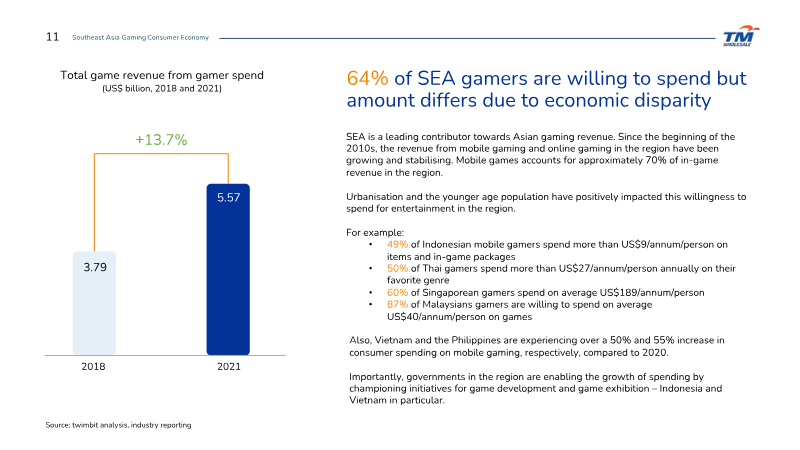
3 Southeast Asia Gaming Consumer Economy WHOLESALE SEA gaming consumer SEA has 6 major gaming markets economy highlights Indonesia, Malaysia, the Philippines, Singapore, Thailand and Vietnam account for 85% of the gamer population in the region. The internet accessibility and smartphone penetration is high, which provides major growth opportunities for the gaming economy. Mobile gaming is highly preferred Mobile gaming is the dominating category in SEA gaming economy. To address this, PC game franchises released hits like League of Legends, Final Fantasy and PUBG to mobile. This trend to serve mobile gamers will continue in the region. Gamers have high willingness to spend In SEA, the more urbanised the population is, the more they are willing to spend to play and watch games. As of 2021, gamers in the region collectively spend US$5.57bn, a 13.7% CAGR from 2018. 0 18% of gamers view eSport tournaments eSport tournaments viewership is at nascent stages and is forecasted to grow exponentially. Governments and game publishers are taking initiatives to host open competition and tournaments in order to accelerate the growth of the community. Game streaming will be a Source: twimbit analysis, industry reporting significant revenue contributor in the region in coming years.
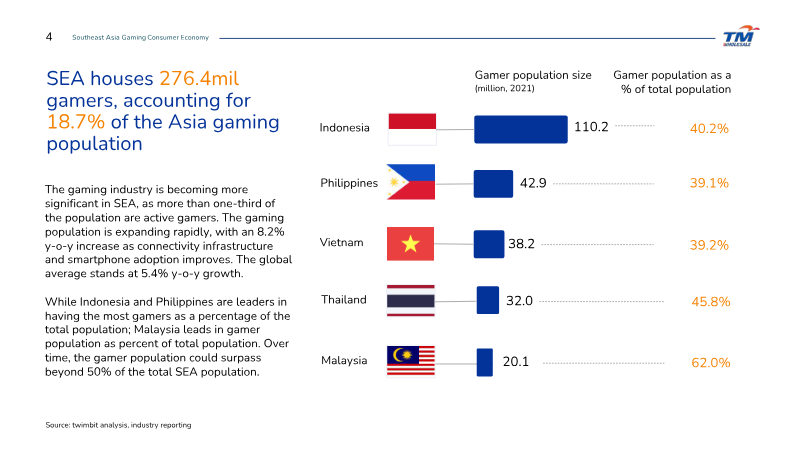
4 Southeast Asia Gaming Consumer Economy WHOLESALE SEA houses 276.4mil Gamer population size Gamer population as a gamers, accounting for (million, 2021) % of total population 18.7% of the Asia gaming Indonesia 110.2 40.2% population The gaming industry is becoming more Philippines 42.9 39.1% significant in SEA, as more than one-third of the population are active gamers. The gaming population is expanding rapidly, with an 8.2% Vietnam 38.2 39.2% y-o-y increase as connectivity infrastructure and smartphone adoption improves. The global average stands at 5.4% y-o-y growth. While Indonesia and Philippines are leaders in Thailand 32.0 45.8% having the most gamers as a percentage of the total population; Malaysia leads in gamer population as percent of total population. Over time, the gamer population could surpass Malaysia 20.1 62.0% beyond 50% of the total SEA population. Source: twimbit analysis, industry reporting
5 Southeast Asia Gaming Consumer Economy WHOLESALE Gamer population size forecast Gaming population may exceed (million, 2021-2025f) 50% of total SEA population by Gaming population SEA population 2024 SEA current population is at 640 million. The rapid growth pace of the gaming population has and will continue to outgrow the SEA total population growth. In just a few years, 1 in 2 Southeast Asians is likely to be a x 367.8 gamer, active on their console, desktop or mobile. 296.9 318.8 324.4 This pace will be more significant in younger median age 276.4 Southeast Asian countries, such as Vietnam. The average CAGR in the region between 2021 to 2025f is 7.4%. 2021 2022f 2023f 2024f 2025f Source: twimbit analysis, industry reporting
6 Southeast Asia Gaming Consumer Economy WHOLESALE 51% of Southeast Asian gamers are Top 5 game genres in SEA active in action strategy and casual (2021) games 86% of Southeast Asian gamers are actively participating in these top 5 game genres. Generally, the leading game genre, 36% 15% 13% action strategy, has a lower entry barrier and a lower time commitment. For instance, some of the leading action strategy Role playing games in the SEA region are Counter Strike and Mobile Strategy Action Legends. Both games run between 5-10 minutes for each round before restarting a new round . The popularity of the strategy genre is also exhibited in the SEA Games 2022,where subset of it - Multi-player Online Battle Arena (MOBA), was the main competing genre. 13% 9% Casual Adventure Source: twimbit analysis, industry reporting
Vietnam Mobile Gaming 2025 AIUS STARI Frontier in Southeast Asia SONAE MES 75.3 M 58.5 M 1,300M <u>1,194M</u> 1,218M 1,268M 1,200M <u>1,146M</u> <u>1,135M</u> 1,140M Mobile Users Mobile Players 1,100M 82% 75.7 Mbps 1,000M of midcore games are average 5G speed, 99% 800M imported from China coverage 2021 2022 ...
<u>01</u> Esports consumption in Southeast 05 <u>03</u> Appendix 20 Asia (SEA) Glossary 21 Consumer engagement maturity 06 Audience demographics 09 Methodology 22 Engagement and interaction 11 Contacts 23 <u>02</u> Special focus: SEA esports snapshots 14 Country profiles ...
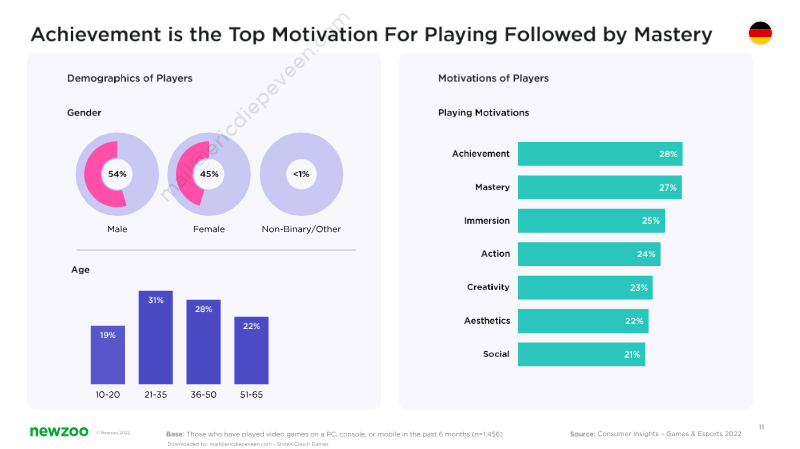
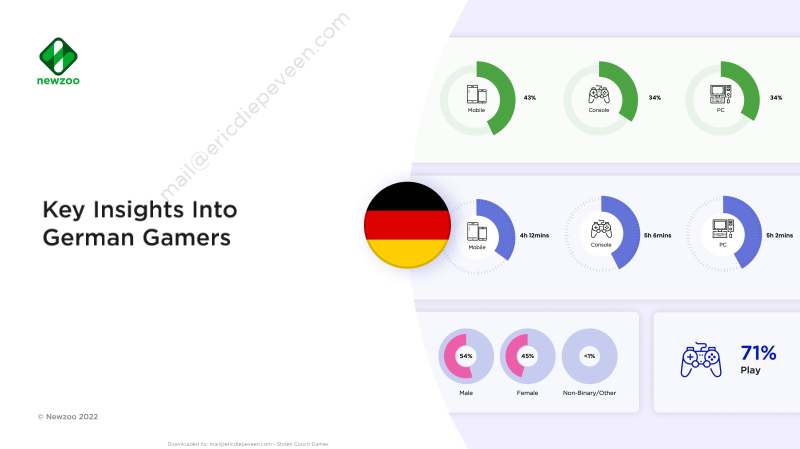
The Consumer Insights: Games and Esports 2022 report provides a comprehensive analysis of global gaming behaviors, motivations, and market engagement. The primary purpose of the research is to equip game developers, publishers, and industry stakeholders with actionable data to benchmark titles, understand player demographics, and identify growth opportunities across 36 diverse international markets. By examining over 100 key performance indicators, the analysis offers a granular view of how players interact with PC, console, and mobile platforms. The research is underpinned by a robust methodology, drawing on survey data from over 75,000 consumers worldwide. The findings highlight distinct engagement patterns, such as the prevalence of specific gaming personas—notably Time Fillers and Mainstream Gamers—and the interplay between playing and viewing habits. For instance, data from the German market indicates that while playing remains the dominant activity, a significant portion of the population also engages with gaming video content and esports. Furthermore, the report identifies key drivers for consumer spending, noting that price sensitivity, the desire for exclusive content, and social connectivity are primary motivators for financial investment in games. Covering a broad geographic scope that includes North America, Europe, Latin America, the Middle East, and the Asia-Pacific region, the report serves as a strategic tool for navigating the complex global gaming landscape. By synthesizing metrics such as monthly active users, daily active users, and lifetime player value, the analysis facilitates a deeper understanding of the motivations driving player behavior. Ultimately, the findings emphasize that a nuanced approach to audience segmentation and platform-specific engagement is essential for companies seeking to reach and retain diverse gaming populations in an increasingly competitive entertainment market.
The computer and video game industry in the United States demonstrated significant economic strength in 2013, generating a total revenue of $21.53 billion. This financial performance underscores the sector's role as a major contributor to the national economy, driven by robust consumer demand for interactive entertainment across various platforms and delivery methods. Consumer spending on game content accounted for $15.39 billion of the total industry revenue. A notable shift in purchasing behavior is evident in the 11 percent year-over-year growth of digital format sales. This trend highlights a transition toward digital distribution models, reflecting evolving consumer preferences for immediate access to content over traditional physical media. These findings provide a snapshot of the domestic gaming market during the 2013 calendar year, focusing specifically on revenue generation and sales distribution. By tracking the growth of digital formats alongside total content expenditure, the data illustrates a maturing market that is increasingly reliant on digital infrastructure to sustain its financial trajectory. The industry maintains a strong foothold in the entertainment sector, characterized by consistent revenue streams and a clear movement toward digital-first consumption patterns.