Scopely
Documents about Scopely

Trends in mobile game publishing with Scopely, Flaregames and IGG
Mobile game publishing has evolved into a strategic partnership model where publishers function as co-developers, providing essential funding, marketing infrastructure, and operational expertise.
- Mobile game publishing has shifted to a co-development model where publishers provide funding, marketing, and operational infrastructure to allow developers to focus exclusively on core gameplay.
- Publishers prioritize developers who demonstrate team cohesion and the capacity to produce multiple titles, moving away from interest in one-off projects.
- Successful pitches must feature addictive, universally appealing core mechanics that transcend specific demographic biases.
Indie Dimepiece: Super Tribes
The gaming industry has undergone a profound transformation between late 2021 and mid-2026, characterized by shifting monetization models, the integration of artificial intelligence, and a volatile investment climate.
- AppLovin has established itself as the dominant force in mobile ad tech by rewriting industry rules and creating a dependency model that forces competitors to rely on its infrastructure.
- Microfun successfully scaled 'Gossip Harbor' to the second-highest position in the US merge game market, demonstrating that significant growth is still achievable in highly competitive genres.
- Leading game studios are increasingly integrating AI to maintain live service operations, as evidenced by InnoGames using AI to extend the lifecycle of 'Sunrise Village'.

South Park's demonisation of F2P: let's blame Dungeon Keeper
The mobile gaming industry in late 2014 remains characterized by a persistent, polarized debate regarding the ethics and quality of free-to-play (F2P) monetization models.
- The mobile gaming industry is undergoing a structural shift toward service-oriented, co-development partnerships, exemplified by Scopely’s $35 million funding round.
- German developers are successfully transitioning from browser and PC markets to mobile, with Goodgame Studios scaling its workforce to 1,000 employees.
- Public perception of free-to-play (F2P) monetization remains polarized, with the 2014 mobile iteration of Dungeon Keeper serving as the primary symbol for criticisms regarding aggressive timers and exploitative mechanics.
Checklist for a Free App
The gaming industry has undergone a period of profound transformation between 2022 and mid-2026, characterized by a shift toward hybrid monetization models, the integration of artificial intelligence, and a cooling of venture capital investment.
- Mobile gaming success is increasingly driven by iterative product development, as evidenced by Voodoo’s model of testing 2,000 prototypes annually to identify hits.
- User acquisition (UA) strategies frequently collapse during the scaling phase, requiring systems that go beyond standard platform-provided tools to maintain performance.
- In a privacy-centric advertising landscape, the quality and optimization of ad creatives have become the primary drivers of marketing effectiveness.
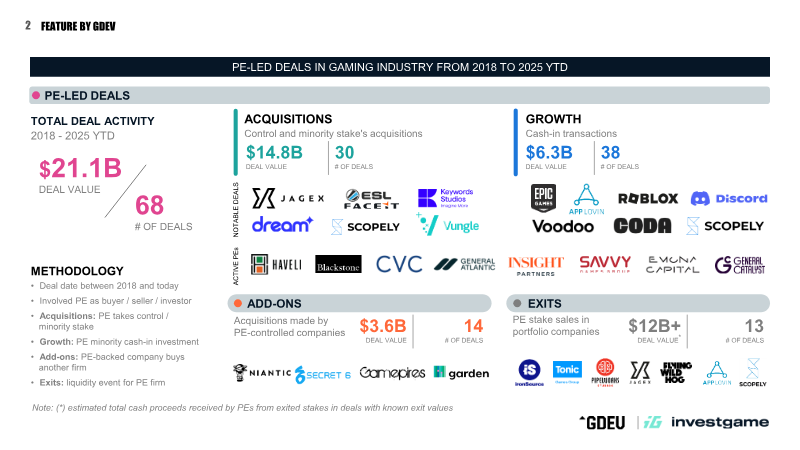


The Rise of the Financial Kingmakers: Private Equity’s $21B+ Bet on Gaming
The analysis demonstrates that private equity (PE) has increasingly positioned itself as a decisive force in the gaming sector, channeling more than $21 billion into acquisitions and growth investments from 2018 through the first half of 2025.
- Private equity firms deployed over $21 billion into the gaming sector between 2018 and mid-2025, with annual deal values consistently surpassing $1 billion.
- Control acquisitions represent the primary investment strategy, accounting for approximately 60% of total capital deployed in the sector.
- Content creation studios holding strong IP portfolios are the most targeted assets, securing 42 of the 68 total private equity-led deals identified.

China Ruyi FY2025 Q4 Earnings Release
China Ruyi achieved a substantial financial turnaround in fiscal year 2025, transitioning from a net loss of RMB 206.6 million in the previous year to a net profit of RMB 1.786 billion.
- China Ruyi achieved a financial turnaround in FY2025, reporting a net profit of RMB 1.786 billion compared to a net loss of RMB 206.6 million in the previous year.
- The company generated RMB 3.343 billion in revenue and achieved an adjusted net profit of RMB 1.96 billion for the fiscal year.
- The firm’s balance sheet shows total assets of RMB 30.26 billion and total equity of RMB 23.85 billion, with basic earnings per share at RMB 11.42 cents.