Engine
Company
Documents about Engine

GDC Summer Dev Speedrun - Star Wars: Republic Commando With Harley Baldwin
The development of Star Wars: Republic Commando, released in 2005, serves as a case study in balancing ambitious squad-based mechanics with the severe hardware constraints of the original Xbox.
- To address player feedback that the game did not feel like a squad-based experience, the development team implemented a simple code change that defaulted the squad to 'search and destroy' behavior whenever the player entered a new area, ensuring the AI remained visible and active.
- Technical limitations in Unreal Engine 2 and the hardware of the era forced level designers to use short hallways to connect large arenas, as the engine struggled to render expansive environments alongside the necessary connective geometry.
- Early prototypes for vehicle-based or moving-platform gameplay were abandoned because the physics simulation costs were prohibitively expensive for the hardware available at the time of development.

How Film, Games & Social Media are Merging Using AR PG Connects Digital #2
The convergence of film, gaming, and social media is being driven by the rapid advancement of augmented reality (AR) and real-time rendering technologies.
- The convergence of film, gaming, and social media is driven by the adoption of shared real-time rendering tools like Unreal Engine and Unity, which enable high-fidelity interactive experiences across all three sectors.
- Virtual production is replacing traditional green-screen workflows by using LED walls and real-time ray tracing to allow filmmakers to manipulate environments instantaneously.
- The democratization of mobile computing power has enabled social media users to create professional-grade visual effects, while digital twins provide the high-resolution scanning necessary to bridge physical and virtual worlds.

Got Games on Your Apple Watch? PG Connects Digital #2
Abylight Studios, a Barcelona-based developer established in 2004, highlights the potential for high-quality 3D gaming on the Apple Watch through the development of their title, Mind Keeper: The Lurking Fear.
- The Apple Watch represents an underutilized market for standalone 3D gaming, offering indie developers a less crowded platform to reach dedicated audiences.
- Abylight Studios developed the 'Providence Engine,' a custom lightweight visual editor, to bypass the limitations of standard tools like Unity when building for the Apple Watch.
- Successful Apple Watch game design requires building standalone experiences that do not rely on an iPhone, specifically optimizing for the device's unique hardware constraints.

T1000’s, Trex’s & Eyebrow Mites PG Connects Digital #2
Steve Williams, a veteran computer graphics pioneer and former chief animator at Industrial Light & Magic (ILM), provided an analytical retrospective on the evolution of computer-generated imagery (CGI) during his session at Pocket Gamer Connects Digital #2 in June 2020.
- The transition from stop-motion to digital assets in films like Jurassic Park proved that CGI could replicate physical realism—such as breathing and weight—that was previously deemed impossible by industry experts.
- Technological breakthroughs in visual effects are driven by a synergy between creative curiosity and the inevitable progression of hardware capabilities.
- Modern real-time rendering, exemplified by Unreal Engine and productions like The Mandalorian, represents the next phase of visual evolution where any imagery is theoretically possible given sufficient computational power.


Half-Year Report of 11 Bit Studios S.A. for the First Half of 2020
11 bit studios S.A. achieved the second-best half-year financial performance in its history during the first half of 2020, characterized by a 63.2% year-on-year revenue increase to PLN 50.2 million and a 237% surge in net profit to over PLN 25.0 million.
- 11 bit studios achieved its second-best half-year performance in H1 2020, with revenue rising 63.2% year-on-year to PLN 50.2 million and net profit surging 237% to over PLN 25.0 million.
- The company holds a strong liquidity position with PLN 114.2 million in total financial assets and over PLN 95 million in cash reserves, which are being used to self-finance three major internal projects: 'Project 8', 'Dolly', and 'Eleanor'.
- The publisher is strategically shifting away from the indie segment toward higher-budget productions, highlighted by the migration of 'Project 8' to Unreal Engine 5.

Epic's $18B Valuation: Too High or Too Low?
The analysis evaluates the $18 billion valuation of Epic Games following a 2020 investment by Sony.
- Epic Games' valuation reached approximately $17.86B to $18B following a $250M investment from Sony and a planned $750M funding round.
- When compared to public game companies using 2019 EBITDA multiples, Epic Games appears to be fairly valued or potentially undervalued.
- The majority of Epic's valuation is currently driven by the Fortnite business, creating a significant risk if the title experiences a material decline in performance.

ILMxLAB: Pioneering Immersive Entertainment
Immersive entertainment is undergoing a fundamental transformation, moving away from isolated virtual reality experiences toward a model of persistent, interconnected digital worlds.
- Location-based VR experiences can serve as a primary retail anchor, as evidenced by a Westfield London location where 71.6% of visitors reported the VR attraction was their sole reason for visiting the mall.
- The future of immersive entertainment lies in a multi-platform ecosystem where a single identity and narrative persist across devices, ranging from mobile AR and tablet-based crafting to console gaming and full-immersion VR.
- Hyper-reality experiences like 'The Void' successfully leverage untethered headsets, motion capture, and multi-user networking to create social environments where strangers often leave feeling like close friends.

Epic Games $18B Valuation: Too High or Too Low?
The July 2020 analysis evaluates whether Epic Games’ $18 billion valuation, prompted by a $250 million investment from Sony, is justified or inflated.
- Following a $250 million investment from Sony for a 1.4% stake in July 2020, Epic Games reached a valuation of approximately $17.86 billion, with potential to exceed $18 billion pending further funding rounds.
- A sum-of-the-parts valuation analysis suggests Epic Games is worth roughly $25 billion plus additional 'option value' from emerging business lines, indicating the company may be undervalued compared to public gaming peers.
- The majority of Epic's current valuation remains heavily dependent on the performance of Fortnite, which generated $1.8 billion in reported revenue according to 2019 SuperData figures.

Procedural Islands of 'Dauntless'
The procedural island pipeline developed for the action RPG Dauntless addresses the challenge of creating diverse, high-quality game environments with a small development team.
- The Dauntless island pipeline integrates Houdini Engine with Unreal Engine to automate environment generation while maintaining manual artistic control over topology and foliage.
- The system utilizes a modular 'recipe' architecture that defines biomes by aggregating specific parameters, meshes, and foliage types.
- The generation process follows a multi-stage workflow, beginning with 2D Voronoi-based layout constraints and concluding with 3D landmass and asset instantiation.

New Game Engines: To Live in Promise
The introduction of Unreal Engine 5 represents a significant leap in graphical fidelity and rendering technology, yet it highlights a persistent tension in the gaming industry between technical capability and economic viability.
- Epic Games' Unreal Engine 5 introduces a new royalty structure that waives fees on the first $1 million of revenue, significantly lowering the barrier to entry for medium-sized studios.
- High-fidelity, single-player experiences like Red Dead Redemption 2 and GTA V require massive budgets and teams, limiting their production to only a few major publishers per year.
- Despite the industry's focus on photorealism, market data shows that simple, stylized games like Minecraft and Fortnite often outperform high-fidelity titles in popularity and revenue.
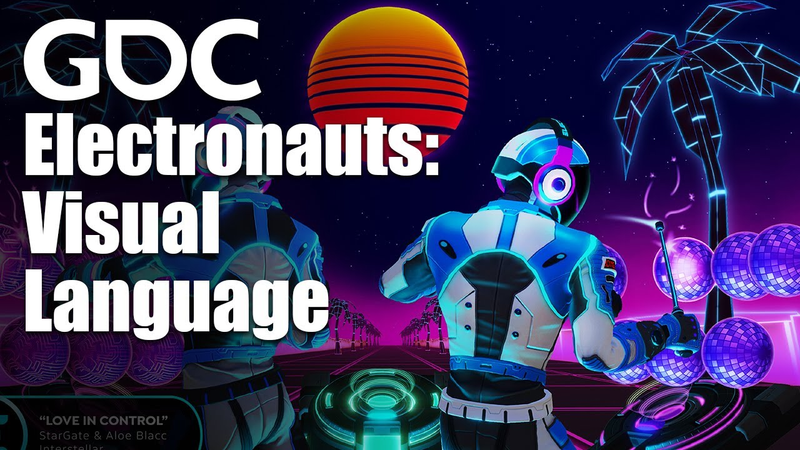
Visual Language of Electronauts: An Immersive Sound Based VR Experience
Electronauts is an immersive virtual reality music creation experience designed to enable users to perform music regardless of their formal musical training.
- Electronauts is a music creation experience developed by Survios that utilizes a proprietary 'Music Reality Engine' to ensure user inputs remain on-beat regardless of musical skill.
- The visual design of the experience was heavily influenced by 1980s synth-wave aesthetics, utilizing neon color palettes, geometric shapes, and cosmic imagery to create a psychedelic, sensory-overloading environment.
- The environment design for the 'Prodigy One' hub was inspired by professional audio equipment, incorporating speakers, equalizers, and turntables into the architecture to reinforce the theme of sound-driven creation.

The Making of Masterpiece VR with Jonathan Gagne | GduX.me 2020
The democratization of 3D content creation relies on shifting from traditional 2D interfaces to native virtual reality environments.
- VR-based 3D modeling, supported by machine learning, can increase production speeds by up to 10x and reduce the learning curve by a factor of 200 compared to traditional 2D interfaces.
- Masterpiece VR currently supports a user base of over 30,000 individuals and maintains seamless integration with industry-standard pipelines including Unity, Unreal Engine, and Substance Painter.
- The VR industry is maturing through the combination of high-fidelity software and lightweight, cloud-enabled hardware, with a long-term shift expected toward augmented reality as motion-tracking constraints are resolved.