Disney
CompanyUnited States
Documents about Disney
Gaming Report: VC Trends and Emerging Opportunities Q1 2024
The analysis evaluates venture-capital dynamics and emerging opportunities within the global gaming sector during the first quarter of 2024.
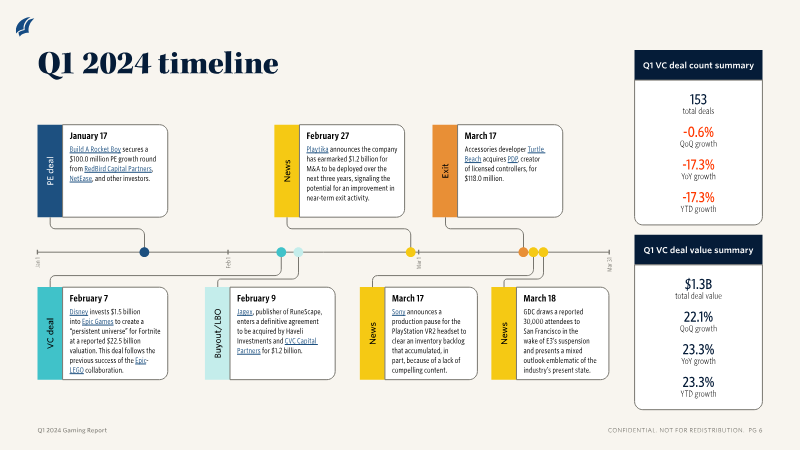
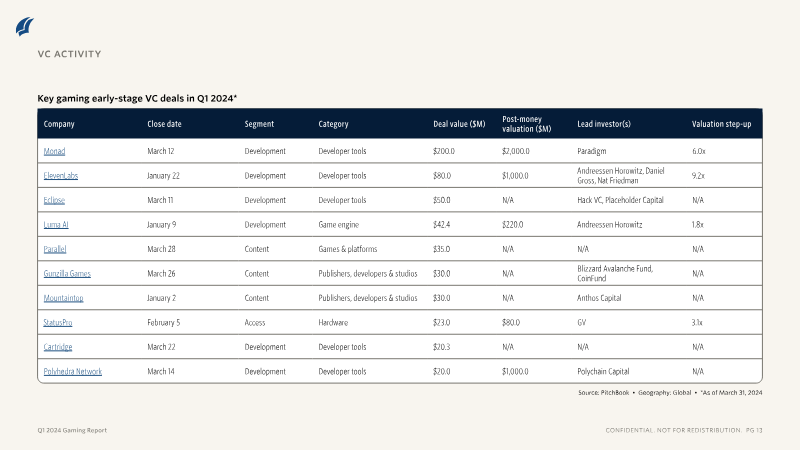
- Q1 2024 venture funding in gaming reached $1.3 billion across 153 deals, marking a 22.1% increase in deal value quarter-over-quarter and a 23.3% increase year-over-year.
- While total deal count remains down 17.3% compared to Q1 2023, projected 2024 funding is expected to exceed 2023 totals by approximately $1 billion.
- Development-focused investments currently lead the market, though analysts anticipate a shift back toward content as high-quality game pipelines mature.

GungHo Business Report Vol. 41
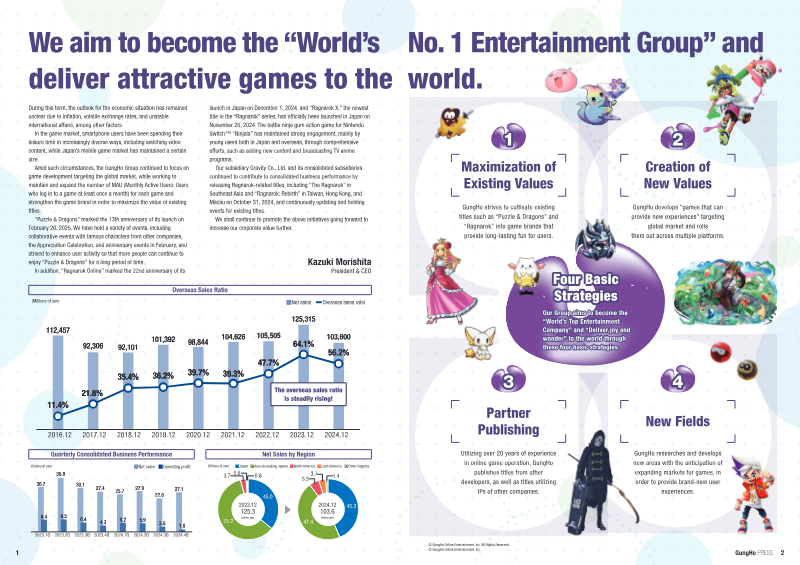
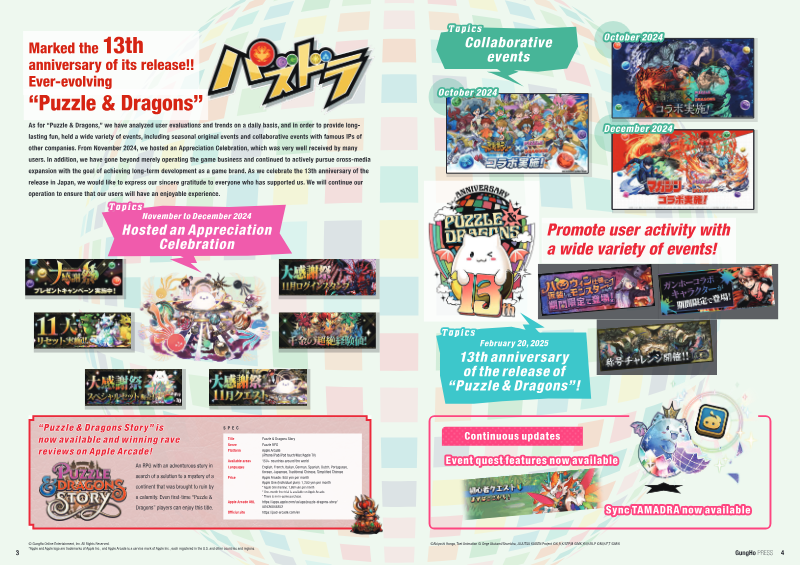
GungHo Online Entertainment aims to establish itself as the world’s leading entertainment group by delivering high-quality gaming experiences across global markets.
- GungHo reported 103.6 billion yen in net sales and 17.49 billion yen in operating profit for the 2024 fiscal year.
- International expansion is a primary growth driver, with overseas sales now accounting for 47.7% of total revenue.
- The 13-year-old title Puzzle & Dragons remains the company's core financial pillar, supported by new releases like Disney Pixel RPG and the Japanese launch of Ragnarok X.

TWIG #278 The AAA Studio Model is Dead??? And who are the BIG Gaming VC Funds good for?
The modern gaming industry is currently navigating a period of structural tension between traditional AAA development and the evolving demands of venture capital and transmedia integration.
- Despite industry speculation, high-budget AAA titles remain the primary drivers of revenue and player engagement according to data from Newzoo and Circana.
- The pursuit of Hollywood-style transmedia adaptations often fails to yield significant incremental revenue relative to high production costs, indicating a lack of strategic alignment for long-term growth.
- Venture capital firms like a16z and Bitkraft are creating market instability by pressuring portfolio studios to pursue high-risk, unicorn-style returns that conflict with sustainable development.

London Games Festival: The VGIM Guide
The London Games Festival serves as a significant two-week celebration of the city’s £2 billion video games sector, acting as a central hub for industry professionals and the public.
- London's video games sector is valued at £2 billion, with the London Games Festival serving as a primary hub for industry networking and talent showcasing.
- Blizzard has successfully resolved IP disputes with NetEase, facilitating the return of World of Warcraft to the Chinese market.
- Miniclip has acquired Futurlab, the developer behind Powerwash Simulator, as industry consolidation continues.

6 Days of Indie Game Dev - Devlog
The development process for the first-person shooter Twisted Tower focuses on reconciling a thematic dissonance between a Disney-inspired fairy tale aesthetic and a gritty horror environment.
- To establish a distinct visual identity for the FPS 'Twisted Tower,' the developer pivoted from a generic shooter aesthetic to a 'Disney-esque horror' theme by applying 'grimy' textures to clean assets to create a jarring, contradictory effect.
- Small-scale texture adjustments, such as adding subtle shadows or grid patterns to flat surfaces, can significantly enhance environmental depth and visual interest without requiring complex modeling.
- The developer emphasizes that effective game design often relies on 'slamming two contradictory ideas together,' such as pairing cute, whimsical themes with violent, grotesque gameplay elements.
Q1'24 Gaming Deals Report: The Dog Days Are Over
The gaming industry entered a period of stabilization during the first quarter of 2024, signaling an end to the post-pandemic market correction.
- The gaming industry has reached a stabilization point where transaction activity is settling at a new baseline that remains higher than 2019 levels.
- Investment is bifurcated: early-stage funding remains robust, supported by 65 specialized funds and major deals like Disney’s $1.5 billion investment in Epic Games, while late-stage financing and IPOs remain stagnant.
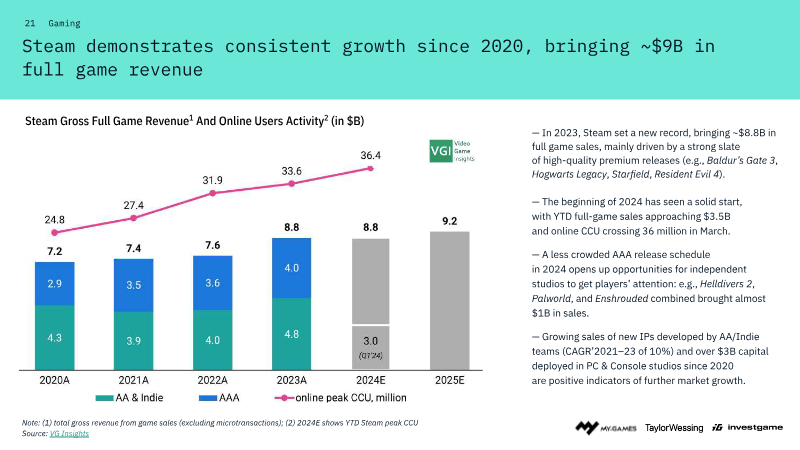
- PC and console gaming are outperforming the mobile sector, attracting over $3 billion in venture capital since 2020 due to higher success rates for new intellectual property.


Gaming Industry Report: Q1 2024
The global gaming market is projected to reach $189.3 billion in 2024, representing a 2.9% year-over-year increase.
- The global gaming market is projected to reach $189.3 billion in 2024, marking a 2.9% year-over-year growth.
- Venture capital funding for gaming reached $594 million across 124 rounds in Q1 2024, a 94% increase in volume and 28% rise in deal count compared to the previous quarter.
- Major gaming and tech companies hold approximately $302 billion in combined cash reserves, signaling a strong environment for future industry consolidation.
State of Play: Spring Edition
Mobile gaming has solidified its position as the industry’s primary driver, currently engaging 1.9 billion players and tracking toward $118 billion in annual revenue by 2027.
- Mobile gaming is the industry's primary growth engine, with 1.9 billion players and projected annual revenue of $118 billion by 2027.
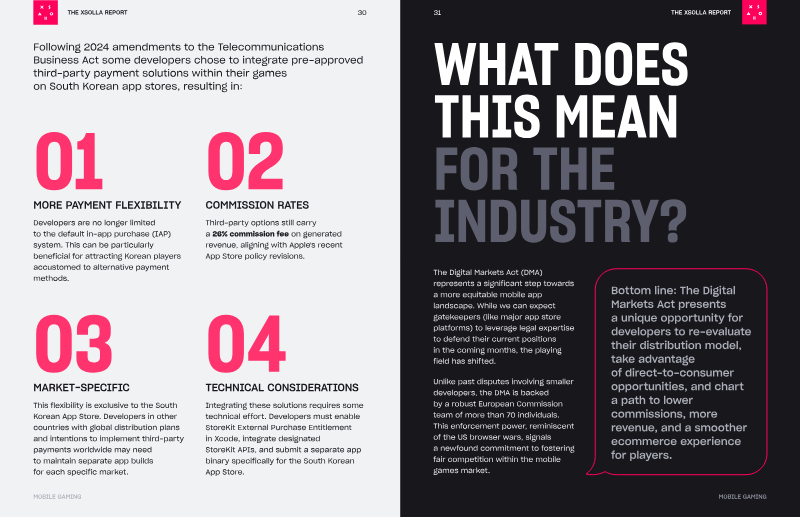
- Regulatory changes like the EU's Digital Markets Act are dismantling app store walled gardens, enabling developers to bypass standard commission fees through alternative billing and direct-to-consumer commerce.
- Cross-platform play is now a standard expectation, with 87% of multiplayer gamers participating and developers increasingly integrating 5G and mobile wallets to facilitate unified 'cross-pay' ecosystems.
ZiMAD: Subscriptions Now Account for More Than 70% of Magic Jigsaw Puzzles’ Revenue
The mobile gaming studio ZiMAD has successfully sustained its flagship title, Magic Jigsaw Puzzles, for over a decade by evolving its monetization and engagement strategies.
- Subscription-based revenue now accounts for more than 70% of total payments within the mobile game Magic Jigsaw Puzzles.
- ZiMAD sustains its decade-old flagship title by offering premium subscriptions that remove advertisements and provide exclusive features to dedicated users.
- The game’s core demographic consists primarily of women over the age of 50 who prioritize low-stress, non-competitive gameplay.

Fireside Chat: How the Home of Dead by Daylight has Stayed Independent. Charlie Scowen & Danni Pratt
Behaviour Interactive, a Canadian game developer with over 30 years of industry experience, maintains its independence by balancing original intellectual property development with strategic co-development services.
- Behaviour Interactive has maintained independence for over 30 years, currently employing over 1,300 people across six global studios.
- The studio enforces a strict 'no-crunch' policy, a culture spearheaded by CEO Rémy Racine that prioritizes work-life balance and employee retention.
- Behaviour Interactive utilizes a 'passion-first' service model, refusing to accept external development projects unless at least one team member is personally obsessed with the specific IP.

Microsoft Has a Big Fight Ahead if Its "Gamer First" Xbox App Store Is Going to Work
Microsoft faces significant structural and regulatory hurdles in its ambition to launch a "gamer first" mobile app store.
- Microsoft is actively pursuing the development of a 'gamer first' mobile app store to challenge the existing Apple and Google duopoly.
- Phil Spencer has publicly criticized Apple’s recent EU App Store policy changes, arguing they fail to foster genuine competition and may even hinder it.
- Regulatory efforts, including US lawsuits and the EU’s Digital Markets Act, have thus far failed to effectively open mobile ecosystems to alternative storefronts.

Investing in Influence: Video Games Industry Memo, 15/02/2024
The video games industry is witnessing a strategic shift toward "investing for influence" rather than traditional internal development or full-scale acquisitions.
- Major media and technology firms are shifting from internal development to an 'investing for influence' model to secure presence in digital ecosystems without the operational burden of managing game divisions.
- Disney’s $1.5 billion investment in Epic Games serves as a primary example of this strategy, allowing the company to gain creative influence over a virtual platform while outsourcing technical complexities.
- The industry is moving toward a model of minority stakes, similar to Tencent’s long-standing strategy, to capture audience engagement and foster connections within dominant 'walled garden' platforms.