Diamond
Company
Documents about Diamond



Whitepaper13 pages
Prank, Troll, Gross and Gore: Performance Issues in Esport Live-Streaming
Karhulahti's study examines how live-streaming of competitive esports is shaped by spectator interference, using a twelve-month observation of League of Legends streamer Gross Gore.
- Spectator interference in live esports streams, such as pranks, trolling, and mass food orders, disrupts the 'interview frame' of streamer-viewer conversation, and the streamer responds by sustaining a consistent, humorous persona.
- Live-stream viewers actively seek to alter match outcomes and broadcast direction, and the resulting unpredictability creates a distinctive dramatic appeal that drives viewership, differing fundamentally from traditional sport or esport spectatorship.
- The study's single case study, League of Legends streamer Gross Gore, drew over ten million viewers and £106,033 in fan donations in 2015, illustrating the economic scale of such performances.
DiGRAJan 2016
Whitepaper4 pages
The Spontaneous Playfulness of Creativity: Lessons from Interactive Theatre for Digital Games
This paper argues that the practices and theories of improvisational and activist theatre can enrich digital game design by introducing spontaneous, playful creativity into how developers conceive characters, relationships, social issues, and gameplay.
- The paper argues that improvisational and activist theatre methods can introduce spontaneous, playful creativity into digital game design, shifting developers away from a sole focus on technical topics like facial rendering and AI agents.
- It proposes adapting Uta Hagen's character analysis questions and Stanislavski-inspired "inside out" development to build digital characters from the inside rather than from surface traits.
- It applies Chris Crawford's arithmetic formulation of relationship motivation, along with Keith Johnstone's status-tower and "Lists" exercises, to construct relationship dynamics and generate first-instinct game ideas.
DiGRAJan 2007
Whitepaper7 pages
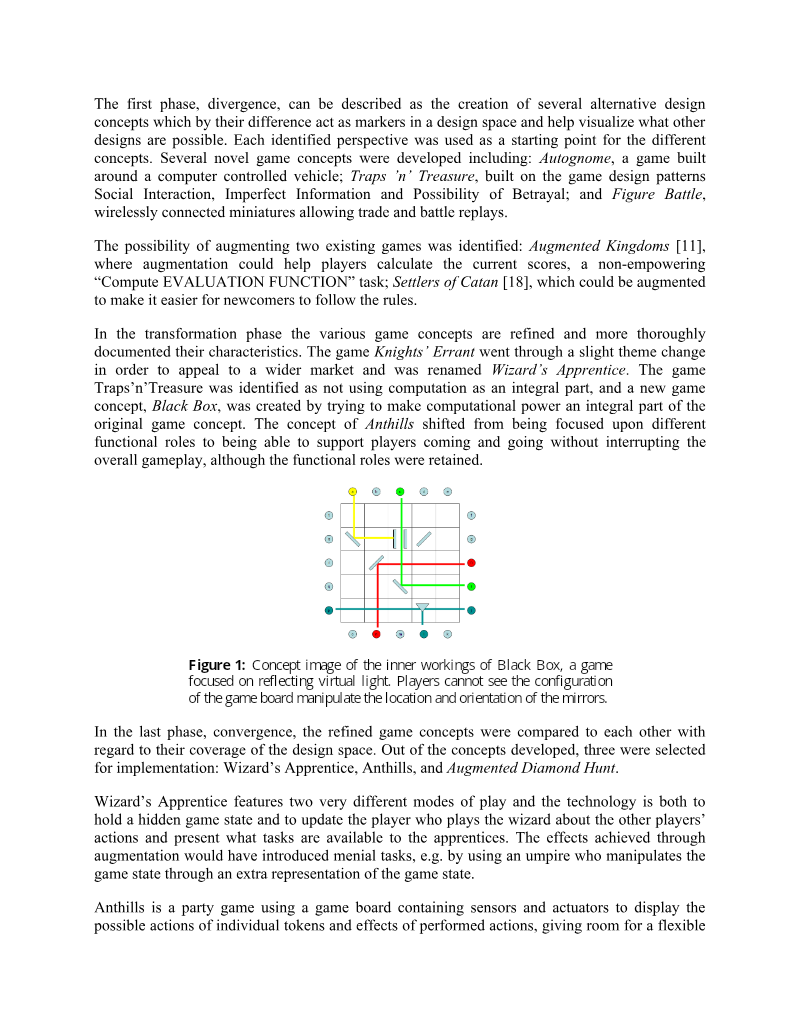
Augmented Board Games: Enhancing Board Games with Electronics
This paper, presented at DiGRA 2005, examines augmented board games: traditional board games extended with electronics, sensors, and computational power to enhance gameplay.
- The paper, presented at DiGRA 2005, maps the design space of augmented board games (traditional board games extended with electronics, sensors, and computing), with the goal of mapping subspaces rather than producing a complete taxonomy.
- The authors set three research priorities: minimize unempowering or tedious player activities, provide mechanics impossible or impractical without technology, and preserve the social environment of non-augmented board games.
- Purely aesthetic augmentation was deliberately excluded unless it arose as a side effect of gameplay improvements.
Interactive InstituteJan 2005