Reports in the Market (Overall) category.
The United States represents the second-largest gaming market globally, generating $47.3 billion in revenue from a population of 191 million gamers. Research conducted in 2022 indicates that 72% of the American online population are game enthusiasts, a broad category encompassing those who play, watch, or socially engage with video games. While 71% of the population plays games, there is a significant overlap with viewership, as 44% of the population watches gaming video content and 18% engages with esports.
The demographic profile of American gamers is nearly evenly split by gender, with 52% identifying as male and 47% as female. Engagement spans all age groups, though the 21-35 bracket is the most active at 35%. Player motivations are diverse, led by social interaction (37%), action (37%), and achievement (36%). While mobile is the most popular platform by reach, capturing 48% of players, console gaming commands the highest engagement time, averaging six hours per week.
Economic engagement is high, with 49% of the online population spending money on games. The primary drivers for spending include the desire to play with friends or family, taking advantage of sales, and unlocking exclusive content. Popular titles like Fortnite, Grand Theft Auto V, and Call of Duty dominate the market, with shooters and adventure games ranking as the top genres by monthly active users. This data is derived from a 2022 consumer insights survey of 3,054 online respondents in the U.S., part of a broader global study covering 36 markets.
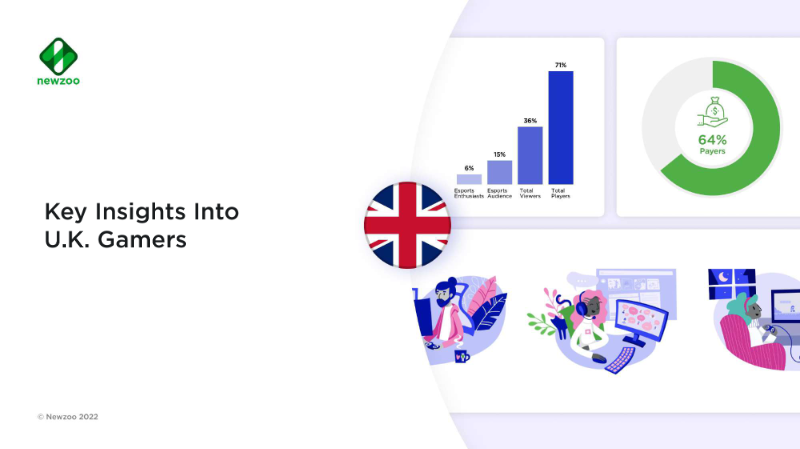
The United Kingdom represents a major global gaming hub, ranking as the sixth-largest market by revenue and tenth by player population as of late 2022. Research conducted among the online population aged 10 to 65 indicates that gaming is a primary entertainment pillar in the region, with 71% of the population identifying as game enthusiasts. This engagement is split between active play and content viewership, with 36% of the population exclusively playing games and another 35% both playing and viewing gaming video content.
The demographic profile of UK gamers is nearly balanced by gender, consisting of 52% male and 47% female players. While gaming spans all age groups, the 21-35 bracket is the most active. Motivation for play is driven primarily by the desire to unwind and relax, followed by the pursuit of achievement and social interaction. When categorized by persona, Time Fillers—those who play casually to pass the time—represent the largest segment, followed by Mainstream Gamers who engage deeply with both play and viewership.
Platform preferences show that mobile gaming has the highest reach at 46%, followed by console at 41% and PC at 29%. However, PC and console players demonstrate higher average weekly time commitments compared to mobile users. Financial engagement is also significant, with 63% of players identified as payers. The primary driver for spending is the availability of sales or special offers, though social motivations, such as spending to play with friends or family, also influence purchasing behavior.
The findings are based on a 2022 survey of 2,010 respondents in the United Kingdom, part of a broader global study covering 36 markets. The methodology utilizes a representative sample of the online population to track dozens of key performance indicators, including audience profiles, platform behavior, and monetization trends.
The global game development landscape in 2022 is defined by a tension between technological tradition and evolving labor standards. PC remains the primary platform for 63% of developers, while the PlayStation 5 has established itself as the leading console for both current and future development cycles. Despite the industry’s technical foundations, there is profound skepticism regarding decentralized technologies; over 70% of studios express no interest in cryptocurrency or NFTs, and a third of professionals believe the metaverse concept will fail to materialize. Conversely, accessibility has reached a critical milestone, with 39% of developers now integrating features for impaired players, marking the first time such initiatives have outpaced non-implementation.
Labor dynamics are undergoing a significant transformation as professionals increasingly prioritize social activism and workplace equity. While a record 60% of developers now work 40 hours or less per week, the industry continues to struggle with systemic cultural issues. Approximately 62% of companies failed to formally address widespread reports of toxicity and misconduct, and the workforce remains predominantly male and relatively inexperienced, with over half of all professionals having ten years or less in the field. Furthermore, the rise of unionization discussions, reported by 23% of professionals, suggests a growing movement toward formal collective bargaining.
The industry’s geographic footprint remains heavily concentrated in the West, with 54% of developers based in the United States and 16% in Western Europe. Although remote work has become more prevalent, this shift has not yet decentralized the industry’s core hubs, as regions like Asia, Canada, and South America each represent 6% or less of the global workforce. This distribution reflects a Western-centric bias in current industry data and highlights the continued dominance of North American and European studios in shaping global development trends and labor standards.
The global games market entered a corrective phase in 2022, with annual revenues projected to decline by 4.3% to $184.4 billion. This contraction follows a period of unsustainable pandemic-driven expansion and is further exacerbated by macroeconomic inflation, supply chain disruptions, and a sparse release schedule for major titles. Despite this short-term dip, the industry maintains a massive engagement base of 3.2 billion players and is expected to resume an upward trajectory, reaching an estimated $211.2 billion by 2025. While mature markets like North America and Asia-Pacific are experiencing revenue declines, emerging mobile-first regions such as Latin America and the Middle East & Africa continue to show positive growth.
The industry is currently undergoing a structural shift toward platform-agnostic ecosystems and hybrid monetization strategies. As traditional mobile advertising faces challenges from privacy policy changes like Apple’s IDFA, console and PC developers are increasingly adopting programmatic in-game advertising to monetize the hundreds of millions of players who do not make direct purchases. This shift is supported by major platform holders like Sony and Microsoft, who are integrating non-intrusive, blended advertisements to create recurring revenue streams. Furthermore, the rise of user-generated content, cloud gaming, and blockchain-based models is redefining how players interact with and derive value from digital environments.
Future market stability is increasingly tied to ecosystem-based analysis rather than hardware-specific metrics, reflecting a broader trend of cross-platform play and industry consolidation. Regulatory shifts in China have also prompted a strategic pivot toward global expansion in other emerging markets. As the industry evolves, success will likely depend on balancing diverse monetization models with authentic player experiences, while leveraging new technologies in virtual reality and cloud infrastructure to maintain long-term engagement across a diversifying global audience.
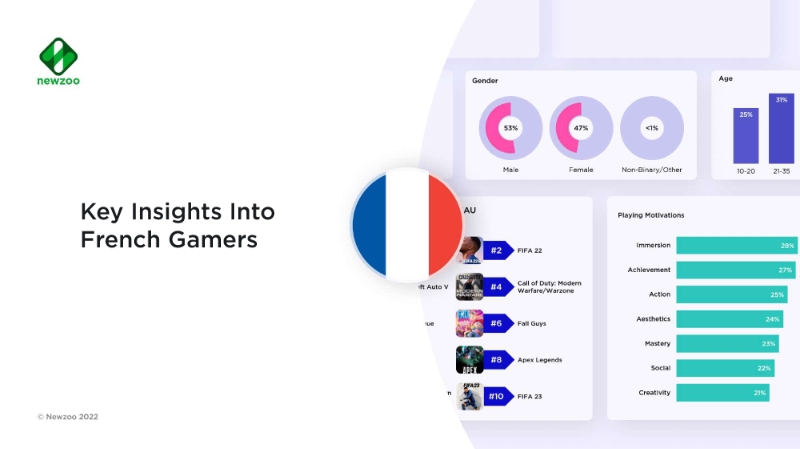
France represents a significant gaming market, ranking seventh globally in terms of revenue and fifteenth in total player count as of 2022. The French gaming population is highly engaged, with 71% of the online population aged 10 to 65 identifying as game enthusiasts. While 38% of this group only plays games, a substantial 34% also views gaming video content, and 15% are classified as esports enthusiasts who watch professional competitive gaming at least once a month.
The demographic profile of French players is nearly balanced by gender, consisting of 52% men and 48% women. The largest age cohort is the 21-35 bracket, representing 31% of the player base. In terms of behavior, Time Fillers and Mainstream Gamers are the most common personas. Time Fillers use games primarily to pass the time and show less interest in viewing content, whereas Mainstream Gamers are deeply invested in both playing and watching gaming media. Mobile is the most popular platform, utilized by 44% of the online population, followed by console at 41% and PC at 30%. Despite mobile's reach, PC players record the highest average weekly playtime at four hours and forty minutes.
Monetization data indicates that 56% of French players are payers, driven primarily by value-based incentives such as sales or special offers. Other significant spending motivators include unlocking exclusive content and the desire to play with friends or family, underscoring the social nature of the market. This analysis is based on a 2022 survey of 2,080 online consumers in France, part of a broader global study covering 36 markets and over 75,000 respondents.
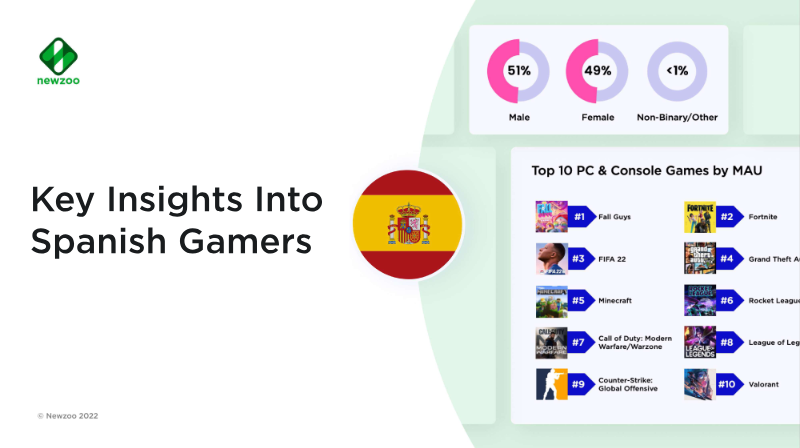
Spain represents a significant global gaming market, ranking 13th in the world with an annual revenue of $2.38 billion. The industry maintains a massive reach within the country, as 83% of the online population aged 10 to 65 are classified as game enthusiasts. Engagement is multifaceted, with 82% of the population playing games and 45% viewing gaming content. Notably, there is a high degree of overlap between these behaviors; 38% of the population both plays and watches games, while only 7% are exclusive viewers.
The demographic profile of Spanish gamers is nearly evenly split between genders, with 51% female and 49% male. Participation remains strong across age groups, though it peaks among those aged 21 to 50. Achievement, action, and mastery serve as the primary motivations for play. While mobile is the most popular platform by reach, utilized by 60% of the population, PC and console players demonstrate higher engagement depth, averaging four hours of play per week compared to three hours on mobile.
Market behavior indicates a strong propensity for spending, with 48% of the online population identified as payers. The primary drivers for monetization include sales or special offers and the desire to play with friends or family. In terms of content, the market is dominated by major global franchises such as Fall Guys, Fortnite, and FIFA 22, with adventure and sports ranking as the top genres by monthly active users. These findings are based on a 2022 consumer study involving a sample of 2,086 online respondents in Spain, forming part of a broader global research initiative covering 36 markets.
The global gaming industry is undergoing a transformative shift into a primary mass medium, projected to reach 3.5 billion players and $225 billion in revenue by 2025. This evolution is characterized by gaming’s role as a central pillar of culture and social connection, with over a third of players utilizing the medium specifically for socialization. Analysis across 21 global markets reveals that gamers are highly engaged "super-consumers" who spend nearly 60 hours a week across television and internet platforms, making them a critical demographic for brand attention.
To effectively reach this audience, the industry must move beyond traditional demographic stereotypes and adopt a motivation-based segmentation. This approach identifies six distinct player types, allowing for more authentic engagement. However, a significant gap remains between the diverse player base and the industry’s internal demographics, which remain predominantly male and white. Prioritizing equity, inclusion, and accessibility is essential for future growth, as evidenced by the commercial success of titles that prioritize inclusive design and representation.
Successful brand integration requires a departure from standard advertising in favor of intrinsic in-game experiences and value-driven partnerships. Strategies such as gamified commerce, immersive virtual events, and the utilization of original intellectual property yield higher attention and recall rates than traditional social media formats. By fostering mutually beneficial relationships and respecting established gaming codes, brands can leverage the medium not just for visibility, but as a sophisticated tool for long-term community building and commercial innovation.
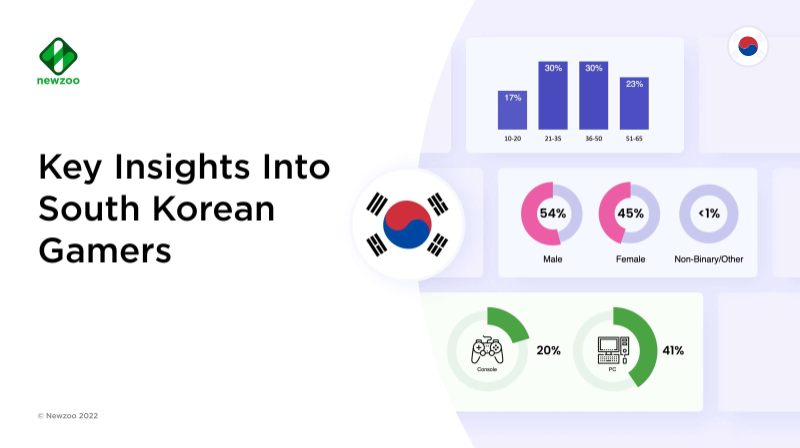
South Korea represents the fourth largest gaming market globally by revenue, valued at $8.3 billion, with a highly engaged population of 33 million gamers. Research conducted in 2022 indicates that 76% of the online population are game enthusiasts who engage with the medium through playing, viewing, or social interaction. While 72% of the population plays games, there is a significant overlap with viewership; 48% of South Koreans both play and watch gaming content, while 22% specifically engage with esports.
The demographic profile of South Korean gamers is diverse, with a nearly even split between males (54%) and females (45%) and broad representation across age groups, particularly those between 21 and 50. Socializing is the primary motivator for play, followed by action and achievement. Despite the high engagement levels, player personas vary; the most common types are Time Fillers, who play casually to pass the time, and Mainstream Gamers, who invest heavily in both playing and viewing.
Mobile is the dominant platform, utilized by 59% of the online population, though PC players record the highest average weekly engagement at five hours. In terms of software, League of Legends and Shooter genres lead in monthly active users. Monetization is also robust, with 38% of the population spending money on games. The primary drivers for spending include the desire to advance more quickly or easily in-game, followed by responding to sales or special offers.
The findings are based on a 2022 consumer insights survey of 2,094 respondents from the South Korean online population. The data highlights a mature market where gaming is a mainstream social activity integrated into daily life across all demographics, supported by a strong esports culture and a high propensity for in-game spending.
Gaming has evolved into a multi-dimensional entertainment ecosystem where traditional play is no longer the sole driver of engagement. Findings indicate that 79% of the global online population are game enthusiasts, participating through playing, viewing content, or socializing in virtual worlds. This shift is most pronounced among younger generations; for Gen Alpha, gaming has surpassed social media and streaming video as the primary source of entertainment.
The research highlights a significant trend toward the "metaverse," with 75% of players and 44% of non-players engaging in game worlds for social interaction without playing the core game. This high level of engagement translates into substantial economic impact, with consumer spending in the sector projected to exceed $200 billion in 2023. Approximately half of Gen Alpha, Gen Z, and Millennial gamers are already classified as payers, a figure expected to rise as younger cohorts gain independent purchasing power.
Data suggests that gamers are a highly receptive audience for brands, exhibiting 36% more positive attitudes toward brand messaging compared to non-players. However, the diversity of the audience necessitates a nuanced approach. Using proprietary segmentation, the analysis shows that while older generations often act as "Time Fillers," younger audiences are more likely to be "Ultimate Gamers" or "All-Round Enthusiasts." Even within the same genre, such as Battle Royale, player demographics and motivations vary significantly between titles like Fortnite and Apex Legends, affecting their preferences for products like energy drinks or alcohol.
The findings are based on a 2022 study utilizing Computer Assisted Web Interviewing (CAWI) with a representative sample of 75,930 respondents. The scope covers 36 global markets across North America, Europe, Latin America, and Asia-Pacific, targeting the online population aged 10 to 65. Additional sentiment studies on the metaverse and blockchain gaming supplement the core consumer data.
In-game events have become a cornerstone of mobile game monetization and player retention, with 90% of the top 100 grossing mobile titles utilizing seasonal events. This analysis examines the strategic implementation of these live operations across major global markets, including the US, China, and Japan, focusing on data from late 2020 through late 2021.
The findings indicate that seasonal events are highly effective at re-engaging existing players and acquiring new ones. In the US, developers primarily leverage public holidays like Christmas and Halloween, while Asian markets utilize region-specific occasions such as China’s Qixi Festival and Japan’s Sakura season. Successful implementations often combine UI changes with playable content, such as the tower defense mode in Genshin Impact’s Lantern Rite event, which drove daily revenue from $200,000 to over $1.25 million. Revenue is typically generated through time-limited skins, themed currencies, and special gacha mechanics.
Promotional collaborations with external brands represent a significant growth area, appearing in 42% of the top 100 US iOS games—a steady increase since 2017. This trend is even more pronounced in Asia, where 51% of top Chinese games and 62% of top Japanese games feature collaborations. These partnerships extend beyond gaming IPs to include non-gaming brands like KFC or virtual influencers like Kizuna AI. The latter’s partnership with Sky: Children of the Light demonstrated the power of niche fanbases, pushing the game to over $1 million in daily revenue through a single $20 accessory kit.
Methodologically, the insights are derived from GameRefinery’s proprietary three-layered taxonomy, which categorizes games by category, genre, and subgenre. The data highlights that while events are ubiquitous among top-tier titles, they remain underutilized by lower-ranking games, serving as a key differentiator for market leaders across the casual, mid-core, and casino segments.
The strategy genre represents a cornerstone of the mobile gaming market, accounting for approximately 17% of total revenue on the US iOS platform as of October 2021. Analysis reveals that the genre is heavily dominated by the 4X strategy subgenre, which comprises 20 of the top 25 grossing strategy titles. While the market is characterized by aging hits and high competition, recent success has been driven by genre-blending, where developers integrate mechanics from other categories—such as merge, match-3, or RPG elements—to broaden player appeal.
Key market leaders include State of Survival, which became the top-grossing 4X title following a massive year-long collaboration with The Walking Dead, and Supercell, which remains the primary outlier succeeding with non-4X strategy titles like Clash of Clans. In contrast, the MOBA subgenre continues to face sustainability challenges in the US; despite a strong launch, League of Legends: Wild Rift struggled to maintain a position in the top 200 grossing charts, leaving the long-term viability of newer entries like Pokémon UNITE uncertain.
The core appeal of the genre is rooted in long-term power progression, complex live operations, and deep social integration. Data indicates that successful titles leverage permanent boosts, recurring event loops, and competitive guild mechanics to drive engagement. According to a survey of over 7,000 mobile gamers in English-speaking Western markets, the primary motivational drivers for strategy players are strategic planning, resource optimization, and social competition. These findings suggest that while the 4X subgenre remains the revenue leader, the path to growth lies in sophisticated monetization through battle passes and the continuous expansion of social and competitive features.
The global video games industry experienced a period of significant financial expansion during the first three quarters of 2021, characterized by a 2.5x year-over-year growth in cumulative deal value. Total closed transactions reached $57.7 billion across 667 deals, nearly tripling the $22.7 billion recorded during the same period in 2020. This surge was driven by a robust performance in mergers and acquisitions, which accounted for 48% of total value, followed by public offerings at 37% and private investments at 15%.
The gaming segment remained the primary driver of activity, representing 75% of total deal value. Mobile gaming emerged as a particularly dominant force, contributing 84% of M&A value in the third quarter alone, highlighted by Electronic Arts’ $1.4 billion acquisition of Playdemic. While public offerings faced a cooling period in the third quarter due to market turbulence and share price declines among industry leaders, the period still saw massive exits, including the $3.75 billion IPO of Krafton. Private placements also hit record levels, with late-stage funding rounds for companies like Sorare and Discord signaling sustained investor confidence.
A notable shift in the industry landscape is the rapid ascent of blockchain gaming. This sub-sector saw a 34x year-over-year increase in deal value, reaching $1.56 billion. Investment is currently concentrated in companies building platform layers and infrastructure for non-fungible tokens and play-to-earn models. Geographically, China remained a focal point for strategic activity, largely led by Tencent, which closed 69 deals during the nine-month period.
The data is compiled through the tracking of closed transactions across the gaming, platform, tech, and esports segments, excluding pure gambling and betting. Methodology involves a combination of public media monitoring, business partner insights, and S&P Capital IQ data. The findings suggest that despite a slight quarterly deceleration in public markets, the broader gaming ecosystem continues to attract record-breaking capital from both venture funds and strategic corporate investors.