Reports in the Market (Overall) category.
Virtual worlds have emerged as a critical marketing frontier, fundamentally reshaping how brands engage with younger demographics. As Gen Z increasingly prioritizes immersive gaming platforms over traditional social media, these environments offer a unique opportunity to capture sustained, high-level attention. This shift necessitates that brands transition from viewing gaming as a peripheral experiment to integrating it as a core component of their broader omnichannel marketing strategies.
The current landscape is defined by rapid expansion, with over 2,800 brand experiences launched to date and a notable trend toward high-impact, lower-commitment integrations. While activity is heavily concentrated within Roblox and Fortnite, success depends on selecting platforms that align with specific audience demographics rather than pursuing scale alone. By moving away from standalone owned worlds toward more agile, targeted activations, brands can better navigate the complexities of these digital ecosystems while maintaining consistent engagement levels.
Effective participation in virtual worlds requires a rigorous, data-driven approach that bridges the gap between on-platform interaction and tangible business outcomes. Brands must implement comprehensive measurement frameworks that track performance across the entire marketing funnel, linking virtual engagement to off-platform metrics such as sales uplift and brand search volume. When executed through bespoke strategies and strategic partnerships, these activations move beyond mere visibility, delivering measurable value that justifies the investment in immersive digital experiences. This evolution reflects a broader industry maturation, where the focus has shifted from simple presence to the strategic optimization of virtual environments as high-performing commercial channels.
Modern Times Group (MTG) concluded the 2024 fiscal year as a focused European mobile gaming entity, reporting net sales of SEK 6,015 million, representing a 3% currency-adjusted growth. Despite achieving an adjusted EBITDA of SEK 1,666 million, the group recorded a net loss of SEK 210 million. The company maintains a strong liquidity position with SEK 3,543 million in cash and equivalents and no utilized external debt, supported by a disciplined capital allocation strategy that includes active share buybacks and a commitment to long-term, evergreen game franchises.
The company’s strategic trajectory is defined by its "Gaming Village" model, which emphasizes organic growth and accretive M&A to bolster its portfolio of studios, including InnoGames, Hutch, and Ninja Kiwi. A transformative development in this period was the acquisition of Plarium Global Ltd, finalized in early 2025, which significantly scales the group’s mid-core gaming capabilities and adds the flagship title RAID: Shadow Legends to its offerings. This expansion is supported by the "Flow Platform," a centralized infrastructure designed to share business intelligence and user acquisition tools across the group’s subsidiaries.
Sustainability and governance remain central to the company’s operational framework. In 2024, MTG transitioned its reporting to align with the Corporate Sustainability Reporting Directive (CSRD) and European Sustainability Reporting Standards (ESRS). While this methodological shift resulted in a reported 118.2% increase in location-based greenhouse gas emissions due to expanded accounting scopes, the company has committed to a 50% reduction in value chain emissions by 2032. Furthermore, the group maintains a robust governance structure, reporting no incidents of corruption or bribery, and continues to prioritize consumer safety through transparent odds disclosure and data protection measures. The board remains focused on long-term shareholder value, integrating ESG metrics into executive incentive schemes while maintaining a stable, low-leverage financial foundation.
The Q4 2023 Gaming Industry Report presents a global market that expanded to $212 billion, with the MENAP region contributing $2.8 billion and experiencing a 30% quarter‑over‑quarter rise in both gamers and investment activity. Mobile gaming remains the dominant platform, accounting for 46% of the global player base, while indie PC titles capture a growing share of revenue at roughly 30%. The report also highlights the continued diversification of the industry, noting that game‑to‑movie adaptations generated over $1.4 billion in 2023, underscoring cross‑media opportunities.
Regulatory scrutiny intensified across the sector, with a 15% increase in litigation and high‑profile antitrust cases against major platform holders such as Google and Apple. Significant fines were imposed for deceptive practices, reflecting a tightening legal environment that could reshape market dynamics.
M&A activity rebounded sharply in Q4, with transactions totaling $68.7 billion—a 769% jump largely driven by the Activision‑Blizzard deal—while global venture capital funding fell. In contrast, MENAP venture activity rose 30%, indicating a strategic pivot toward emerging markets including Asia, Africa, and MENAP for future consolidation. This trend presents both challenges and opportunities for indie studios, potentially enabling higher‑quality titles through increased resources.
Shorooq Partners focuses on early‑stage gaming investments within MENAP, targeting pre‑seed to Series A deals with ticket sizes of $1–8 million. The firm prioritizes studios that possess strong intellectual property, robust monetization models, and software solutions that enhance processing efficiency and scalable user connectivity. By engaging through conferences such as the WN Conference Abu Dhabi and LEAP 2024, newsletters, and partnership initiatives, Shorooq aims to nurture the growing MENAP gaming ecosystem.
The industry snapshot reveals a workforce that remains predominantly male and White, yet shows growing diversity in gender identity, sexual orientation, and geographic mobility. Two‑thirds of respondents are male, 24 % female, and 8 % non‑binary, with 28 % identifying as LGBTQ+. The U.S. dominates the sample (54 %), and California remains the top state of residence, while Washington has experienced the largest influx. Most workers are under 35 (64 %) and concentrated in design, programming, and visual arts roles.
Layoffs continue to be a significant concern, especially within AAA studios where two‑thirds of respondents report company layoffs and nearly one in five have been personally let go. Indie studios experience fewer corporate cuts, yet a higher proportion of individuals report personal layoffs. Roughly half of all respondents anticipate no layoffs in the next year, but those with prior layoff experience express greater uncertainty.
Generative AI elicits polarized views: 42 % see it as a productivity catalyst, while 38 % view it as ethically problematic and potentially job‑threatening. The debate centers on balancing efficiency gains against concerns over originality, labor displacement, and environmental impact.
VR/AR/MR remains a niche segment, with only 8 % of respondents engaged in such projects. Meta Quest/Horizon dominates the market, and accessibility features are widely adopted, though advanced options lag behind. Monetization trends show premium titles favor digital downloads and physical copies, whereas free‑to‑play games rely heavily on in‑app purchases for currency and cosmetics.
Crunch culture persists, with 87 % of workers clocking overtime in the past year and over half citing essential work or self‑pressure as drivers. Union support is strong in the U.S., with 82 % backing unionization and a majority expressing interest, though leadership opinions are slightly more divided.
The global video game industry is currently undergoing a structural correction following a decade of rapid expansion that concluded in 2021. The primary thesis of this transition is that the industry’s previous growth engines—mobile expansion, live-service models, and pandemic-era engagement—have plateaued, leading to a 12% decline in real-term content spending. This downturn is characterized by widespread commercial underperformance, record-high layoffs, and a significant contraction in venture capital funding. As production budgets for AAA titles balloon toward $500 million, the market has become increasingly polarized, with player engagement and revenue heavily concentrated within a small cohort of long-standing, established franchises that effectively crowd out new releases.
Geographically and sectorally, the landscape is shifting as Chinese developers gain significant global market share, rising from 0.5% to 12.5% of non-domestic content spending over the last 13 years. While the mobile sector faces a 23% revenue drop due to privacy-related user acquisition costs and competition from social media, the industry is pivoting toward cross-platform accessibility and hardware-agnostic distribution. Platforms like Roblox and Steam continue to dominate engagement, though developers face increasing pressure from high platform commission fees and the necessity of navigating a saturated market where discovery is increasingly difficult.
Looking forward, the industry is attempting to mitigate these challenges through technological and business model innovation. Strategies include the integration of generative AI to enhance NPC behavior, the adoption of cloud-native simulations, and a strategic pivot toward programmatic advertising to supplement stagnant game pricing. Furthermore, regulatory pressures on app stores are expected to improve developer margins, while a resurgence in handheld hardware and cross-platform connectivity aims to unify fragmented ecosystems. Ultimately, the industry is moving toward a risk-averse, multiplatform approach, prioritizing long-term engagement and operational efficiency to survive an increasingly competitive and capital-intensive environment.
The analysis demonstrates that global video‑gaming spend has surged to roughly $200 B in 2025, a 150 % rise since 2011, yet real‑term growth has stalled and margins have slipped to single digits. Mobile remains the only rapidly expanding segment, yet its revenue fell 23 % in Q1 2024 and download volumes dropped sharply after privacy deprecations, concentrating spend among a handful of high‑margin titles. Console sales have plateaued for a decade; Nintendo’s Switch drives modest growth while PlayStation and Xbox see flat or declining sales outside Japan, and AR/VR shipments underperform forecasts. PC and cloud‑based platforms such as Steam continue to dominate full‑game purchases, yet user engagement per capita remains low despite a 250 % rise in users and a 300 % increase in releases.
Geographic analysis shows China as the largest single market ($50–65 B) and India emerging as a significant contributor, together accounting for roughly 30 % of projected $300 B spend. Western developers capture about two‑thirds of growth, but Chinese and emerging‑market titles increasingly dominate the AAA landscape. Venture capital funding has contracted sharply—only 1,500 deals worldwide with a steep decline in late‑stage investments—and studios face record layoffs and shrinking publisher share prices, underscoring heightened risk.
The sector’s future hinges on non‑core, social‑centric platforms such as Roblox and UGC ecosystems that generate billions of engagement hours and pay developers substantial sums, albeit with limited autonomy. Cloud gaming, AI‑driven content, and ad‑supported SVOD models are emerging growth levers, yet rising development costs (AAA titles now exceeding $600 M) and thin operating margins continue to pressure publishers. Overall, the industry is in a state of consolidation, with blockbuster titles and platform‑centric ecosystems capturing most revenue while new entrants struggle to sustain momentum.
The global video game industry is currently transitioning from a post-pandemic period of stagnation toward a new era of growth defined by the convergence of hardware-agnostic ecosystems and decentralized distribution. The primary thesis posits that the industry is evolving into a collection of independent, platform-agnostic environments where traditional barriers—such as closed app store models—are being dismantled in favor of direct-to-consumer web stores and alternative distribution channels. This shift is designed to improve developer margins and provide greater control over monetization strategies, including tiered pricing and subscription models, to better serve a price-sensitive global player base.
Technological and creative innovation serves as the catalyst for this transformation, with Generative AI accelerating development cycles and the expansion of user-generated content (UGC) fostering deeper intergenerational engagement. Cloud gaming is projected to become a cornerstone of this evolution, with revenues expected to reach $18.3 billion by 2030. These advancements, while promising, necessitate a strategic pivot toward robust content curation and the resolution of complex intellectual property challenges. As games increasingly function as community-driven platforms, stakeholders must prioritize engagement over legacy hardware dependencies to remain competitive.
A significant opportunity for expansion lies in the correction of a persistent monetization imbalance. Although gaming commands 12.5% of total media consumption time, it currently captures only 3% of global advertising spend. By integrating sophisticated advertising models alongside AI-driven development and UGC, the industry is positioned to capture this latent value. Ultimately, the future of the sector depends on the successful navigation of market saturation through strategic windowing and the adoption of flexible, multiplatform ecosystems that prioritize community-led discovery and long-term player retention.
The global games market is entering a period of moderate maturation, with total revenue projected to reach $188.8 billion in 2025, a 3.4% increase over the previous year. The industry now serves 3.6 billion players, reflecting a 4.4% year-over-year expansion. While mobile gaming maintains its dominance, accounting for $103.0 billion or 55% of total revenue, console gaming is poised for the strongest growth at 5.5%, reaching $45.9 billion. PC gaming remains a stable pillar with $39.9 billion in revenue. Despite the growth in player counts, average spend per payer is experiencing a slight decline, signaling a strategic pivot toward maximizing engagement and retention within saturated markets rather than relying solely on aggressive monetization.
Strategic success in this environment increasingly depends on long-tail engagement and the effective management of post-launch content. Data indicates that releasing single-player titles during the second quarter yields 34% higher engagement compared to the saturated holiday season. Furthermore, simultaneous multi-platform launches significantly outperform staggered releases, and titles exiting Early Access after a six-month window demonstrate superior acquisition results. Developers are also increasingly leveraging remakes and remasters to mitigate rising development costs, while user-generated content platforms like Roblox continue to expand as foundational ecosystems for daily active users.
Geographically, the market continues to diversify, with Latin America emerging as a notable growth region projected to reach $8.3 billion, driven primarily by mobile adoption. The industry’s analytical framework, which focuses on consumer spending on software and services, highlights that player attrition typically stabilizes after 12 weeks. Consequently, long-term commercial viability is now inextricably linked to aligning content updates and discounting strategies with this post-launch retention curve, ensuring that community support remains as critical as initial sales performance.
G5 Entertainment’s performance throughout 2024 reflects a strategic pivot toward profitability and direct-to-consumer distribution despite a contraction in overall net turnover. While annual revenue declined to SEK 1,134 million from the previous year’s SEK 1,320 million, the fourth quarter signaled a potential stabilization with the first sequential quarterly growth in USD terms since 2021. This financial resilience is underpinned by a significant expansion in gross margins, which reached 69.1%, and a 214% surge in quarterly EBIT. These gains are primarily attributed to the increasing prominence of the G5 Store, which now facilitates 19% of net revenue by bypassing traditional third-party platform fees.
The company’s operational focus has shifted toward a more concentrated, high-value player base. Although monthly and daily active user counts saw double-digit declines, the average revenue per paying user rose to USD 65.7, suggesting that the portfolio—led by titles such as Sherlock and Hidden City—is successfully retaining loyal, monetizing audiences. Geographically, North America continues to be the primary revenue driver at 61% of the total market share, followed by Europe at 27%. This regional stability, combined with disciplined user acquisition spending and a 24-month amortization cycle for research and development, has bolstered the group’s cash position to SEK 275.5 million.
The year concluded with a strong emphasis on shareholder returns, evidenced by a proposed dividend of SEK 8.0 per share, representing over half of the annual net profit. By leveraging non-IFRS metrics to track unique user engagement and gross revenue per payer, the group maintains a granular view of its free-to-play ecosystem. Ultimately, the transition toward internal payment platforms and the optimization of marketing expenses have allowed for improved earnings quality and a robust balance sheet, even as the broader mobile gaming market faces top-line pressure.
The financial results for the fiscal year ending March 2025 reflect a period of significant contraction for the company, characterized by a year-over-year decline across all primary performance metrics. Net sales fell by 30.3% to 1,164.9 billion yen, while operating profit decreased by 46.6% to 282.5 billion yen. This downturn was largely driven by a 30.9% decline in revenue from the dedicated video game platform segment, which remains the company’s core business, accounting for the vast majority of total sales.
The decline in performance is attributed to a cooling demand for the aging Nintendo Switch hardware, which saw unit sales drop from 15.70 million in the previous fiscal year to 10.80 million. Software sales also experienced a contraction, falling 22.2% to 155.41 million units. Despite these headwinds, the company maintained a robust digital sales strategy, with the proportion of digital revenue increasing by 3.3 percentage points to 53.5% of total platform software sales. Geographic distribution of revenue remained heavily weighted toward international markets, with 76.4% of sales generated outside of Japan.
Looking ahead to the fiscal year ending March 2026, the company projects a recovery, forecasting net sales of 1,900.0 billion yen and an operating profit of 320.0 billion yen. This optimistic outlook is anchored by the planned launch of the Nintendo Switch 2 hardware on June 5, 2025, supported by a robust pipeline of new software titles and upgrade packs. The company continues to leverage its intellectual property through diverse channels, including visual content and theme park expansions, while maintaining a focus on long-term engagement through its established user base of over 100 million annual playing users.
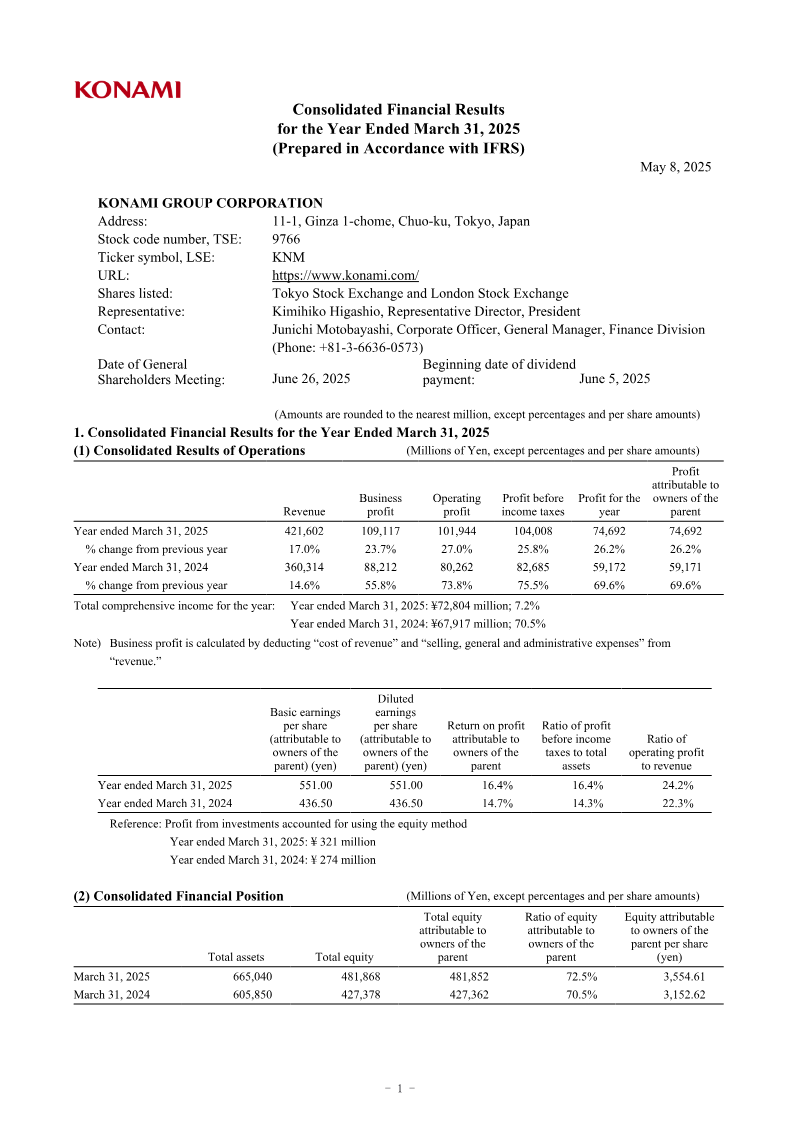
Konami Group Corporation achieved record-breaking financial performance for the fiscal year ending March 31, 2025, characterized by a 17.0% year-on-year revenue increase to ¥421,602 million. This growth trajectory, which marks the second consecutive year of record highs across all profit categories, was primarily propelled by the Digital Entertainment segment. A 22.5% surge in revenue within this division, fueled by the robust performance of key console and mobile titles, solidified its position as the company’s primary financial engine. Operating profit reached ¥101,944 million, reflecting the efficacy of the current business strategy and operational scaling.
Diversified growth was evident across other core divisions, with the Gaming & Systems segment recording a 7.4% revenue increase and the Amusement segment growing by 4.6%. Although the Sports segment faced a minor contraction in business profit, the company maintained a resilient financial foundation, concluding the period with ¥294,216 million in cash and cash equivalents. This stability has enabled a shareholder-friendly capital allocation policy, resulting in an increased annual dividend of ¥165.50 per share.
Looking toward the fiscal year ending March 31, 2026, the organization maintains a positive outlook, projecting continued expansion. Strategic initiatives for the coming year include the launch of new game titles, the enhancement of casino management system features, and the further scaling of the Pilates Mirror and outsourced sports facility operations. With a dividend increase to ¥166.00 per share already projected, the company remains focused on leveraging its diversified portfolio to sustain long-term profitability and market leadership.
The global video game industry is currently navigating a period of significant contraction and structural realignment following a decade of rapid expansion between 2011 and 2021. Real-term spending on game content has declined by approximately 12% since 2021, as the market shifts from a growth-oriented environment to a capital-constrained, zero-sum landscape. This downturn is marked by record-high layoffs, widespread studio closures, and a sharp reduction in venture capital funding. The industry is increasingly dominated by a small cohort of entrenched live-service titles that act as "black holes," consuming the vast majority of player time and financial resources, which makes the launch of new, independent titles increasingly difficult.
Market dynamics are further complicated by extreme resource inflation, with AAA production budgets frequently ballooning to between $200 million and $500 million. While mobile gaming remains the primary driver of global revenue, it faces its own challenges, including declining download volumes and rising user acquisition costs. Meanwhile, the console sector shows signs of stagnation, with current-generation hardware trailing its predecessors in total unit sales. As traditional growth models stall, the industry is pivoting toward new strategies, including the integration of programmatic advertising, the adoption of generative AI to improve production efficiency, and a push toward cross-platform accessibility to maximize player retention.
Geographically, the center of gravity is shifting toward Asian markets, where local developers are increasingly challenging Western incumbents with high-performing, globally resonant titles. Concurrently, the rise of user-generated content platforms like Roblox and the maturation of PC-based modding ecosystems are redefining how players engage with digital worlds. Looking forward, the industry is pinning its recovery on technological advancements in cloud computing and AI-driven development, alongside regulatory shifts that may allow developers to capture a larger share of revenue through alternative distribution channels. Success in this new era requires moving beyond traditional gameplay loops toward interconnected, persistent ecosystems that prioritize social infrastructure and long-term engagement.