Reports in the Market (Overall) category.
The metaverse represents a fundamental shift from a two-dimensional internet toward a persistent, three-dimensional social ecosystem driven by gamified virtual spaces. This evolution is currently led by "game as a platform" models, most notably Roblox, which leverages tens of millions of daily active users to host diverse commercial and social experiences. While major global brands in fashion, luxury, and finance are increasingly investing in "direct-to-avatar" economies and digital real estate to reach younger, digital-native demographics, the sector faces significant economic and technical hurdles. High developer take rates, consistent net losses among platform leaders, and networking limitations that prevent massive simultaneous user scaling remain primary obstacles to long-term growth.
The integration of blockchain technology and non-fungible tokens (NFTs) has introduced new economic paradigms, such as the "Play-to-Earn" model. Although these games accounted for nearly half of all decentralized application wallet activity by late 2021, their growth is largely concentrated in emerging markets where users treat gaming as an income-generating activity. The sustainability of these ecosystems is currently challenged by high entry barriers and a prioritization of financial speculation over core gameplay quality. For the industry to mature, it must transition toward higher-quality experiences and more robust virtual economies that offer genuine utility beyond profile-picture status symbols.
Mass adoption of these decentralized virtual worlds is currently constrained by technical and regulatory friction. Interoperability across different platforms remains a theoretical goal rather than a functional reality, while high transaction fees on networks like Ethereum and environmental concerns create additional barriers. Furthermore, the industry must navigate complex legal landscapes regarding digital privacy, content moderation, and the protection of intellectual property. Despite a cooling of initial market hype following a crypto correction in 2022, the long-term trajectory points toward a transmedia future where digital assets and virtual identities are central to global commerce and social interaction.
The global mobile ecosystem experienced significant expansion throughout 2021 and into 2022, characterized by record-breaking consumer spending of $170 billion and a projected ad spend of $336 billion. Despite initial concerns regarding privacy changes following the release of iOS 14.5, the industry demonstrated remarkable resilience as App Tracking Transparency opt-in rates reached 25% globally, far exceeding early market expectations. This growth was distributed across key verticals including fintech, e-commerce, and gaming, with mobile e-commerce sales alone reaching $3.56 trillion.
The fintech sector emerged as a primary driver of engagement, with installs and sessions rising by 34% and 53% respectively. While traditional banking and payment apps maintain the highest market share, cryptocurrency and stock trading platforms saw the most intense user activity, with session lengths nearly doubling. However, this heightened interest triggered a sharp increase in acquisition costs, with fintech eCPIs rising from $1.05 to $3.40 over the course of a year. Similarly, e-commerce apps saw a 46% surge in in-app revenue despite rising costs and declining retention, signaling a shift where users are spending more money and time per session even as new user acquisition becomes more expensive.
Mobile gaming remains the dominant force in the app economy, accounting for 52% of total consumer spend. Global game installs grew by 32%, led by the hyper-casual subvertical, though action and adventure titles commanded the highest levels of engagement and session frequency. While Day 30 retention rates for games nearly doubled to 9%, the industry faces a growing divide between high-volume downloads and long-term stickiness. As user acquisition costs continue to climb across all regions—particularly in LATAM and EMEA—the focus for developers has shifted from pure volume to maximizing lifetime value and implementing sophisticated re-engagement strategies to sustain growth in an increasingly competitive landscape.
The gaming investment landscape in the first three quarters of 2022 reflects a significant market correction following a record-breaking 2021. While the total value of closed and announced deals reached $124.5 billion—nearly double the previous year's volume—this figure is heavily skewed by Microsoft’s pending $69 billion acquisition of Activision Blizzard. Excluding that single transaction, the market shows clear signs of cooling due to macroeconomic instability, post-pandemic shifts in user engagement, and increased regulatory scrutiny.
Strategic mergers and acquisitions (M&A) remain the primary driver of deal value, reaching a record $101.4 billion year-to-date, despite a 40% decline in the number of closed transactions. Major players like Embracer Group, Sony, and Saudi Arabia’s Public Investment Fund (PIF) dominated this activity. Conversely, public offerings have nearly collapsed, reaching their lowest point since early 2020, with deal values shrinking fivefold compared to 2021. Private investments also saw a sharp decline in the third quarter, dropping 69% from the previous quarter, signaling that the "soured" economic climate has finally impacted venture capital and corporate rounds.
The report highlights a notable shift in the blockchain and Web3 gaming sectors. While early-stage investment in this space previously drove market growth, the third quarter of 2022 marked the first period of negative growth for blockchain-related investments, with total deal value falling 14% year-over-year. Investors are becoming more selective, moving away from infrastructure platforms toward studios capable of producing engaging content. Geographically, the United States remains the most active market for gaming investments, followed by the United Kingdom and Turkey. Gender diversity remains a challenge for the industry, as 89% of companies receiving investment are male-led, with women-led entities representing only 2% of the total.
Gaming has evolved into a multi-dimensional entertainment ecosystem that extends far beyond traditional play, encompassing viewing, socializing, and content creation. Research conducted between February and April 2022 across 36 global markets reveals that 79% of the online population are game enthusiasts. This engagement is most profound among younger generations; for Gen Alpha, gaming has surpassed social media and streaming as the primary source of entertainment. The study utilized a representative sample of 75,930 respondents aged 10 to 65 to analyze behaviors across five distinct generational cohorts.
Data indicates that gaming is increasingly a platform for social connection, with 75% of players engaging in game worlds for social purposes without playing the primary game. This trend is a significant driver of the emerging metaverse. Financial engagement is also high, with approximately half of Gen Alpha, Gen Z, and Millennials spending money on games. Total consumer spending in the sector was projected to exceed $200 billion in 2023. Furthermore, the rise of blockchain gaming and play-to-earn models shows significant future potential, with 34% of players in the United States expressing interest in these technologies.
The findings emphasize that gamers are a highly attractive demographic for brands, as players generally hold 36% more positive attitudes toward brands compared to non-players. However, the diversity of the audience necessitates a nuanced approach to engagement. Using a proprietary segmentation model, the research identifies various personas ranging from Ultimate Gamers to Time Fillers. For instance, while both Apex Legends and Fortnite are battle royale titles, their player bases differ significantly in age, gender, and brand preferences, illustrating that effective marketing requires deep insights into specific game communities and generational motivations.
The first half of 2022 marked an unprecedented surge in gaming‑sector transactions, with 455 deals closed and a total value of $43.3 billion, rising to $113.6 billion when including announced but not yet finalized agreements. This activity set a new industry benchmark, reflecting heightened investor confidence and a broadening appetite for both mature and emerging gaming assets.
Deal activity spanned the full spectrum of financing structures. Control‑oriented mergers and acquisitions dominated, while minority‑stake purchases, early‑stage venture capital, late‑stage venture capital, corporate strategic investments, IPOs and SPAC listings, fixed‑income instruments, and hybrid private‑public offerings each contributed to a diversified capital landscape. The data, compiled from public filings, market‑insight providers, and partner research, cover global markets and encompass all major video‑games subsectors, from console and PC titles to mobile and cloud‑based platforms.
The analysis underscores that the record‑setting volume and value were driven not only by traditional M&A but also by an expanding ecosystem of venture and corporate funding, indicating a maturing market where both established publishers and nascent developers attract substantial capital. The report’s methodology emphasizes transparency and non‑advisory intent, positioning the findings as a reference point for industry participants rather than a basis for specific investment decisions.
Access to the underlying deal tables and community insights is tiered across subscription levels, ranging from free access to comprehensive expert‑grade data, with sponsorship from Hiro Capital and Naavik noted as independent of the analytical conclusions.
The primary aim of the Q1 2022 Gaming Deals Activity analysis is to quantify and interpret investment trends within the video‑game sector, offering stakeholders a data‑driven snapshot of market dynamics during the first quarter of 2022. By aggregating transaction records across all major regions, the study evaluates both total capital deployed and the frequency of deals, thereby establishing a benchmark for comparative performance.
During the quarter, investors allocated roughly $1.1 billion to 52 distinct transactions, reflecting a sharp contraction relative to the previous year. Deal value fell to one‑quarter of the Q1 2021 level (a 2.5‑fold decline), while the number of agreements dropped by nearly half (a 1.9‑fold reduction). These figures signal a pronounced slowdown in financing activity, likely driven by broader macro‑economic pressures and heightened risk aversion among venture and private‑equity participants. The analysis also isolates the blockchain‑gaming niche, for which supplemental data were provided by Naavik, indicating that even emerging sub‑segments are not insulated from the overall downturn.
Geographically, the dataset spans global markets, encompassing North America, Europe, Asia‑Pacific and emerging economies, and it covers the full spectrum of gaming‑related enterprises—from traditional publishers and developers to ancillary service providers and crypto‑gaming platforms. The report underscores that the observed decline is not merely a seasonal fluctuation but a substantive shift in capital allocation patterns, suggesting that investors may recalibrate strategies toward more resilient or diversified portfolios in the coming quarters.
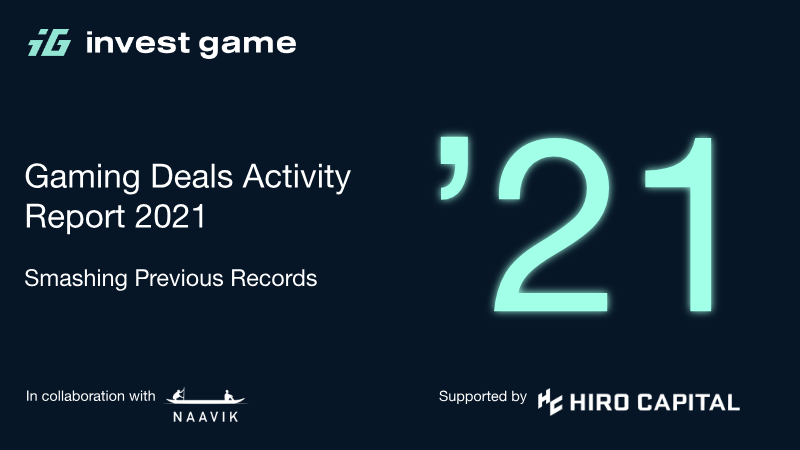
The video games industry experienced a record-breaking financial year in 2021, with the total value of closed transactions reaching $71.3 billion across 937 deals. This represents a 2.1x growth in value and a 1.4x increase in deal volume compared to the previous year. When including announced but not yet closed transactions, the total market activity reached $80.4 billion. The industry saw significant expansion across all primary segments, including gaming titles, platform and technology, and esports, driven by a surge in high-value "mega-deals" and a massive influx of capital into emerging sectors.
Mergers and acquisitions served as the primary engine for growth, accounting for $34.5 billion in closed deal value. Mobile gaming remained the most targeted sub-segment for acquisitions, representing 49% of M&A value, followed by PC and console gaming at 34%. Private investments also doubled to $12 billion, with late-stage transactions making up the majority of this capital. Notably, blockchain gaming emerged as a breakthrough sector, with investment value skyrocketing 68x year-over-year to $3.1 billion. Public offerings, including IPOs and SPACs, contributed $24.8 billion to the annual total, despite a slight decrease in the overall number of transactions.
The competitive landscape for strategic investors shifted as Embracer Group surpassed Tencent for the top ranking by closing 26 deals valued at $6.7 billion. In the venture capital space, BITKRAFT Ventures, Andreessen Horowitz, and Makers Fund led activity, collectively participating in hundreds of deals. Geographically, Turkey emerged as a significant global hub for early-stage gaming startups. Data for these findings was compiled through the tracking of closed transactions using public media, business partnerships, and S&P Capital IQ, excluding pure gambling and betting entities. The analysis concludes that the aggressive consolidation and investment trends observed in 2021 are positioned to continue into 2022.
The global gaming industry experienced a massive production surge throughout 2021, characterized by a 93% increase in game creation and a 31% rise in the number of active creators. While the easing of pandemic-related restrictions led to a stabilization of engagement levels, the market established a "new normal" where total revenue grew by 30%. This growth was particularly pronounced in the Americas and EMEA regions, driven by a combination of in-app purchases and robust advertising revenue. Hypercasual and casual genres emerged as the primary catalysts for this expansion, with hypercasual titles seeing a 137% increase in production and a 162% surge in in-app purchase revenue.
Strategic shifts toward multiplatform development and multiplayer experiences are now essential for maximizing player retention and market reach. Although mobile remains the dominant platform, especially in markets like China and Japan, developers are increasingly prioritizing cross-platform compatibility to extend the lifespan of their titles. Industry consolidation reached record levels with $85 billion in acquisitions, yet small indie studios remain vital drivers of innovation. These smaller entities are leveraging accessible development tools and specialized analytics to compete with larger enterprises, focusing on "live game" models where consistent content updates can boost revenue by over 85% for top-performing games.
Portfolio diversification has proven to be a critical factor for financial success, as publishers operating across three or more genres generate up to 197% more daily revenue than those specializing in a single category. Despite this clear advantage, 76% of developers continue to focus on a single genre, representing a significant area for potential growth. Moving forward, the industry is trending toward the standardization of cross-platform play and the adoption of sophisticated third-party engagement tools. These advancements allow developers of all sizes to manage post-launch content more effectively, ensuring long-term sustainability in an increasingly competitive global market.
This analysis examines the gaming behaviors and preferences of Gen Alpha (ages 10-12) and Gen Z (ages 13-27), positioning these cohorts as the primary drivers of the industry's future. The central thesis asserts that for these younger generations, gaming has evolved beyond a mere pastime into a ubiquitous "lifestyle" platform that fulfills fundamental needs for socialization, self-expression, and immersion. This shift is characterized by high engagement across multiple dimensions, including playing, viewing content, and participating in virtual social communities.
Key findings indicate that 90% of Gen Alpha and Gen Z are "game enthusiasts," significantly higher than the 79% found in the total online population. These groups invest a substantial portion of their leisure time in gaming; it is the top entertainment source for Gen Alpha and a top-three source for Gen Z, rivaling social networks and streaming. Socialization is a critical driver, with 70% of Gen Z expressing interest in using game worlds for social gatherings beyond active gameplay, such as attending virtual parties or watching movies. This behavior suggests these generations will be the primary catalysts for metaverse adoption.
Economic engagement is also high, with 52% of Gen Alpha and Gen Z spending money on games, compared to 42% of the general population. Mobile is the leading platform for both play and spend, though Gen Alpha shows a unique affinity for consoles driven by franchises like Fortnite and Mario. The primary motivators for spending include unlocking exclusive playable content and personalizing the in-game experience through virtual goods like currencies and gear.
The data is derived from Newzoo’s 2022 Global Gamer Research, utilizing Computer Assisted Web Interviewing (CAWI) conducted between February and April 2022. The study features a representative sample of 75,930 respondents across 36 global markets, covering North America, Europe, MEA, Latin America, and Asia-Pacific.
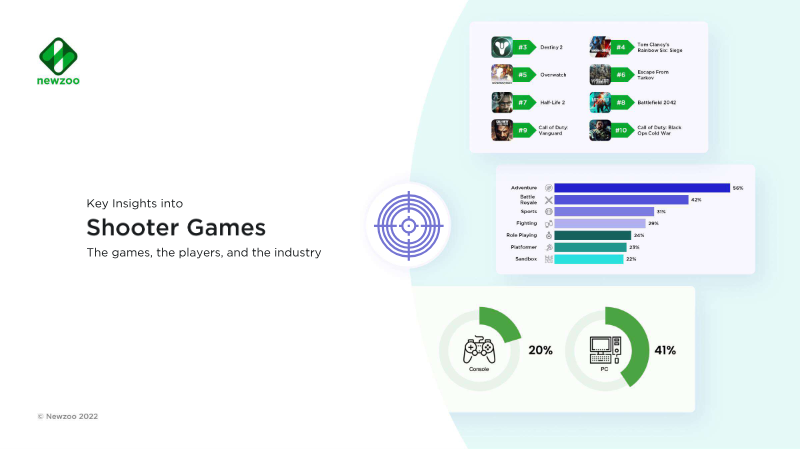
Shooter games represent the fifth highest-revenue generating genre globally as of 2022. This genre, defined by the primary mechanic of defeating enemies via firearms or projectiles, maintains a massive footprint across PC, console, and mobile platforms. While historical titles like Doom and Halo established the genre's foundation, modern success is driven by online competitive play and live streaming engagement. Notably, this analysis excludes Battle Royale and Vehicular Combat titles, which are classified as independent genres.
Data from August 2022 indicates that shooters command high engagement, ranking as a top genre for monthly active users on both Steam and consoles. The player base is predominantly male (63%) and young, with 38% of players falling between the ages of 10 and 20. High-intensity "Ultimate Gamers" and "All-Round Enthusiasts" show the strongest affinity for the genre, with 82% of the former group having played a shooter in the six months prior to the study. Beyond the core genre, shooter fans show significant cross-genre overlap with adventure and battle royale titles, while showing the least interest in simulation and strategy games.
The genre's ecosystem is heavily influenced by specific themes and monetization strategies. Contemporary war is the most popular theme, utilized by 68% of the player base, while levels and maps remain the dominant gameplay mechanic. In terms of monetization, the market is characterized by a high prevalence of both pay-to-play models and in-app purchases, with 97% of players engaging with titles that feature microtransactions. Geographically, the research covers 37 markets, excluding China and India, and utilizes a sample of over 19,000 active gamers to identify these behavioral and demographic trends.
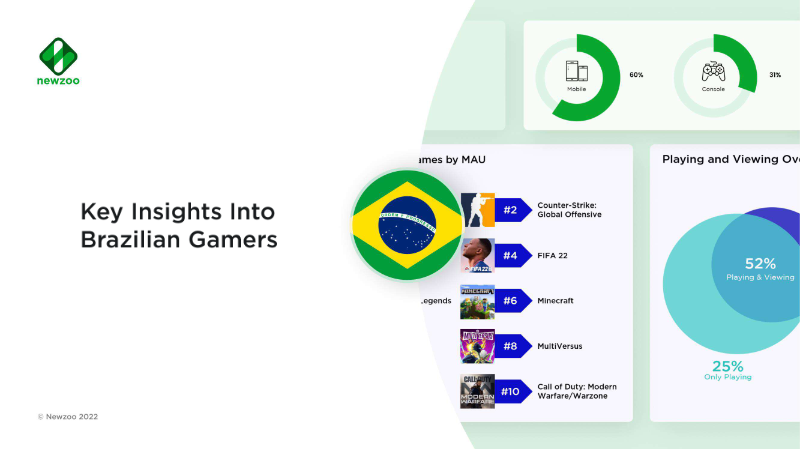
Brazil represents a significant force in the global gaming industry, ranking as the 10th largest market worldwide by revenue and 5th by total player count as of 2022. The region is characterized by high levels of engagement, with 80% of the online population identified as game enthusiasts. This engagement extends beyond play, as 60% of the audience both plays and watches gaming video content, while only 25% play without viewing.
The demographic profile of Brazilian gamers is diverse, though it skews toward younger males. Approximately 51% of players are male and 48% are female, with the 21–35 age bracket forming the largest segment at 43%. Mobile gaming is the dominant platform, utilized by 60% of the gaming population, followed by console and PC at 31% and 30% respectively. Despite the prevalence of mobile, average weekly play times are consistent across platforms, ranging from roughly four and a half to five hours.
Monetization trends indicate a healthy spending culture, with 43% of players classified as payers. The primary drivers for spending include unlocking exclusive playable content and personalizing in-game characters. Popular titles in the region include competitive and social games such as League of Legends, Fortnite, and Roblox.
The findings are based on a survey of 2,063 active internet users aged 10–65 in residential developed areas of Brazil. The methodology utilizes a "Residential Developed Approach," ensuring the data is representative of the connected population within these specific geographic zones. The research was conducted by Newzoo as part of their 2022 Global Games Market Report and Consumer Insights series.
The 2022 Multiplayer Report examines the evolving preferences, behaviors, and technical expectations of online gamers across major global markets. The primary thesis suggests that while traditional genres like Battle Royale and First-Person Shooters remain dominant, the success of multiplayer titles increasingly depends on social connectivity and technical reliability. The findings indicate that 77% of the global gaming population engages in multiplayer play, with overall engagement across all genres increasing by an average of 3.3% compared to the previous year.
Key data points highlight that genre is the primary factor for game selection (49%), followed closely by social drivers such as the ability to chat in-game (31%) and having friends already active in the title (34%). Technical performance is equally critical, with 35% of players prioritizing quick matchmaking and 33% requiring skill-based pairing. Regarding monetization, the data shows a 5% year-over-year increase in players purchasing downloadable content. While core gamers are 58% more likely to spend over $20 on additional content, casual audiences remain active spenders in lower price brackets.
The scope of the research covers four major gaming markets—the United States, United Kingdom, Japan, and South Korea—representing a significant portion of global gaming revenue. The analysis segments the industry into various categories, including mobile, PC, and console platforms, while distinguishing between casual and core gamer demographics. Internal data from Unity reveals a 150% growth in PC multiplayer development and a 40% increase in mobile multiplayer projects since early 2021.
Methodology for these insights involved a survey of approximately 1,500 multiplayer gamers conducted in Q3 2021 and Q3 2022. The sample was split evenly between casual players, defined by a minimum of 30 minutes of weekly multiplayer play, and core players, who engage for at least four hours weekly in competitive genres. This survey data was supplemented by anonymized, aggregated internal metrics from Unity’s live gaming solutions.