Reports in the Market (Overall) category.
The global mobile gaming landscape has entered a period of stabilization following pandemic-era surges, with quarterly downloads maintaining a steady baseline of 14 billion. Although total revenue experienced a 6% year-over-year decline to $21.2 billion in early 2022, the market remains significantly larger than its pre-pandemic state. Casual games continue to lead in volume, representing 80% of all downloads, yet Mid-Core titles remain the primary economic engine, generating 60% of total player spending. While the United States maintains its position as the leading consumer market, the Asia-Pacific region exerts increasing influence, evidenced by Taiwan’s rise to the fifth-largest global market and the region's dominance in high-monetization genres like MMORPGs and Card Battlers.
Strategic advertising and intellectual property integration have become essential for navigating this competitive environment. Strategy and RPG titles are increasingly prioritizing YouTube for share of voice, while the acquisition of MoPub by AppLovin has shifted the advertising landscape for strategy games. Success in the rapidly growing Card Battler sub-genre, which earns 62% of its revenue from the APAC region, is largely driven by high-performing titles like Yu-Gi-Oh! Master Duel and the effective use of Live Ops and Season Passes. Furthermore, cross-media synergies, such as the impact of the Netflix series Arcane on game downloads, demonstrate the power of multimedia IP in driving user acquisition.
The market outlook suggests a temporary correction phase with a projected return to growth by 2023. While Asian markets currently account for 80% of MMORPG revenue, Western interest is growing, as seen with the successful U.S. launch of Diablo Immortal. Similarly, the Real-Time Strategy sector is seeing a geographic shift, with China overtaking the U.S. as the top market for the sub-genre. Future expansion across these segments will likely depend on localized IP collaborations and sophisticated user acquisition strategies tailored to specific regional preferences.
The global game development landscape in 2022 reflects a period of significant structural and cultural transition. PC remains the primary development platform, while the PlayStation 5 maintains its position as the leading console choice. Conversely, mobile development has experienced a decade-long decline in developer interest. Emerging hardware like the Steam Deck and PlayStation VR2 continues to capture attention, yet the industry remains deeply skeptical of speculative technologies such as the metaverse, cryptocurrency, and NFTs. These concerns are rooted in anxieties regarding environmental sustainability, ethical business practices, and the long-term viability of blockchain-based models.
Workplace culture and labor dynamics have emerged as central themes, marked by a measurable improvement in work-life balance as 60 percent of developers now maintain a 40-hour work week or less. Despite this progress, the industry struggles with systemic issues, as a majority of studios have failed to adequately address internal reports of misconduct and toxicity. This environment has fueled a growing movement toward collective bargaining, with 55 percent of developers supporting unionization and nearly one-quarter of workplaces engaging in active discussions regarding labor organization.
The industry continues to prioritize accessibility, with a record 39 percent of developers integrating inclusive design features into their projects. However, broader efforts toward diversity and social activism remain inconsistent across various studios. Furthermore, the workforce remains predominantly male and early-career, highlighting a demographic imbalance that persists alongside ongoing tensions between developers and major platform holders. As evidenced by the 34 percent of developers who support Epic Games in its legal conflict with Apple, there is a clear desire for greater autonomy and a shift in the power dynamics that currently govern the digital distribution ecosystem.
The global gaming industry reached a record-breaking $113.6 billion in total deal value during the first half of 2022. This surge in valuation, driven primarily by a select group of high-profile mega-deals, occurred despite a broader contraction in the total volume of transactions. While public markets experienced a significant downturn resulting from macroeconomic instability and post-pandemic corrections, private investment remained resilient, contributing $4.6 billion to the sector. This activity underscores a strategic shift toward mobile-focused acquisitions and a maturation of the blockchain gaming space, which is currently pivoting away from speculative models toward more sustainable, content-driven development.
The scope of this analysis encompasses global closed and announced transactions across the gaming industry, excluding pure gambling and non-gaming blockchain entities. Within this landscape, the data reveals a persistent structural challenge regarding corporate governance and inclusivity, as 88% of company founders are identified as men. This lack of gender diversity remains a notable trend within the leadership ranks of the organizations securing capital.
Ultimately, the industry is navigating a period of transition characterized by a flight to quality and a focus on long-term project viability. Although the frequency of deals has declined compared to previous periods, the concentration of capital into large-scale acquisitions and strategic private investments suggests that institutional confidence in gaming remains high. The sector is effectively recalibrating, moving past the rapid expansion of the pandemic era toward a more disciplined investment environment that prioritizes established mobile platforms and robust, sustainable gaming ecosystems.
The hyper-casual mobile gaming sector experienced a notable escalation in acquisition costs during the latter half of 2022, characterized by rising median cost-per-install (CPI) rates across both Android and iOS platforms. By the fourth quarter of 2022, median CPI reached all-time highs of $0.20 on Android and $0.42 on iOS. This upward trend in acquisition spending was global, as no major market tracked by ad spend experienced a decrease in median CPI on Android, while iOS markets saw varied fluctuations, including a significant decrease in the United States and notable increases in France and Germany.
Retention metrics reveal a consistent performance advantage for iOS over Android across all tiers of game quality. For the top 2% of hyper-casual titles, iOS achieved a 45% Day 1 retention rate compared to 38% on Android, with Day 7 retention figures similarly favoring iOS at 19% versus 14%. This performance gap persists among the top 25% of games and the median cohort, where iOS maintains a higher percentage of returning players. These findings underscore a widening disparity between high-performing titles and average games, emphasizing the critical importance of engagement optimization in a landscape of increasing user acquisition costs.
The analysis draws upon data from over 100,000 games and one-third of the global mobile player base to establish these benchmarks. By segmenting performance by platform and geographic region, the data highlights the shifting economic landscape for developers and publishers. The findings suggest that while market saturation and rising costs present significant challenges, the ability to maintain player retention remains the primary differentiator between top-tier hyper-casual games and the broader market.
The report examines gaming‑industry transactions during the first quarter of 2022, revealing a sharp contraction in overall deal value compared with the same period in 2021. Total closed deals reached $15.2 billion across 262 transactions, a decline driven almost entirely by a 90% drop in public offerings that fell to $0.5 billion. Private‑investment activity, however, expanded, with $3.2 billion raised in 174 deals—a 36% year‑over‑year increase—half of which came from blockchain‑powered gaming ventures that captured $1.6 billion.
Mergers and acquisitions maintained a steady volume of 81 deals but saw a 23% decline in value to $4.35 billion, with the gaming sector accounting for 35% of that figure ($4 billion). Mega‑acquisitions such as Microsoft’s $68.7 billion purchase of Activision Blizzard and Take‑Two’s $12.7 billion acquisition of Zynga underscored the sector’s high‑profile activity, even as overall M&A value fell 76% year‑over‑year.
Early‑stage funding contracted, with seed and Series A rounds totaling 37 deals that raised $334 million—an increase in average size but a 26% drop in count. Late‑stage rounds remained sizable, highlighted by Dream Games’ $255 million Series C. The blockchain gaming sub‑sector rebounded strongly, with 88 deals raising $1.6 billion—an eleven‑fold increase in count and a nineteen‑fold jump in value from the previous year. The analysis covers global activity across all gaming segments for Q1 2022, providing a comprehensive snapshot of the market’s shifting dynamics.
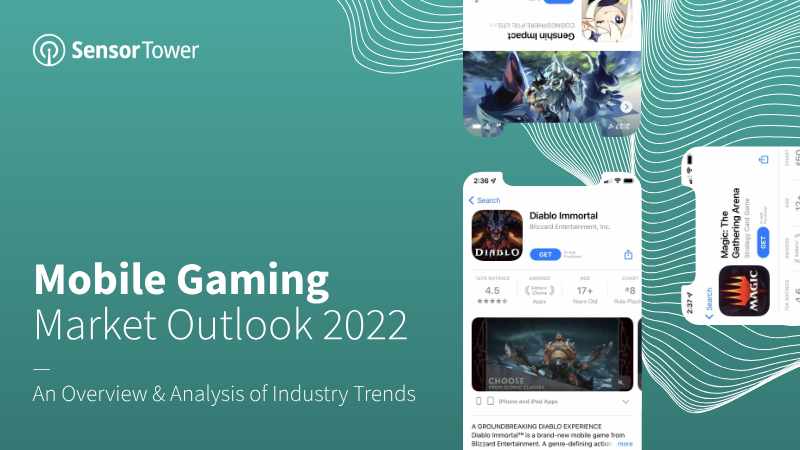
The analysis outlines a 2022 outlook for the global mobile‑gaming market, emphasizing that quarterly installs have plateaued at roughly 14 billion after a pandemic‑driven surge, with casual titles still accounting for about 80 % of downloads. Revenue dynamics have shifted: mid‑core games now generate 60 % of total earnings, while overall mobile‑game revenue fell 7 % year‑over‑year in Q1 2022, marking the first decline since the industry’s rapid expansion. The United States remains the largest spend market, yet Asia‑Pacific regions—especially Taiwan and Brazil—exhibit the fastest growth rates.
Advertising spend analysis reveals that role‑playing games dominate iOS channels, with YouTube capturing an 8.2 % share of voice and exceeding 10 % in Q2 2022; Android spend lags across all networks. Card‑battler titles emerge as the fastest‑growing sub‑genre, driven largely by Japan and China, which together account for 62 % of player spending. Yu‑Gi‑Oh! Master Duel leads launch revenue, reaching $80 million in five months and achieving a worldwide revenue per day of $20—twice that of its nearest competitor. MMORPGs hold the second‑largest spending position globally, with Diablo Immortal topping U.S. spend at $22 million in H1 2022 and maintaining a modest 10 % share of U.S. MMORPG installs.
In the United States, Diablo Immortal generated over $30 million in its first six weeks and captured 3.2 % of mid‑core revenue, yet U.S. players still lag behind Asian markets where Lineage M and Odin: Valhalla Rising amassed $225–$350 million in the same period. The report underscores that U.S. MMORPG revenue represents only about 4 % of the global total, highlighting the critical need for localized market strategies in future mobile RPG releases.
The analysis demonstrates that the metaverse, blockchain gaming, and NFTs have transitioned from niche curiosities to mainstream commercial forces, reshaping consumer engagement across entertainment, fashion, and gaming. Major brands—including Nike, Gucci, Samsung, and Louis Vuitton—are investing in digital real estate and virtual storefronts to capture a digitally native audience, while music artists leverage virtual concerts and NFT sales as alternative revenue streams. Virtual events such as Ariana Grande’s Rift Tour and Justin Bieber’s Wave performance illustrate the capacity of fully digital experiences to attract millions of concurrent viewers, signaling a shift toward immersive entertainment and fan‑centric monetization.
In the fashion sector, digital‑first houses like Auroboros and The Fabricant generate millions of users by selling high‑priced virtual garments, integrating NFTs to provide ownership and community benefits. The report projects that realistic XR shopping, AR try‑ons, and interoperable digital wardrobes will drive higher engagement and conversion rates, enabling luxury brands to test markets digitally before physical production. Blockchain gaming remains dominated by low‑revenue titles, yet play‑to‑earn (P2E) ecosystems—exemplified by Axie Infinity’s 3 billion gamers and Illuvium’s $72 million funding—are expanding, with guilds such as Yield Guild Games monetizing in‑game assets through lending models. Sustainability hinges on continued user engagement and broader adoption beyond speculative gains.
Non‑PFP NFTs, including virtual land, music collectibles, and utility tokens, are gaining traction through community‑building perks and cross‑game interoperability, as seen in VeeFriends, NBA Top Shot, Habbo Hotel, and Metakey. These use cases broaden the NFT value proposition and support deeper metaverse integration. However, the industry faces significant regulatory and safety challenges: governments are pushing for open standards to mitigate political, moderation, and privacy risks, while the proliferation of user‑generated content amplifies concerns over deepfakes, disinformation, and harassment. Addressing these issues will require new legal frameworks and robust community moderation before a safe, inclusive metaverse can be fully realized.
China continues to dominate the global gaming market, yet a series of regulatory tightening measures—particularly anti‑addiction rules for minors and an expanded licensing framework—have introduced significant uncertainty and higher operational costs for both domestic and foreign developers. The new minor‑protection law caps playtime, limits in‑game spending, and restricts live‑streaming access for users under 18, while the licensing system now demands detailed content reviews and real‑name verification. These requirements are projected to dampen player engagement and increase investment risk over the long term.
Regulators enforce licensing through a complex approval process, yet many unlicensed titles persist on platforms such as Steam, VR services, cloud gaming, and mobile ad‑only games. Enforcement remains uneven; fines are issued but monitoring is inconsistent. Console and live‑streaming services often circumvent restrictions via overseas purchases, backdoors, or content renaming, creating a regulatory environment that is difficult to monitor and enforce uniformly.
The revised licensing regime now permits a single license for multiplatform releases, encouraging developers to produce cross‑platform titles and streamlining the approval process. The market remains dominated by free‑to‑play mobile games, with LiveOps and regular content updates sustaining high retention. In 2021, half of the top 50 grossing mobile games were launched before 2019. Chinese studios are increasingly exporting their expertise, establishing international studios and publishing arms to tap global markets while leveraging IP‑based mobile games to penetrate China’s competitive scene.
The report examines the rapidly expanding Indian mobile gaming market, highlighting a projected 91 % share of online gamers playing on smartphones and an estimated revenue of US$2.2 billion in 2022, with a projected average revenue per user of US$1.5 by 2027. It distinguishes between non‑real‑money gaming (non‑RMG) and real‑money gaming (RMG), focusing on the top five non‑RMG genres—Adventure, Battle Royale, Puzzle, Arcade, and Racing—and key RMG categories such as card‑based games, sports‑fantasy, and casual RMG. Data sourced from Newzoo consumer research and MAAS campaign analytics reveal that 62 % of non‑RMG players are male, while RMG users skew slightly more balanced at 55 % male. Millennials and Gen‑Z (ages 13–41) dominate, with 55 % of adventure and battle royale players in the 13‑27 bracket. Motivations differ: non‑RMG gamers seek entertainment and challenge, whereas RMG players are driven by seasonal events like cricket tournaments or festive card‑game gatherings.
Key performance indicators for advertisers include install‑to‑registration rates of ~50 % for casual games and ~25 % for card‑based RMG, with retention dropping from 30 % on day one to 3 % by day thirty for casual titles. The analysis underscores the importance of vernacular creatives, cross‑interest programmatic targeting, and multi‑channel optimization to reduce audience overlap. It also notes emerging trends—Web3 play‑to‑earn models, esports growth, and super‑app consolidation—that signal continued market maturation. The report concludes that while monetization remains a challenge for non‑RMG segments, strategic acquisition and in‑game advertising innovations can unlock substantial growth across India’s diverse gaming ecosystem.
The analysis examines how emerging technologies and shifting consumer behaviors are reshaping the global gaming ecosystem. Blockchain‑based monetisation, particularly non‑fungible tokens (NFTs), has met with mixed reception. While the promise of secure, legitimised trading is evident in titles such as Axie Infinity, major publishers have reacted cautiously. Valve’s ban of crypto games on Steam and Ubisoft’s withdrawal from NFT initiatives after player backlash illustrate a broader industry reluctance, compounded by regulatory constraints in jurisdictions like South Korea and platform‑level anti‑steering rules from Apple and Google. Consequently, publishers are exploring “NFT‑like” features under less controversial branding to satisfy investor appetite while mitigating gamer discontent.
Live‑streaming and cloud gaming are emerging as pivotal drivers of player engagement. Interactive shows such as Facebook’s Rival Peak and PAC‑MAN Community have amassed over 100 million minutes of viewership in three months, opening new monetisation avenues. The semiconductor shortage is accelerating the migration of high‑end titles—Elden Ring, Starfield—to cloud platforms. Services like NVIDIA GeForce NOW and Google Stadia have already recorded user growth, while publishers leverage cloud to deliver AAA content on legacy hardware (e.g., Nintendo Switch) and broaden access through subscription bundles such as Game Pass Ultimate. This trend signals a shift toward broader platform reach and subscription retention.
Geographically, the Asia‑Pacific region dominates global game revenues at $42.6 billion, driven by China’s mobile‑first market and an 8.7% compound annual growth rate (CAGR). North America matches this revenue figure at $42.6 billion, with a 7.9% CAGR. Latin America, the Middle East, and Africa are projected to grow faster than the global average, increasing their share of worldwide revenues. COVID‑19’s impact on Asia‑Pacific was muted, partly due to a strong console gaming emphasis that helped sustain growth. The findings collectively underscore the importance of balancing innovative monetisation models, expanding platform accessibility, and regional market dynamics in shaping the future of gaming.
Global mobile app activity in Q2 2022 showed a modest 2.5 % year‑over‑year decline in total downloads, falling to 35 billion worldwide. TikTok remained the undisputed leader on both Apple’s App Store and Google Play, while Meta’s suite of apps—Instagram, WhatsApp, Messenger—dominated the top‑10 rankings globally. In the United States consumer spending shifted away from games toward non‑game categories, and Meta’s share slipped to fourth place on Google Play. Europe and Asia mirrored TikTok’s dominance, yet regional leaders varied: Google Maps surged in Europe, and VooV Meeting experienced a 47 % jump amid China’s lockdowns.
On Google Play, Asia was the most dynamic market. Instagram captured 22 % of all Meta installs and outpaced Facebook, Snapchat, and WhatsApp. India accounted for 70 % of TikTok’s downloads, while Meesho and WhatsApp Business each exceeded 30 % of their regional installs. Meta’s overall Google Play installs in Asia grew 22 % YoY, whereas competitors showed mixed performance. Worldwide, Meta pulled more than 550 million downloads on Google Play—well ahead of Google’s 320 million—and expanded its lead over the rival.
Google Play downloads totaled 7 billion in Q2 2022, a 26 % YoY increase but still 9.7 % below pre‑pandemic Q2 2019 levels. India remained the largest market with 6 billion downloads, despite a ~10 % YoY decline, while Indonesia’s 8.5 % QoQ growth to 6 billion positioned it to potentially overtake Brazil’s 7.26 billion downloads. Other markets, including the U.S. and Mexico, saw modest changes, underscoring India’s continued dominance and Indonesia’s rapid expansion.
In gaming, Miniclip’s acquisition of Sybo and the inclusion of Subway Surfers propelled it to sixth place in worldwide mobile game downloads, achieving 472 million installs and $194 million in consumer spending, with a May spike. Travel‑app downloads rebounded to over 100 million in the U.S. and 28 million in the U.K., while ticket‑app installs surged, with the top five apps exceeding 10 million U.S. downloads—an increase of more than 70 % from pre‑pandemic levels—highlighting robust growth potential in both gaming and travel/event segments as consumer activity returns to pre‑COVID norms.
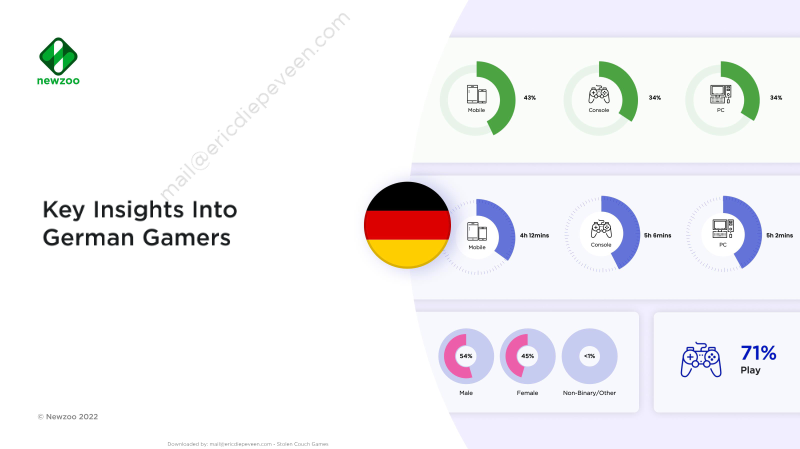
Germany represents a significant pillar of the global gaming industry, ranking as the largest games market in the European Union and the fifth largest worldwide by revenue. As of 2022, the German gaming landscape is characterized by a high level of engagement, with 71% of the online population aged 10 to 65 identifying as game enthusiasts. This engagement extends beyond active play to include viewing gaming video content, social interaction, and community participation.
The demographic profile of German players is nearly balanced by gender, consisting of 52% males and 48% females. While gaming is popular across all age groups, the 21-35 age bracket represents the largest segment at 31%. Motivation for play is primarily driven by the desire to relax and unwind, followed by the pursuit of achievement and social connection. Among the various gamer personas, Time Fillers and Mainstream Gamers are the most prevalent, reflecting a mix of casual mobile play and more dedicated multi-platform engagement.
Platform preferences show that mobile gaming has the highest reach, utilized by 43% of the online population, followed by console and PC at 34% each. Despite the higher reach of mobile, PC and console players demonstrate higher average weekly play times, exceeding five hours. Popular titles in the market include Minecraft, Roblox, and Grand Theft Auto V, with Adventure and Action genres leading in popularity.
Monetization remains strong, with 63% of players spending money on games. The primary driver for spending is the availability of sales or special offers, though a significant portion of consumers also pays to unlock exclusive content or to personalize their in-game experience. These findings are based on a 2022 survey of 2,057 online consumers in Germany, forming part of a broader global research initiative covering 36 markets.