Newzoo
Research100 documents
Documents
Report30 pages
Games, Esports, Live Streaming, Cloud and the Metaverse: 2022 Trends to Watch
The global gaming industry is currently undergoing a structural transformation characterized by the integration of emerging technologies and a pivot toward cross-platform accessibility. Central to this evolution is the expansion of cloud gaming, which serves as a critical bridge to overcome hardware constraints, allowing publishers to reach broader audiences on mobile devices and legacy consoles. Simultaneously, the metaverse is maturing into a robust commercial ecosystem, fueled by significant venture capital investment, the proliferation of virtual real estate, and the integration of digital fashion. These developments signal a broader industry shift toward enhanced creator-viewer interactivity and the adoption of Web3.0 business models.
Monetization strategies are diversifying as companies experiment with blockchain-based player trading and fan engagement tools, despite notable consumer resistance toward non-fungible tokens. This period is also defined by a surge in high-quality cross-media intellectual property adaptations and a crowded release calendar, which intensifies competition for consumer attention. Furthermore, regulatory and consumer pressures are forcing a transition toward more open app store ecosystems, challenging traditional distribution gatekeepers.
Within the esports sector, organizations are actively diversifying revenue streams by prioritizing mobile-first titles and leveraging co-streaming to maximize viewership reach. These trends, observed throughout 2022, reflect a strategic effort to sustain growth across global markets. By synthesizing market intelligence and tracking key performance metrics, the industry continues to navigate the complexities of digital transformation, balancing the pursuit of innovative monetization with the necessity of maintaining user trust in an increasingly interconnected virtual landscape.
- Cloud gaming is driving industry growth by bypassing hardware limitations, enabling publishers to deliver high-end experiences to mobile devices and legacy consoles.
- The metaverse is evolving into a commercial ecosystem supported by significant venture capital, virtual real estate markets, and digital fashion integration.
- Monetization models are shifting toward Web3.0 and blockchain-based player trading, despite ongoing consumer resistance to non-fungible tokens.
- Regulatory and consumer pressure is forcing a transition away from traditional app store gatekeepers toward more open distribution ecosystems.
- Esports organizations are prioritizing mobile-first titles and utilizing co-streaming strategies to diversify revenue and expand global viewership.
+5
NewzooJan 2022
Report30 pages
Games, Esports, Live Streaming, Cloud and the Metaverse: 2022
The global gaming industry is undergoing a fundamental transformation characterized by the convergence of traditional media, high-fidelity content, and emerging Web3 technologies. The primary thesis posits that the sector is shifting toward an interconnected, cross-platform ecosystem where revenue diversification and creator-driven engagement models are essential for growth. While consumer skepticism persists regarding blockchain-based assets and NFTs, publishers are successfully navigating this transition by prioritizing mobile esports, co-streaming strategies, and efforts to circumvent restrictive app store ecosystems to foster deeper fan loyalty.
Technological infrastructure is evolving to support this expansion, with cloud-based solutions and Platform-as-a-Service models playing a critical role in mitigating hardware limitations. By integrating gaming experiences into smart TVs and leveraging cloud technology, companies are effectively broadening their reach to new demographics. Simultaneously, the metaverse has emerged as a significant focal point for venture capital and brand investment, as corporations increasingly utilize digital fashion and virtual real estate to capture the attention of younger, digitally native audiences.
Geographically, the market remains dominated by the Asia-Pacific region, which generates $88.2 billion in annual revenue, representing over half of the global total. North America follows with $42.6 billion, maintaining a strong position in the industry landscape. However, the long-term trajectory of the market is increasingly influenced by emerging territories in Latin America, the Middle East, and Africa. These regions are currently expanding at rates exceeding the global average, signaling a gradual decentralization of revenue and a more diverse, globalized future for the interactive entertainment sector.
- The Asia-Pacific region dominates the global gaming market with $88.2 billion in annual revenue, accounting for more than 50% of the total global share.
- North America remains a primary industry pillar, generating $42.6 billion in annual revenue.
- Emerging markets in Latin America, the Middle East, and Africa are currently experiencing growth rates that exceed the global average, signaling a shift toward market decentralization.
- Publishers are prioritizing mobile esports, co-streaming, and direct-to-consumer strategies to bypass restrictive app store ecosystems and increase fan loyalty.
- Cloud-based infrastructure and Platform-as-a-Service models are being used to overcome hardware limitations and expand reach through smart TV integration.
+5
NewzooJan 2022

Report2 pages
Global Esports and Live Streaming Market Report
The report outlines the global esports and live‑streaming landscape for 2022, emphasizing key tournaments, viewership metrics, and emerging strategic shifts by major publishers. Counter‑Strike: Global Offensive dominated with the PGL Major Antwerp drawing 10.5 million hours watched and an average concurrent unique viewer (ACU) of 96.7 k, followed by Dota 2 and League of Legends events that collectively attracted over 20 million hours. Valorant’s regional tours and the upcoming Champions Tour in Japan added nearly 3 million hours, while Wild Rift’s global championship moved to Singapore with a $2 million prize pool and 24 teams. PUBG Mobile’s Nations Cup returned to Bangkok with a $500 k prize pool, and the IEM Rio Major was re‑announced after pandemic cancellations, selling out tickets in Brazil’s Jeunesse Arena.
The analysis highlights a shift toward franchising models that reduce entry barriers, notably Riot’s new Valorant structure that foregoes franchise fees in favor of long‑term partnerships and financial stipends, contrasting with the high costs seen in League of Legends. Third‑party organizers are encouraged to host off‑season events, expanding grassroots participation and diversifying content. The report also notes the growing importance of women’s tournaments, such as Riot’s Game Changers initiative, to broaden audience engagement.
Data were sourced from Newzoo’s platform aggregating Twitch, YouTube, and Facebook Gaming streams, covering global viewership across 2022. The scope spans North America, Europe, Asia-Pacific, and Latin America, focusing on major esports titles and live‑streaming platforms. The methodology involved compiling broadcast hours, ACU figures, and prize pool totals to assess market size, growth drivers, and investment trends within the esports ecosystem.
- Counter-Strike: Global Offensive led 2022 viewership with the PGL Major Antwerp recording 10.5 million hours watched and an average concurrent viewership of 96.7k.
- Riot Games is shifting its Valorant esports strategy from high-cost franchising to a partnership model that eliminates franchise fees in favor of financial stipends.
- Major esports titles including Dota 2 and League of Legends events generated over 20 million hours of combined viewership in 2022.
- Wild Rift’s global championship in Singapore featured a $2 million prize pool across 24 teams, while the PUBG Mobile Nations Cup in Bangkok offered a $500k prize pool.
- Valorant’s regional tours and the upcoming Champions Tour in Japan contributed nearly 3 million hours of viewership to the global landscape.
+1
NewzooJan 2022
Report46 pages
The Metaverse, Blockchain Gaming, and NFTs: Navigating the Internet’s Uncharted Waters 2022
The analysis demonstrates that the metaverse, blockchain gaming, and NFTs have transitioned from niche curiosities to mainstream commercial forces, reshaping consumer engagement across entertainment, fashion, and gaming. Major brands—including Nike, Gucci, Samsung, and Louis Vuitton—are investing in digital real estate and virtual storefronts to capture a digitally native audience, while music artists leverage virtual concerts and NFT sales as alternative revenue streams. Virtual events such as Ariana Grande’s Rift Tour and Justin Bieber’s Wave performance illustrate the capacity of fully digital experiences to attract millions of concurrent viewers, signaling a shift toward immersive entertainment and fan‑centric monetization.
In the fashion sector, digital‑first houses like Auroboros and The Fabricant generate millions of users by selling high‑priced virtual garments, integrating NFTs to provide ownership and community benefits. The report projects that realistic XR shopping, AR try‑ons, and interoperable digital wardrobes will drive higher engagement and conversion rates, enabling luxury brands to test markets digitally before physical production. Blockchain gaming remains dominated by low‑revenue titles, yet play‑to‑earn (P2E) ecosystems—exemplified by Axie Infinity’s 3 billion gamers and Illuvium’s $72 million funding—are expanding, with guilds such as Yield Guild Games monetizing in‑game assets through lending models. Sustainability hinges on continued user engagement and broader adoption beyond speculative gains.
Non‑PFP NFTs, including virtual land, music collectibles, and utility tokens, are gaining traction through community‑building perks and cross‑game interoperability, as seen in VeeFriends, NBA Top Shot, Habbo Hotel, and Metakey. These use cases broaden the NFT value proposition and support deeper metaverse integration. However, the industry faces significant regulatory and safety challenges: governments are pushing for open standards to mitigate political, moderation, and privacy risks, while the proliferation of user‑generated content amplifies concerns over deepfakes, disinformation, and harassment. Addressing these issues will require new legal frameworks and robust community moderation before a safe, inclusive metaverse can be fully realized.
- The metaverse and blockchain gaming have evolved into mainstream commercial forces, with major brands like Nike, Gucci, Samsung, and Louis Vuitton investing in virtual storefronts and digital real estate.
- Virtual events are demonstrating massive scale, as evidenced by Ariana Grande’s Rift Tour and Justin Bieber’s Wave performance attracting millions of concurrent viewers.
- Blockchain gaming is expanding through play-to-earn models, highlighted by Axie Infinity’s 3 billion gamers and Illuvium’s $72 million in funding, though long-term viability depends on engagement beyond speculative gains.
- Digital-first fashion houses like Auroboros and The Fabricant are successfully monetizing virtual garments, utilizing NFTs to provide ownership and community benefits to users.
- Non-PFP NFTs, such as virtual land and music collectibles from projects like NBA Top Shot and VeeFriends, are gaining traction by focusing on utility and cross-game interoperability.
+2
NewzooJan 2022

Report29 pages
Analyzing the Consumer and Market Impacts of Chinese Games Market Policies: China
China continues to dominate the global gaming market, yet a series of regulatory tightening measures—particularly anti‑addiction rules for minors and an expanded licensing framework—have introduced significant uncertainty and higher operational costs for both domestic and foreign developers. The new minor‑protection law caps playtime, limits in‑game spending, and restricts live‑streaming access for users under 18, while the licensing system now demands detailed content reviews and real‑name verification. These requirements are projected to dampen player engagement and increase investment risk over the long term.
Regulators enforce licensing through a complex approval process, yet many unlicensed titles persist on platforms such as Steam, VR services, cloud gaming, and mobile ad‑only games. Enforcement remains uneven; fines are issued but monitoring is inconsistent. Console and live‑streaming services often circumvent restrictions via overseas purchases, backdoors, or content renaming, creating a regulatory environment that is difficult to monitor and enforce uniformly.
The revised licensing regime now permits a single license for multiplatform releases, encouraging developers to produce cross‑platform titles and streamlining the approval process. The market remains dominated by free‑to‑play mobile games, with LiveOps and regular content updates sustaining high retention. In 2021, half of the top 50 grossing mobile games were launched before 2019. Chinese studios are increasingly exporting their expertise, establishing international studios and publishing arms to tap global markets while leveraging IP‑based mobile games to penetrate China’s competitive scene.
- China’s regulatory environment has tightened through strict anti-addiction laws for minors, which now cap playtime, limit in-game spending, and restrict live-streaming access for users under 18.
- The licensing framework now requires detailed content reviews and real-name verification, increasing operational costs and long-term investment risks for both domestic and foreign developers.
- While the licensing process is complex, a new policy allowing a single license for multiplatform releases is incentivizing developers to prioritize cross-platform title development.
- Regulatory enforcement remains inconsistent, with many unlicensed titles continuing to operate on platforms like Steam, VR services, and cloud gaming despite the official approval requirements.
- The Chinese mobile market is characterized by high maturity and retention, evidenced by the fact that 50% of the top 50 grossing mobile games in 2021 were released prior to 2019.
NewzooJan 2022
Report30 pages
Newzoo’s Games, Esports, Live Streaming, Cloud and the Metaverse
The analysis examines how emerging technologies and shifting consumer behaviors are reshaping the global gaming ecosystem. Blockchain‑based monetisation, particularly non‑fungible tokens (NFTs), has met with mixed reception. While the promise of secure, legitimised trading is evident in titles such as Axie Infinity, major publishers have reacted cautiously. Valve’s ban of crypto games on Steam and Ubisoft’s withdrawal from NFT initiatives after player backlash illustrate a broader industry reluctance, compounded by regulatory constraints in jurisdictions like South Korea and platform‑level anti‑steering rules from Apple and Google. Consequently, publishers are exploring “NFT‑like” features under less controversial branding to satisfy investor appetite while mitigating gamer discontent.
Live‑streaming and cloud gaming are emerging as pivotal drivers of player engagement. Interactive shows such as Facebook’s Rival Peak and PAC‑MAN Community have amassed over 100 million minutes of viewership in three months, opening new monetisation avenues. The semiconductor shortage is accelerating the migration of high‑end titles—Elden Ring, Starfield—to cloud platforms. Services like NVIDIA GeForce NOW and Google Stadia have already recorded user growth, while publishers leverage cloud to deliver AAA content on legacy hardware (e.g., Nintendo Switch) and broaden access through subscription bundles such as Game Pass Ultimate. This trend signals a shift toward broader platform reach and subscription retention.
Geographically, the Asia‑Pacific region dominates global game revenues at $42.6 billion, driven by China’s mobile‑first market and an 8.7% compound annual growth rate (CAGR). North America matches this revenue figure at $42.6 billion, with a 7.9% CAGR. Latin America, the Middle East, and Africa are projected to grow faster than the global average, increasing their share of worldwide revenues. COVID‑19’s impact on Asia‑Pacific was muted, partly due to a strong console gaming emphasis that helped sustain growth. The findings collectively underscore the importance of balancing innovative monetisation models, expanding platform accessibility, and regional market dynamics in shaping the future of gaming.
- The Asia-Pacific and North American markets are currently tied for the global lead in game revenue at $42.6 billion each, with Asia-Pacific maintaining an 8.7% compound annual growth rate.
- Cloud gaming is expanding rapidly as publishers use services like NVIDIA GeForce NOW to deliver AAA titles to legacy hardware, driven by semiconductor shortages and the need for broader platform reach.
- Major publishers are pivoting away from explicit NFT branding due to significant player backlash and platform-level restrictions from companies like Valve, Apple, and Google, opting instead for less controversial 'NFT-like' monetization features.
- Interactive live-streaming content is proving to be a high-engagement driver, with titles like Rival Peak and PAC-MAN Community generating over 100 million minutes of viewership in a three-month period.
- Emerging markets in Latin America, the Middle East, and Africa are projected to outpace the global average in revenue growth, signaling a shift in the geographic distribution of the gaming industry.
+4
NewzooJan 2022
Report18 pages
Key Insights Into German Gamers
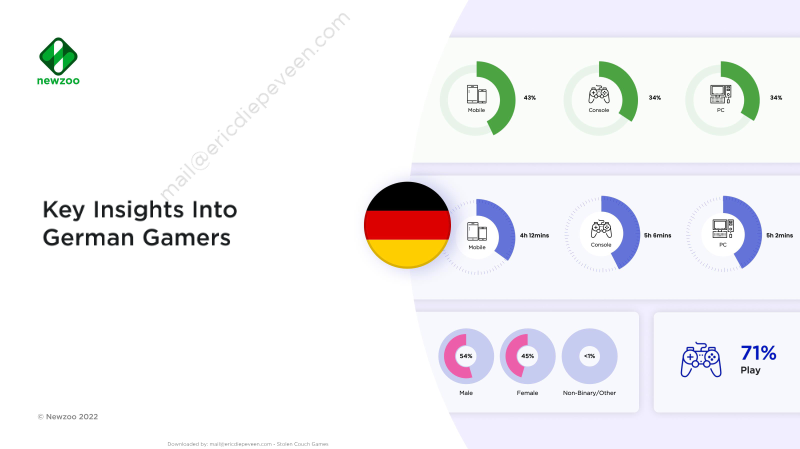
Germany represents a significant pillar of the global gaming industry, ranking as the largest games market in the European Union and the fifth largest worldwide by revenue. As of 2022, the German gaming landscape is characterized by a high level of engagement, with 71% of the online population aged 10 to 65 identifying as game enthusiasts. This engagement extends beyond active play to include viewing gaming video content, social interaction, and community participation.
The demographic profile of German players is nearly balanced by gender, consisting of 52% males and 48% females. While gaming is popular across all age groups, the 21-35 age bracket represents the largest segment at 31%. Motivation for play is primarily driven by the desire to relax and unwind, followed by the pursuit of achievement and social connection. Among the various gamer personas, Time Fillers and Mainstream Gamers are the most prevalent, reflecting a mix of casual mobile play and more dedicated multi-platform engagement.
Platform preferences show that mobile gaming has the highest reach, utilized by 43% of the online population, followed by console and PC at 34% each. Despite the higher reach of mobile, PC and console players demonstrate higher average weekly play times, exceeding five hours. Popular titles in the market include Minecraft, Roblox, and Grand Theft Auto V, with Adventure and Action genres leading in popularity.
Monetization remains strong, with 63% of players spending money on games. The primary driver for spending is the availability of sales or special offers, though a significant portion of consumers also pays to unlock exclusive content or to personalize their in-game experience. These findings are based on a 2022 survey of 2,057 online consumers in Germany, forming part of a broader global research initiative covering 36 markets.
- Germany is the largest gaming market in the EU and the fifth largest globally, with 71% of the online population aged 10 to 65 identifying as game enthusiasts as of 2022.
- Mobile gaming has the highest market reach at 43%, though PC and console players demonstrate higher engagement with average weekly play times exceeding five hours.
- The German gaming demographic is nearly gender-balanced at 52% male and 48% female, with the 21-35 age bracket serving as the largest segment at 31%.
- Monetization is robust, as 63% of players spend money on games, primarily driven by sales, special offers, and the desire to unlock exclusive content or personalization options.
- Adventure and Action are the leading genres in the market, with Minecraft, Roblox, and Grand Theft Auto V identified as popular titles.
+1
NewzooJan 2022
Report39 pages
Newzoo IP-Based Mobile Games Report (2022)
Intellectual property has emerged as a primary driver of success in the mobile gaming landscape, particularly as privacy changes like Apple’s IDFA have complicated traditional user acquisition. In 2021, the dominance of established franchises was underscored by the fact that only one non-IP title reached the top ten global downloads. High-spending players, defined as those investing over $25 per month, demonstrate a significantly higher propensity to download games based on familiar franchises compared to low spenders. This trend translates into superior long-term value and revenue potential for developers who leverage recognized brands to bypass rising marketing costs.
The global market exhibits distinct regional dynamics regarding IP performance. While Western properties such as Disney and Marvel achieve massive download volumes worldwide, Eastern IPs—specifically those originating from Japanese manga and Chinese literature—consistently lead the top-grossing charts. This financial success is driven by the integration of deep monetization mechanics, such as gacha systems, and a strong cultural fit within Asian markets. However, the mere presence of a popular brand does not guarantee longevity. Success requires a "fan-first" approach where game mechanics align seamlessly with the source material. Titles like Umamusume: Pretty Derby illustrate how high-quality simulation and immersive character work drive retention, whereas technical shortcomings or a poor fit between the genre and the IP can lead to rapid player churn.
Long-term profitability in the IP-based mobile sector depends on deep collaboration between developers and licensors to create exclusive content that expands the franchise's universe. Experts emphasize that localized cultural optimization and high production values are essential for maintaining engagement. By utilizing comprehensive market data and consumer research, industry stakeholders can better navigate these trends, sizing global opportunities and identifying the specific franchise-mechanic combinations that resonate most effectively with high-value audiences.
- Established intellectual property is now a primary driver of mobile success, evidenced by the fact that only one non-IP title reached the top ten global downloads in 2021.
- High-spending players, defined as those investing over $25 per month, show a significantly higher propensity to download games based on familiar franchises than low spenders.
- While Western IPs like Disney and Marvel drive high global download volumes, Eastern IPs from Japanese manga and Chinese literature dominate top-grossing charts due to deep monetization mechanics like gacha systems.
- Leveraging recognized brands serves as a critical strategy to bypass rising user acquisition costs caused by privacy changes such as Apple’s IDFA.
- Long-term retention requires a 'fan-first' approach where game mechanics, such as the high-quality simulation found in Umamusume: Pretty Derby, align seamlessly with the source material.
+1
NewzooJan 2022
Report44 pages
Newzoo Trend Report 2022: An Overview and Outlook of Virtual Reality
The global virtual reality market is undergoing a significant resurgence, transitioning from a niche hardware segment into a sustainable ecosystem. This evolution is primarily driven by the proliferation of affordable standalone 6DoF devices, such as the Meta Quest and Pico 4, which have lowered barriers to entry for mainstream consumers. While these standalone units may lack the raw performance of high-end PC VR setups, their accessibility has catalyzed rapid growth in the active install base. Data indicates that nearly 60% of VR gamers engage with their headsets at least once a week, signaling high retention and a shift toward consistent usage patterns.
Gaming remains the primary gateway for consumer adoption, bolstered by the emergence of high-quality "killer apps" and the popularity of adventure and shooter genres. The market is also seeing a shift toward hybrid monetization models, including downloadable content and subscriptions, alongside an increase in social and fitness-oriented virtual environments. Beyond entertainment, VR technology is becoming increasingly essential for industrial applications. Powerful 3D engines like Unreal and Unity are facilitating the expansion of immersive technology into healthcare simulations, remote architectural planning, and education.
The global active VR hardware install base is projected to reach 46 million units by the end of 2024, reflecting a compound annual growth rate of 42.0% since 2019. This sustained momentum is supported by continuous advancements in motion tracking and haptic feedback, as well as substantial investments from major software and hardware firms. As the technology matures, the integration of VR into both consumer lifestyles and professional workflows suggests a long-term trajectory toward widespread cross-industry utility.
- The global active VR hardware install base is projected to reach 46 million units by the end of 2024, representing a 42.0% compound annual growth rate since 2019.
- Market growth is primarily driven by the transition to affordable standalone 6DoF devices, such as the Meta Quest and Pico 4, which have significantly lowered barriers to mainstream entry.
- VR gaming shows strong user retention, with nearly 60% of gamers engaging with their headsets at least once a week.
- Gaming serves as the primary consumer gateway, with market monetization shifting toward hybrid models including subscriptions and downloadable content alongside social and fitness-oriented environments.
- Immersive technology is expanding beyond entertainment into industrial sectors like healthcare, architecture, and education, facilitated by 3D engines such as Unreal and Unity.
+1
NewzooJan 2022
Report46 pages
The Metaverse, Blockchain Gaming, and NFTs: Navigating the Internet’s Uncharted Waters
The metaverse represents a fundamental shift from a two-dimensional internet toward a persistent, three-dimensional social ecosystem driven by gamified virtual spaces. This evolution is currently led by "game as a platform" models, most notably Roblox, which leverages tens of millions of daily active users to host diverse commercial and social experiences. While major global brands in fashion, luxury, and finance are increasingly investing in "direct-to-avatar" economies and digital real estate to reach younger, digital-native demographics, the sector faces significant economic and technical hurdles. High developer take rates, consistent net losses among platform leaders, and networking limitations that prevent massive simultaneous user scaling remain primary obstacles to long-term growth.
The integration of blockchain technology and non-fungible tokens (NFTs) has introduced new economic paradigms, such as the "Play-to-Earn" model. Although these games accounted for nearly half of all decentralized application wallet activity by late 2021, their growth is largely concentrated in emerging markets where users treat gaming as an income-generating activity. The sustainability of these ecosystems is currently challenged by high entry barriers and a prioritization of financial speculation over core gameplay quality. For the industry to mature, it must transition toward higher-quality experiences and more robust virtual economies that offer genuine utility beyond profile-picture status symbols.
Mass adoption of these decentralized virtual worlds is currently constrained by technical and regulatory friction. Interoperability across different platforms remains a theoretical goal rather than a functional reality, while high transaction fees on networks like Ethereum and environmental concerns create additional barriers. Furthermore, the industry must navigate complex legal landscapes regarding digital privacy, content moderation, and the protection of intellectual property. Despite a cooling of initial market hype following a crypto correction in 2022, the long-term trajectory points toward a transmedia future where digital assets and virtual identities are central to global commerce and social interaction.
- The metaverse is evolving into a 3D social ecosystem led by 'game as a platform' models like Roblox, which currently sustains tens of millions of daily active users.
- Blockchain-based 'Play-to-Earn' games represented nearly 50% of all decentralized application wallet activity by late 2021, though growth is primarily driven by emerging markets seeking income rather than gameplay.
- Long-term growth for virtual platforms is hindered by high developer take rates, persistent net losses among industry leaders, and technical limitations preventing massive simultaneous user scaling.
- The sector faces significant friction from a lack of platform interoperability, high transaction fees on networks like Ethereum, and unresolved regulatory challenges regarding digital privacy and intellectual property.
- The industry must shift from speculative financial models and profile-picture NFTs toward higher-quality gaming experiences and virtual economies that provide genuine utility.
+3
NewzooJan 2022
Report22 pages
Newzoo Gamer Insights: The Future of Gaming
The Gamer Generations Report 2022 examines the evolving relationship between younger consumers and the video game industry, asserting that gaming has become an integral, multi-dimensional pillar of daily life for Gen Alpha and Gen Z. The analysis highlights a shift where gaming serves not just as entertainment, but as a primary venue for socialization, self-expression, and immersion. This trend is positioning these generations as the primary drivers of future virtual worlds and the emerging metaverse.
Data for this study was collected between February and April 2022 via Computer Assisted Web Interviewing, surveying 75,930 respondents across 36 global markets. The scope covers Gen Alpha (ages 10-12) and Gen Z (ages 13-27), comparing their behaviors against the total online population. Key findings indicate that 90% of Gen Alpha and Gen Z are "game enthusiasts" who engage through playing, viewing, or social interaction, compared to 79% of the general population. Furthermore, these groups spend significantly more leisure time on gaming than older cohorts; it is the top entertainment source for Gen Alpha and a top-three source for Gen Z, rivaling social networks and video streaming.
Economic engagement is also high, with 52% of Gen Alpha and 48% of Gen Z spending money on games, primarily on mobile platforms. The top spending motivators include unlocking exclusive content and personalizing in-game experiences through currencies and gear. Socially, 70% of Gen Z expresses interest in using game worlds for non-gaming gatherings, such as concerts or virtual hangouts. The report concludes that as gaming becomes a ubiquitous social platform, brands and developers must adapt to these generations' preferences for multiplayer connectivity, character customization, and diverse content consumption.
- 90% of Gen Alpha and Gen Z are active game enthusiasts, significantly higher than the 79% engagement rate seen in the general online population.
- Gaming is the primary entertainment source for Gen Alpha and a top-three source for Gen Z, competing directly with social media and video streaming platforms.
- Economic engagement is high, with 52% of Gen Alpha and 48% of Gen Z spending money on games, primarily driven by mobile platform purchases for exclusive content and personalization.
- 70% of Gen Z respondents express interest in utilizing virtual game worlds for non-gaming social activities, including concerts and virtual hangouts.
- The shift toward gaming as a multi-dimensional social platform requires developers to prioritize multiplayer connectivity, deep character customization, and diverse content consumption to remain relevant to younger cohorts.
+1
NewzooJan 2022

Report21 pages
Newzoo’s Global Gamer Study 2022
Gaming has evolved into a multi-dimensional entertainment ecosystem that extends far beyond traditional play, encompassing viewing, socializing, and content creation. Research conducted between February and April 2022 across 36 global markets reveals that 79% of the online population are game enthusiasts. This engagement is most profound among younger generations; for Gen Alpha, gaming has surpassed social media and streaming as the primary source of entertainment. The study utilized a representative sample of 75,930 respondents aged 10 to 65 to analyze behaviors across five distinct generational cohorts.
Data indicates that gaming is increasingly a platform for social connection, with 75% of players engaging in game worlds for social purposes without playing the primary game. This trend is a significant driver of the emerging metaverse. Financial engagement is also high, with approximately half of Gen Alpha, Gen Z, and Millennials spending money on games. Total consumer spending in the sector was projected to exceed $200 billion in 2023. Furthermore, the rise of blockchain gaming and play-to-earn models shows significant future potential, with 34% of players in the United States expressing interest in these technologies.
The findings emphasize that gamers are a highly attractive demographic for brands, as players generally hold 36% more positive attitudes toward brands compared to non-players. However, the diversity of the audience necessitates a nuanced approach to engagement. Using a proprietary segmentation model, the research identifies various personas ranging from Ultimate Gamers to Time Fillers. For instance, while both Apex Legends and Fortnite are battle royale titles, their player bases differ significantly in age, gender, and brand preferences, illustrating that effective marketing requires deep insights into specific game communities and generational motivations.
- Gaming has become a primary entertainment ecosystem for 79% of the global online population, with Gen Alpha prioritizing gaming over social media and streaming.
- The gaming sector reached a projected consumer spend exceeding $200 billion in 2023, with approximately 50% of Millennials, Gen Z, and Gen Alpha actively spending money on games.
- Gaming is increasingly used as a social platform, as 75% of players engage in game worlds for social interaction rather than playing the primary game mechanics.
- Gamers represent a high-value demographic for advertisers, holding 36% more positive attitudes toward brands than non-players.
- Interest in blockchain and play-to-earn gaming models is significant, with 34% of U.S. players expressing interest in these technologies.
+1
NewzooJan 2022