1 free read left. Create a free account for unlimited reading + AI research.
Create free accountWhitepaperInternational Journal of Role-Playing
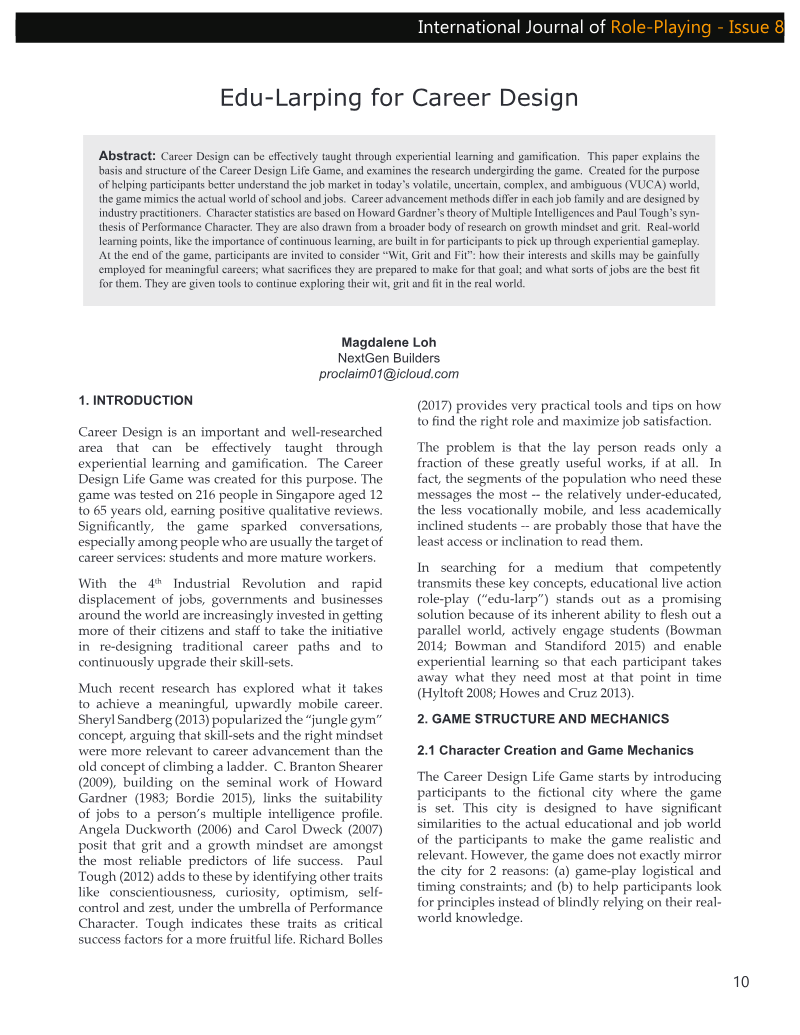
The game is built on a central thesis that career success depends on three elements: interests and skills, persistence and growth mindset, and alignment between personal values and work environment.
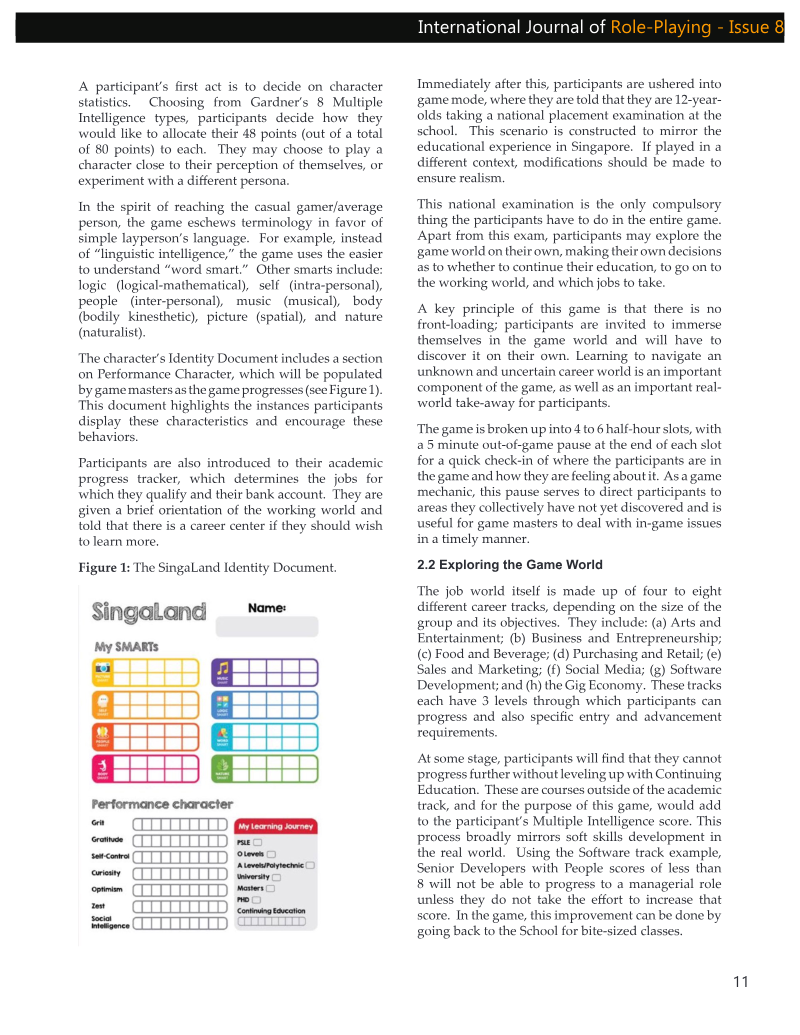
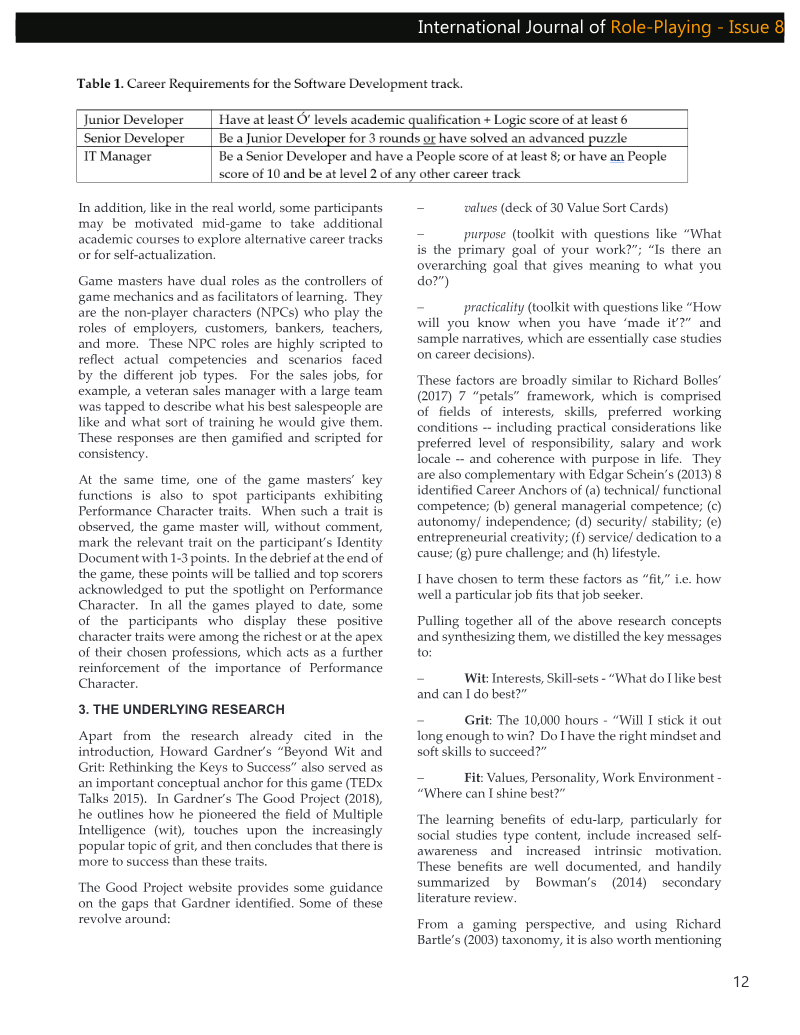
The document presents the Career Design Life Game, an educational live-action role-play ("edu-larp") designed to teach career design through experiential learning and gamification. Its purpose is to help participants understand the job market in a volatile, uncertain, complex, and ambiguous (VUCA) world, and its central thesis is that career success depends on three elements, summarized as "Wit, Grit and Fit": interests and skills, persistence and growth mindset, and alignment between personal values and work environment. The game's character attributes draw on Howard Gardner's theory of Multiple Intelligences, Paul Tough's Performance Character traits, and research on grit and growth mindset, while the fit dimension draws on Richard Bolles' "petals" framework and Edgar Schein's career anchors.
The game was tested with 216 participants in Singapore aged 12 to 65, and the author reports positive qualitative feedback, particularly that it generated discussion among students and mature workers who are typically the targets of career services. Its structure includes a fictional city modeled on Singapore's education and job systems, four to eight career tracks with three advancement levels each, and game masters who act as both mechanics controllers and facilitators, playing non-player character roles scripted from real job competencies. Participants can progress through an entirely self-directed experience, and the game's learning outcomes are assessed through observed behaviors and post-game debriefs rather than in-game success alone.
The document is largely descriptive and presents no formal comparative or statistical evaluation of learning outcomes; its evidence consists of the 216-person pilot, anecdotal observations of player behavior, and a literature review of edu-larp benefits, including increased self-awareness and intrinsic motivation. Post-game facilitation includes a handbook and access to government-backed career coaches in Singapore, and the author suggests future expansions such as broader job ranges and recession or structural unemployment scenarios.



European Conference on Games Based Learning (ECGBL) · 2026
European Conference on Games Based Learning (ECGBL) · 2026



European Conference on Games Based Learning (ECGBL) · 2026

Comments